Samsung Electronics is reportedly targeting 2029 for operations at the first fab in its Yongin National Industrial Complex, moving the start date forward by one to two years from the previously expected 2030–2031 window.
BusinessKorea and Chosun Ilbo first reported the revised schedule on July 12, while Yonhap News Agency independently reported that Samsung is pursuing the earlier target for the first of six planned semiconductor fabs at the site in Gyeonggi Province. Samsung has not publicly detailed the production technology, capacity, or product mix planned for the line.
The 2029 target leaves little slack. According to the reports, site preparation would need to begin in the second half of 2026, with fab construction starting in 2027. A leading-edge fab typically takes roughly two years to build before equipment installation, qualification and ramp-up are factored in.
South Korea’s government is expected to accelerate land compensation, permits, contractor selection and other administrative work. The critical constraint is infrastructure: a fab cannot run without substantial, reliable electricity and water supplies.
BusinessKorea reported that officials are reviewing an earlier start for a 3GW liquefied natural gas power plant, along with faster rollout of subsequent power-supply phases and planned water infrastructure. Those projects will determine whether Samsung can turn a 2029 operating target into actual wafer output.
Samsung’s Yongin buildout is a long-range capacity project rather than a short-term fix for component pricing or availability. The complex was approved as a national industrial complex in late 2024 and is planned to include six Samsung fabs, power facilities and a supplier ecosystem. Earlier operation of the first line could pull forward orders and expansion plans for materials, equipment and component suppliers.
Chosun Ilbo also linked the acceleration to Samsung’s recently announced semiconductor investment plans for the Honam region, including proposed fabs in Gwangju. The reporting suggests Yongin remains Samsung’s nearer-term priority as it stages a larger domestic manufacturing expansion.
For IT buyers and Windows PC builders, the practical impact is indirect: Samsung’s 2029 goal is a capacity roadmap milestone, not an imminent change in memory, SSD or processor supply.
BusinessKorea and Chosun Ilbo first reported the revised schedule on July 12, while Yonhap News Agency independently reported that Samsung is pursuing the earlier target for the first of six planned semiconductor fabs at the site in Gyeonggi Province. Samsung has not publicly detailed the production technology, capacity, or product mix planned for the line.
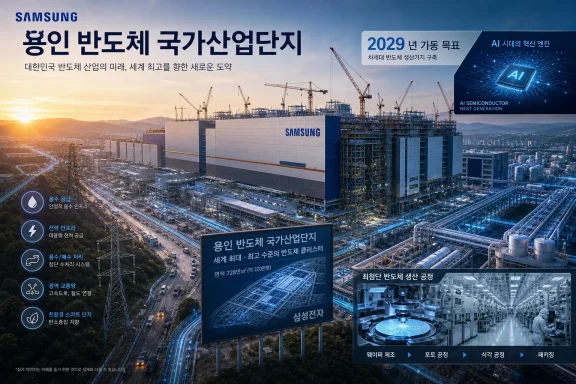 A schedule that depends on infrastructure
The 2029 target leaves little slack. According to the reports, site preparation would need to begin in the second half of 2026, with fab construction starting in 2027. A leading-edge fab typically takes roughly two years to build before equipment installation, qualification and ramp-up are factored in.South Korea’s government is expected to accelerate land compensation, permits, contractor selection and other administrative work. The critical constraint is infrastructure: a fab cannot run without substantial, reliable electricity and water supplies.
BusinessKorea reported that officials are reviewing an earlier start for a 3GW liquefied natural gas power plant, along with faster rollout of subsequent power-supply phases and planned water infrastructure. Those projects will determine whether Samsung can turn a 2029 operating target into actual wafer output.
Why Windows and enterprise readers should care
This is not a consumer-PC announcement, and it does not mean new Samsung SSDs or memory modules will arrive in 2029. It is, however, another signal that the company expects sustained demand for advanced memory and logic chips, particularly from AI infrastructure and the wider electronics supply chain.Samsung’s Yongin buildout is a long-range capacity project rather than a short-term fix for component pricing or availability. The complex was approved as a national industrial complex in late 2024 and is planned to include six Samsung fabs, power facilities and a supplier ecosystem. Earlier operation of the first line could pull forward orders and expansion plans for materials, equipment and component suppliers.
Chosun Ilbo also linked the acceleration to Samsung’s recently announced semiconductor investment plans for the Honam region, including proposed fabs in Gwangju. The reporting suggests Yongin remains Samsung’s nearer-term priority as it stages a larger domestic manufacturing expansion.
For IT buyers and Windows PC builders, the practical impact is indirect: Samsung’s 2029 goal is a capacity roadmap milestone, not an imminent change in memory, SSD or processor supply.
References
- Primary source: Businesskorea
Published: 2026-07-13T02:26:09+00:00
Samsung Advances Yongin Fab Timeline
Samsung Electronics is accelerating its efforts to secure global semiconductor leadership by pushing to advance the operation timeline of its first productionwww.businesskorea.co.kr - Independent coverage: 조선일보
Published: 2026-07-12T05:31:31.944000+00:00
Samsung Accelerates Yongin Semiconductor Fab to 2029 Ahead of Gwangju
Samsung Accelerates Yongin Semiconductor Fab to 2029 Ahead of Gwangju 360 trillion won Yongin investment precedes 425 trillion won Honam expansion, inwww.chosun.com