

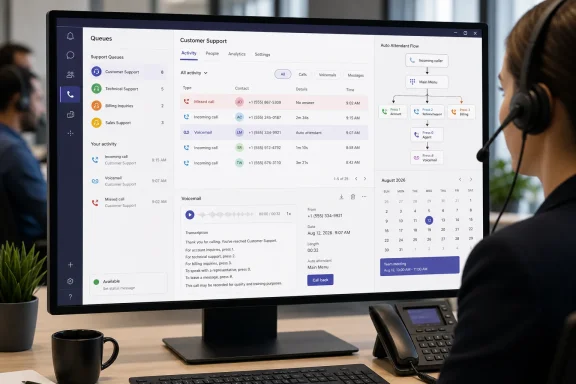
Microsoft plans to bring Auto Attendant shared voicemail into the Teams Queues app in August 2026, giving customer-service teams a single place to see calls that reached an automated menu and were then sent to voicemail.
The Microsoft 365 roadmap entry, ID 567457, lists the feature as in development for general availability on Teams desktop in Microsoft’s worldwide multi-tenant cloud. Rather than requiring staff to monitor a group mailbox or separate Outlook delivery, voicemail left after an Auto Attendant call should appear in the Queues app alongside the relevant missed-call history.
Teams already supports shared voicemail for Auto Attendants and Call Queues. An organization can direct calls to a voicemail destination backed by a Microsoft 365 group, distribution list, or mail-enabled security group, allowing more than one person to access incoming messages.
Microsoft’s documentation says shared voicemails in Queues are displayed under their associated missed-call record in shared call history. The new piece is visibility for messages sent to an Auto Attendant, not merely Call Queue-related voicemail. That matters for front-door phone menus, after-hours routing, and departmental numbers that do not enter an agent queue before callers leave a message.
For teams handling sales, support, reception, or service requests, the practical benefit is context: the caller’s missed interaction and voicemail can be reviewed from the same operational workspace used to track queue activity and return calls.
Microsoft recommends using a distinct group for each Auto Attendant or Call Queue. Reusing one shared voicemail group across voice applications with different agent sets can expose messages to people who should not have access to them.
Queues app availability and permissions also remain relevant. Microsoft positions the app for Teams Phone operations, with authorized users able to manage certain Auto Attendant and Call Queue settings. Organizations should confirm that the intended supervisors or agents have the necessary Teams licensing, app access, and group membership before treating Queues as the primary place for voicemail handling.
Admins using Auto Attendant voicemail should review group ownership and membership ahead of the rollout, then validate the Queues experience once the feature reaches their tenant.
The Microsoft 365 roadmap entry, ID 567457, lists the feature as in development for general availability on Teams desktop in Microsoft’s worldwide multi-tenant cloud. Rather than requiring staff to monitor a group mailbox or separate Outlook delivery, voicemail left after an Auto Attendant call should appear in the Queues app alongside the relevant missed-call history.
 What is changing
Teams already supports shared voicemail for Auto Attendants and Call Queues. An organization can direct calls to a voicemail destination backed by a Microsoft 365 group, distribution list, or mail-enabled security group, allowing more than one person to access incoming messages.Microsoft’s documentation says shared voicemails in Queues are displayed under their associated missed-call record in shared call history. The new piece is visibility for messages sent to an Auto Attendant, not merely Call Queue-related voicemail. That matters for front-door phone menus, after-hours routing, and departmental numbers that do not enter an agent queue before callers leave a message.
For teams handling sales, support, reception, or service requests, the practical benefit is context: the caller’s missed interaction and voicemail can be reviewed from the same operational workspace used to track queue activity and return calls.
Admin considerations
This is not a new voicemail system or a replacement for routing configuration. Admins will still need an Auto Attendant configured to redirect the relevant calls to shared voicemail, and the voicemail must be associated with an appropriate Microsoft 365 group, distribution list, or mail-enabled security group.Microsoft recommends using a distinct group for each Auto Attendant or Call Queue. Reusing one shared voicemail group across voice applications with different agent sets can expose messages to people who should not have access to them.
Queues app availability and permissions also remain relevant. Microsoft positions the app for Teams Phone operations, with authorized users able to manage certain Auto Attendant and Call Queue settings. Organizations should confirm that the intended supervisors or agents have the necessary Teams licensing, app access, and group membership before treating Queues as the primary place for voicemail handling.
Rollout timing
The roadmap’s August 2026 date is a target, not a guarantee, and Microsoft can revise rollout timing or scope before general availability. Microsoft Learn previously described Auto Attendant shared voicemail visibility in Queues as arriving during the second quarter of 2026, so the roadmap’s more specific August target is the better planning marker for now.Admins using Auto Attendant voicemail should review group ownership and membership ahead of the rollout, then validate the Queues experience once the feature reaches their tenant.
References
- Primary source: Microsoft 365 Roadmap
Published: 2026-07-14T22:41:38.6349466Z
Microsoft 365 Roadmap | Microsoft 365
The Microsoft 365 Roadmap lists updates that are currently planned for applicable subscribers. Check here for more information on the status of new features and updates.www.microsoft.com
- Official source: learn.microsoft.com
Manage Shared Voicemail - Microsoft Teams | Microsoft Learn
Learn how to configure and manage Shared Voicemail for Auto Attendants and Call Queues.learn.microsoft.com
