

CVE-2026-50294 exposes sensitive Windows kernel information to a local attacker and is fixed by Microsoft’s July 14, 2026 security updates. The flaw affects Windows 11 24H2, 25H2 and 26H1, multiple Windows 10 editions, and supported or extended-support Windows Server releases dating back to Windows Server 2012.
Microsoft classifies the vulnerability as Important, while its CVSS 3.1 base score is 6.2. Detailed in the Microsoft Security Response Center’s July security release, the flaw does not provide remote code execution or directly modify data, but the information it reveals could help an attacker understand a target’s protected kernel environment.
Administrators should deploy the applicable July cumulative update rather than treating this as a standalone package. The relevant test is whether each device has reached Microsoft’s fixed build for its Windows branch.
CVE-2026-50294 is categorized as CWE-497, Exposure of Sensitive System Information to an Unauthorized Control Sphere. Microsoft’s published description says an unauthorized attacker can exploit the Windows kernel weakness locally to disclose information.
The CVSS vector is
That combination deserves careful interpretation. “Local” limits the initial attack surface because the flaw cannot simply be reached across the network, but “privileges required: none” means an attacker who can execute code in an unprivileged context may not need an administrator account to reach the vulnerable behavior.
The CVSS vector does not explain exactly how an attacker obtains that local execution foothold. It could come from another vulnerability, malicious software, an abused application boundary or direct access to a shared system. Microsoft has not published enough technical detail to identify the precise kernel object, API or memory structure involved.
This is therefore most relevant as a potential component in an exploit chain. Kernel information leaks are often useful because modern Windows defenses deliberately conceal memory addresses and other implementation details. Information disclosure can reduce that uncertainty, making a separate memory-corruption or privilege-escalation flaw more reliable, although Microsoft has not stated that CVE-2026-50294 bypasses a particular mitigation.
The appearance of Windows 10 21H2, Windows 10 22H2, Windows Server 2012 and Windows Server 2012 R2 does not mean every installation receives the fix through ordinary consumer Windows Update. Servicing eligibility depends on edition, lifecycle status and participation in the relevant Extended Security Updates program. Administrators should verify that older machines are properly licensed and enrolled rather than assuming an update scan with no results means the device is safe.
For modern Windows 11 and Windows Server systems, the correction arrives through the regular cumulative servicing model. Installing a newer cumulative update should also carry the security change forward, but update compliance tools should confirm the resulting OS build instead of checking only whether a deployment job reported success.
It does not mean attackers have been confirmed exploiting CVE-2026-50294 in the wild. Report confidence measures confidence in the vulnerability’s existence and technical accuracy; it is separate from Microsoft’s fields for public disclosure, exploitation status and expected exploitability.
That distinction is especially important for this flaw because Microsoft has disclosed little beyond the impact, affected products, weakness category and CVSS vector. The vulnerability is real and patched, but there is not enough public information to reproduce the vulnerable path or determine what data can be recovered from the kernel.
The absence of a detailed public explanation also prevents defenders from building a dependable behavioral detection specifically for CVE-2026-50294. Endpoint telemetry may reveal suspicious local code execution or follow-on privilege escalation, but there is no published process name, event ID, syscall sequence or crash signature that administrators can use as a CVE-specific indicator.
Patching is the primary mitigation. Restricting local code execution, applying application control policies and limiting interactive access to sensitive servers can reduce opportunities for abuse, but those controls do not correct the kernel defect.
It should nevertheless remain in the normal July 2026 deployment cycle. Multi-user systems, remote desktop hosts, developer workstations, virtual desktop infrastructure and servers where untrusted or semi-trusted code can run present a more meaningful exposure than tightly controlled single-purpose appliances.
Security teams should also avoid evaluating the flaw in isolation. An information leak that appears moderate on its own can become more valuable when combined with a separate elevation-of-privilege vulnerability. The practical risk rises on systems where attackers are more likely to gain an initial low-privilege foothold.
For deployment teams, the immediate task is concrete: inventory the Windows build numbers, install the July 14 cumulative updates, restart where required and verify that endpoints have reached or exceeded the fixed builds. Until Microsoft publishes further technical details, build-level compliance is the clearest evidence that CVE-2026-50294 has been removed from a Windows fleet.
Microsoft classifies the vulnerability as Important, while its CVSS 3.1 base score is 6.2. Detailed in the Microsoft Security Response Center’s July security release, the flaw does not provide remote code execution or directly modify data, but the information it reveals could help an attacker understand a target’s protected kernel environment.
Administrators should deploy the applicable July cumulative update rather than treating this as a standalone package. The relevant test is whether each device has reached Microsoft’s fixed build for its Windows branch.
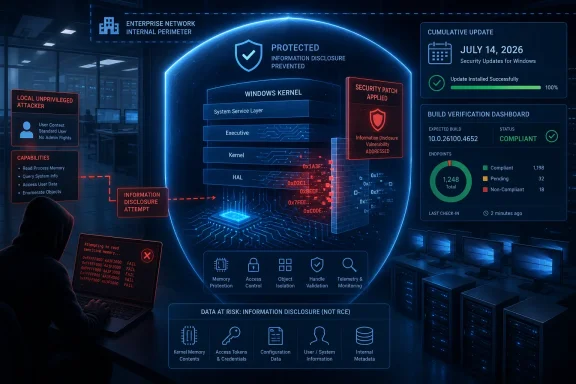 A Local Attack With No Privilege Requirement
CVE-2026-50294 is categorized as CWE-497, Exposure of Sensitive System Information to an Unauthorized Control Sphere. Microsoft’s published description says an unauthorized attacker can exploit the Windows kernel weakness locally to disclose information.The CVSS vector is
AV:L/AC:L/PR:N/UI:N/S:U/C:H/I:N/A:N. In practical terms, exploitation requires local access, has low attack complexity, needs no existing privileges and does not depend on another user clicking a link or opening a file. A successful attack has a high confidentiality impact but no direct integrity or availability impact under Microsoft’s scoring.That combination deserves careful interpretation. “Local” limits the initial attack surface because the flaw cannot simply be reached across the network, but “privileges required: none” means an attacker who can execute code in an unprivileged context may not need an administrator account to reach the vulnerable behavior.
The CVSS vector does not explain exactly how an attacker obtains that local execution foothold. It could come from another vulnerability, malicious software, an abused application boundary or direct access to a shared system. Microsoft has not published enough technical detail to identify the precise kernel object, API or memory structure involved.
This is therefore most relevant as a potential component in an exploit chain. Kernel information leaks are often useful because modern Windows defenses deliberately conceal memory addresses and other implementation details. Information disclosure can reduce that uncertainty, making a separate memory-corruption or privilege-escalation flaw more reliable, although Microsoft has not stated that CVE-2026-50294 bypasses a particular mitigation.
Fixed Builds Span the Windows Fleet
The affected-products data covers both current Windows 11 releases and older platforms still receiving security servicing through enterprise or extended-support channels. Devices below the following build levels remain affected:- Windows 11 24H2 is affected before build 26100.8875.
- Windows 11 25H2 is affected before build 26200.8875.
- Windows 11 26H1 is affected before build 28000.2269.
- Windows 10 21H2 and 22H2 are affected before builds 19044.7548 and 19045.7548, respectively.
- Windows 10 version 1607 and Windows Server 2016 are affected before build 14393.9339.
- Windows 10 version 1809 and Windows Server 2019 are affected before build 17763.9020.
- Windows Server 2022 is affected before build 20348.5386.
- Windows Server 2025 is affected before build 26100.33158.
- Windows Server 2012 and Windows Server 2012 R2 require their applicable July servicing updates, reaching builds 9200.26226 and 9600.23291 respectively.
The appearance of Windows 10 21H2, Windows 10 22H2, Windows Server 2012 and Windows Server 2012 R2 does not mean every installation receives the fix through ordinary consumer Windows Update. Servicing eligibility depends on edition, lifecycle status and participation in the relevant Extended Security Updates program. Administrators should verify that older machines are properly licensed and enrolled rather than assuming an update scan with no results means the device is safe.
For modern Windows 11 and Windows Server systems, the correction arrives through the regular cumulative servicing model. Installing a newer cumulative update should also carry the security change forward, but update compliance tools should confirm the resulting OS build instead of checking only whether a deployment job reported success.
“Confirmed” Describes Evidence, Not Active Exploitation
The report-confidence language attached to CVSS data is easy to misread. A finding marked confirmed means the vendor or available technical evidence establishes that the vulnerability exists. Microsoft’s acknowledgement and release of corrected builds provide that confirmation.It does not mean attackers have been confirmed exploiting CVE-2026-50294 in the wild. Report confidence measures confidence in the vulnerability’s existence and technical accuracy; it is separate from Microsoft’s fields for public disclosure, exploitation status and expected exploitability.
That distinction is especially important for this flaw because Microsoft has disclosed little beyond the impact, affected products, weakness category and CVSS vector. The vulnerability is real and patched, but there is not enough public information to reproduce the vulnerable path or determine what data can be recovered from the kernel.
The absence of a detailed public explanation also prevents defenders from building a dependable behavioral detection specifically for CVE-2026-50294. Endpoint telemetry may reveal suspicious local code execution or follow-on privilege escalation, but there is no published process name, event ID, syscall sequence or crash signature that administrators can use as a CVE-specific indicator.
Patching is the primary mitigation. Restricting local code execution, applying application control policies and limiting interactive access to sensitive servers can reduce opportunities for abuse, but those controls do not correct the kernel defect.
Patch Priority Depends on Exposure, Not the Score Alone
CVE-2026-50294 is not the kind of vulnerability that normally forces administrators to interrupt every production workload immediately. Its 6.2 score, local attack vector and lack of direct integrity or availability impact place it below remotely exploitable code-execution flaws and vulnerabilities already used in attacks.It should nevertheless remain in the normal July 2026 deployment cycle. Multi-user systems, remote desktop hosts, developer workstations, virtual desktop infrastructure and servers where untrusted or semi-trusted code can run present a more meaningful exposure than tightly controlled single-purpose appliances.
Security teams should also avoid evaluating the flaw in isolation. An information leak that appears moderate on its own can become more valuable when combined with a separate elevation-of-privilege vulnerability. The practical risk rises on systems where attackers are more likely to gain an initial low-privilege foothold.
For deployment teams, the immediate task is concrete: inventory the Windows build numbers, install the July 14 cumulative updates, restart where required and verify that endpoints have reached or exceeded the fixed builds. Until Microsoft publishes further technical details, build-level compliance is the clearest evidence that CVE-2026-50294 has been removed from a Windows fleet.
References
- Primary source: MSRC
Published: 2026-07-14T07:00:00-07:00
Security Update Guide - Microsoft Security Response Center
 msrc.microsoft.com
- Related coverage: aha.org
