

Microsoft’s July 14, 2026 security updates fix CVE-2026-49806, an Important-rated elevation-of-privilege vulnerability in the Windows USB Print Driver that can let a locally authenticated attacker obtain higher privileges. The flaw affects supported Windows 11 releases and Windows Server 2025, making the monthly cumulative update the primary remedy for desktops, print-connected workstations, and servers carrying the vulnerable driver code.
Detailed in Microsoft’s Security Update Guide and the CVE record, CVE-2026-49806 carries a CVSS 3.1 base score of 7.0. Microsoft assessed the vulnerability as not publicly disclosed, not exploited in the wild, and less likely to be exploited when the July updates were published.
That assessment lowers the immediate alarm level, but it does not make the bug harmless. Elevation-of-privilege vulnerabilities are commonly used after an attacker has already gained limited access through phishing, a compromised account, malicious software, or another vulnerability.
CVE-2026-49806 is associated with CWE-362, a race condition involving concurrent execution, and CWE-416, use after free. Those classifications indicate that the USB printing component can mishandle memory when operations occur in a particular sequence or timing window.
Microsoft’s CVSS vector describes a local attack requiring low privileges, no user interaction, and high attack complexity. A successful exploit can have a high impact on confidentiality, integrity, and availability, which is consistent with an attacker crossing from an ordinary account into a more privileged Windows security context.
The high-complexity rating is significant. It means exploitation depends on conditions outside the attacker’s direct control, such as winning a timing race or repeatedly manipulating the affected component until the required memory state appears. It does not mean exploitation is impossible, only that a reliable exploit may be more difficult to build and run than a straightforward privilege-escalation technique.
The attack is also local rather than directly network-based. CVE-2026-49806 is not described as a vulnerability that an unauthenticated internet user can trigger by sending traffic to a Windows PC or print server. An attacker must first be able to execute code or otherwise operate with low privileges on the target.
That distinction matters for prioritization. Internet-facing remote-code-execution vulnerabilities generally demand the fastest response, while a local privilege escalation is more likely to serve as the second stage of an intrusion. Once paired with an initial-access method, however, it can turn a constrained foothold into broad control of the device.
The corrected build boundaries listed in the CVE record are:
For individual Windows 11 systems, the practical action is to install the July 2026 cumulative security update through Windows Update and restart if requested. Managed environments should deploy the corresponding update through Windows Autopatch, Microsoft Intune, Windows Server Update Services, Configuration Manager, or the organization’s existing patch platform.
The build can be checked by running
Microsoft lists an official fix rather than a separate workaround. There is therefore little reason to experiment with disabling printing services, removing devices, or changing driver-installation policy solely for CVE-2026-49806 when the cumulative update is available.
CVE-2026-49806 is separate from the better-known network printing weaknesses associated with PrintNightmare. Microsoft has not described this issue as a remote Print Spooler compromise, and the local attack vector should not be inflated into one. The relevant risk is that code already running on a Windows device may be able to abuse the USB Print Driver to escape its limited account permissions.
That makes shared workstations and systems where untrusted users can sign in particularly relevant. Help-desk terminals, training-room PCs, kiosk-like deployments that still permit desktop applications, lab machines, and multi-user servers can provide the low-privilege starting point the CVSS assessment assumes.
Endpoint security controls still add value while updates move through deployment rings. Microsoft Defender for Endpoint and comparable EDR tools may detect suspicious post-exploitation behavior, while application control can reduce the chance that an attacker executes the first-stage payload. Those controls are layers around the vulnerability, not replacements for correcting the driver.
Organizations that tightly control removable hardware should also avoid assuming that a USB device policy eliminates the issue. The vulnerable component and the supported attack path must be evaluated separately from whether employees are permitted to plug in arbitrary printers. Microsoft’s advisory identifies the operating-system component as the affected product and provides patching as the remediation.
For most enterprises, CVE-2026-49806 should move with the July cumulative updates through established testing and deployment rings. Administrators should pay closer attention to machines where low-privilege access is broadly available, where USB printing is operationally important, or where compromising one endpoint would expose administrator credentials and management infrastructure.
Print servers deserve scrutiny even though the vulnerability is local. A server may be less exposed to ordinary users than a workstation, but the consequence of privilege escalation can be greater if the system holds driver packages, services many clients, or is administered with powerful domain credentials.
The unusually large July 2026 Patch Tuesday release also makes CVE-by-CVE deployment impractical for most Windows estates. As reported by BleepingComputer and cataloged in the Zero Day Initiative’s monthly review, Microsoft addressed hundreds of vulnerabilities across its products. Administrators should evaluate the cumulative Windows package as a whole instead of delaying it because this particular CVE is neither public nor actively exploited.
CVE-2026-49806 is ultimately a post-compromise privilege escalation risk, not a remote break-in by itself. The concrete milestone is simple: Windows 11 devices must reach builds 26100.8875, 26200.8875, or 28000.2269 as appropriate, while Windows Server 2025 must reach build 26100.33158 or later.
Detailed in Microsoft’s Security Update Guide and the CVE record, CVE-2026-49806 carries a CVSS 3.1 base score of 7.0. Microsoft assessed the vulnerability as not publicly disclosed, not exploited in the wild, and less likely to be exploited when the July updates were published.
That assessment lowers the immediate alarm level, but it does not make the bug harmless. Elevation-of-privilege vulnerabilities are commonly used after an attacker has already gained limited access through phishing, a compromised account, malicious software, or another vulnerability.
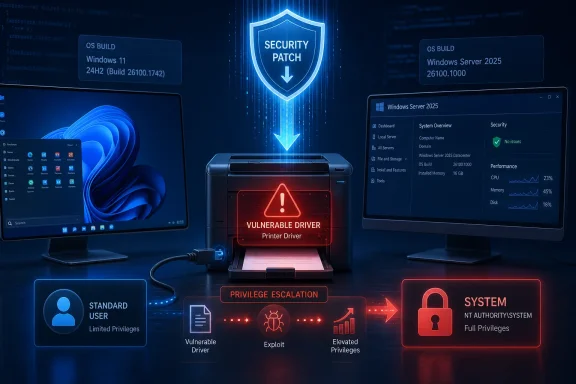 A Local Flaw With SYSTEM-Level Consequences
CVE-2026-49806 is associated with CWE-362, a race condition involving concurrent execution, and CWE-416, use after free. Those classifications indicate that the USB printing component can mishandle memory when operations occur in a particular sequence or timing window.Microsoft’s CVSS vector describes a local attack requiring low privileges, no user interaction, and high attack complexity. A successful exploit can have a high impact on confidentiality, integrity, and availability, which is consistent with an attacker crossing from an ordinary account into a more privileged Windows security context.
The high-complexity rating is significant. It means exploitation depends on conditions outside the attacker’s direct control, such as winning a timing race or repeatedly manipulating the affected component until the required memory state appears. It does not mean exploitation is impossible, only that a reliable exploit may be more difficult to build and run than a straightforward privilege-escalation technique.
The attack is also local rather than directly network-based. CVE-2026-49806 is not described as a vulnerability that an unauthenticated internet user can trigger by sending traffic to a Windows PC or print server. An attacker must first be able to execute code or otherwise operate with low privileges on the target.
That distinction matters for prioritization. Internet-facing remote-code-execution vulnerabilities generally demand the fastest response, while a local privilege escalation is more likely to serve as the second stage of an intrusion. Once paired with an initial-access method, however, it can turn a constrained foothold into broad control of the device.
Windows 11 and Server 2025 Receive the Fix
The published CVE data identifies Windows 11 versions 24H2, 25H2, and 26H1 as affected on both x64 and Arm64 hardware. Windows Server 2025 is affected in its full and Server Core installation options.The corrected build boundaries listed in the CVE record are:
- Windows 11 version 24H2 is affected below build 26100.8875.
- Windows 11 version 25H2 is affected below build 26200.8875.
- Windows 11 version 26H1 is affected below build 28000.2269.
- Windows Server 2025 is affected below build 26100.33158.
For individual Windows 11 systems, the practical action is to install the July 2026 cumulative security update through Windows Update and restart if requested. Managed environments should deploy the corresponding update through Windows Autopatch, Microsoft Intune, Windows Server Update Services, Configuration Manager, or the organization’s existing patch platform.
The build can be checked by running
winver, reviewing Settings > System > About, or querying devices with PowerShell and endpoint-management inventory. A machine remaining below its fixed build threshold should be treated as vulnerable even if a scanner has not yet refreshed its CVE mapping.Microsoft lists an official fix rather than a separate workaround. There is therefore little reason to experiment with disabling printing services, removing devices, or changing driver-installation policy solely for CVE-2026-49806 when the cumulative update is available.
USB Printing Remains a Privileged Boundary
USB printer support may look like a narrow attack surface, but Windows printing components operate across several trust boundaries. Driver loading, device discovery, spooler activity, and communication between user processes and privileged services all create opportunities for malformed requests or unsafe object lifetimes to become security problems.CVE-2026-49806 is separate from the better-known network printing weaknesses associated with PrintNightmare. Microsoft has not described this issue as a remote Print Spooler compromise, and the local attack vector should not be inflated into one. The relevant risk is that code already running on a Windows device may be able to abuse the USB Print Driver to escape its limited account permissions.
That makes shared workstations and systems where untrusted users can sign in particularly relevant. Help-desk terminals, training-room PCs, kiosk-like deployments that still permit desktop applications, lab machines, and multi-user servers can provide the low-privilege starting point the CVSS assessment assumes.
Endpoint security controls still add value while updates move through deployment rings. Microsoft Defender for Endpoint and comparable EDR tools may detect suspicious post-exploitation behavior, while application control can reduce the chance that an attacker executes the first-stage payload. Those controls are layers around the vulnerability, not replacements for correcting the driver.
Organizations that tightly control removable hardware should also avoid assuming that a USB device policy eliminates the issue. The vulnerable component and the supported attack path must be evaluated separately from whether employees are permitted to plug in arbitrary printers. Microsoft’s advisory identifies the operating-system component as the affected product and provides patching as the remediation.
Patch Priority Depends on the Device’s Role
Microsoft’s “exploitation less likely” classification and the absence of public disclosure or observed attacks support normal accelerated patching rather than emergency isolation. The confirmed report-confidence metric means Microsoft has validated the vulnerability and its technical basis; it does not mean attackers already possess working exploit code.For most enterprises, CVE-2026-49806 should move with the July cumulative updates through established testing and deployment rings. Administrators should pay closer attention to machines where low-privilege access is broadly available, where USB printing is operationally important, or where compromising one endpoint would expose administrator credentials and management infrastructure.
Print servers deserve scrutiny even though the vulnerability is local. A server may be less exposed to ordinary users than a workstation, but the consequence of privilege escalation can be greater if the system holds driver packages, services many clients, or is administered with powerful domain credentials.
The unusually large July 2026 Patch Tuesday release also makes CVE-by-CVE deployment impractical for most Windows estates. As reported by BleepingComputer and cataloged in the Zero Day Initiative’s monthly review, Microsoft addressed hundreds of vulnerabilities across its products. Administrators should evaluate the cumulative Windows package as a whole instead of delaying it because this particular CVE is neither public nor actively exploited.
CVE-2026-49806 is ultimately a post-compromise privilege escalation risk, not a remote break-in by itself. The concrete milestone is simple: Windows 11 devices must reach builds 26100.8875, 26200.8875, or 28000.2269 as appropriate, while Windows Server 2025 must reach build 26100.33158 or later.
References
- Primary source: MSRC
Published: 2026-07-14T07:00:00-07:00
Security Update Guide - Microsoft Security Response Center
 msrc.microsoft.com
- Related coverage: tomshardware.com
Windows Server vulnerability can grant system privileges with just a malformed packet — domain controllers are being exploited in the wild | Tom's Hardware
System administrators, run the May 12 patch immediately if you haven't already.www.tomshardware.com
