

CVE-2026-49802 is a newly patched Windows USB Print Driver vulnerability that can let a low-privileged local attacker elevate access and potentially take full control of an affected PC or server. Microsoft rated the flaw Important and released fixes on July 14, 2026, for supported Windows 11 editions and Windows Server 2025.
Detailed in Microsoft’s Security Update Guide and subsequently cataloged by the National Vulnerability Database, the vulnerability carries a CVSS 3.1 base score of 7.0. Microsoft assesses exploitation as less likely, with no evidence that the flaw was publicly disclosed or exploited before the update became available.
That lowers the immediate emergency level, but it does not make the bug harmless. Privilege-escalation vulnerabilities are commonly used after an attacker has obtained an initial foothold, turning limited user-level execution into administrative or SYSTEM-level control.
Microsoft describes CVE-2026-49802 as a race condition in the Windows USB Print Driver. More specifically, concurrent operations can access a shared resource without proper synchronization, creating conditions for a use-after-free memory error.
The weakness is categorized under CWE-362, concurrent execution with improper synchronization, and CWE-416, use after free. In practical terms, the driver can continue using memory after that memory has been released, potentially allowing carefully timed attacker-controlled operations to influence what the privileged driver processes.
Successful exploitation requires local access and existing low-level privileges. The CVSS vector is
The attack complexity is rated high, reflecting the timing-sensitive nature of race-condition exploitation. An attacker must reliably trigger a specific sequence of events inside the USB printing path, rather than simply send one malformed request.
If that sequence succeeds, however, the modeled impact is severe across confidentiality, integrity, and availability. The attacker could potentially access protected information, modify system resources, disable security controls, install persistent malware, or disrupt the device.
The build boundaries provide a straightforward verification method. On a Windows client, running
Simply having no USB printer attached should not be treated as proof that a system is safe. The vulnerable Windows component may still be installed and available, while an attacker who already has local code execution may be able to interact with exposed driver interfaces without following an ordinary end-user printing workflow.
That prerequisite changes prioritization, but elevation-of-privilege bugs remain valuable links in an attack chain. Malware initially launched from a standard user account operates under meaningful restrictions; moving into a highly privileged context can expose credentials, security configuration, services, and data belonging to other users.
Servers deserve particular attention. Windows Server 2025 and Server Core systems may not be used as interactive printing workstations, yet the affected component’s presence still matters. A compromised application account or remote desktop session could provide the low-privileged position needed to attempt local escalation.
Microsoft’s “exploitation less likely” assessment is a forecast, not a guarantee. It indicates that the company does not currently expect reliable exploitation to become widespread, based on the technical barriers and information available on July 14. It does not mean exploitation is impossible or that proof-of-concept research cannot emerge after analysts compare patched and unpatched driver binaries.
The confidence element in Microsoft’s CVSS presentation should also be read narrowly. A confirmed rating reflects Microsoft’s confidence that the vulnerability and documented technical characteristics are real; it does not indicate confirmed attacks. Exploit maturity, public disclosure status, and remediation availability are separate considerations.
Because Windows cumulative updates replace operating-system components as a set, administrators generally do not need to locate or update an individual USB printing driver manually. Applying the appropriate cumulative update and confirming that the device reaches or exceeds the fixed build is the meaningful control.
Organizations should prioritize systems where local access is easier to obtain or especially damaging, including:
That testing should not become an indefinite delay. The patch changes code in a privileged driver, and attackers can often learn more about a vulnerability by examining exactly what Microsoft altered. The useful exposure window begins shrinking as defenders deploy the fixed binaries and researchers complete their patch comparisons.
CVE-2026-49802 is ultimately a post-compromise escalation risk rather than an internet-facing break-in route. For Windows 11 and Windows Server 2025 administrators, the concrete target is clear: deploy the July 14, 2026 security update and verify builds 26100.8875, 26200.8875, 28000.2269, or 26100.33158, as applicable, rather than relying on the absence of a connected printer or current exploitation reports.
Detailed in Microsoft’s Security Update Guide and subsequently cataloged by the National Vulnerability Database, the vulnerability carries a CVSS 3.1 base score of 7.0. Microsoft assesses exploitation as less likely, with no evidence that the flaw was publicly disclosed or exploited before the update became available.
That lowers the immediate emergency level, but it does not make the bug harmless. Privilege-escalation vulnerabilities are commonly used after an attacker has obtained an initial foothold, turning limited user-level execution into administrative or SYSTEM-level control.
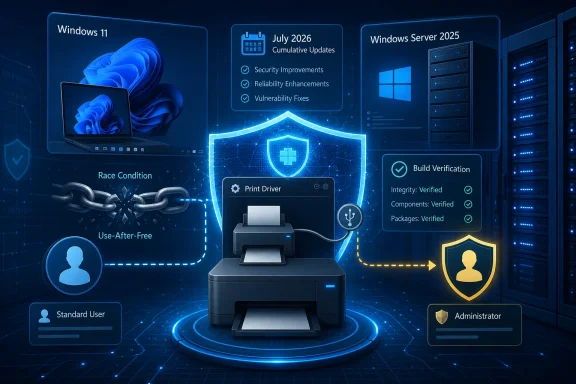 A Race Condition Opens the Privilege Boundary
Microsoft describes CVE-2026-49802 as a race condition in the Windows USB Print Driver. More specifically, concurrent operations can access a shared resource without proper synchronization, creating conditions for a use-after-free memory error.The weakness is categorized under CWE-362, concurrent execution with improper synchronization, and CWE-416, use after free. In practical terms, the driver can continue using memory after that memory has been released, potentially allowing carefully timed attacker-controlled operations to influence what the privileged driver processes.
Successful exploitation requires local access and existing low-level privileges. The CVSS vector is
CVSS:3.1/AV:L/AC:H/PR:L/UI:N/S:U/C:H/I:H/A:H, indicating that the attack cannot be launched directly across a network and does not require another user to click a file or approve a prompt.The attack complexity is rated high, reflecting the timing-sensitive nature of race-condition exploitation. An attacker must reliably trigger a specific sequence of events inside the USB printing path, rather than simply send one malformed request.
If that sequence succeeds, however, the modeled impact is severe across confidentiality, integrity, and availability. The attacker could potentially access protected information, modify system resources, disable security controls, install persistent malware, or disrupt the device.
The Affected List Is Narrower Than Many Windows Flaws
The initial CVE record identifies the following operating systems and fixed-build boundaries:- Windows 11 version 24H2 is affected on x64 and Arm64 systems before build 26100.8875.
- Windows 11 version 25H2 is affected on x64 and Arm64 systems before build 26200.8875.
- Windows 11 version 26H1 is affected on x64 and Arm64 systems before build 28000.2269.
- Windows Server 2025 is affected before build 26100.33158.
- Windows Server 2025 Server Core installations are affected before build 26100.33158.
The build boundaries provide a straightforward verification method. On a Windows client, running
winver or checking Settings under System and About will show the installed OS build. Administrators can retrieve the same information at scale through Microsoft Intune, Configuration Manager, Windows Update for Business reporting, PowerShell inventory, or their endpoint management platform.Simply having no USB printer attached should not be treated as proof that a system is safe. The vulnerable Windows component may still be installed and available, while an attacker who already has local code execution may be able to interact with exposed driver interfaces without following an ordinary end-user printing workflow.
Local Does Not Mean Low Priority
CVE-2026-49802 is not another PrintNightmare-style unauthenticated remote attack. Its local attack vector means an adversary first needs access to the machine through another vulnerability, malicious document, compromised application, stolen session, exposed remote-management tool, or implanted malware.That prerequisite changes prioritization, but elevation-of-privilege bugs remain valuable links in an attack chain. Malware initially launched from a standard user account operates under meaningful restrictions; moving into a highly privileged context can expose credentials, security configuration, services, and data belonging to other users.
Servers deserve particular attention. Windows Server 2025 and Server Core systems may not be used as interactive printing workstations, yet the affected component’s presence still matters. A compromised application account or remote desktop session could provide the low-privileged position needed to attempt local escalation.
Microsoft’s “exploitation less likely” assessment is a forecast, not a guarantee. It indicates that the company does not currently expect reliable exploitation to become widespread, based on the technical barriers and information available on July 14. It does not mean exploitation is impossible or that proof-of-concept research cannot emerge after analysts compare patched and unpatched driver binaries.
The confidence element in Microsoft’s CVSS presentation should also be read narrowly. A confirmed rating reflects Microsoft’s confidence that the vulnerability and documented technical characteristics are real; it does not indicate confirmed attacks. Exploit maturity, public disclosure status, and remediation availability are separate considerations.
Patch Deployment Is the Primary Fix
Microsoft has not documented a separate workaround or mitigation for CVE-2026-49802. The practical response is therefore to install the July 2026 cumulative security update applicable to each affected Windows release.Because Windows cumulative updates replace operating-system components as a set, administrators generally do not need to locate or update an individual USB printing driver manually. Applying the appropriate cumulative update and confirming that the device reaches or exceeds the fixed build is the meaningful control.
Organizations should prioritize systems where local access is easier to obtain or especially damaging, including:
- Shared workstations, kiosks, labs, and multiuser systems should receive the update promptly.
- Windows Server 2025 hosts that permit interactive logons or run less-trusted applications should be moved ahead of lower-risk infrastructure.
- Developer systems and administrative workstations should be treated as sensitive because they commonly contain credentials and management tooling.
- Virtual desktop and remote desktop environments should be reviewed because many users share the same underlying platform and privilege boundary.
That testing should not become an indefinite delay. The patch changes code in a privileged driver, and attackers can often learn more about a vulnerability by examining exactly what Microsoft altered. The useful exposure window begins shrinking as defenders deploy the fixed binaries and researchers complete their patch comparisons.
CVE-2026-49802 is ultimately a post-compromise escalation risk rather than an internet-facing break-in route. For Windows 11 and Windows Server 2025 administrators, the concrete target is clear: deploy the July 14, 2026 security update and verify builds 26100.8875, 26200.8875, 28000.2269, or 26100.33158, as applicable, rather than relying on the absence of a connected printer or current exploitation reports.
References
- Primary source: MSRC
Published: 2026-07-14T07:00:00-07:00
Security Update Guide - Microsoft Security Response Center
 msrc.microsoft.com
