

CVE-2026-50316, a Windows Kernel information-disclosure vulnerability, was fixed in Microsoft’s July 14, 2026 security updates and affects supported Windows 10, Windows 11, Windows Server 2022, and Windows Server 2025 installations. The flaw can allow an authorized local attacker to recover sensitive information written to log files, making the monthly cumulative update the primary remediation.
Detailed in the Microsoft Security Response Center’s Security Update Guide, CVE-2026-50316 carries a CVSS 3.1 base score of 5.5 and is classified as an information-disclosure issue rather than a route to remote code execution or direct privilege escalation. Microsoft’s description maps the weakness to CWE-532, Insertion of Sensitive Information into Log File.
The distinction matters for patch prioritization. This is not presented as an unauthenticated attack that can be launched across a network, but it could provide useful data to an attacker who already has local access through a compromised account, malicious process, remote session, or another vulnerability.
CVE-2026-50316 stems from the Windows Kernel placing sensitive information into log data that an authorized local attacker may be able to read. Microsoft has not publicly detailed the exact log, the data structures involved, or the conditions that cause the sensitive content to be recorded.
The CVSS characteristics indicate a local attack requiring low privileges, with no user interaction needed once the attacker can operate on the system. A successful exploit affects confidentiality but is not scored as directly changing data, disrupting availability, or crossing into a separately managed security authority.
That produces the following practical risk profile:
Microsoft has confirmed the vulnerability, which is what the advisory’s “Report Confidence” metric is communicating. It does not mean that Microsoft has confirmed active attacks.
That metric is easily misread because the accompanying Security Update Guide text discusses how confidence can range from an uncertain report to a vendor-verified flaw. A “Confirmed” rating means Microsoft or the affected software’s author has validated the vulnerability, detailed technical reports exist, or functional reproduction is possible. It says nothing by itself about exploitation in the wild.
The affected and corrected build boundaries published with the CVE include:
For Windows 10 version 21H2 and 22H2, the relevant July package is KB5099539, which advances the operating system to builds 19044.7548 and 19045.7548. Windows 11 versions 24H2 and 25H2 receive KB5101650, bringing them to builds 26100.8875 and 26200.8875.
Windows 11 version 26H1 receives KB5101649 and build 28000.2525. Windows Server 2022 is serviced by KB5099540, producing build 20348.5386, while Windows Server 2025 receives KB5099536 and build 26100.33158. Server Core installations of Windows Server 2025 are also listed as affected.
There is an apparent wrinkle in Microsoft’s machine-readable affected-version data for Windows 11 version 26H1: one record uses build 28000.2269 as an affected boundary, while the July cumulative update advances production systems to 28000.2525. Administrators should use the current July package and resulting build, not treat the older June build as the preferred remediation target.
To confirm deployment, IT teams can check
A reboot-pending device should remain classified as unremediated until the new kernel binaries are loaded. This is especially important on servers where cumulative updates may have been staged during a maintenance window but not yet activated.
That makes the flaw more relevant on shared systems, session hosts, developer workstations, jump servers, and machines where less-trusted users or processes coexist with sensitive workloads. Remote Desktop Session Host deployments and other multi-user Windows systems deserve particular attention because local access does not necessarily imply that the user should see information generated by the kernel or another security context.
The vulnerability may also matter during post-compromise activity. Attackers commonly collect logs and diagnostic artifacts after obtaining a foothold because those files can contain identifiers, paths, addresses, configuration details, fragments of processed data, or clues about security software. Microsoft has not stated which of those categories, if any, CVE-2026-50316 exposes, so defenders should avoid assuming a worst-case credential leak—but they should also avoid assuming the disclosed information is operationally useless.
No registry workaround or configuration-based mitigation has been published as a substitute for the security update. Restricting interactive logon rights, reducing local administrator membership, monitoring access to protected logs, and applying application control can lower the likelihood that an attacker reaches the vulnerable path, but those controls do not correct the kernel behavior.
The confirmed report-confidence rating instead tells defenders that the underlying flaw is established rather than speculative. Microsoft has issued an official fix, and the CVE record contains concrete affected-version ranges. That provides enough evidence for vulnerability-management systems to identify exposed assets even though the company has withheld deeper technical details.
Keeping those concepts separate prevents two common prioritization mistakes. Treating “Confirmed” as proof of active exploitation exaggerates the immediate threat, while dismissing a medium-severity local disclosure flaw because no attacks are known ignores its potential value in a multi-stage intrusion.
For most organizations, CVE-2026-50316 should travel through the standard accelerated Patch Tuesday workflow: test the July cumulative updates against critical applications, deploy first to exposed and multi-user systems, verify the resulting OS builds, and complete required restarts. Systems still below builds 19045.7548, 26100.8875, 26200.8875, 20348.5386, or 26100.33158 after the July maintenance cycle remain measurably exposed to a Microsoft-confirmed kernel data leak.
Detailed in the Microsoft Security Response Center’s Security Update Guide, CVE-2026-50316 carries a CVSS 3.1 base score of 5.5 and is classified as an information-disclosure issue rather than a route to remote code execution or direct privilege escalation. Microsoft’s description maps the weakness to CWE-532, Insertion of Sensitive Information into Log File.
The distinction matters for patch prioritization. This is not presented as an unauthenticated attack that can be launched across a network, but it could provide useful data to an attacker who already has local access through a compromised account, malicious process, remote session, or another vulnerability.
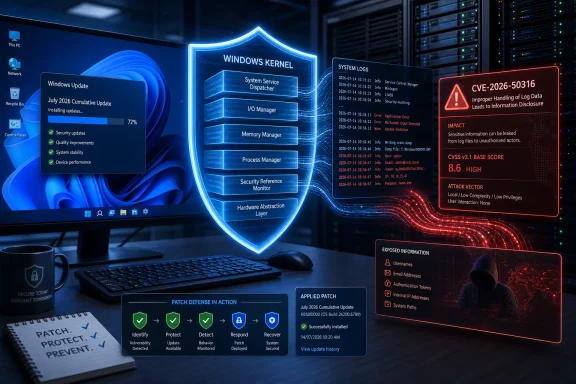 Sensitive Kernel Data Lands Where It Should Not
CVE-2026-50316 stems from the Windows Kernel placing sensitive information into log data that an authorized local attacker may be able to read. Microsoft has not publicly detailed the exact log, the data structures involved, or the conditions that cause the sensitive content to be recorded.The CVSS characteristics indicate a local attack requiring low privileges, with no user interaction needed once the attacker can operate on the system. A successful exploit affects confidentiality but is not scored as directly changing data, disrupting availability, or crossing into a separately managed security authority.
That produces the following practical risk profile:
- An attacker must first obtain some level of local authorization on the target Windows device.
- Exploitation does not require another user to open a document, follow a link, or approve a prompt.
- The immediate result is exposure of sensitive information rather than execution of attacker-controlled kernel code.
- Disclosed information could potentially support a broader attack, although Microsoft has not documented a specific exploit chain.
Microsoft has confirmed the vulnerability, which is what the advisory’s “Report Confidence” metric is communicating. It does not mean that Microsoft has confirmed active attacks.
That metric is easily misread because the accompanying Security Update Guide text discusses how confidence can range from an uncertain report to a vendor-verified flaw. A “Confirmed” rating means Microsoft or the affected software’s author has validated the vulnerability, detailed technical reports exist, or functional reproduction is possible. It says nothing by itself about exploitation in the wild.
July’s Cumulative Updates Close the Leak
Microsoft is delivering the correction through the normal cumulative-update channels rather than a separate kernel hotfix. Administrators should verify the installed OS build because an update scan alone does not prove that every endpoint successfully completed installation and rebooted.The affected and corrected build boundaries published with the CVE include:
| Windows release | Vulnerable builds | Corrected build |
|---|---|---|
| Windows 10 version 21H2 | Earlier than 19044.7548 | 19044.7548 |
| Windows 10 version 22H2 | Earlier than 19045.7548 | 19045.7548 |
| Windows 11 version 24H2 | Earlier than 26100.8875 | 26100.8875 |
| Windows 11 version 25H2 | Earlier than 26200.8875 | 26200.8875 |
| Windows 11 version 26H1 | Earlier than the applicable corrected 28000 build | 28000.2525 |
| Windows Server 2022 | Earlier than 20348.5386 | 20348.5386 |
| Windows Server 2025 | Earlier than 26100.33158 | 26100.33158 |
Windows 11 version 26H1 receives KB5101649 and build 28000.2525. Windows Server 2022 is serviced by KB5099540, producing build 20348.5386, while Windows Server 2025 receives KB5099536 and build 26100.33158. Server Core installations of Windows Server 2025 are also listed as affected.
There is an apparent wrinkle in Microsoft’s machine-readable affected-version data for Windows 11 version 26H1: one record uses build 28000.2269 as an affected boundary, while the July cumulative update advances production systems to 28000.2525. Administrators should use the current July package and resulting build, not treat the older June build as the preferred remediation target.
To confirm deployment, IT teams can check
winver, query operating-system build inventory through Microsoft Intune or Configuration Manager, or use PowerShell:Get-ComputerInfo | Select-Object WindowsProductName, WindowsVersion, OsBuildNumberA reboot-pending device should remain classified as unremediated until the new kernel binaries are loaded. This is especially important on servers where cumulative updates may have been staged during a maintenance window but not yet activated.
Local Access Keeps the Risk Contained, Not Harmless
CVE-2026-50316 is less urgent than a remotely exploitable kernel vulnerability exposed to unauthenticated network traffic. Its attack path assumes that the adversary has already crossed another boundary and can execute locally with authorization.That makes the flaw more relevant on shared systems, session hosts, developer workstations, jump servers, and machines where less-trusted users or processes coexist with sensitive workloads. Remote Desktop Session Host deployments and other multi-user Windows systems deserve particular attention because local access does not necessarily imply that the user should see information generated by the kernel or another security context.
The vulnerability may also matter during post-compromise activity. Attackers commonly collect logs and diagnostic artifacts after obtaining a foothold because those files can contain identifiers, paths, addresses, configuration details, fragments of processed data, or clues about security software. Microsoft has not stated which of those categories, if any, CVE-2026-50316 exposes, so defenders should avoid assuming a worst-case credential leak—but they should also avoid assuming the disclosed information is operationally useless.
No registry workaround or configuration-based mitigation has been published as a substitute for the security update. Restricting interactive logon rights, reducing local administrator membership, monitoring access to protected logs, and applying application control can lower the likelihood that an attacker reaches the vulnerable path, but those controls do not correct the kernel behavior.
“Confirmed” Is Not the Same as a Zero-Day
At publication, the available advisory material does not identify CVE-2026-50316 as publicly disclosed or actively exploited. Microsoft’s assessment places it below the emergency tier associated with known zero-days and Internet-reachable remote-code-execution flaws.The confirmed report-confidence rating instead tells defenders that the underlying flaw is established rather than speculative. Microsoft has issued an official fix, and the CVE record contains concrete affected-version ranges. That provides enough evidence for vulnerability-management systems to identify exposed assets even though the company has withheld deeper technical details.
Keeping those concepts separate prevents two common prioritization mistakes. Treating “Confirmed” as proof of active exploitation exaggerates the immediate threat, while dismissing a medium-severity local disclosure flaw because no attacks are known ignores its potential value in a multi-stage intrusion.
For most organizations, CVE-2026-50316 should travel through the standard accelerated Patch Tuesday workflow: test the July cumulative updates against critical applications, deploy first to exposed and multi-user systems, verify the resulting OS builds, and complete required restarts. Systems still below builds 19045.7548, 26100.8875, 26200.8875, 20348.5386, or 26100.33158 after the July maintenance cycle remain measurably exposed to a Microsoft-confirmed kernel data leak.
References
- Primary source: MSRC
Published: 2026-07-14T07:00:00-07:00
Security Update Guide - Microsoft Security Response Center
 msrc.microsoft.com
- Related coverage: aha.org
