

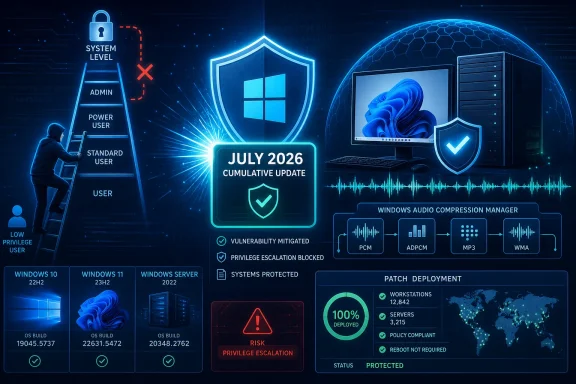
Detailed in Microsoft’s Security Update Guide and recorded by the National Vulnerability Database, the flaw stems from improper access control in the Windows Audio Compression Manager, or ACM. Microsoft says an authorized attacker can exploit the weakness locally to elevate privileges, potentially gaining extensive control over a compromised machine.
This is not a drive-by Internet attack. Microsoft’s CVSS vector describes a local attack requiring low privileges, low complexity, and no interaction from another user. That combination still makes CVE-2026-50351 a useful post-compromise vulnerability: an attacker who has already obtained limited access could use it to break out of that restricted security context.
A Local Foothold Could Become Full Control
The CVSS vector for CVE-2026-50351 is CVSS:3.1/AV:L/AC:L/PR:L/UI:N/S:U/C:H/I:H/A:H. In practical terms, an attacker must first be able to run code or otherwise operate locally under a low-privilege account, but exploitation is not expected to require unusual timing conditions or assistance from a second user.
Microsoft assigns high potential impact across confidentiality, integrity, and availability. A successful elevation could therefore allow an attacker to access protected information, modify system resources, disrupt the machine, or deploy additional payloads with permissions unavailable to an ordinary user.
That distinction matters for risk assessment. CVE-2026-50351 is not described as a route into an otherwise unreachable PC, but it could turn an initial foothold obtained through phishing, stolen credentials, a malicious download, or another vulnerability into a much more serious compromise.
The vulnerability is categorized as CWE-284, Improper Access Control. Microsoft has not publicly documented the precise ACM operation, object, or permission check involved, leaving defenders without enough technical detail to build a reliable behavioral detection specifically around the flaw.
Windows Audio Compression Manager is a longstanding part of the Windows multimedia architecture used to coordinate audio codecs and format conversion. Despite the name, the security impact should not be interpreted as a simple sound-quality or media-playback problem. The vulnerable component provides an avenue for crossing a Windows privilege boundary.
“Confirmed” Describes Confidence, Not Active Attacks
Microsoft lists the vulnerability’s report confidence as confirmed. That means the vendor has confirmed the flaw’s existence and considers the available technical evidence sufficiently credible; it does not, by itself, mean attackers are exploiting CVE-2026-50351 in the wild.
This distinction is especially important because the Security Update Guide’s metric explanation discusses both technical confidence and the information potentially available to attackers. A confirmed rating raises confidence that the vulnerability is real, reproducible, and addressed by the update, but it is not equivalent to Microsoft’s separate exploitation-status assessments.
As of the July 14 publication, the National Vulnerability Database was still awaiting its own enrichment of the CVE record. The NVD displayed Microsoft’s 7.8 score, vector, description, affected-version data, and CWE classification rather than an independent NIST assessment.
No public root-cause analysis or proof-of-concept exploit was identified in the initial disclosures. Administrators should not infer safety from that limited disclosure, however: local privilege-escalation bugs are frequently valuable when chained with initial-access techniques, and additional technical analysis may emerge after organizations have had time to reverse-engineer the patch.
July’s Cumulative Updates Draw the Security Boundary
The affected-version data shows that the vulnerability crosses multiple generations of Windows. For current Windows 11 deployments, the key fixed build thresholds include:
- Windows 11 version 24H2 is corrected in OS build 26100.8875.
- Windows 11 version 25H2 is corrected in OS build 26200.8875.
- Windows 11 version 26H1 is corrected in OS build 28000.2269.
- Windows 10 versions 21H2 and 22H2 are corrected in builds 19044.7548 and 19045.7548.
- Windows 10 version 1607 is corrected in build 14393.9339.
- Windows 10 version 1809 is corrected in build 17763.9020.
For mainstream Windows 11 24H2 and 25H2 PCs, Microsoft delivers the fix through KB5101650, released on July 14. Windows 10 versions 21H2 and 22H2 receive builds 19044.7548 and 19045.7548 through KB5099539.
Microsoft’s affected-product record also includes Windows Server editions, including Server Core installations. That broad reach means administrators should not dismiss the advisory simply because a server has no conventional speakers, audio peripherals, or interactive multimedia workload. Vulnerability exposure is determined by the affected Windows component and build, not by whether staff intentionally use audio features.
The safest validation method is to check the installed OS build after deployment rather than relying solely on an update’s status in a management console. On Windows 11, administrators can run winver, inspect Settings > System > About, query endpoint-management inventory, or use PowerShell-based build reporting to confirm that devices have reached or exceeded the corrected revision.
Removing or disabling audio hardware is not a documented mitigation for CVE-2026-50351. Nor should organizations assume that disabling the Windows Audio service necessarily blocks the vulnerable code path. Without a vendor-supported workaround and technical proof that a configuration change eliminates exposure, deploying the cumulative security update remains the defensible response.
Patch Priority Depends on Who Can Run Code
CVE-2026-50351 deserves normal-to-high Patch Tuesday priority across desktops, shared workstations, virtual desktop infrastructure, session hosts, and servers where users or applications can execute code under restricted accounts. Systems exposed to untrusted installers, browser-delivered payloads, developer tooling, or multiple interactive users present especially relevant escalation opportunities.
For enterprise deployments, the update should still pass through established validation rings because July’s cumulative packages contain changes beyond this one ACM correction. Microsoft’s Windows release notes should be reviewed for known issues and other security-hardening changes that could affect legacy networking, drivers, or line-of-business software.
Security teams can reduce the window of risk by combining patch deployment with controls that restrict the attacker’s starting position. Microsoft Defender Application Control, AppLocker, attack-surface reduction rules, removal of unnecessary local accounts, and strong endpoint detection do not repair ACM, but they can make it harder for an intruder to execute the first-stage code needed to reach a local privilege-escalation path.
Detection teams should also look for the consequence rather than waiting for a CVE-specific signature. Suspicious child processes, unexpected service creation, modifications to protected registry or file locations, credential-access behavior, and a low-privilege process suddenly operating with SYSTEM-level rights can indicate an escalation attempt even when the underlying exploit technique is unknown.
The immediate milestone is straightforward: Windows 11 24H2 and 25H2 systems should reach builds 26100.8875 and 26200.8875, while older clients and servers should meet the fixed build listed for their servicing branch. Until those cumulative updates are installed and verified, a low-privilege presence on an affected machine may still have a path to far more consequential access.