

CVE-2026-58614 is a Windows Kernel security-feature bypass caused by an out-of-bounds read, and Microsoft has patched it across supported Windows 10, Windows 11, and Windows Server releases in the July 14, 2026 security updates. The flaw requires an authorized attacker to operate locally, but its position inside the kernel makes the monthly cumulative updates the only dependable remediation.
Microsoft rates the vulnerability Important, with a CVSS 3.1 base score of 5.5. The Microsoft Security Response Center describes the consequence narrowly: a successful attacker can bypass a security feature rather than execute arbitrary code or directly obtain SYSTEM privileges.
At publication, Microsoft had not identified public disclosure or exploitation in the wild, and its assessment placed exploitation in the “less likely” category. That makes CVE-2026-58614 less urgent than an actively exploited zero-day, but not a reason to omit or indefinitely defer the July cumulative update.
Microsoft’s advisory identifies the underlying weakness as an out-of-bounds read, categorized as CWE-125. This class of bug occurs when software reads memory outside the limits of the buffer it was supposed to access.
In ordinary user-mode software, an out-of-bounds read may expose data belonging to the same application. Inside the Windows Kernel, memory handling carries broader security implications because the kernel manages processes, access controls, hardware interaction, and separation between user and privileged execution contexts.
Microsoft has not publicly documented which specific kernel security control can be bypassed, what memory becomes visible, or how an attacker would trigger the defective read. There is also no public proof-of-concept exploit accompanying the July disclosure. Administrators should therefore avoid assuming that the flaw defeats a particular technology such as Secure Boot, BitLocker, Credential Guard, or virtualization-based security unless Microsoft later says so.
The CVSS rating nevertheless provides useful boundaries. CVE-2026-58614 is a local vulnerability requiring existing authorization on the target, with no separate user interaction needed once the attacker is in position. Its principal scored impact is confidentiality rather than integrity or availability, which is consistent with a read operation that exposes information needed to circumvent a protection.
That distinction matters. A security-feature bypass is often most useful as one stage in a larger attack chain rather than as a complete compromise by itself. Information obtained from kernel memory could, depending on the undocumented details, help an attacker defeat a mitigation, recover sensitive state, or make another exploit more reliable.
Microsoft has not claimed that CVE-2026-58614 independently provides code execution or privilege escalation. Any scenario that extends beyond the published security-feature bypass should be treated as analysis, not as a confirmed capability.
Relevant patched build thresholds include:
Microsoft’s structured vulnerability data also lists Windows Server 2012 and Windows Server 2012 R2, including Server Core installations. Those operating systems require the applicable Extended Security Update servicing arrangements; they should not be interpreted as receiving unrestricted mainstream security support.
For inventory purposes, administrators should verify the installed cumulative update or resulting operating-system build rather than search for a separate CVE-specific package. Windows kernel fixes are normally delivered as part of the monthly cumulative servicing model, so CVE-2026-58614 does not have an independent patch that can be deployed while excluding the rest of July’s changes.
An attacker must already have authorized local access, which substantially reduces exposure on well-managed systems. The risk changes on shared workstations, Remote Desktop Session Hosts, developer machines, jump servers, and environments where an initial phishing or application exploit may give an intruder a foothold without full administrative control.
Kernel information disclosures and mitigation bypasses are particularly relevant to exploit chains. Attackers frequently combine separate weaknesses to move from an initial low-privilege position to a more durable or privileged compromise. A flaw that appears modest in isolation can remove uncertainty or defeat a protection that would otherwise stop the next stage.
Microsoft says the vulnerability was not publicly disclosed before the coordinated July release and was not known to be exploited. Its report-confidence status is confirmed, meaning the vendor accepts that the vulnerability and supporting technical evidence are real. That status does not mean exploitation has been observed.
The explanatory text about report confidence shown in Microsoft’s Security Update Guide is generic CVSS documentation. It explains how the metric works across vulnerabilities; it is not a technical description of CVE-2026-58614’s root cause or an indication that exploit code is available.
Administrators should deploy through their normal July patch rings, beginning with representative Windows 11 and Windows Server systems and then expanding after application and boot testing. Security teams should also confirm that endpoint-management dashboards report the new build, since a device marked compliant by policy may still be waiting for installation or a required restart.
That broader payload argues for controlled testing, especially on servers using older networking, automation, or security software. It does not provide a practical reason to leave the kernel flaw unpatched, because Microsoft has not published a workaround or registry-based mitigation for CVE-2026-58614.
Windows Server 2022 administrators have an additional known issue to review: Microsoft says a limited set of systems with an unrecommended BitLocker Group Policy configuration may request the recovery key on the first restart after installing KB5099540. Recovery keys and BitLocker policy state should therefore be checked before broad server deployment.
Organizations maintaining offline Windows images must also account for Microsoft’s current
For CVE-2026-58614 itself, the decision remains straightforward: install the July 14, 2026 cumulative update, verify the resulting build, and complete the reboot. The unresolved issue is not whether the defect exists, but exactly which kernel protection the out-of-bounds read bypasses—a detail Microsoft may disclose only after patched systems have had time to move through enterprise deployment rings.
Microsoft rates the vulnerability Important, with a CVSS 3.1 base score of 5.5. The Microsoft Security Response Center describes the consequence narrowly: a successful attacker can bypass a security feature rather than execute arbitrary code or directly obtain SYSTEM privileges.
At publication, Microsoft had not identified public disclosure or exploitation in the wild, and its assessment placed exploitation in the “less likely” category. That makes CVE-2026-58614 less urgent than an actively exploited zero-day, but not a reason to omit or indefinitely defer the July cumulative update.
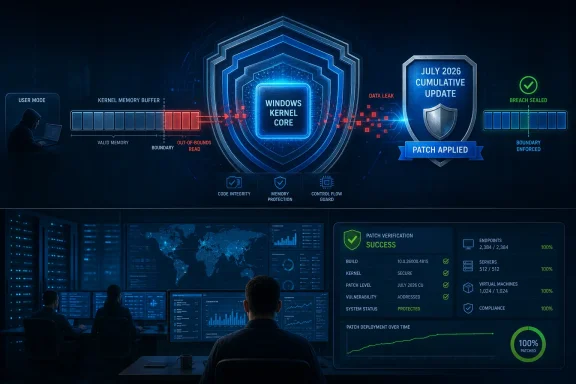 A Kernel Read Crosses a Security Boundary
Microsoft’s advisory identifies the underlying weakness as an out-of-bounds read, categorized as CWE-125. This class of bug occurs when software reads memory outside the limits of the buffer it was supposed to access.In ordinary user-mode software, an out-of-bounds read may expose data belonging to the same application. Inside the Windows Kernel, memory handling carries broader security implications because the kernel manages processes, access controls, hardware interaction, and separation between user and privileged execution contexts.
Microsoft has not publicly documented which specific kernel security control can be bypassed, what memory becomes visible, or how an attacker would trigger the defective read. There is also no public proof-of-concept exploit accompanying the July disclosure. Administrators should therefore avoid assuming that the flaw defeats a particular technology such as Secure Boot, BitLocker, Credential Guard, or virtualization-based security unless Microsoft later says so.
The CVSS rating nevertheless provides useful boundaries. CVE-2026-58614 is a local vulnerability requiring existing authorization on the target, with no separate user interaction needed once the attacker is in position. Its principal scored impact is confidentiality rather than integrity or availability, which is consistent with a read operation that exposes information needed to circumvent a protection.
That distinction matters. A security-feature bypass is often most useful as one stage in a larger attack chain rather than as a complete compromise by itself. Information obtained from kernel memory could, depending on the undocumented details, help an attacker defeat a mitigation, recover sensitive state, or make another exploit more reliable.
Microsoft has not claimed that CVE-2026-58614 independently provides code execution or privilege escalation. Any scenario that extends beyond the published security-feature bypass should be treated as analysis, not as a confirmed capability.
The Affected Range Reaches from Windows Server 2012 to Windows 11 26H1
The affected-product list is broad because the vulnerable code is shared across multiple generations of Windows. Microsoft identifies supported configurations spanning Windows 10 Version 1607 through Windows 11 version 26H1, as well as server releases from Windows Server 2012 to Windows Server 2025.Relevant patched build thresholds include:
- Windows 10 Version 21H2 is addressed in build 19044.7548.
- Windows 10 Version 22H2 is addressed in build 19045.7548.
- Windows 11 version 24H2 is addressed in build 26100.8875.
- Windows 11 version 25H2 is addressed through the July servicing line associated with KB5101650.
- Windows 11 version 26H1 is addressed in build 28000.2525 through KB5101649.
- Windows Server 2016 is addressed in build 14393.9339.
- Windows Server 2019 is addressed in build 17763.9020 through KB5099538.
- Windows Server 2022 is addressed in build 20348.5386 through KB5099540.
- Windows Server 2025 is addressed in build 26100.33158.
Microsoft’s structured vulnerability data also lists Windows Server 2012 and Windows Server 2012 R2, including Server Core installations. Those operating systems require the applicable Extended Security Update servicing arrangements; they should not be interpreted as receiving unrestricted mainstream security support.
For inventory purposes, administrators should verify the installed cumulative update or resulting operating-system build rather than search for a separate CVE-specific package. Windows kernel fixes are normally delivered as part of the monthly cumulative servicing model, so CVE-2026-58614 does not have an independent patch that can be deployed while excluding the rest of July’s changes.
Patch Validation Matters More Than the Raw CVSS Number
A 5.5 score can place CVE-2026-58614 below many organizations’ emergency deployment threshold. That is reasonable when comparing it with unauthenticated remote-code-execution flaws, but CVSS alone does not describe the operational context of a compromised endpoint.An attacker must already have authorized local access, which substantially reduces exposure on well-managed systems. The risk changes on shared workstations, Remote Desktop Session Hosts, developer machines, jump servers, and environments where an initial phishing or application exploit may give an intruder a foothold without full administrative control.
Kernel information disclosures and mitigation bypasses are particularly relevant to exploit chains. Attackers frequently combine separate weaknesses to move from an initial low-privilege position to a more durable or privileged compromise. A flaw that appears modest in isolation can remove uncertainty or defeat a protection that would otherwise stop the next stage.
Microsoft says the vulnerability was not publicly disclosed before the coordinated July release and was not known to be exploited. Its report-confidence status is confirmed, meaning the vendor accepts that the vulnerability and supporting technical evidence are real. That status does not mean exploitation has been observed.
The explanatory text about report confidence shown in Microsoft’s Security Update Guide is generic CVSS documentation. It explains how the metric works across vulnerabilities; it is not a technical description of CVE-2026-58614’s root cause or an indication that exploit code is available.
Administrators should deploy through their normal July patch rings, beginning with representative Windows 11 and Windows Server systems and then expanding after application and boot testing. Security teams should also confirm that endpoint-management dashboards report the new build, since a device marked compliant by policy may still be waiting for installation or a required restart.
July’s Cumulative Updates Carry Their Own Deployment Considerations
The July 2026 Windows updates contain far more than this kernel correction. Microsoft’s release notes include Secure Boot certificate servicing, Remote Desktop publisher hardening, networking changes affecting unregistered third-party TDI transports, and fixes for OLE Automation compatibility problems introduced in June.That broader payload argues for controlled testing, especially on servers using older networking, automation, or security software. It does not provide a practical reason to leave the kernel flaw unpatched, because Microsoft has not published a workaround or registry-based mitigation for CVE-2026-58614.
Windows Server 2022 administrators have an additional known issue to review: Microsoft says a limited set of systems with an unrecommended BitLocker Group Policy configuration may request the recovery key on the first restart after installing KB5099540. Recovery keys and BitLocker policy state should therefore be checked before broad server deployment.
Organizations maintaining offline Windows images must also account for Microsoft’s current
boot.stl guidance. Installation media updated with Dynamic Update packages needs the correct boot.stl file for the target Windows version and architecture, or the resulting media may fail to start with error 0xc0430001.For CVE-2026-58614 itself, the decision remains straightforward: install the July 14, 2026 cumulative update, verify the resulting build, and complete the reboot. The unresolved issue is not whether the defect exists, but exactly which kernel protection the out-of-bounds read bypasses—a detail Microsoft may disclose only after patched systems have had time to move through enterprise deployment rings.
References
- Primary source: MSRC
Published: 2026-07-14T07:00:00-07:00
Security Update Guide - Microsoft Security Response Center
 msrc.microsoft.com
- Related coverage: aha.org
- Related coverage: tomshardware.com
Windows Server vulnerability can grant system privileges with just a malformed packet — domain controllers are being exploited in the wild | Tom's Hardware
System administrators, run the May 12 patch immediately if you haven't already.www.tomshardware.com
