

Microsoft’s July 14, 2026 security release fixes CVE-2026-54982, a remote code execution vulnerability in the Windows Reliable Multicast Transport Driver, or RMCAST. Systems that receive the corresponding Windows cumulative update should be treated as patch priorities, particularly where multicast networking is enabled or used by server, media-distribution, or specialized line-of-business applications.
The vulnerability was published in the Microsoft Security Response Center’s Security Update Guide as part of July 2026 Patch Tuesday. Microsoft identifies the impact as remote code execution, but the submitted advisory text does not disclose the vulnerable function, attack prerequisites, affected Windows versions, CVSS score, or whether exploitation has been detected in the wild.
That missing detail matters. Remote code execution in a Windows networking driver is potentially serious, but the label alone does not establish that any internet host can be compromised without authentication or user interaction.
Reliable Multicast Transport is designed to deliver data from one sender to multiple receivers while providing reliability features not available with ordinary multicast traffic. Windows implements the protocol through the RMCAST networking component and its associated driver.
Because RMCAST operates within the Windows networking stack, a memory-safety or input-validation failure can have consequences beyond the failure of an ordinary user-mode application. A successful attack against a kernel-mode driver could potentially execute code with highly privileged access, crash the operating system, or provide a stepping stone for further compromise.
Microsoft has not provided enough public technical information in the submitted material to determine whether CVE-2026-54982 can be triggered simply by sending a packet to an affected machine. Administrators should not assume that the vulnerability is automatically reachable from the public internet, because practical exposure may depend on whether RMCAST is installed, bound to an interface, actively listening, or invoked by an application.
The reverse assumption is equally risky. A component does not have to be widely used on employee laptops to represent a meaningful enterprise threat. Multicast technologies can appear in deployment systems, media platforms, telemetry products, financial-data applications, industrial environments, and older software whose network dependencies are poorly documented.
That passage appears to be explanatory text for a vulnerability-scoring metric rather than a technical description of CVE-2026-54982 itself. It should not be read as evidence that Microsoft is uncertain whether this particular RMCAST vulnerability exists.
Microsoft’s publication of CVE-2026-54982 and delivery of a security update represent vendor acknowledgement of the flaw. What remains unclear is how much technical knowledge is publicly available to attackers, whether proof-of-concept code exists, and whether exploitation has progressed beyond security research.
Those distinctions affect patch prioritization:
Administrators should use the Security Update Guide’s affected-product table to map CVE-2026-54982 to the exact KB required by each operating-system version. That mapping is especially important in mixed environments containing Windows 11, Windows Server, older LTSC installations, or systems covered by extended security programs.
A practical deployment sequence is to install the July updates on representative machines that exercise multicast-dependent applications, monitor for network and application regressions, and then accelerate production rollout. The security risk argues against a lengthy testing hold, but networking-driver changes deserve targeted validation rather than a generic desktop smoke test.
Testing should include applications that use group communication, multicast discovery, media distribution, or specialized Windows Sockets transports. Administrators should also check Windows Event Viewer, application logs, service health, network captures, and crash telemetry after installation.
The July Windows updates introduce other networking changes, including Microsoft’s enforcement of registration requirements for third-party Transport Driver Interface transports. Microsoft warns that applications using sockets over unregistered third-party TDI transports may stop working after updates released on or after July 14, 2026. That hardening is not necessarily part of the RMCAST vulnerability fix, but it could complicate troubleshooting if a legacy network application fails immediately after the same cumulative update is deployed.
Network teams can add context by reviewing multicast traffic, firewall policy, listening endpoints, application documentation, and packet captures. Systems exchanging RMCAST traffic across security boundaries should move ahead of ordinary clients in the deployment queue.
Segmentation remains useful while updates are tested. Organizations can restrict unnecessary multicast traffic between user, server, management, and industrial networks, while host firewalls can limit inbound traffic to approved peers and interfaces. Any temporary filtering must account for legitimate applications; silently blocking multicast in a production environment can break service discovery or one-to-many distribution workflows.
Security monitoring teams should watch for unusual multicast activity directed at Windows hosts, malformed or high-volume packet sequences, unexplained kernel crashes, and unexpected processes appearing after network anomalies. Microsoft has not disclosed an attack signature in the submitted information, so these are defensive monitoring measures rather than indicators specific to CVE-2026-54982.
Installing the July 14 Windows security updates is the primary remediation. Disabling applications or protocols without understanding their dependencies is a fallback risk-reduction measure, not a substitute for applying the vendor fix.
The next important milestone will be additional MSRC data clarifying the affected Windows editions, CVSS vector, exploitability assessment, and public or active-exploitation status. Until then, CVE-2026-54982 warrants prompt patching on Windows systems that use or can receive RMCAST traffic, with accelerated deployment on servers and specialized networked devices where the driver’s attack surface is more than theoretical.
The vulnerability was published in the Microsoft Security Response Center’s Security Update Guide as part of July 2026 Patch Tuesday. Microsoft identifies the impact as remote code execution, but the submitted advisory text does not disclose the vulnerable function, attack prerequisites, affected Windows versions, CVSS score, or whether exploitation has been detected in the wild.
That missing detail matters. Remote code execution in a Windows networking driver is potentially serious, but the label alone does not establish that any internet host can be compromised without authentication or user interaction.
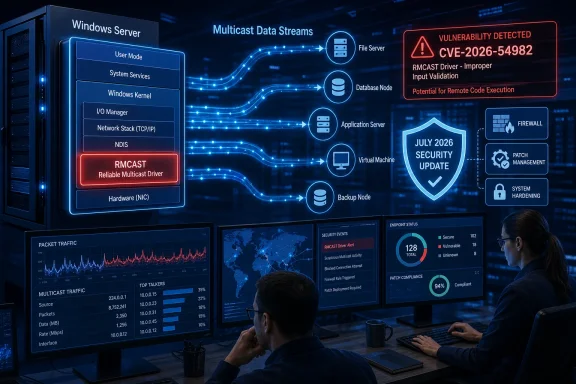 RMCAST Puts the Flaw Close to the Windows Kernel
Reliable Multicast Transport is designed to deliver data from one sender to multiple receivers while providing reliability features not available with ordinary multicast traffic. Windows implements the protocol through the RMCAST networking component and its associated driver.Because RMCAST operates within the Windows networking stack, a memory-safety or input-validation failure can have consequences beyond the failure of an ordinary user-mode application. A successful attack against a kernel-mode driver could potentially execute code with highly privileged access, crash the operating system, or provide a stepping stone for further compromise.
Microsoft has not provided enough public technical information in the submitted material to determine whether CVE-2026-54982 can be triggered simply by sending a packet to an affected machine. Administrators should not assume that the vulnerability is automatically reachable from the public internet, because practical exposure may depend on whether RMCAST is installed, bound to an interface, actively listening, or invoked by an application.
The reverse assumption is equally risky. A component does not have to be widely used on employee laptops to represent a meaningful enterprise threat. Multicast technologies can appear in deployment systems, media platforms, telemetry products, financial-data applications, industrial environments, and older software whose network dependencies are poorly documented.
Microsoft’s Metric Text Is Not an Exploitability Disclosure
The description supplied with the CVE discusses a metric that measures confidence in the existence of a vulnerability and the credibility of the available technical information. It explains the difference between an issue that is only suspected, one supported by incomplete research, and one confirmed by the affected vendor.That passage appears to be explanatory text for a vulnerability-scoring metric rather than a technical description of CVE-2026-54982 itself. It should not be read as evidence that Microsoft is uncertain whether this particular RMCAST vulnerability exists.
Microsoft’s publication of CVE-2026-54982 and delivery of a security update represent vendor acknowledgement of the flaw. What remains unclear is how much technical knowledge is publicly available to attackers, whether proof-of-concept code exists, and whether exploitation has progressed beyond security research.
Those distinctions affect patch prioritization:
- A publicly documented packet format or proof of concept would make reproduction easier.
- Confirmed exploitation would justify emergency deployment and active threat hunting.
- A flaw requiring access to a specific multicast session would have a narrower attack surface than an unauthenticated vulnerability reachable over a commonly exposed service.
- A vulnerability affecting a dormant component could still become reachable when a third-party application activates RMCAST.
July’s Cumulative Updates Carry the Fix
Microsoft distributes most Windows component fixes through cumulative operating-system updates rather than standalone patches for individual drivers. For Windows 11 version 26H1, Microsoft’s July release is KB5101649, bringing the OS to build 28000.2525. Other supported Windows and Windows Server releases have their own July 14 cumulative or security-only packages.Administrators should use the Security Update Guide’s affected-product table to map CVE-2026-54982 to the exact KB required by each operating-system version. That mapping is especially important in mixed environments containing Windows 11, Windows Server, older LTSC installations, or systems covered by extended security programs.
A practical deployment sequence is to install the July updates on representative machines that exercise multicast-dependent applications, monitor for network and application regressions, and then accelerate production rollout. The security risk argues against a lengthy testing hold, but networking-driver changes deserve targeted validation rather than a generic desktop smoke test.
Testing should include applications that use group communication, multicast discovery, media distribution, or specialized Windows Sockets transports. Administrators should also check Windows Event Viewer, application logs, service health, network captures, and crash telemetry after installation.
The July Windows updates introduce other networking changes, including Microsoft’s enforcement of registration requirements for third-party Transport Driver Interface transports. Microsoft warns that applications using sockets over unregistered third-party TDI transports may stop working after updates released on or after July 14, 2026. That hardening is not necessarily part of the RMCAST vulnerability fix, but it could complicate troubleshooting if a legacy network application fails immediately after the same cumulative update is deployed.
Exposure Begins With Configuration, Not the CVE Name
Asset owners should first identify where RMCAST is actually present and in use. Searching software inventories for the driver and related Windows networking components can establish coverage, but a file’s presence does not prove that a system is remotely exploitable.Network teams can add context by reviewing multicast traffic, firewall policy, listening endpoints, application documentation, and packet captures. Systems exchanging RMCAST traffic across security boundaries should move ahead of ordinary clients in the deployment queue.
Segmentation remains useful while updates are tested. Organizations can restrict unnecessary multicast traffic between user, server, management, and industrial networks, while host firewalls can limit inbound traffic to approved peers and interfaces. Any temporary filtering must account for legitimate applications; silently blocking multicast in a production environment can break service discovery or one-to-many distribution workflows.
Security monitoring teams should watch for unusual multicast activity directed at Windows hosts, malformed or high-volume packet sequences, unexplained kernel crashes, and unexpected processes appearing after network anomalies. Microsoft has not disclosed an attack signature in the submitted information, so these are defensive monitoring measures rather than indicators specific to CVE-2026-54982.
Installing the July 14 Windows security updates is the primary remediation. Disabling applications or protocols without understanding their dependencies is a fallback risk-reduction measure, not a substitute for applying the vendor fix.
The next important milestone will be additional MSRC data clarifying the affected Windows editions, CVSS vector, exploitability assessment, and public or active-exploitation status. Until then, CVE-2026-54982 warrants prompt patching on Windows systems that use or can receive RMCAST traffic, with accelerated deployment on servers and specialized networked devices where the driver’s attack surface is more than theoretical.
References
- Primary source: MSRC
Published: 2026-07-14T07:00:00-07:00
Security Update Guide - Microsoft Security Response Center
 msrc.microsoft.com
- Official source: learn.microsoft.com
Driver Ship Room Release Cadence Windows - Windows drivers | Microsoft Learn
This article provides information about the operation schedule for Windows driver ship room. In order to provide the best experience for Windows users, there are certain times where aspects of publication operations are suspended.learn.microsoft.com - Official source: techcommunity.microsoft.com
