

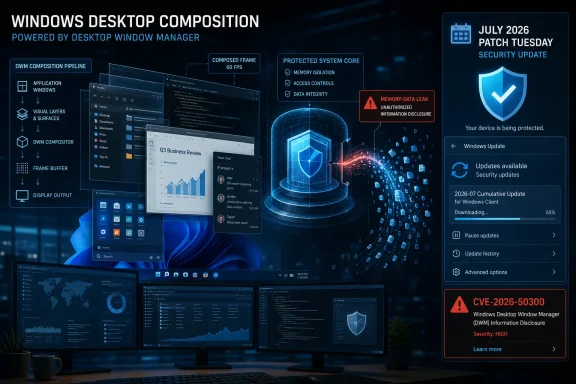
Microsoft has patched CVE-2026-50300, an information-disclosure vulnerability associated with the Windows Desktop Window Manager Core Library, in the July 14, 2026 security updates. The flaw requires an attacker to already have local access and valid authorization, but successful exploitation could expose sensitive information from memory without user interaction.
Microsoft rates the vulnerability Important, with a CVSS 3.1 base score of 5.5. The company says it was neither publicly disclosed nor known to be exploited when the updates were released, making this a routine—but still necessary—Patch Tuesday deployment rather than an emergency response.
The vulnerability was detailed in Microsoft’s Security Update Guide and included in the July 2026 Patch Tuesday catalog. Trend Micro’s Zero Day Initiative independently lists CVE-2026-50300 as an Important information-disclosure issue with no known public disclosure or active exploitation.
Microsoft’s CVSS vector for CVE-2026-50300 is
The consequence is limited to confidentiality. Microsoft does not credit the vulnerability with directly modifying data, interrupting Windows availability, executing code, or elevating the attacker to administrator. Its potential confidentiality impact, however, is rated High, which suggests exploitation could expose information that would normally be inaccessible to the attacking process.
That distinction matters for triage. CVE-2026-50300 is not a network worm, remote desktop takeover, or one-click compromise. It is more likely to be useful as one component of a longer attack chain after an adversary has obtained an initial foothold through another vulnerability, stolen credentials, malicious software, or physical access.
An information leak can help an attacker inspect memory contents, discover security-relevant values, or collect data belonging to another context. It can also provide information needed to make a separate memory-corruption exploit more reliable, although Microsoft has not publicly documented such a chain for CVE-2026-50300.
An integer underflow occurs when an arithmetic operation produces a result below the minimum value a data type can represent. The value can then wrap to a much larger number, potentially causing subsequent bounds calculations to become incorrect. If that incorrect value is used while reading memory, a component may access data beyond the intended buffer.
That behavior aligns with the information-disclosure classification: Windows may read or return memory that should have remained outside the requesting process’s reach. Microsoft has not published a proof of concept, vulnerable function name, trigger sequence, or detailed explanation of what data could be recovered.
There is also a naming inconsistency worth noting. Microsoft’s advisory title identifies the affected component as the Windows DWM Core Library, while the CVE description distributed to the National Vulnerability Database refers more generally to the Windows kernel. These descriptions are not necessarily contradictory because Desktop Window Manager relies on privileged Windows graphics and kernel components, but administrators should avoid assuming that the flaw is confined to the visible
The public record is still undergoing NVD enrichment, and the advisory was only published on July 14. Component descriptions and affected-platform metadata can be refined after release, particularly when Microsoft clarifies where the faulty calculation occurs.
Users generally cannot reduce exposure by disabling an optional application or uninstalling a feature. DWM is part of the Windows desktop architecture and normally runs continuously during an interactive session. Server systems can also contain related graphics components depending on the Windows edition, installation mode, and affected code path.
The practical mitigation is therefore the cumulative Windows security update supplied for each supported operating-system branch. Microsoft has not identified a separate registry workaround, Group Policy control, service configuration, or feature-disablement procedure that provides equivalent protection.
CVE-2026-50300 affects multiple supported Windows client and server releases covered by Microsoft’s July security servicing. Organizations should use the Security Update Guide, Windows Update for Business reports, Microsoft Intune, Configuration Manager, Windows Server Update Services, or their vulnerability-management platform to map the CVE to the appropriate cumulative update for each device.
Legacy and extended-support estates deserve particular attention. Public CVE metadata includes older serviced branches alongside current Windows releases, meaning the issue should not be treated as relevant only to the newest Windows 11 feature update. Systems receiving Extended Security Updates must have the correct licensing and servicing prerequisites before their July fixes will be applied.
Multi-user Windows environments have the clearest exposure. Remote Desktop Session Hosts, virtual desktop infrastructure, shared workstations, jump servers, classroom PCs, laboratory systems, and kiosk-like deployments can give many users access to the same underlying operating system. A local information-disclosure flaw has more value where sensitive processes and multiple security contexts coexist.
Administrators should prioritize deployment on:
Security teams should also avoid treating a successful update installation as proof that every endpoint is protected. Verify the resulting OS build, review update failure codes, and identify devices that have not checked in since July 14. Machines held back by safeguard policies, servicing-stack problems, insufficient disk space, or repeated rollback behavior require separate remediation.
That difference is important. Confidence in the vulnerability’s existence is high because Microsoft assigned the CVE, described the weakness classes, scored the flaw, identified affected products, and shipped corrected Windows packages. Confidence about real-world exploitation techniques is lower because no public proof of concept, exploitation report, or detailed researcher analysis was available at publication.
The low-complexity CVSS assessment nevertheless indicates that Microsoft does not expect exploitation to require unusually difficult conditions once an attacker has local privileges. Defenders should not translate “not publicly disclosed” into “not technically usable.” It means Microsoft had not identified public disclosure or exploitation by the July 14 release date, not that exploitation is impossible or will remain undocumented.
There is no evidence at present that CVE-2026-50300 should trigger incident-response actions by itself. Organizations do not need to hunt for a published exploit signature that does not yet exist, and Microsoft has not disclosed indicators of compromise tied to the flaw. The appropriate response is to deploy the July cumulative updates, confirm installation, and continue monitoring for changes to Microsoft’s exploitability assessment.
CVE-2026-50300 is ultimately a conventional Patch Tuesday risk: locally reachable, potentially valuable in a chained intrusion, and fixed through normal Windows servicing. Its next meaningful milestone will be any revision from Microsoft clarifying the DWM-versus-kernel component description—or a change from “exploitation not detected” to evidence that attackers have begun putting the information leak to work.
Microsoft rates the vulnerability Important, with a CVSS 3.1 base score of 5.5. The company says it was neither publicly disclosed nor known to be exploited when the updates were released, making this a routine—but still necessary—Patch Tuesday deployment rather than an emergency response.
The vulnerability was detailed in Microsoft’s Security Update Guide and included in the July 2026 Patch Tuesday catalog. Trend Micro’s Zero Day Initiative independently lists CVE-2026-50300 as an Important information-disclosure issue with no known public disclosure or active exploitation.
 A Local Flaw With a High Confidentiality Impact
Microsoft’s CVSS vector for CVE-2026-50300 is AV:L/AC:L/PR:L/UI:N/S:U/C:H/I:N/A:N. In practical terms, the attacker must operate locally, needs low-level privileges, faces low attack complexity, and does not need to persuade another user to open a file or perform an action.The consequence is limited to confidentiality. Microsoft does not credit the vulnerability with directly modifying data, interrupting Windows availability, executing code, or elevating the attacker to administrator. Its potential confidentiality impact, however, is rated High, which suggests exploitation could expose information that would normally be inaccessible to the attacking process.
That distinction matters for triage. CVE-2026-50300 is not a network worm, remote desktop takeover, or one-click compromise. It is more likely to be useful as one component of a longer attack chain after an adversary has obtained an initial foothold through another vulnerability, stolen credentials, malicious software, or physical access.
An information leak can help an attacker inspect memory contents, discover security-relevant values, or collect data belonging to another context. It can also provide information needed to make a separate memory-corruption exploit more reliable, although Microsoft has not publicly documented such a chain for CVE-2026-50300.
Microsoft’s Records Point to an Integer Underflow
The National Vulnerability Database currently describes the root problem as an integer underflow, also known as integer wraparound, in the Windows kernel. It maps the issue to both CWE-191, Integer Underflow, and CWE-125, Out-of-bounds Read.An integer underflow occurs when an arithmetic operation produces a result below the minimum value a data type can represent. The value can then wrap to a much larger number, potentially causing subsequent bounds calculations to become incorrect. If that incorrect value is used while reading memory, a component may access data beyond the intended buffer.
That behavior aligns with the information-disclosure classification: Windows may read or return memory that should have remained outside the requesting process’s reach. Microsoft has not published a proof of concept, vulnerable function name, trigger sequence, or detailed explanation of what data could be recovered.
There is also a naming inconsistency worth noting. Microsoft’s advisory title identifies the affected component as the Windows DWM Core Library, while the CVE description distributed to the National Vulnerability Database refers more generally to the Windows kernel. These descriptions are not necessarily contradictory because Desktop Window Manager relies on privileged Windows graphics and kernel components, but administrators should avoid assuming that the flaw is confined to the visible
dwm.exe process.The public record is still undergoing NVD enrichment, and the advisory was only published on July 14. Component descriptions and affected-platform metadata can be refined after release, particularly when Microsoft clarifies where the faulty calculation occurs.
DWM Makes the Bug Broadly Relevant
Desktop Window Manager is responsible for composing application windows and producing the final desktop image shown on screen. It underpins routine Windows features including transparency, animations, thumbnails, multiple-monitor composition, and other graphical effects.Users generally cannot reduce exposure by disabling an optional application or uninstalling a feature. DWM is part of the Windows desktop architecture and normally runs continuously during an interactive session. Server systems can also contain related graphics components depending on the Windows edition, installation mode, and affected code path.
The practical mitigation is therefore the cumulative Windows security update supplied for each supported operating-system branch. Microsoft has not identified a separate registry workaround, Group Policy control, service configuration, or feature-disablement procedure that provides equivalent protection.
CVE-2026-50300 affects multiple supported Windows client and server releases covered by Microsoft’s July security servicing. Organizations should use the Security Update Guide, Windows Update for Business reports, Microsoft Intune, Configuration Manager, Windows Server Update Services, or their vulnerability-management platform to map the CVE to the appropriate cumulative update for each device.
Legacy and extended-support estates deserve particular attention. Public CVE metadata includes older serviced branches alongside current Windows releases, meaning the issue should not be treated as relevant only to the newest Windows 11 feature update. Systems receiving Extended Security Updates must have the correct licensing and servicing prerequisites before their July fixes will be applied.
Patch Priority Depends on the Host’s Role
The lack of known exploitation lowers the immediate urgency compared with the remote-code-execution and privilege-escalation vulnerabilities in the same July release. It does not make the update optional, particularly on systems where untrusted users or processes can obtain local sessions.Multi-user Windows environments have the clearest exposure. Remote Desktop Session Hosts, virtual desktop infrastructure, shared workstations, jump servers, classroom PCs, laboratory systems, and kiosk-like deployments can give many users access to the same underlying operating system. A local information-disclosure flaw has more value where sensitive processes and multiple security contexts coexist.
Administrators should prioritize deployment on:
- Shared Windows machines that permit interactive logon by multiple users.
- Remote Desktop Services and virtual desktop hosts running graphical sessions.
- Developer workstations that regularly execute untrusted test builds, packages, or scripts.
- Privileged access workstations that handle administrative credentials or sensitive management tools.
- Endpoints where endpoint detection has already reported malware, suspicious local execution, or credential abuse.
Security teams should also avoid treating a successful update installation as proof that every endpoint is protected. Verify the resulting OS build, review update failure codes, and identify devices that have not checked in since July 14. Machines held back by safeguard policies, servicing-stack problems, insufficient disk space, or repeated rollback behavior require separate remediation.
Exploitability Is Confirmed, but Public Detail Is Thin
The material supplied with the advisory describes an exploit-maturity metric: essentially, how certain the industry is that a vulnerability exists and how much technical information is available to attackers. For CVE-2026-50300, Microsoft’s acknowledgement and released fix establish that the vulnerability is real, even though the public technical record remains sparse.That difference is important. Confidence in the vulnerability’s existence is high because Microsoft assigned the CVE, described the weakness classes, scored the flaw, identified affected products, and shipped corrected Windows packages. Confidence about real-world exploitation techniques is lower because no public proof of concept, exploitation report, or detailed researcher analysis was available at publication.
The low-complexity CVSS assessment nevertheless indicates that Microsoft does not expect exploitation to require unusually difficult conditions once an attacker has local privileges. Defenders should not translate “not publicly disclosed” into “not technically usable.” It means Microsoft had not identified public disclosure or exploitation by the July 14 release date, not that exploitation is impossible or will remain undocumented.
There is no evidence at present that CVE-2026-50300 should trigger incident-response actions by itself. Organizations do not need to hunt for a published exploit signature that does not yet exist, and Microsoft has not disclosed indicators of compromise tied to the flaw. The appropriate response is to deploy the July cumulative updates, confirm installation, and continue monitoring for changes to Microsoft’s exploitability assessment.
CVE-2026-50300 is ultimately a conventional Patch Tuesday risk: locally reachable, potentially valuable in a chained intrusion, and fixed through normal Windows servicing. Its next meaningful milestone will be any revision from Microsoft clarifying the DWM-versus-kernel component description—or a change from “exploitation not detected” to evidence that attackers have begun putting the information leak to work.
References
- Primary source: MSRC
Published: 2026-07-14T07:00:00-07:00
Security Update Guide - Microsoft Security Response Center
 msrc.microsoft.com
