

CVE-2026-50327 is a high-severity Windows Media vulnerability that can let an authenticated attacker execute code through a heap-based buffer overflow. Microsoft released the correction on July 14, 2026, for Windows 11 versions 24H2, 25H2, and 26H1, as well as Windows Server 2025 and Server Core.
Despite Microsoft’s “Remote Code Execution” title, this is not an unauthenticated network attack against any reachable Windows PC. Microsoft’s CVSS data describes a local, low-complexity attack requiring low privileges but no additional user interaction, making CVE-2026-50327 primarily a post-compromise risk.
The vulnerability carries a CVSS 3.1 score of 7.8, rated High. Microsoft disclosed the issue through the Security Update Guide, while the National Vulnerability Database identifies the underlying weakness as CWE-122, a heap-based buffer overflow.
A heap-based buffer overflow occurs when software writes more data into a heap allocation than that allocation can safely hold. The excess data can corrupt nearby memory, potentially changing application behavior, crashing a process, or allowing attacker-controlled code to execute.
Microsoft’s public description says the flaw resides in Windows Media, but it does not identify a particular codec, file format, executable, DLL, or media-processing workflow. Administrators therefore should not assume that disabling a specific player application or blocking one familiar media extension removes the exposure.
Windows media-handling components may be invoked by more than the visible media player. File previews, metadata extraction, thumbnail generation, communications software, line-of-business applications, and third-party programs can all depend on operating-system media services. The affected component and attack prerequisites published so far do not provide enough detail to build a reliable configuration-only defense.
The vulnerability’s confidentiality, integrity, and availability impacts are all rated High. Successful exploitation could consequently allow an attacker to access protected information, alter data or system state, and disrupt the affected application or machine.
That combination is materially different from a zero-click vulnerability reachable directly over the Internet. An attacker must first obtain authorized local access or another means of running code on the target. The Windows Media flaw can then become a second-stage tool for expanding what that foothold can accomplish.
The practical attack chain could begin with stolen credentials, a malicious installer, an abused remote-management session, another software vulnerability, or code running inside a restricted user context. CVE-2026-50327 potentially supplies the code-execution step after that initial boundary has already been crossed.
Microsoft’s use of the Remote Code Execution impact category can still be technically appropriate because successful exploitation results in attacker-selected code executing on the vulnerable machine. It should not, however, be read as evidence that an anonymous attacker can send a network packet to Windows Media and immediately take control.
CISA’s vulnerability record currently marks exploitation as none and assesses the flaw as not automatable, while assigning it total technical impact. That points toward a serious but targeted post-access technique rather than a self-propagating or broadly reachable network exploit. There was no public indication at disclosure that CVE-2026-50327 was being actively exploited.
The absence of known exploitation is a snapshot, not a guarantee. Memory-corruption vulnerabilities become more attractive once attackers can compare patched and unpatched Windows binaries, a process known as patch diffing. Microsoft’s confirmation and released correction also give researchers and adversaries a concrete place to begin looking, even though the advisory withholds detailed exploitation instructions.
The affected build thresholds are:
The inclusion of Server Core is significant. CVE-2026-50327 does not depend on a user launching a desktop media-player interface; the vulnerable Windows functionality remains present in the reduced server installation. Administrators should not exclude Server Core from deployment merely because it lacks the standard desktop experience.
For Windows 11, update-management teams should verify the resulting OS build rather than checking only whether a July update appears in installation history. A machine that installed an earlier preview release or failed partway through cumulative-update servicing may remain below the corrected threshold.
Windows Update, Windows Server Update Services, Microsoft Configuration Manager, Intune, and Windows Autopatch should deliver the fix through their normal cumulative-update channels. Organizations using offline images or gold templates also need to service those sources, or newly deployed machines may enter production below the July security baseline.
CVE-2026-50327 is vendor-confirmed, has a defined memory-safety classification, an assigned CVSS vector, named affected products, and released security updates. Those elements provide strong confidence that the vulnerability is real, even though Microsoft has not published the vulnerable function, triggering media input, or proof-of-concept code.
That distinction matters when triaging a large Patch Tuesday release. Sparse public detail does not mean the report is speculative. It means defenders have enough information to identify affected systems and deploy a fix, while would-be attackers have not been handed a complete exploitation recipe.
Administrators should prioritize shared workstations, Remote Desktop Session Hosts, developer PCs, jump servers, and systems where lower-privileged accounts can run software. These environments make the local-access prerequisite easier to satisfy and increase the value of a low-complexity flaw that requires no further user interaction.
Application-control policies, restricted interactive logon, least-privilege administration, and endpoint detection can reduce the chance that an attacker reaches the exploitation stage. They do not correct the underlying Windows Media memory error, and Microsoft has not documented a CVE-specific workaround offering equivalent protection.
The concrete remediation point is the installed build: Windows 11 devices need their July 14, 2026 cumulative security update, while Windows Server 2025 must reach build 26100.33158 or later. Until those updates are deployed, an attacker who already has a low-privilege foothold may have a low-complexity route into Windows Media’s vulnerable memory-handling code.
Despite Microsoft’s “Remote Code Execution” title, this is not an unauthenticated network attack against any reachable Windows PC. Microsoft’s CVSS data describes a local, low-complexity attack requiring low privileges but no additional user interaction, making CVE-2026-50327 primarily a post-compromise risk.
The vulnerability carries a CVSS 3.1 score of 7.8, rated High. Microsoft disclosed the issue through the Security Update Guide, while the National Vulnerability Database identifies the underlying weakness as CWE-122, a heap-based buffer overflow.
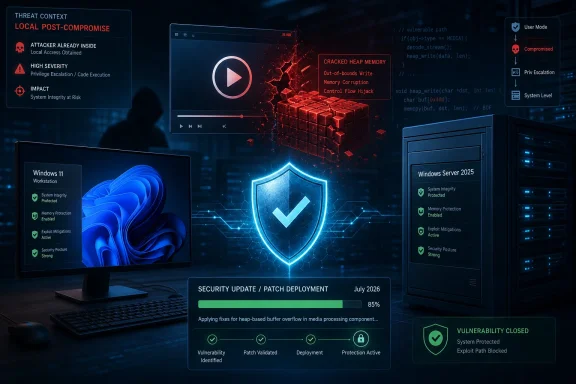 Windows Media’s Memory Handling Opens the Door
A heap-based buffer overflow occurs when software writes more data into a heap allocation than that allocation can safely hold. The excess data can corrupt nearby memory, potentially changing application behavior, crashing a process, or allowing attacker-controlled code to execute.Microsoft’s public description says the flaw resides in Windows Media, but it does not identify a particular codec, file format, executable, DLL, or media-processing workflow. Administrators therefore should not assume that disabling a specific player application or blocking one familiar media extension removes the exposure.
Windows media-handling components may be invoked by more than the visible media player. File previews, metadata extraction, thumbnail generation, communications software, line-of-business applications, and third-party programs can all depend on operating-system media services. The affected component and attack prerequisites published so far do not provide enough detail to build a reliable configuration-only defense.
The vulnerability’s confidentiality, integrity, and availability impacts are all rated High. Successful exploitation could consequently allow an attacker to access protected information, alter data or system state, and disrupt the affected application or machine.
“Remote Code Execution” Needs a Local Foothold
The CVSS vector for CVE-2026-50327 isCVSS:3.1/AV:L/AC:L/PR:L/UI:N/S:U/C:H/I:H/A:H. The attack vector is Local, privileges required are Low, attack complexity is Low, and user interaction is not required.That combination is materially different from a zero-click vulnerability reachable directly over the Internet. An attacker must first obtain authorized local access or another means of running code on the target. The Windows Media flaw can then become a second-stage tool for expanding what that foothold can accomplish.
The practical attack chain could begin with stolen credentials, a malicious installer, an abused remote-management session, another software vulnerability, or code running inside a restricted user context. CVE-2026-50327 potentially supplies the code-execution step after that initial boundary has already been crossed.
Microsoft’s use of the Remote Code Execution impact category can still be technically appropriate because successful exploitation results in attacker-selected code executing on the vulnerable machine. It should not, however, be read as evidence that an anonymous attacker can send a network packet to Windows Media and immediately take control.
CISA’s vulnerability record currently marks exploitation as none and assesses the flaw as not automatable, while assigning it total technical impact. That points toward a serious but targeted post-access technique rather than a self-propagating or broadly reachable network exploit. There was no public indication at disclosure that CVE-2026-50327 was being actively exploited.
The absence of known exploitation is a snapshot, not a guarantee. Memory-corruption vulnerabilities become more attractive once attackers can compare patched and unpatched Windows binaries, a process known as patch diffing. Microsoft’s confirmation and released correction also give researchers and adversaries a concrete place to begin looking, even though the advisory withholds detailed exploitation instructions.
July’s Builds Define the Protection Boundary
Microsoft’s affected-product data names modern Windows branches rather than every supported version of the operating system. The published scope covers x64 and ARM64 editions of Windows 11, plus x64 Windows Server 2025 installations.The affected build thresholds are:
- Windows 11 version 24H2 builds earlier than 26100.8875 are affected.
- Windows 11 version 25H2 builds earlier than 26200.8875 are affected.
- Windows Server 2025 builds earlier than 26100.33158 are affected, including Server Core.
- Windows 11 version 26H1 is included in the affected-product data and should be brought to its July 14, 2026 security level.
The inclusion of Server Core is significant. CVE-2026-50327 does not depend on a user launching a desktop media-player interface; the vulnerable Windows functionality remains present in the reduced server installation. Administrators should not exclude Server Core from deployment merely because it lacks the standard desktop experience.
For Windows 11, update-management teams should verify the resulting OS build rather than checking only whether a July update appears in installation history. A machine that installed an earlier preview release or failed partway through cumulative-update servicing may remain below the corrected threshold.
Windows Update, Windows Server Update Services, Microsoft Configuration Manager, Intune, and Windows Autopatch should deliver the fix through their normal cumulative-update channels. Organizations using offline images or gold templates also need to service those sources, or newly deployed machines may enter production below the July security baseline.
Confidence Is High Even Though Details Remain Sparse
The confidence metric accompanying Microsoft’s advisory describes how certain the vendor is that the vulnerability exists and how credible the available technical information is. It is separate from CVSS severity and from the probability that attackers will exploit the flaw.CVE-2026-50327 is vendor-confirmed, has a defined memory-safety classification, an assigned CVSS vector, named affected products, and released security updates. Those elements provide strong confidence that the vulnerability is real, even though Microsoft has not published the vulnerable function, triggering media input, or proof-of-concept code.
That distinction matters when triaging a large Patch Tuesday release. Sparse public detail does not mean the report is speculative. It means defenders have enough information to identify affected systems and deploy a fix, while would-be attackers have not been handed a complete exploitation recipe.
Administrators should prioritize shared workstations, Remote Desktop Session Hosts, developer PCs, jump servers, and systems where lower-privileged accounts can run software. These environments make the local-access prerequisite easier to satisfy and increase the value of a low-complexity flaw that requires no further user interaction.
Application-control policies, restricted interactive logon, least-privilege administration, and endpoint detection can reduce the chance that an attacker reaches the exploitation stage. They do not correct the underlying Windows Media memory error, and Microsoft has not documented a CVE-specific workaround offering equivalent protection.
The concrete remediation point is the installed build: Windows 11 devices need their July 14, 2026 cumulative security update, while Windows Server 2025 must reach build 26100.33158 or later. Until those updates are deployed, an attacker who already has a low-privilege foothold may have a low-complexity route into Windows Media’s vulnerable memory-handling code.
References
- Primary source: MSRC
Published: 2026-07-14T07:00:00-07:00
Security Update Guide - Microsoft Security Response Center
 msrc.microsoft.com
