

CVE-2026-50433, a Windows Media use-after-free vulnerability fixed in Microsoft’s July 14, 2026 security updates, can let a locally authenticated attacker elevate privileges and gain extensive control over an affected Windows machine. Microsoft rates the flaw Important, with a CVSS 3.1 base score of 7.8, making it a priority for administrators even though it is not currently classified as an actively exploited zero-day.
Detailed in Microsoft’s Security Update Guide and corroborated by the National Vulnerability Database, the vulnerability affects supported and extended-support Windows releases ranging from Windows Server 2012 to Windows 11 version 26H1. Microsoft’s assessment at publication said the flaw had not been publicly disclosed or exploited, while SANS Internet Storm Center listed exploitation as less likely.
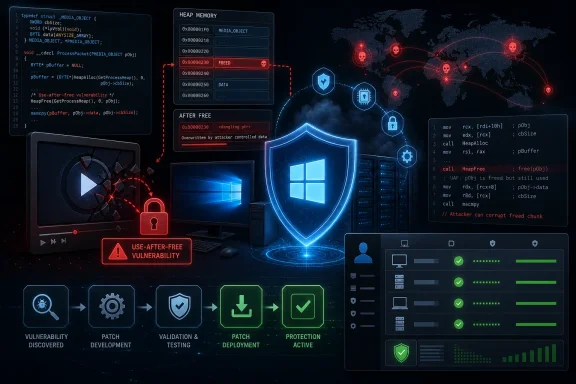
CVE-2026-50433 is a use-after-free memory-safety error in Windows Media. This class of flaw occurs when software continues using a region of memory after it has been released, potentially allowing an attacker to replace or manipulate the data subsequently processed at that location.
Microsoft describes the attack vector as local, with low attack complexity and low privileges required. No interaction from another user is necessary once the attacker is authorized on the machine. In practical terms, this is not a vulnerability that an anonymous internet user can directly trigger against an unprotected network port; the attacker must first obtain access under an existing account or execute code in a local security context.
That prerequisite does not make the flaw harmless. Privilege-escalation vulnerabilities are commonly used as the second stage of an intrusion, after phishing, malicious downloads, stolen credentials, exposed remote-management services, or another software vulnerability has provided an initial foothold.
The CVSS vector assigns high potential impact to confidentiality, integrity, and availability. A successful exploit could therefore move an attacker beyond the restrictions of a standard account, allowing access to protected data, changes to system resources, and disruption of the affected computer.
CISA’s Stakeholder-Specific Vulnerability Categorization record lists no known exploitation and says the attack is not readily automatable, but assesses the potential technical impact as total. That combination captures the central risk: exploitation is not currently widespread or straightforward to launch remotely, but the result could be severe if an attacker has already reached the machine.
Affected client platforms include:
The fixed build thresholds include 9200.26226 for Windows Server 2012, 9600.23291 for Server 2012 R2, 14393.9339 for Server 2016, 17763.9020 for Server 2019, 20348.5386 for Server 2022, and 26100.33158 for Server 2025.
These build numbers are more useful than product names alone when validating deployment. Organizations using Windows Server Update Services, Microsoft Configuration Manager, Intune, Azure Update Manager, or third-party patch tooling should check the installed OS build rather than relying only on a dashboard showing that July updates were approved.
For CVE-2026-50433, Microsoft has identified the weakness as CWE-416, Use After Free, and supplied a complete CVSS vector. The temporal score reported by SANS is 6.8, reflecting the availability of an official fix and the absence of established exploitation at publication.
The distinctions matter:
Use-after-free vulnerabilities can be challenging to turn into reliable exploits because memory layout, process behavior, and platform mitigations affect repeatability. Conversely, the availability of patched and unpatched Windows binaries gives researchers and attackers material for patch diffing, where the fixed code is compared with its vulnerable predecessor to locate the security-sensitive change.
Administrators should prioritize systems where compromise of an ordinary account would have an outsized effect. That includes shared workstations, Remote Desktop Session Hosts, jump servers, developer machines holding signing credentials, and servers on which service or administrative accounts can log on interactively.
Endpoint detection controls remain useful while updates move through testing. Security teams can look for an unprivileged process unexpectedly spawning elevated children, token manipulation, suspicious service creation, changes to protected registry locations, or security-tool tampering following activity involving media files or Windows Media components. These behaviors are not unique to CVE-2026-50433, but they can reveal the post-exploitation activity that makes a local elevation flaw operationally dangerous.
Organizations retaining Windows 10 or older Windows Server releases under extended servicing arrangements also need to verify entitlement and update-channel health. An update being listed for a legacy product does not guarantee that every unmanaged installation will receive it automatically.
For most environments, CVE-2026-50433 does not justify emergency isolation ahead of remotely exploitable or actively exploited July vulnerabilities. It does justify inclusion in the current cumulative-update deployment rather than deferral to a later cycle. Once the July 14, 2026 updates are installed and the fixed OS build is verified, the Windows Media privilege-escalation path addressed by this CVE is closed.
Detailed in Microsoft’s Security Update Guide and corroborated by the National Vulnerability Database, the vulnerability affects supported and extended-support Windows releases ranging from Windows Server 2012 to Windows 11 version 26H1. Microsoft’s assessment at publication said the flaw had not been publicly disclosed or exploited, while SANS Internet Storm Center listed exploitation as less likely.
 A Local Foothold Can Become Full-System Control
CVE-2026-50433 is a use-after-free memory-safety error in Windows Media. This class of flaw occurs when software continues using a region of memory after it has been released, potentially allowing an attacker to replace or manipulate the data subsequently processed at that location.Microsoft describes the attack vector as local, with low attack complexity and low privileges required. No interaction from another user is necessary once the attacker is authorized on the machine. In practical terms, this is not a vulnerability that an anonymous internet user can directly trigger against an unprotected network port; the attacker must first obtain access under an existing account or execute code in a local security context.
That prerequisite does not make the flaw harmless. Privilege-escalation vulnerabilities are commonly used as the second stage of an intrusion, after phishing, malicious downloads, stolen credentials, exposed remote-management services, or another software vulnerability has provided an initial foothold.
The CVSS vector assigns high potential impact to confidentiality, integrity, and availability. A successful exploit could therefore move an attacker beyond the restrictions of a standard account, allowing access to protected data, changes to system resources, and disruption of the affected computer.
CISA’s Stakeholder-Specific Vulnerability Categorization record lists no known exploitation and says the attack is not readily automatable, but assesses the potential technical impact as total. That combination captures the central risk: exploitation is not currently widespread or straightforward to launch remotely, but the result could be severe if an attacker has already reached the machine.
The Affected Windows List Spans Desktops and Servers
The CVE record identifies a broad set of Windows client and server editions as affected. Both x64 and ARM64 variants are included where those architectures are available, while several older Windows 10 releases also include 32-bit systems.Affected client platforms include:
- Windows 10 version 1607 before build 14393.9339.
- Windows 10 version 1809 before build 17763.9020.
- Windows 10 version 21H2 before build 19044.7548.
- Windows 10 version 22H2 before build 19045.7548.
- Windows 11 version 24H2 before build 26100.8875.
- Windows 11 version 25H2 before build 26200.8875.
- Windows 11 version 26H1 before the applicable serviced build, including build 28000.2269 in Microsoft’s published CVE data.
The fixed build thresholds include 9200.26226 for Windows Server 2012, 9600.23291 for Server 2012 R2, 14393.9339 for Server 2016, 17763.9020 for Server 2019, 20348.5386 for Server 2022, and 26100.33158 for Server 2025.
These build numbers are more useful than product names alone when validating deployment. Organizations using Windows Server Update Services, Microsoft Configuration Manager, Intune, Azure Update Manager, or third-party patch tooling should check the installed OS build rather than relying only on a dashboard showing that July updates were approved.
“Confirmed” Describes Evidence, Not Active Attacks
The report-confidence language attached to CVE records can be easy to misread. A vulnerability marked as confirmed does not mean Microsoft has observed it being exploited; it means the vendor or available technical evidence confirms that the underlying security defect exists.For CVE-2026-50433, Microsoft has identified the weakness as CWE-416, Use After Free, and supplied a complete CVSS vector. The temporal score reported by SANS is 6.8, reflecting the availability of an official fix and the absence of established exploitation at publication.
The distinctions matter:
- The vulnerability’s existence and technical impact have been confirmed.
- Microsoft had not identified public disclosure when the July 14 advisory was released.
- Microsoft had not identified exploitation in the wild at that time.
- The published assessment placed exploitation in the “less likely” category.
Use-after-free vulnerabilities can be challenging to turn into reliable exploits because memory layout, process behavior, and platform mitigations affect repeatability. Conversely, the availability of patched and unpatched Windows binaries gives researchers and attackers material for patch diffing, where the fixed code is compared with its vulnerable predecessor to locate the security-sensitive change.
Patch Deployment Is the Primary Mitigation
Microsoft has not published a separate workaround or configuration-based mitigation that removes the need to install the security update. The practical response is to deploy the July 2026 cumulative security update appropriate to each affected Windows release and confirm that the resulting build meets or exceeds Microsoft’s fixed threshold.Administrators should prioritize systems where compromise of an ordinary account would have an outsized effect. That includes shared workstations, Remote Desktop Session Hosts, jump servers, developer machines holding signing credentials, and servers on which service or administrative accounts can log on interactively.
Endpoint detection controls remain useful while updates move through testing. Security teams can look for an unprivileged process unexpectedly spawning elevated children, token manipulation, suspicious service creation, changes to protected registry locations, or security-tool tampering following activity involving media files or Windows Media components. These behaviors are not unique to CVE-2026-50433, but they can reveal the post-exploitation activity that makes a local elevation flaw operationally dangerous.
Organizations retaining Windows 10 or older Windows Server releases under extended servicing arrangements also need to verify entitlement and update-channel health. An update being listed for a legacy product does not guarantee that every unmanaged installation will receive it automatically.
For most environments, CVE-2026-50433 does not justify emergency isolation ahead of remotely exploitable or actively exploited July vulnerabilities. It does justify inclusion in the current cumulative-update deployment rather than deferral to a later cycle. Once the July 14, 2026 updates are installed and the fixed OS build is verified, the Windows Media privilege-escalation path addressed by this CVE is closed.
References
- Primary source: MSRC
Published: 2026-07-14T07:00:00-07:00
Security Update Guide - Microsoft Security Response Center
 msrc.microsoft.com
- Related coverage: aha.org
