

Microsoft has fixed CVE-2026-50369, an Important-rated Windows Remote Desktop Services vulnerability that could let an authenticated attacker elevate privileges across a network. The flaw carries a CVSS 3.1 base score of 8.8 and affects supported Windows client and server releases, including Windows 11 24H2, 25H2 and 26H1 as well as Windows Server 2012 through Windows Server 2025.
Detailed in Microsoft’s July 14, 2026 security release, the vulnerability is a use-after-free memory error associated with a race condition in Remote Desktop Services. Administrators running Remote Desktop Session Host systems, jump servers, virtual desktop infrastructure or other RDP-accessible machines should prioritize the July cumulative updates rather than treating this as a routine workstation-only privilege-escalation fix.
The Zero Day Initiative’s July security-update review lists CVE-2026-50369 as neither publicly disclosed nor known to be exploited when the patches were released. That lowers the immediate emergency level, but the combination of network reachability, low attack complexity and high confidentiality, integrity and availability impact makes delayed patching difficult to justify on exposed Remote Desktop infrastructure.
Microsoft describes CVE-2026-50369 as allowing an authorized attacker to elevate privileges over a network. Its CVSS vector is
This is not an unauthenticated, pre-login RDP worm scenario. An attacker first needs some level of legitimate access, which could come from a compromised account, stolen credentials, an existing foothold or access deliberately granted to a low-privilege user.
That requirement should not be mistaken for a strong mitigation. Credential theft is a standard entry point in ransomware and hands-on-keyboard intrusions, while Remote Desktop environments are explicitly designed to accept network sessions from authenticated users. A flaw that converts limited RDP access into greater control can shorten the distance between initial compromise and full system takeover.
The absence of user interaction matters as well. Once the attacker has the required privileges and network path, Microsoft’s scoring does not indicate that an administrator or victim must open a file, approve a prompt or perform another action to trigger exploitation.
Microsoft assigns an unchanged scope to the flaw, meaning the security authority directly affected by the vulnerable component does not change under CVSS rules. That technical distinction does little to soften the operational consequence: a successful privilege escalation on an RDP host could expose sensitive session data, permit system modification or disrupt the machine.
A use-after-free defect occurs when software retains a reference to an object after the memory backing that object has been returned for reuse. If an attacker can influence timing and replacement data, the stale reference may point to attacker-controlled or otherwise unexpected content.
Race conditions can make exploitation less deterministic in practice because success depends on the order and timing of operations. Microsoft nevertheless rates the attack complexity as low, signaling that the vendor does not believe specialized circumstances outside the attacker’s control create a substantial barrier to reliable exploitation.
Public technical material remains limited. Microsoft has confirmed the vulnerability and supplied its weakness classifications, affected-version boundaries and CVSS assessment, but it has not published the precise Remote Desktop Services code path, packet sequence or object lifecycle needed to reproduce the flaw. That gives defenders enough information to prioritize patching without immediately handing out a detailed exploit recipe.
The report-confidence element supplied with Microsoft’s assessment is also important. A confirmed rating means the issue is not merely suspected from an unexplained crash or incomplete external report; the vendor has acknowledged the vulnerability and released an official correction. It does not mean exploit code is public or attacks are underway.
Affected systems include:
Windows 10 21H2 and 22H2 are listed with corrected builds 19044.7548 and 19045.7548. Whether a particular Windows 10 installation is still entitled to receive those fixes depends on its edition and support channel, so administrators should not assume that an out-of-support consumer installation is protected merely because the version appears in the CVE record.
The breadth of the affected matrix suggests that the vulnerable Remote Desktop Services code is shared across multiple Windows generations. It also means mixed server estates cannot safely limit validation to the newest Windows Server 2025 hosts.
Administrators should deploy the July 2026 cumulative security updates, reboot where required and verify the installed OS build rather than relying only on a successful management-console status. Windows Update for Business, WSUS, Microsoft Configuration Manager and other patching platforms can report a deployment as offered or installed even while a pending restart leaves the active binaries unchanged.
Restricting TCP and UDP port 3389 at the perimeter remains good practice, but it is not a substitute for this update. Network Level Authentication, multifactor authentication, Remote Desktop Gateway policies and privileged-access controls can reduce the chance that an attacker obtains the required session, yet none corrects the underlying memory-management error once an authorized connection reaches a vulnerable service.
Security teams should also review unexpected RDP logons, newly created privileged accounts, service changes and unusual activity following remote sessions. Microsoft had not identified active exploitation at publication, so there is no vendor-provided incident signature specific to CVE-2026-50369; detection must initially lean on normal identity, endpoint and privilege-escalation telemetry.
CVE-2026-50369 is not the unauthenticated RDP catastrophe its network attack vector might first suggest. It is instead a potentially valuable post-authentication escalation path on exactly the machines organizations use to concentrate remote access. The practical deadline is therefore the next maintenance window for ordinary endpoints—and sooner for Remote Desktop hosts that accept sessions from users outside the tightly controlled administrator tier.
Detailed in Microsoft’s July 14, 2026 security release, the vulnerability is a use-after-free memory error associated with a race condition in Remote Desktop Services. Administrators running Remote Desktop Session Host systems, jump servers, virtual desktop infrastructure or other RDP-accessible machines should prioritize the July cumulative updates rather than treating this as a routine workstation-only privilege-escalation fix.
The Zero Day Initiative’s July security-update review lists CVE-2026-50369 as neither publicly disclosed nor known to be exploited when the patches were released. That lowers the immediate emergency level, but the combination of network reachability, low attack complexity and high confidentiality, integrity and availability impact makes delayed patching difficult to justify on exposed Remote Desktop infrastructure.
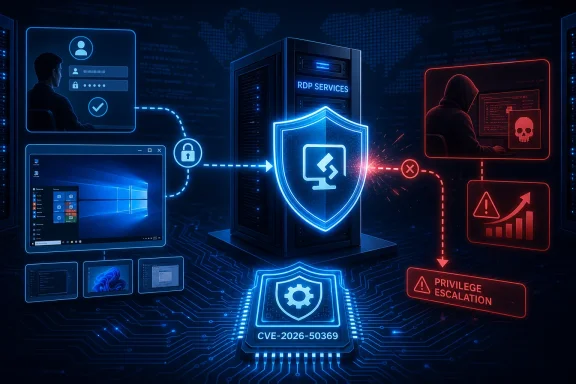 Authentication Is Required, but the Attack Stays on the Network
Microsoft describes CVE-2026-50369 as allowing an authorized attacker to elevate privileges over a network. Its CVSS vector is AV:N/AC:L/PR:L/UI:N/S:U/C:H/I:H/A:H: exploitation can occur remotely, requires low privileges, needs no separate user interaction and is expected to have a high impact across confidentiality, integrity and availability.This is not an unauthenticated, pre-login RDP worm scenario. An attacker first needs some level of legitimate access, which could come from a compromised account, stolen credentials, an existing foothold or access deliberately granted to a low-privilege user.
That requirement should not be mistaken for a strong mitigation. Credential theft is a standard entry point in ransomware and hands-on-keyboard intrusions, while Remote Desktop environments are explicitly designed to accept network sessions from authenticated users. A flaw that converts limited RDP access into greater control can shorten the distance between initial compromise and full system takeover.
The absence of user interaction matters as well. Once the attacker has the required privileges and network path, Microsoft’s scoring does not indicate that an administrator or victim must open a file, approve a prompt or perform another action to trigger exploitation.
Microsoft assigns an unchanged scope to the flaw, meaning the security authority directly affected by the vulnerable component does not change under CVSS rules. That technical distinction does little to soften the operational consequence: a successful privilege escalation on an RDP host could expose sensitive session data, permit system modification or disrupt the machine.
A Race Condition Creates the Memory-Safety Failure
The National Vulnerability Database records two weakness categories supplied by Microsoft: CWE-416, use after free, and CWE-362, improper synchronization of a shared resource. Together, they indicate that Remote Desktop Services can continue using memory after it has been released because concurrent operations are not synchronized correctly.A use-after-free defect occurs when software retains a reference to an object after the memory backing that object has been returned for reuse. If an attacker can influence timing and replacement data, the stale reference may point to attacker-controlled or otherwise unexpected content.
Race conditions can make exploitation less deterministic in practice because success depends on the order and timing of operations. Microsoft nevertheless rates the attack complexity as low, signaling that the vendor does not believe specialized circumstances outside the attacker’s control create a substantial barrier to reliable exploitation.
Public technical material remains limited. Microsoft has confirmed the vulnerability and supplied its weakness classifications, affected-version boundaries and CVSS assessment, but it has not published the precise Remote Desktop Services code path, packet sequence or object lifecycle needed to reproduce the flaw. That gives defenders enough information to prioritize patching without immediately handing out a detailed exploit recipe.
The report-confidence element supplied with Microsoft’s assessment is also important. A confirmed rating means the issue is not merely suspected from an unexplained crash or incomplete external report; the vendor has acknowledged the vulnerability and released an official correction. It does not mean exploit code is public or attacks are underway.
The Affected List Reaches From Windows 10 to Server 2025
The CVE record covers a broad collection of Windows releases rather than one isolated Remote Desktop deployment generation. Both full and Server Core installations appear where Microsoft maintains separate server product entries.Affected systems include:
- Windows 10 versions 1607, 1809, 21H2 and 22H2 are affected within the servicing channels listed by Microsoft.
- Windows 11 versions 24H2 and 25H2 require builds at or above 26100.8875 and 26200.8875, respectively.
- Windows 11 version 26H1 requires build 28000.2269 or later.
- Windows Server 2012 and 2012 R2 remain covered where Extended Security Updates or other applicable servicing arrangements are in place.
- Windows Server 2016, Windows Server 2019, Windows Server 2022 and Windows Server 2025 are affected.
- Server Core installations are explicitly included for Windows Server 2012, 2012 R2, 2016, 2019 and 2025.
Windows 10 21H2 and 22H2 are listed with corrected builds 19044.7548 and 19045.7548. Whether a particular Windows 10 installation is still entitled to receive those fixes depends on its edition and support channel, so administrators should not assume that an out-of-support consumer installation is protected merely because the version appears in the CVE record.
The breadth of the affected matrix suggests that the vulnerable Remote Desktop Services code is shared across multiple Windows generations. It also means mixed server estates cannot safely limit validation to the newest Windows Server 2025 hosts.
Patch the Systems That Turn Credentials Into Sessions
For enterprise IT, the highest-priority targets are systems where users or administrators can initiate Remote Desktop sessions: RD Session Host servers, administrative jump boxes, support workstations, VDI hosts and servers reachable through Remote Desktop gateways or VPN connections. Internet exposure increases risk, but internal-only hosts still matter because the attacker model already assumes valid low-level credentials.Administrators should deploy the July 2026 cumulative security updates, reboot where required and verify the installed OS build rather than relying only on a successful management-console status. Windows Update for Business, WSUS, Microsoft Configuration Manager and other patching platforms can report a deployment as offered or installed even while a pending restart leaves the active binaries unchanged.
Restricting TCP and UDP port 3389 at the perimeter remains good practice, but it is not a substitute for this update. Network Level Authentication, multifactor authentication, Remote Desktop Gateway policies and privileged-access controls can reduce the chance that an attacker obtains the required session, yet none corrects the underlying memory-management error once an authorized connection reaches a vulnerable service.
Security teams should also review unexpected RDP logons, newly created privileged accounts, service changes and unusual activity following remote sessions. Microsoft had not identified active exploitation at publication, so there is no vendor-provided incident signature specific to CVE-2026-50369; detection must initially lean on normal identity, endpoint and privilege-escalation telemetry.
CVE-2026-50369 is not the unauthenticated RDP catastrophe its network attack vector might first suggest. It is instead a potentially valuable post-authentication escalation path on exactly the machines organizations use to concentrate remote access. The practical deadline is therefore the next maintenance window for ordinary endpoints—and sooner for Remote Desktop hosts that accept sessions from users outside the tightly controlled administrator tier.
References
- Primary source: MSRC
Published: 2026-07-14T07:00:00-07:00
Security Update Guide - Microsoft Security Response Center
 msrc.microsoft.com
