

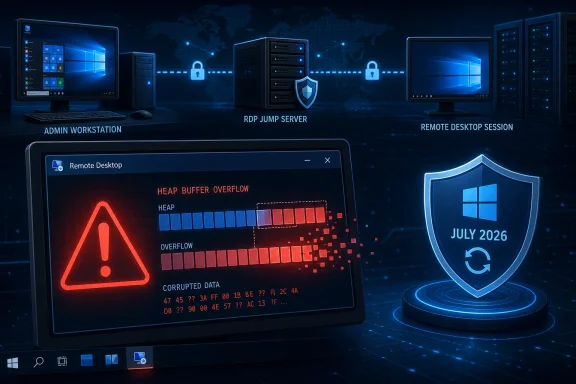
Detailed in Microsoft’s Security Update Guide, the vulnerability carries a CVSS 3.1 base score of 7.5 High and is classified as CWE-122, a heap-based buffer overflow. The National Vulnerability Database describes the attack as network-based, low-complexity, requiring neither privileges nor user interaction.
Microsoft has marked the report confidence as confirmed, meaning the company has verified the vulnerability rather than publishing a tentative assessment. That confidence metric does not mean exploitation has been observed; it indicates that credible technical evidence exists and that Microsoft accepts the flaw as real.
The Client Side of RDP Is the Exposed Component
The product name matters. CVE-2026-50330 affects the Remote Desktop Client, not simply systems configured to accept inbound Remote Desktop connections.
That distinction broadens the operational concern. Disabling Remote Desktop Services on a workstation, blocking inbound TCP port 3389, or confirming that Network Level Authentication is enabled on a server does not necessarily address a flaw in the client code used to establish outgoing sessions.
Microsoft’s description says an unauthorized attacker can exploit the condition “over a network.” Combined with the CVSS vector AV:N/AC:L/PR:N/UI:N, the published assessment indicates that exploitation does not require an existing account, elevated access, or a user clicking through a warning after the vulnerable interaction begins.
The public advisory does not yet provide a packet-level explanation, proof of concept, or detailed sequence showing how a malicious endpoint reaches the vulnerable heap operation. Administrators should therefore avoid assuming that ordinary RDP server hardening controls eliminate the risk. Until Microsoft or the reporting researcher publishes deeper technical analysis, the safe conclusion is that connecting from an unpatched client to an attacker-controlled or compromised RDP destination may expose the client-side component.
A heap overflow occurs when software writes more data into a heap allocation than the allocated region can hold. Depending on memory layout and platform defenses, the immediate outcome can range from a client crash to corruption that enables more consequential behavior.
There is an unusual wrinkle in Microsoft’s scoring. Although the advisory labels the issue an elevation-of-privilege vulnerability, its CVSS impact metrics specify high availability impact but no confidentiality or integrity impact: C:N/I:N/A:H. That combination describes a remotely triggerable, high-impact failure more clearly than a conventional privilege escalation that grants control over data or system settings. Microsoft has not yet published enough technical detail to reconcile that apparent mismatch, so defenders should follow the vendor’s classification without interpreting the score as proof of arbitrary code execution.
July’s Cumulative Updates Carry the Fix
CVE-2026-50330 is serviced through Windows cumulative updates rather than a standalone Remote Desktop package. For current Windows 11 deployments, July’s corrected build levels include:
- Windows 11 24H2 reaches OS build 26100.8875 through KB5101650.
- Windows 11 25H2 reaches OS build 26200.8875 through KB5101650.
- Windows 11 26H1 receives KB5101649 and reaches OS build 28000.2525.
- Windows 10 21H2 reaches OS build 19044.7548 through KB5099539.
- Windows 10 22H2 reaches OS build 19045.7548 through KB5099539.
The affected range is considerably wider than currently marketed desktop releases. Microsoft’s structured CVE data identifies Windows 10 Version 1607 and Version 1809, Windows Server 2012 and Server Core, and later Windows Server generations alongside Windows 11. That makes the vulnerability relevant to long-term servicing installations and legacy servers that remain eligible for security updates through specialized support channels.
Windows 10 deserves particular attention because ordinary support for Version 22H2 ended on October 14, 2025. Devices receiving Windows 10 Extended Security Updates can obtain the July 2026 fixes, but unmanaged machines that remained on Windows 10 without ESU coverage cannot be assumed to have received CVE-2026-50330 remediation.
Administrators should verify the installed OS build rather than relying solely on a Windows Update success message. A compliance check can query Win32_OperatingSystem, Get-ComputerInfo, endpoint-management inventory, or the CurrentBuild and UBR registry values to confirm that each machine has crossed the corrected servicing boundary.
Windows 11 26H1 presents an early-data inconsistency worth noting. The initial structured CVE record identifies builds earlier than 28000.2269 as affected, but 28000.2269 was the June 2026 security build, while Microsoft’s July package KB5101649 advances 26H1 to 28000.2525. Because CVE-2026-50330 was released on July 14, administrators should deploy the July cumulative update rather than treating the older boundary as evidence that June’s package is sufficient.
RDP Jump Boxes Belong Near the Front of the Queue
CVE-2026-50330 is not one of the actively exploited or publicly disclosed zero-days highlighted in reporting on Microsoft’s July 2026 Patch Tuesday release. BleepingComputer’s Patch Tuesday coverage identified separate AD FS, SharePoint Server, and BitLocker issues as the month’s zero-day cases.
That lowers the immediate threat signal, but it does not make the Remote Desktop flaw a routine workstation issue. CISA’s SSVC data records no known exploitation while classifying the vulnerability as automatable with total technical impact. NVD was still awaiting its own enrichment as of July 15, leaving Microsoft’s assessment as the primary technical account.
The combination of network reachability, low attack complexity, no authentication requirement, and no user interaction justifies accelerated testing. Machines used by help desks and infrastructure teams often initiate RDP sessions across less-trusted network segments and hold credentials or management access that ordinary endpoints do not.
Patch priority should therefore reflect how the client is used:
- Privileged access workstations and jump servers that initiate RDP sessions should receive the update first.
- Remote administration hosts used to manage customer, branch-office, or third-party systems should follow closely.
- Shared support desktops and virtual desktop infrastructure containing RDP tooling should be included even when they do not accept inbound RDP.
- Legacy Windows Server and Windows 10 LTSC systems should be checked for applicable servicing coverage and corrected build numbers.
- Standard user endpoints should remain in the normal expedited security-update deployment unless application testing identifies a blocker.
Network controls still reduce exposure while patches move through testing. Administrators can limit outbound RDP to approved destinations, require staff to use managed jump hosts, segment administration networks, and investigate unexpected connections to external TCP 3389 endpoints. These controls are compensating measures, not replacements for updating the client component.
“Confirmed” Describes Evidence, Not Active Attacks
The report-confidence text supplied with the advisory is easy to misread as an exploitation warning. In CVSS 3.1, confirmed means detailed reports, reproducible results, source evidence, or direct vendor acknowledgement support the vulnerability’s existence.
It says nothing by itself about whether exploit code is public or attacks are occurring. A confirmed vulnerability may remain difficult for outsiders to reproduce when the vendor publishes only a short description, as Microsoft has done here.
The designation nevertheless matters because it removes uncertainty about whether the vulnerable condition is merely suspected. Microsoft has issued an official fix, assigned a specific memory-safety weakness, and published affected build boundaries. Attackers now have a starting point for comparing patched and unpatched Remote Desktop binaries, making prolonged patch delays progressively harder to justify.
For enterprise teams, the immediate milestone is not simply approving July’s cumulative update but proving that RDP-capable management endpoints have installed it. Windows 11 24H2 and 25H2 systems should report build 26100.8875 or 26200.8875, respectively, while Windows 11 26H1 should be on July’s 28000.2525 build. Anything below the applicable corrected level should remain in the remediation queue, particularly if it is trusted to administer other Windows machines.
References
- CVE-2026-50330 Windows Remote Desktop Client Elevation of Privilege Vulnerability MSRC · 2026-07-14T07:00:00-07:00