

CVE-2026-63879 is a newly published Linux kernel vulnerability in the AMDGPU graphics driver that deserves attention well beyond the usual Linux security mailing-list audience. The flaw, rated 7.8 High by the Linux kernel CNA, affects how AMDGPU’s Heterogeneous Memory Management code obtains pages for GPU work that uses process memory. The defect is a race condition: if the driver reads an MMU notifier sequence more than once while assembling a large memory range, it can mistakenly treat pages as safe after the operating system has already invalidated them. The fix is compact, but the consequences of getting this synchronization wrong include potential confidentiality, integrity, and availability impact for a local authenticated user on affected systems.
AMDGPU is the in-kernel Linux driver family used by modern AMD Radeon GPUs and AMD Instinct-class accelerators. It supports graphics, display, media, compute, virtualization-adjacent workflows, and, through its interaction with the AMD Kernel Fusion Driver component, portions of the ROCm compute stack. That breadth is why a bug in a seemingly specialized function can matter to desktop Linux users, workstation administrators, AI developers, and organizations operating GPU-enabled servers.
That efficiency creates a demanding coordination problem. The CPU’s memory manager owns the authoritative page tables, but the GPU driver may need to create a compatible view of the same address range. If an application frees, remaps, migrates, writes to, or otherwise changes memory while the GPU driver is preparing to access it, the driver must detect that change reliably. A stale mapping is not merely a performance issue; it can become a route to reading or modifying pages that no longer correspond to the intended allocation.
HMM does not mean that every AMD Radeon user is constantly exposed to this bug. The affected path is associated with memory-management operations that involve the driver’s HMM range handling and user-space memory. However, the design is important in environments where GPU compute, user-pointer buffers, shared virtual memory, and memory faulting are in active use.
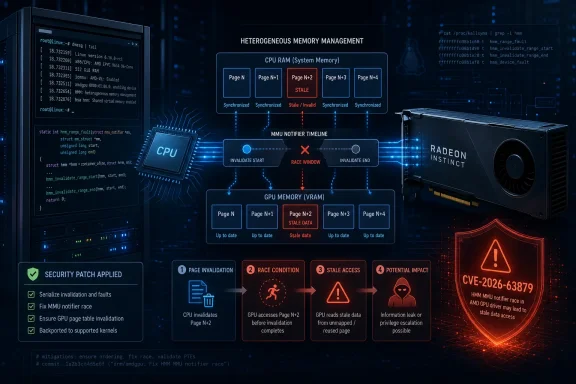
The vulnerable behavior arose because the sequence was read repeatedly during a range operation. In a multi-chunk request, the driver could begin with one sequence value, encounter an invalidation, and later acquire a new sequence value. That later value could make a final validation appear successful even though earlier pages in the same logical range had been obtained before the address-space change.
The error was not that the driver used a notifier sequence. It was that it could refresh the sequence during the processing of the same overall request. The later sequence did not prove that pages gathered before the refresh were still valid. It only described the state after the refresh.
This preserves the intended contract: either the entire range has survived without a conflicting invalidation, or the driver detects that it must not use the pages and must retry or abandon the operation. In other words, the fix restores a consistent snapshot boundary across all chunks.
Kernel security frequently benefits from code that is easier to reason about. In low-level memory-management code, a small simplification can make it clearer which values are immutable for an operation, which values are reset, and which ones must remain stable across retry paths.
A problematic sequence might look like this:
Depending on the exact workload, device capability, timing, and downstream use of the pages, stale references can support data disclosure, data corruption, process crashes, GPU resets, or a broader kernel compromise. The CVSS vector reflects that possibility by assigning high impacts for confidentiality, integrity, and availability, even though exploitation is local and requires low privileges.
Nevertheless, kernel memory races should be treated seriously. A local attacker does not need to persuade a victim to open a document or click a link if they already have an account, shell access, a sandbox escape foothold, or the ability to run workloads on a multi-user GPU system. That is why local privilege boundaries remain meaningful in enterprise threat models.
A kernel labeled with an older base number may already be protected if its distributor has incorporated the relevant change. Conversely, a self-built kernel, a custom embedded image, a third-party appliance, or a vendor fork may remain exposed even if it resembles a nominally supported version family.
For organizations with source-built kernels, the code-level check is similarly clear. The fixed design obtains the HMM notifier sequence once per requested range, before range chunking begins, and uses that original sequence in validity checking. Teams that cherry-pick fixes should ensure they preserve this semantic behavior rather than copying surrounding style changes alone.
For administrators, this means commit hashes are useful verification artifacts but poor user-facing patch labels. Package updates, vendor advisories, and kernel build metadata are generally a more dependable way to manage deployment at scale.
A shared research server with multiple users, a CI worker that runs untrusted code, or a hosted development environment has a more obvious local-attacker model than a single-user gaming PC. In those settings, a low-privilege account with access to GPU APIs may be exactly the starting point an attacker needs.
CVE-2026-63879 is a reminder that performance features are security-sensitive infrastructure. Hardware acceleration does not bypass operating-system memory rules; it magnifies the importance of faithfully applying them across devices.
Whenever a logical operation spans multiple chunks, developers must decide whether each chunk can independently observe current state or whether all chunks need one consistent starting generation. Here, security and correctness require the second model. The driver cannot safely “advance its baseline” halfway through gathering the pages for one range.
The safer approach is routine kernel hygiene: install your distribution’s security update, reboot into the patched kernel, and avoid treating graphics drivers as separate from the operating system’s attack surface.
That distinction matters. Updating AMD Adrenalin Edition drivers on Windows does not patch a Linux kernel installation. Likewise, booting a patched Linux distribution does not change the Windows driver. Organizations running mixed-OS fleets need separate patch-validation processes for each platform.
The practical lesson is simple: do not label all “Linux on a Windows PC” deployments vulnerable without checking the actual kernel and driver model. Native Linux, a virtual machine with GPU passthrough, WSL, and a remote Linux GPU server are materially different environments.
Even if workloads are separated by Unix accounts or job schedulers, the kernel remains the ultimate isolation boundary. A GPU-enabled account should not be able to turn flawed memory synchronization into access to pages outside its intended scope.
This does not mean every container deployment is immediately exploitable. It means that “the workload is containerized” is not an adequate closure statement for a kernel CVE. Security teams should inventory GPU device exposure, identify which nodes have AMD hardware and accessible compute stacks, and update the host operating system.
For virtual desktop infrastructure, remote rendering, and GPU-backed developer desktops, administrators should verify both the hypervisor host and any Linux guests that use the affected driver. The correct patch target depends on where the vulnerable code is running.
These measures are compensating controls, not fixes. They can also have significant operational cost. A research cluster that disables accelerator access may interrupt high-value work, while an enterprise endpoint policy that broadly removes graphics permissions could cause unnecessary disruption.
A mature program treats accelerator drivers as part of the kernel attack surface, tracks them in vulnerability management, and includes GPU-specific use cases in incident response planning.
The next most common mistake will be confusing the installed package with the booted kernel. A package manager can report that an update is present while the system continues to run an older, exposed kernel until the next reboot.
This is especially important for enterprise Linux systems, which may use a stable kernel base number for years while integrating selected fixes from much newer upstream branches. A vulnerability scanner that only compares upstream release numbers can produce false positives or false negatives unless it understands the vendor package stream.
Security teams should monitor trusted vendor advisories and incident channels for signs that exploitation techniques are becoming practical. If a credible proof-of-concept emerges, shared GPU infrastructure should move from normal patch priority to expedited remediation.
That audit extends beyond AMD hardware. Any accelerator driver that mirrors CPU page tables, faults user pages, or maintains device mappings based on MMU notifier events faces similar classes of synchronization risk. The details differ, but the principle is universal: a consistent operation needs a consistent validity token.
For Linux users with AMD graphics, the appropriate response is disciplined rather than alarmist: obtain the distribution kernel update, reboot into it, and confirm that the active build includes the backport. For enterprises running shared AMD GPU infrastructure, the issue should prompt a broader review of who can access accelerator devices, where host kernels are exposed to untrusted workloads, and whether kernel patch compliance accounts for GPU-enabled nodes. As heterogeneous computing continues to make CPU and GPU memory more tightly coupled, the quality of these low-level synchronization rules will increasingly determine both performance and platform security.
 Background
AMDGPU is the in-kernel Linux driver family used by modern AMD Radeon GPUs and AMD Instinct-class accelerators. It supports graphics, display, media, compute, virtualization-adjacent workflows, and, through its interaction with the AMD Kernel Fusion Driver component, portions of the ROCm compute stack. That breadth is why a bug in a seemingly specialized function can matter to desktop Linux users, workstation administrators, AI developers, and organizations operating GPU-enabled servers.Why GPU memory management has become a security boundary
Older graphics workloads often followed a simpler model: an application allocated buffers, the driver mapped them for the GPU, and the GPU processed them. Modern GPUs increasingly share virtual-memory concepts with the CPU. Applications can use user-space pointers, unified or shared memory, demand paging, and fault-driven memory access patterns that let large data sets move between system RAM and device memory with less explicit copying.That efficiency creates a demanding coordination problem. The CPU’s memory manager owns the authoritative page tables, but the GPU driver may need to create a compatible view of the same address range. If an application frees, remaps, migrates, writes to, or otherwise changes memory while the GPU driver is preparing to access it, the driver must detect that change reliably. A stale mapping is not merely a performance issue; it can become a route to reading or modifying pages that no longer correspond to the intended allocation.
The role of Heterogeneous Memory Management
Linux Heterogeneous Memory Management, usually abbreviated as HMM, provides infrastructure for devices that need to mirror or participate in a process’s address space. It is especially relevant to accelerators that can work with ordinary application memory rather than only driver-managed GPU buffers.HMM does not mean that every AMD Radeon user is constantly exposed to this bug. The affected path is associated with memory-management operations that involve the driver’s HMM range handling and user-space memory. However, the design is important in environments where GPU compute, user-pointer buffers, shared virtual memory, and memory faulting are in active use.
A vulnerability with a familiar kernel pattern
The central problem in CVE-2026-63879 is a classic time-of-check versus time-of-use race, expressed through Linux’s memory-management notifier model. The driver needs to validate that a range of pages has not changed while it faults in or collects the pages needed for GPU access. It uses a notifier sequence number as a generation-like marker for that validation.The vulnerable behavior arose because the sequence was read repeatedly during a range operation. In a multi-chunk request, the driver could begin with one sequence value, encounter an invalidation, and later acquire a new sequence value. That later value could make a final validation appear successful even though earlier pages in the same logical range had been obtained before the address-space change.
What CVE-2026-63879 Fixes
The vulnerability is described as a fix foramdgpu_hmm_range_get_pages, an AMDGPU function responsible for gathering page-frame information for a requested HMM range. The reported corrective principle is straightforward: the notifier sequence must be read only once for the range, rather than re-read as the range is processed.The vulnerable condition
Large memory operations are often broken into smaller chunks. In this case, the code limits the size of a chunk to 2 GiB, preventing impractically large single range-fault operations. Chunking is normal and sensible, but it requires a consistent transactional view of the entire logical request.The error was not that the driver used a notifier sequence. It was that it could refresh the sequence during the processing of the same overall request. The later sequence did not prove that pages gathered before the refresh were still valid. It only described the state after the refresh.
The corrected behavior
The repaired implementation obtains the notifier sequence once, before it begins walking the range. It then retains that sequence while faulting and collecting all chunks. When code later checks whether the range remains valid, it compares the notifier’s state against the original sequence associated with the range acquisition.This preserves the intended contract: either the entire range has survived without a conflicting invalidation, or the driver detects that it must not use the pages and must retry or abandon the operation. In other words, the fix restores a consistent snapshot boundary across all chunks.
Why the coding-style changes matter less—but still help
The upstream description also mentions cleanup work: removing a pre-initialized return value and using Linux’s common 2 GiB size definition. Those are not the security fix, and administrators should not mistake style-only changes for protection. Still, standardizing constants and simplifying control flow makes future review easier.Kernel security frequently benefits from code that is easier to reason about. In low-level memory-management code, a small simplification can make it clearer which values are immutable for an operation, which values are reset, and which ones must remain stable across retry paths.
Understanding the Notifier-Sequence Race
To understand the severity assessment, it helps to translate the internal mechanism into a concrete sequence of events. The CPU and GPU do not independently decide what a user-space virtual address means. The CPU memory manager can change that meaning at any time in response to normal activity, including unmapping memory, replacing mappings, copy-on-write behavior, page migration, or process teardown.A simplified failure scenario
Consider an application that asks the GPU to operate on a large virtual-memory region. The AMDGPU driver begins to gather pages for that region, processing it in chunks. A sequence number identifies the state of the relevant memory mapping when the operation starts.A problematic sequence might look like this:
- The driver begins gathering the first portion of a memory range using notifier sequence A.
- The application or another thread changes a mapping in the range, causing an MMU invalidation.
- The driver continues processing and reads a new notifier sequence, B, while collecting a later chunk.
- A final validation compares the notifier state with B, finds no later change, and reports the overall range as valid.
- The GPU or driver then operates using page information from before and after the invalidation boundary.
Why stale pages are dangerous
The phrase “invalid pages” can sound like an ordinary crash bug, but invalidity in memory-management code has several meanings. The page may have been unmapped, reassigned to another allocation, replaced, migrated, or had access permissions changed. The driver’s page-frame array may therefore no longer accurately describe the process memory the GPU was supposed to access.Depending on the exact workload, device capability, timing, and downstream use of the pages, stale references can support data disclosure, data corruption, process crashes, GPU resets, or a broader kernel compromise. The CVSS vector reflects that possibility by assigning high impacts for confidentiality, integrity, and availability, even though exploitation is local and requires low privileges.
A race condition is not a guaranteed exploit
It is important to separate a vulnerability’s capability from a claim of universal exploitability. Race conditions depend on timing and may be hard to trigger reliably. Specific hardware behavior, kernel configuration, driver execution paths, and the availability of relevant GPU compute interfaces can all affect practical exploit development.Nevertheless, kernel memory races should be treated seriously. A local attacker does not need to persuade a victim to open a document or click a link if they already have an account, shell access, a sandbox escape foothold, or the ability to run workloads on a multi-user GPU system. That is why local privilege boundaries remain meaningful in enterprise threat models.
Affected Versions and Patch Status
The CVE record identifies Linux kernel releases beginning with Linux 6.2 as affected, with versions earlier than 6.2 listed as unaffected for this specific defect. The record further indicates that stable kernel 7.0.12 contains the remediation and that Linux 7.1 incorporates the original upstream fix.Do not rely on version labels alone
The version statement needs careful interpretation. Linux distributions do not necessarily ship an unmodified upstream kernel whose version string directly maps to the upstream stable line. Ubuntu, Red Hat Enterprise Linux, SUSE, Debian, Fedora, Arch Linux, appliance vendors, and cloud-image maintainers can backport security fixes into older-looking kernel versions.A kernel labeled with an older base number may already be protected if its distributor has incorporated the relevant change. Conversely, a self-built kernel, a custom embedded image, a third-party appliance, or a vendor fork may remain exposed even if it resembles a nominally supported version family.
The practical patch question
The most useful operational question is not simply, “Am I running kernel 7.0.12?” It is: Does the installed kernel package include the CVE-2026-63879 remediation or its equivalent backport? Distribution security advisories and package changelogs are the proper place to confirm that answer.For organizations with source-built kernels, the code-level check is similarly clear. The fixed design obtains the HMM notifier sequence once per requested range, before range chunking begins, and uses that original sequence in validity checking. Teams that cherry-pick fixes should ensure they preserve this semantic behavior rather than copying surrounding style changes alone.
Why two stable references can exist
The public CVE entry lists more than one stable-kernel reference. That is normal for Linux vulnerability tracking. A single upstream correction may be backported to multiple maintained branches, with each branch receiving a different commit identifier because the surrounding code differs.For administrators, this means commit hashes are useful verification artifacts but poor user-facing patch labels. Package updates, vendor advisories, and kernel build metadata are generally a more dependable way to manage deployment at scale.
Why This Matters for AMD GPU Compute
Gaming and desktop rendering dominate public discussion of Radeon drivers, but the HMM path is particularly significant for compute-oriented usage. Modern GPU workloads increasingly depend on memory that is dynamically allocated, shared, migrated, or faulted in response to demand rather than copied through strictly manual buffer-management steps.ROCm and accelerator-oriented environments
ROCm-based development, scientific applications, AI training or inference jobs, and GPU-accelerated data analytics can place heavier demands on user-space memory interaction than ordinary desktop compositing. AMD’s compute ecosystem includes both consumer-adjacent Radeon hardware and specialized accelerator deployments, so the same kernel driver family can appear across very different risk environments.A shared research server with multiple users, a CI worker that runs untrusted code, or a hosted development environment has a more obvious local-attacker model than a single-user gaming PC. In those settings, a low-privilege account with access to GPU APIs may be exactly the starting point an attacker needs.
Shared virtual-memory design tradeoffs
Unified and shared memory improve developer productivity. They allow code to treat CPU memory and accelerator memory more flexibly, reduce manual copying, and support data sets that do not fit cleanly in one memory pool. But these features also create more cross-subsystem state that must be synchronized correctly.CVE-2026-63879 is a reminder that performance features are security-sensitive infrastructure. Hardware acceleration does not bypass operating-system memory rules; it magnifies the importance of faithfully applying them across devices.
Large ranges make consistency harder
The 2 GiB chunk handling in the function is a clue to the scale of the workloads involved. It does not mean a user must allocate exactly 2 GiB to be affected. Rather, it shows that the driver was designed to process very large ranges safely in portions.Whenever a logical operation spans multiple chunks, developers must decide whether each chunk can independently observe current state or whether all chunks need one consistent starting generation. Here, security and correctness require the second model. The driver cannot safely “advance its baseline” halfway through gathering the pages for one range.
Consumer Linux Impact
For a typical single-user Linux desktop with an AMD GPU, CVE-2026-63879 should be patched promptly but not treated as evidence of an immediate remote compromise. The published vector describes local attack complexity as low, requires low privileges, and does not require user interaction. That places it in the category of flaws that can matter after an attacker has obtained code execution as a normal user.Gaming systems and creative workstations
Most gaming workloads do not deliberately exercise the full spectrum of HMM-driven compute and user-pointer memory behavior. That may reduce exposure in practice, but it is not a reason to dismiss the update. Games, browsers, media software, creative applications, game launchers, compatibility layers, and locally installed plugins can all increase the amount of untrusted or semi-trusted code on a machine.The safer approach is routine kernel hygiene: install your distribution’s security update, reboot into the patched kernel, and avoid treating graphics drivers as separate from the operating system’s attack surface.
Linux on Windows-facing hardware
WindowsForum readers may encounter this issue through dual-boot machines, Windows Subsystem for Linux experimentation, developer workstations, handheld gaming devices, or Linux-based systems that share the same AMD hardware fleet as Windows endpoints. The flaw is in the Linux kernel’s AMDGPU code, not in the Windows display driver stack.That distinction matters. Updating AMD Adrenalin Edition drivers on Windows does not patch a Linux kernel installation. Likewise, booting a patched Linux distribution does not change the Windows driver. Organizations running mixed-OS fleets need separate patch-validation processes for each platform.
The Windows Subsystem for Linux caveat
WSL’s graphics architecture is not the same as a native Linux installation driving AMD hardware through the standard bare-metal AMDGPU stack. The presence of a Linux userland inside Windows should not automatically be equated with exposure to this CVE. Whether a particular WSL configuration uses the affected kernel-driver path depends on the platform implementation and GPU virtualization arrangement.The practical lesson is simple: do not label all “Linux on a Windows PC” deployments vulnerable without checking the actual kernel and driver model. Native Linux, a virtual machine with GPU passthrough, WSL, and a remote Linux GPU server are materially different environments.
Enterprise and Cloud Exposure
The enterprise consequences are more significant where GPU access is shared. A local vulnerability becomes a multi-tenant concern when multiple users, containers, scheduled jobs, or development teams can run workloads on the same host or on hosts with shared operational control.Multi-user GPU servers
A machine that gives multiple users access to AMD GPUs for ROCm development, rendering, research, or machine learning should be prioritized for patching. The CVSS score of 7.8 reflects an attacker who already has low-level local access, which is common on shared compute systems by design.Even if workloads are separated by Unix accounts or job schedulers, the kernel remains the ultimate isolation boundary. A GPU-enabled account should not be able to turn flawed memory synchronization into access to pages outside its intended scope.
Containers are not a complete answer
Containers are useful for software packaging and process separation, but they share the host kernel. If a containerized workload is allowed access to GPU devices and the relevant host driver interfaces, a host-kernel vulnerability may remain relevant. Device-node permissions, cgroup controls, runtime integration, and orchestration policy all matter, but none substitute for an updated host kernel.This does not mean every container deployment is immediately exploitable. It means that “the workload is containerized” is not an adequate closure statement for a kernel CVE. Security teams should inventory GPU device exposure, identify which nodes have AMD hardware and accessible compute stacks, and update the host operating system.
Virtualization and passthrough
GPU passthrough introduces another boundary that needs explicit review. Assigning a GPU directly to a virtual machine can reduce host-side sharing, but the guest kernel and its AMDGPU stack are still responsible for safely managing guest workloads. A vulnerable guest can remain a risk to the guest environment even if the host itself is patched.For virtual desktop infrastructure, remote rendering, and GPU-backed developer desktops, administrators should verify both the hypervisor host and any Linux guests that use the affected driver. The correct patch target depends on where the vulnerable code is running.
Recommended Mitigation and Verification
The primary mitigation is to install a kernel release that your distribution confirms includes the fix for CVE-2026-63879. Disabling GPU compute features may reduce exposure in tightly controlled situations, but it is not the preferred long-term remedy and can break legitimate workloads.A practical response sequence
Administrators can use the following order of operations:- Inventory affected systems by identifying Linux hosts with AMD GPUs, AMDGPU loaded, ROCm or comparable compute stacks installed, or GPU passthrough configurations.
- Determine the installed kernel package and build rather than relying only on the upstream version string displayed by
uname -r. - Review the distribution’s security advisory or package changelog for confirmation that CVE-2026-63879 has been addressed.
- Deploy the patched kernel through normal change control, prioritizing shared GPU hosts, developer infrastructure, research systems, CI runners, and container hosts.
- Reboot or otherwise transition workloads to the new kernel, because installing a kernel package alone does not replace the running kernel.
- Verify the active kernel after reboot and retain evidence of package version, booted version, and node compliance.
- Monitor GPU workloads for regressions, particularly compute jobs that use shared virtual memory, unified memory, or heavy fault-driven allocation patterns.
Temporary exposure reduction
Where immediate patching is impossible, reduce access to affected GPU compute interfaces. This may involve restricting membership in groups that can access render or compute device nodes, temporarily draining shared GPU nodes, suspending untrusted multi-user jobs, or avoiding GPU passthrough to tenants.These measures are compensating controls, not fixes. They can also have significant operational cost. A research cluster that disables accelerator access may interrupt high-value work, while an enterprise endpoint policy that broadly removes graphics permissions could cause unnecessary disruption.
Do not test this by attempting exploitation
Administrators should avoid trying to reproduce a race condition on production systems using aggressive page-remapping or GPU fault workloads. Such tests can destabilize a node, corrupt application state, trigger GPU resets, or produce misleading results. Patch verification should focus on trusted build metadata and vendor advisories, with regression testing performed in controlled environments.Strengths and Opportunities
The handling of CVE-2026-63879 also illustrates several positive aspects of the Linux kernel security process.- The defect has a narrowly defined technical root cause. The remediation is centered on preserving one notifier sequence across a logical page-acquisition operation, which makes review and backport assessment more tractable.
- The affected subsystem has explicit synchronization semantics. HMM and MMU interval notifier documentation describe the need to validate address-space stability, giving maintainers a clear conceptual model for auditing similar paths.
- The disclosure includes actionable version guidance. The record identifies Linux 6.2 as the beginning of the affected range and identifies corrected upstream stable and development versions.
- The score appropriately emphasizes local hardening. A 7.8 High rating helps ensure that organizations do not ignore the bug simply because it is not remotely reachable over a network socket.
- The fix offers an audit signal for related code. Developers can review other drivers and subsystems for any operation that refreshes a generation or sequence marker midway through a larger transaction.
An opportunity for stronger GPU fleet governance
GPU servers are often managed as performance assets first and security-sensitive multi-user infrastructure second. This CVE is a useful prompt to improve that balance. Security teams should know which nodes expose GPUs, which workloads access device nodes, which containers receive GPU capabilities, and which kernels actually run on those systems.A mature program treats accelerator drivers as part of the kernel attack surface, tracks them in vulnerability management, and includes GPU-specific use cases in incident response planning.
Risks and Concerns
Despite the clear patch, several factors can complicate risk assessment and remediation.- The vulnerability is timing-dependent. That may lead some teams to under-prioritize it, even though a local attacker can repeatedly attempt a race and exploit reliability can improve over time.
- Distribution backports can create confusion. Upstream version numbers alone do not reliably establish exposure or protection on enterprise distributions and appliance kernels.
- GPU environments are diverse. Native desktops, bare-metal compute hosts, virtual machines, containers, passthrough deployments, and Windows-adjacent Linux configurations do not share the same attack path.
- The CVSS score is important but incomplete. A 7.8 rating communicates serious potential impact, but it cannot capture whether a particular system exposes the necessary interfaces to untrusted users.
- Kernel updates require a running-kernel transition. Reboot windows, long-lived compute jobs, and clustered scheduling constraints can delay the moment when systems are truly protected.
The risk of false reassurance
The most common mistake will be assuming that an AMD GPU automatically means either “definitely vulnerable” or “definitely irrelevant.” Neither conclusion is technically sound. The vulnerable code is in a specific HMM page-range path, but a broad range of modern compute usage can make that path meaningful.The next most common mistake will be confusing the installed package with the booted kernel. A package manager can report that an update is present while the system continues to run an older, exposed kernel until the next reboot.
What to Watch Next
CVE records often evolve after publication. As of July 21, 2026, the National Vulnerability Database entry identifies the kernel.org CNA’s CVSS 3.1 rating of 7.8 High, while NVD enrichment has not yet published its own CVSS assessment. That may change as analysts add metadata, platform information, or further references.Distribution advisories and backports
The most important near-term developments will be distribution-specific security notices. Administrators should watch for advisories that map the vulnerability to supported package streams, especially where a vendor carries a long-term kernel with a heavily backported patch set.This is especially important for enterprise Linux systems, which may use a stable kernel base number for years while integrating selected fixes from much newer upstream branches. A vulnerability scanner that only compares upstream release numbers can produce false positives or false negatives unless it understands the vendor package stream.
Proof-of-concept and exploit research
No administrator should assume that the absence of a public proof-of-concept means the issue is harmless. The vulnerability description is technically informative enough to guide researchers toward the relevant synchronization pattern. Conversely, reports claiming immediate universal exploitation should be evaluated skeptically unless they demonstrate the precise affected path and conditions.Security teams should monitor trusted vendor advisories and incident channels for signs that exploitation techniques are becoming practical. If a credible proof-of-concept emerges, shared GPU infrastructure should move from normal patch priority to expedited remediation.
Audits of adjacent memory paths
The sequence-handling correction may spur scrutiny of neighboring AMDGPU, HMM, and device-memory code. The broader engineering question is whether any other operations treat a multi-stage memory acquisition as though each stage can independently reset the validity baseline.That audit extends beyond AMD hardware. Any accelerator driver that mirrors CPU page tables, faults user pages, or maintains device mappings based on MMU notifier events faces similar classes of synchronization risk. The details differ, but the principle is universal: a consistent operation needs a consistent validity token.
Looking Ahead
CVE-2026-63879 is a concise example of why GPU drivers must be considered first-class security components of a modern operating system. The immediate code change is small—read the notifier sequence once—but it protects a fundamental invariant: pages gathered for one logical GPU operation must be validated against the same memory-map state from beginning to end.For Linux users with AMD graphics, the appropriate response is disciplined rather than alarmist: obtain the distribution kernel update, reboot into it, and confirm that the active build includes the backport. For enterprises running shared AMD GPU infrastructure, the issue should prompt a broader review of who can access accelerator devices, where host kernels are exposed to untrusted workloads, and whether kernel patch compliance accounts for GPU-enabled nodes. As heterogeneous computing continues to make CPU and GPU memory more tightly coupled, the quality of these low-level synchronization rules will increasingly determine both performance and platform security.
References
- Primary source: NVD / Linux Kernel
Published: 2026-07-21T01:03:54-07:00
NVD - CVE-2026-63879
 nvd.nist.gov
- Security advisory: MSRC
Published: 2026-07-21T01:03:54-07:00
Original feed URL
Security Update Guide - Microsoft Security Response Center
 msrc.microsoft.com
