

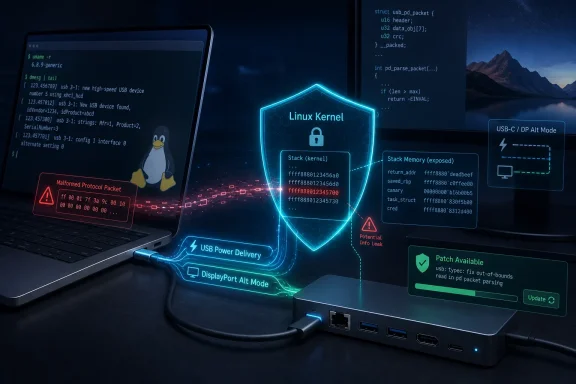
CVE-2026-63961 is a newly published Linux kernel vulnerability that turns an apparently narrow USB Type-C DisplayPort Alt Mode parsing mistake into a meaningful kernel information-disclosure concern. The flaw, resolved upstream and already propagated into multiple stable kernel series, allows a broken or malicious USB-C device to report an incorrect payload count for a DisplayPort Status Update Vendor Defined Object, or VDO. Without adequate validation, the kernel could read uninitialized stack data and pass that data onward through its Type-C and display handling path. For Windows users, this is primarily a Linux, WSL, dual-boot, and enterprise fleet-management story rather than a Windows kernel vulnerability—but it is also a timely reminder that the USB-C dock, monitor, cable, and adapter ecosystem has become part of the attack surface around modern PCs.
CVE-2026-63961 affects the Linux kernel’s USB Type-C subsystem, specifically the DisplayPort Alternate Mode driver in
The public description is direct: a malformed or deliberately malicious device can send an incorrect count for a status-update VDO, causing the kernel to read uninitialized stack data and send it elsewhere. The upstream correction is correspondingly focused: validate the message count before reading the update object.
At first glance, this can sound like an obscure edge case relevant only to Linux laptops attached to exotic USB-C displays. In practice, the affected code sits at the intersection of several ubiquitous technologies:
That distinction matters. A parser that reads even one element beyond the valid received payload can expose memory that was never initialized for that request. The bytes involved may be small and their usefulness to an attacker uncertain, but kernel stack disclosures should never be dismissed as harmless. They can reveal state that was not intended to leave privileged memory and, in some attack chains, can weaken defenses that depend on address or state secrecy.
Linux’s Type-C subsystem manages much of this conversation. Its role includes exposing connectors and alternate modes to the operating system, coordinating with Type-C port controllers, and helping Linux decide whether a cable connection should remain ordinary USB, enter an alternate mode, or reconfigure available lanes for a display signal.
DisplayPort Alt Mode is particularly important because it permits DisplayPort video traffic to travel over selected high-speed lanes in a USB-C cable. Depending on the configuration, a device might allocate more lanes to video for higher resolutions and refresh rates, or preserve some lanes for USB SuperSpeed data. The negotiation process includes messages that describe capabilities, connection state, pin assignments, and desired configuration.
That heterogeneity creates a practical reason for strict input validation. A kernel driver cannot safely assume that a device’s count field matches the actual number of received VDOs merely because the device presents itself as a display-capable USB-C partner.
The Status Update object conveys state relevant to the DisplayPort Alt Mode connection. It can indicate conditions such as whether a display is connected, whether a particular configuration is supported, and whether the partner requests attention or a configuration change. Linux needs to interpret this information so that it can make correct decisions about entering, exiting, or adjusting the active display mode.
The problem is not the existence of the VDO itself. The problem is the relationship between the message’s declared count and the driver’s later attempt to access the VDO payload.
In the vulnerable path, an incorrect count could leave the relevant status object unavailable while the code still attempted to read it. Instead of retrieving valid message data, the kernel could end up reading whatever happened to reside in an uninitialized area of stack memory associated with the processing routine.
That is why the remediation is narrow but important. The fixed code validates that the Status Update message contains the expected payload count before it reads the VDO. If the count does not match the expected structure, the message is rejected rather than interpreted.
The danger arises when stale bytes cross a trust boundary. If the driver reads unintended memory and propagates it into another subsystem, notification, state structure, log, or device-facing response, the kernel has disclosed information it should not have processed.
The severity of such a disclosure depends on details that are not yet fully characterized publicly:
Stable maintainers have backported the correction broadly. The public affected-version data identifies fixed stable releases in the following lines:
For that reason, the correct question is not merely, “Is this kernel newer than 6.x?” It is:
Then compare that value against the distribution’s published security information. On Debian-family systems, package history can often be inspected through the package manager. On RPM-based systems, installed kernel package metadata and vendor advisories are more informative than comparing only the upstream version number.
A reboot is required after installing a new kernel for the running system to gain the fix. This sounds obvious, but it remains one of the most common gaps in kernel vulnerability remediation, particularly on laptops, developer workstations, and systems that are rarely rebooted.
This makes the attack surface significant for a simple reason: users are trained to connect unknown USB-C accessories. Conference-room displays, hotel-room desk hubs, borrowed chargers, public charging stations, retail demo equipment, and third-party docks all create opportunities for a system to encounter untrusted hardware.
A malicious device does not need to imitate a normal USB flash drive to be relevant. It may present a plausible display, dock, or adapter identity while sending malformed protocol data during attachment or alternate-mode negotiation.
This does not mean that every unfamiliar USB-C monitor warrants panic. It means that operating systems must parse device-controlled messages defensively, and users should apply the same caution to unknown docks that they would apply to unknown USB storage devices.
However, physical access is not always a strong protective boundary:
A Linux desktop that lacks USB-C hardware, has no Type-C alternate-mode support enabled, or never negotiates DisplayPort Alt Mode may have a materially smaller practical exposure. But vulnerability management should avoid treating unused hardware as a permanent defense. A dock can be introduced later, a kernel configuration can change, or an otherwise unrelated accessory can expose a previously dormant interface.
Users of rolling-release distributions may receive the fix quickly through a general kernel package update. Users of long-term support distributions should watch for a vendor backport. Those using self-compiled kernels should either move to a fixed stable release or apply the upstream patch after confirming that it cleanly matches their source tree.
The consumer risk is highest where the notebook is regularly connected to unfamiliar USB-C accessories. Travelers, consultants, students, and users who depend on shared hot-desk docking infrastructure should treat timely kernel updates as particularly important.
These environments often use older vendor kernels and may have constrained update processes. A device maker may also assume that a physically mounted display is trusted. That assumption becomes less reliable when displays, cable assemblies, service accessories, or Type-C controller firmware can be replaced during maintenance.
For embedded operators, the vulnerability should trigger an inventory exercise:
Yet WindowsForum readers should not view the issue as irrelevant. Many Windows users operate Linux in parallel, whether through dual boot, dedicated Linux workstations, virtualized lab environments, developer machines, or Windows Subsystem for Linux workflows that interact with external hardware through a broader host setup.
The shared physical hardware can create a false sense that one update covers both operating systems. It does not. If the Linux partition is used with USB-C displays or docks, its kernel needs its own maintenance process.
This is particularly relevant for enthusiasts who install Linux as a secondary OS and only boot it occasionally. Infrequent use often means infrequent updates, and a stale Linux environment may be connected to exactly the same conference-room docks and travel accessories used by the primary Windows installation.
In normal use, WSL does not turn the Linux guest into the host operating system responsible for negotiating a USB-C monitor’s DisplayPort Alt Mode connection. Windows and its host drivers retain control of the physical display and USB-C hardware path.
That said, organizations using WSL should still keep WSL updated because it has its own kernel and security servicing model. The right conclusion is not that CVE-2026-63961 automatically affects every WSL user, but that platform boundaries matter: native Linux Type-C exposure, WSL exposure, and Windows host exposure should be evaluated separately.
A vulnerability in the kernel parsing path for Type-C display messages therefore belongs in a broader endpoint-security conversation. The immediate flaw may be low-level and specialized, but the operational environment is familiar: employees plug corporate devices into shared equipment every day.
A practical remediation policy should include:
Security teams should avoid relying on physical-access policies alone. In a modern office, the boundary between a trusted peripheral and an untrusted one is often blurry. Shared conference-room hardware can change, a dock can be swapped, and an adapter can be inserted into a chain without the laptop owner recognizing the difference.
The same principle applies across kernel development. It is relevant to USB descriptors, network headers, storage metadata, media frames, firmware blobs, virtual-device messages, and any interface where an external component supplies structured data to privileged code.
It may instead reveal a firmware defect, an unsupported cable path, a power-delivery negotiation issue, or a device that violates message-format expectations. Troubleshooting should begin with known-good cables, direct connections, dock firmware updates, and alternate displays before assuming a kernel defect.
For systems that cannot be updated immediately, risk reduction should focus on controlling the peripheral path. Avoid connecting sensitive Linux systems to untrusted USB-C docks, displays, adapters, and charging accessories. Prefer organization-owned, inventoried, and firmware-maintained peripherals where possible.
Distribution advisories will also matter. Major Linux vendors may publish their own affected-package mappings, maintenance timelines, and backport notes. Those advisories are usually more operationally useful than the upstream CVE record because they tell administrators which exact package builds to install.
That does not imply that the entire subsystem is unsafe. It does suggest that maintainers are actively tightening validation around device-originated protocol data, which is the right direction for a complex hardware interface exposed to a diverse and rapidly evolving accessory ecosystem.
Administrators should therefore avoid treating this as a one-off patch that can be ignored once installed. Keeping current with stable kernel maintenance remains the durable strategy, especially for systems that regularly use USB-C charging, docking, and display output.
The good news is that the Linux kernel fix is precise, widely backported, and practical to deploy. For Linux users, the immediate task is routine kernel maintenance. For enterprises, the larger lesson is to bring USB-C docks, displays, and adapters into the same security and lifecycle discipline already applied to laptops, firmware, and network-connected infrastructure.
 Overview
CVE-2026-63961 affects the Linux kernel’s USB Type-C subsystem, specifically the DisplayPort Alternate Mode driver in drivers/usb/typec/altmodes/displayport.c. The bug lies in how the driver processes a DisplayPort Status Update message received over the USB Power Delivery communication channel.The public description is direct: a malformed or deliberately malicious device can send an incorrect count for a status-update VDO, causing the kernel to read uninitialized stack data and send it elsewhere. The upstream correction is correspondingly focused: validate the message count before reading the update object.
At first glance, this can sound like an obscure edge case relevant only to Linux laptops attached to exotic USB-C displays. In practice, the affected code sits at the intersection of several ubiquitous technologies:
- USB Type-C connectors used for charging, data, and display output.
- USB Power Delivery messaging used to negotiate power and alternate functions.
- DisplayPort Alt Mode, which routes DisplayPort video signals through a USB-C connector.
- USB-C hubs, docks, monitors, adapters, KVM switches, capture devices, and potentially compromised peripherals.
What makes this CVE unusual
This is not a conventional buffer-overflow headline involving a large copied payload. The core issue is more subtle: a device-controlled count field tells the kernel how much data is available, yet the kernel previously proceeded to read a status object without first confirming that the expected object was actually present.That distinction matters. A parser that reads even one element beyond the valid received payload can expose memory that was never initialized for that request. The bytes involved may be small and their usefulness to an attacker uncertain, but kernel stack disclosures should never be dismissed as harmless. They can reveal state that was not intended to leave privileged memory and, in some attack chains, can weaken defenses that depend on address or state secrecy.
Background
USB-C is frequently described as “just a connector,” but that description is now incomplete. A single USB-C port can negotiate electrical roles, charging levels, high-speed data paths, accessory capabilities, and video output modes. That flexibility is useful for users who expect one cable to connect a notebook to power, Ethernet, storage, USB accessories, and external displays. It also means that a connection event involves a layered conversation between hardware, firmware, controllers, and the operating system.Linux’s Type-C subsystem manages much of this conversation. Its role includes exposing connectors and alternate modes to the operating system, coordinating with Type-C port controllers, and helping Linux decide whether a cable connection should remain ordinary USB, enter an alternate mode, or reconfigure available lanes for a display signal.
DisplayPort Alt Mode is particularly important because it permits DisplayPort video traffic to travel over selected high-speed lanes in a USB-C cable. Depending on the configuration, a device might allocate more lanes to video for higher resolutions and refresh rates, or preserve some lanes for USB SuperSpeed data. The negotiation process includes messages that describe capabilities, connection state, pin assignments, and desired configuration.
From cable insertion to video output
A typical USB-C display connection is not simply an electrical event. It is a sequence of negotiated states. While exact behavior varies by controller, system design, cable capability, and dock firmware, the flow broadly looks like this:- The USB-C port detects attachment and identifies the connected partner.
- USB Power Delivery communication determines power and data roles where supported.
- The endpoints discover supported alternate modes.
- If DisplayPort Alt Mode is available and selected, the system evaluates pin assignments and lane use.
- The kernel configures the relevant muxes, controllers, and display pipeline.
- The graphics stack detects or updates the external display connection.
The long tail of USB-C complexity
The USB-C market remains full of products with differing feature sets and firmware quality. Some cables support charging but not high-speed data. Some docks contain multiple chips and embedded firmware. Some monitors act as USB hubs and power sources. Some adapters translate between DisplayPort, HDMI, USB, Ethernet, and storage devices.That heterogeneity creates a practical reason for strict input validation. A kernel driver cannot safely assume that a device’s count field matches the actual number of received VDOs merely because the device presents itself as a display-capable USB-C partner.
The Technical Fault
The vulnerable code handles a DisplayPort Status Update VDO. In USB Power Delivery and alternate-mode terminology, VDOs are 32-bit structured values carried within vendor-defined messaging. They are used despite the word “vendor” appearing in the name because the USB-C ecosystem uses standardized VDO layouts for certain recognized alternate modes, including DisplayPort.The Status Update object conveys state relevant to the DisplayPort Alt Mode connection. It can indicate conditions such as whether a display is connected, whether a particular configuration is supported, and whether the partner requests attention or a configuration change. Linux needs to interpret this information so that it can make correct decisions about entering, exiting, or adjusting the active display mode.
The problem is not the existence of the VDO itself. The problem is the relationship between the message’s declared count and the driver’s later attempt to access the VDO payload.
Count fields are part of the security boundary
A count field is fundamentally a promise: the sender claims that a message contains a particular number of data objects. Any receiver that uses the count to decide whether it may safely access an array must verify that promise before dereferencing the array.In the vulnerable path, an incorrect count could leave the relevant status object unavailable while the code still attempted to read it. Instead of retrieving valid message data, the kernel could end up reading whatever happened to reside in an uninitialized area of stack memory associated with the processing routine.
That is why the remediation is narrow but important. The fixed code validates that the Status Update message contains the expected payload count before it reads the VDO. If the count does not match the expected structure, the message is rejected rather than interpreted.
Why uninitialized stack data matters
“Uninitialized stack data” is a technical phrase that can obscure the risk. In plain terms, a function’s temporary memory area may contain leftover values from earlier kernel activity. Those values are not necessarily sensitive, exploitable, repeatable, or attacker-controlled. But they were not intentionally supplied as part of the received USB-C message either.The danger arises when stale bytes cross a trust boundary. If the driver reads unintended memory and propagates it into another subsystem, notification, state structure, log, or device-facing response, the kernel has disclosed information it should not have processed.
The severity of such a disclosure depends on details that are not yet fully characterized publicly:
- The exact data that can appear in the relevant stack location.
- Whether an attacker can repeat the condition reliably.
- Whether the resulting value is observable outside the kernel.
- Whether the value can contribute to a larger exploit chain.
- Whether architecture, compiler hardening, and configuration change the outcome.
Affected Kernel Versions and Fixed Releases
The vulnerability record identifies the issue as affecting Linux kernel code that has existed since the DisplayPort Alternate Mode driver entered the mainline kernel. The affected logic traces back to the Type-C DisplayPort Alt Mode implementation introduced in the Linux 4.19 era.Stable maintainers have backported the correction broadly. The public affected-version data identifies fixed stable releases in the following lines:
- Linux 5.10 is fixed in 5.10.259.
- Linux 5.15 is fixed in 5.15.210.
- Linux 6.1 is fixed in 6.1.176.
- Linux 6.6 is fixed in 6.6.143.
- Linux 6.12 is fixed in 6.12.93.
- Linux 6.18 is fixed in 6.18.35.
- Linux 7.0 is fixed in 7.0.12.
Why package names can mislead administrators
A system may report an older-looking kernel version while still carrying the security fix. Conversely, a machine may be on a newer kernel family but remain vulnerable if it has not received the relevant stable update.For that reason, the correct question is not merely, “Is this kernel newer than 6.x?” It is:
Administrators should consult their vendor’s security tracker, package changelog, and advisory data. This is especially important for long-term support systems, custom hardware appliances, embedded devices, and fleet images that use vendor-maintained kernels.Does the installed distribution kernel include the upstream fix for CVE-2026-63961 or the corresponding DisplayPort Alt Mode count-validation patch?
Checking a local Linux system
On many Linux systems, the first step is to identify the running kernel:uname -rThen compare that value against the distribution’s published security information. On Debian-family systems, package history can often be inspected through the package manager. On RPM-based systems, installed kernel package metadata and vendor advisories are more informative than comparing only the upstream version number.
A reboot is required after installing a new kernel for the running system to gain the fix. This sounds obvious, but it remains one of the most common gaps in kernel vulnerability remediation, particularly on laptops, developer workstations, and systems that are rarely rebooted.
Why DisplayPort Alt Mode Is an Attractive Parsing Target
DisplayPort Alt Mode negotiation happens before the familiar desktop experience of an external monitor appearing in display settings. The user may see only a brief screen flicker, a new monitor label, or a charging icon. Behind the scenes, however, a set of protocol messages determines how the connection should behave.This makes the attack surface significant for a simple reason: users are trained to connect unknown USB-C accessories. Conference-room displays, hotel-room desk hubs, borrowed chargers, public charging stations, retail demo equipment, and third-party docks all create opportunities for a system to encounter untrusted hardware.
A peripheral is not always passive
Traditional threat models sometimes imagine a monitor or dock as a passive endpoint. Modern USB-C accessories are active computers in miniature. They can include programmable controllers, USB hubs, network chips, power-delivery logic, embedded storage, and firmware-update mechanisms.A malicious device does not need to imitate a normal USB flash drive to be relevant. It may present a plausible display, dock, or adapter identity while sending malformed protocol data during attachment or alternate-mode negotiation.
This does not mean that every unfamiliar USB-C monitor warrants panic. It means that operating systems must parse device-controlled messages defensively, and users should apply the same caution to unknown docks that they would apply to unknown USB storage devices.
The physical-access assumption has limits
CVE-2026-63961 generally requires interaction with a USB-C device or a component that can influence the Type-C communication path. That places it closer to a physical-access or local-peripheral threat model than to an internet-exposed remote service vulnerability.However, physical access is not always a strong protective boundary:
- Shared workspaces may have common docking stations.
- Employees travel with laptops and use unfamiliar conference-room equipment.
- Supply-chain compromise can affect accessories before they reach the user.
- A malicious insider can place or replace a peripheral.
- Some enterprise environments permit broad use of employee-owned docks and chargers.
- Dock firmware can itself be a managed security concern.
Impact on Linux Desktops, Laptops, and Embedded Systems
The immediate population of concern is Linux systems that use the affected kernel code and connect to USB-C DisplayPort Alt Mode partners. That includes laptops, tablets, mini PCs, developer workstations, and embedded devices with Type-C display capability.A Linux desktop that lacks USB-C hardware, has no Type-C alternate-mode support enabled, or never negotiates DisplayPort Alt Mode may have a materially smaller practical exposure. But vulnerability management should avoid treating unused hardware as a permanent defense. A dock can be introduced later, a kernel configuration can change, or an otherwise unrelated accessory can expose a previously dormant interface.
Consumer Linux users
For individual Linux users, the patching decision is straightforward. Install the latest distribution-supported kernel update, reboot into it, and avoid installing arbitrary out-of-tree kernel patches simply to address this single issue.Users of rolling-release distributions may receive the fix quickly through a general kernel package update. Users of long-term support distributions should watch for a vendor backport. Those using self-compiled kernels should either move to a fixed stable release or apply the upstream patch after confirming that it cleanly matches their source tree.
The consumer risk is highest where the notebook is regularly connected to unfamiliar USB-C accessories. Travelers, consultants, students, and users who depend on shared hot-desk docking infrastructure should treat timely kernel updates as particularly important.
Embedded and appliance deployments
Embedded deployments may face a more complicated situation. The affected code can appear in industrial panels, kiosks, point-of-sale systems, digital signage, test equipment, automotive development systems, and custom hardware built around Linux-capable processors.These environments often use older vendor kernels and may have constrained update processes. A device maker may also assume that a physically mounted display is trusted. That assumption becomes less reliable when displays, cable assemblies, service accessories, or Type-C controller firmware can be replaced during maintenance.
For embedded operators, the vulnerability should trigger an inventory exercise:
- Identify products using Linux with USB Type-C support.
- Determine whether DisplayPort Alt Mode is compiled and used.
- Map the vendor kernel branch to the patched upstream lineage.
- Request a maintenance release or backport if the current branch is affected.
- Validate display, charging, suspend, resume, and docking behavior after deployment.
What This Means for Windows Users
CVE-2026-63961 does not describe a vulnerability in the Windows kernel, Windows USB stack, or Windows DisplayPort driver model. A standard Windows installation is not patched through a Linux kernel update and is not directly affected merely because the machine has USB-C ports.Yet WindowsForum readers should not view the issue as irrelevant. Many Windows users operate Linux in parallel, whether through dual boot, dedicated Linux workstations, virtualized lab environments, developer machines, or Windows Subsystem for Linux workflows that interact with external hardware through a broader host setup.
Dual-boot systems deserve separate patch discipline
A laptop that boots both Windows and Linux has two independent operating-system security lifecycles. Windows Update may fully patch the Windows side while the Linux installation remains months behind on kernel updates.The shared physical hardware can create a false sense that one update covers both operating systems. It does not. If the Linux partition is used with USB-C displays or docks, its kernel needs its own maintenance process.
This is particularly relevant for enthusiasts who install Linux as a secondary OS and only boot it occasionally. Infrequent use often means infrequent updates, and a stale Linux environment may be connected to exactly the same conference-room docks and travel accessories used by the primary Windows installation.
WSL is not the same as a native Linux laptop kernel
Windows Subsystem for Linux complicates the story, but it should not be overstated. WSL runs Linux workloads under Microsoft’s virtualization architecture and uses a Microsoft-managed Linux kernel in WSL 2 environments. That differs substantially from a native Linux system directly managing a laptop’s USB-C DisplayPort Alt Mode path.In normal use, WSL does not turn the Linux guest into the host operating system responsible for negotiating a USB-C monitor’s DisplayPort Alt Mode connection. Windows and its host drivers retain control of the physical display and USB-C hardware path.
That said, organizations using WSL should still keep WSL updated because it has its own kernel and security servicing model. The right conclusion is not that CVE-2026-63961 automatically affects every WSL user, but that platform boundaries matter: native Linux Type-C exposure, WSL exposure, and Windows host exposure should be evaluated separately.
The Enterprise Exposure
Enterprise IT teams increasingly standardize on USB-C docks to simplify desk setups. One cable can connect a managed laptop to power, displays, wired networking, keyboard and mouse receivers, headsets, storage, and sometimes smart-card readers. That convenience makes docks infrastructure, not merely accessories.A vulnerability in the kernel parsing path for Type-C display messages therefore belongs in a broader endpoint-security conversation. The immediate flaw may be low-level and specialized, but the operational environment is familiar: employees plug corporate devices into shared equipment every day.
Fleet management priorities
For enterprise Linux fleets, the first priority is to determine whether the distribution kernel package already includes the fix. Managed endpoint tools should then identify systems that have installed but not booted into the updated kernel.A practical remediation policy should include:
- Kernel compliance monitoring that distinguishes installed packages from currently running kernels.
- Restart enforcement or maintenance windows for laptops that remain online for long periods.
- USB-C dock inventory management for conference rooms, hot-desking areas, and executive spaces.
- Firmware update programs for docks, monitors, and Type-C controllers where suppliers provide supported updates.
- Peripheral trust guidance that discourages use of unknown charging and display accessories for sensitive systems.
- Exception tracking for embedded or specialized devices that cannot immediately take a new kernel.
Segmentation is not a replacement for patching
Network segmentation, endpoint detection, and least-privilege controls are all valuable. But none of them correct a kernel parser that accepts malformed peripheral input. This class of flaw is best addressed at the source: strict input validation in the driver, delivered through the kernel update.Security teams should avoid relying on physical-access policies alone. In a modern office, the boundary between a trusted peripheral and an untrusted one is often blurry. Shared conference-room hardware can change, a dock can be swapped, and an adapter can be inserted into a chain without the laptop owner recognizing the difference.
Strengths and Opportunities
The response to CVE-2026-63961 has several encouraging characteristics.- The flaw has a focused upstream fix. The remediation validates the VDO count before the driver reads the status object, addressing the unsafe condition directly rather than attempting to mask symptoms later in the stack.
- Stable backports cover several major kernel families. Support across long-lived kernel branches gives distributions and device makers a realistic path to remediation without forcing an immediate migration to a brand-new kernel generation.
- The issue reinforces a reusable defensive pattern. Kernel developers can apply the same lesson throughout USB Power Delivery, Type-C, and alternate-mode code: validate every device-controlled length or count before indexing, copying, or interpreting data.
- Organizations can improve peripheral governance. The CVE provides a concrete reason to inventory shared docks, set firmware-update ownership, and incorporate USB-C accessories into endpoint-risk processes.
- Users have a clear mitigation path. Unlike many hardware protocol issues that require a new controller or a product recall, the primary correction is a software update followed by a reboot.
A broader engineering lesson
The important engineering principle is simple: every boundary field must be checked at the point where it becomes trusted. If a device says it has supplied one object, the driver should verify that one object is actually available before consuming it.The same principle applies across kernel development. It is relevant to USB descriptors, network headers, storage metadata, media frames, firmware blobs, virtual-device messages, and any interface where an external component supplies structured data to privileged code.
Risks and Concerns
The available information also leaves several practical concerns that administrators should consider.- No NVD severity score had been assigned as of July 21, 2026. The absence of a CVSS assessment should not be interpreted as proof of low impact; it means a formal NVD analysis was not yet available.
- Public exploitability details remain limited. There is no confirmed public indication that the vulnerability is being exploited in the wild, but an attacker may not need a fully automated exploit for targeted physical-access scenarios to be relevant.
- Peripheral supply chains remain difficult to assess. A patched host kernel reduces exposure, but it does not solve all risks associated with malicious dock firmware, unexpected USB functions, or compromised accessories.
- Long-lived kernels may lag behind. Custom appliances, older enterprise distributions, and vendor-maintained embedded products can remain vulnerable long after upstream stable branches receive fixes.
- Type-C updates can reveal interoperability defects. The corrected driver should reject malformed messages, but that may expose noncompliant behavior in a marginal dock or monitor that had previously appeared to work by accident.
Do not confuse functionality failures with attacks
After patching, a previously tolerated but malformed device may stop negotiating DisplayPort Alt Mode correctly. An external monitor failing to appear after an update does not automatically mean the patch caused a security regression or that the dock is malicious.It may instead reveal a firmware defect, an unsupported cable path, a power-delivery negotiation issue, or a device that violates message-format expectations. Troubleshooting should begin with known-good cables, direct connections, dock firmware updates, and alternate displays before assuming a kernel defect.
Patch Management and Practical Mitigations
The best mitigation is to update to a vendor-supported kernel containing the CVE-2026-63961 fix. Because this is a kernel issue, merely updating user-space applications, desktop environments, or display-server packages does not resolve it.For systems that cannot be updated immediately, risk reduction should focus on controlling the peripheral path. Avoid connecting sensitive Linux systems to untrusted USB-C docks, displays, adapters, and charging accessories. Prefer organization-owned, inventoried, and firmware-maintained peripherals where possible.
Recommended action plan
A proportionate response can be organized into four steps:- Establish exposure. Determine which Linux systems have USB-C ports, Type-C support, and DisplayPort Alt Mode use cases. Include laptops, developer workstations, kiosks, and embedded appliances.
- Confirm patch status. Check vendor advisories and kernel package changelogs for the CVE or the associated DisplayPort Alt Mode count-validation correction. Do not rely solely on the broad kernel family number.
- Deploy and reboot. Roll out the updated kernel through normal change-management processes, then ensure affected systems boot into it. Validate external-display and docking behavior afterward.
- Reduce peripheral uncertainty. Update dock and monitor firmware where supported, retire unapproved adapters, and establish simple user guidance for shared or travel environments.
What to Watch Next
The next development to watch is the vulnerability’s formal scoring and enrichment. As of July 21, 2026, the public NVD record had not assigned a CVSS 4.0 or CVSS 3.x base score. A later assessment may clarify how analysts view attack complexity, privileges required, user interaction, and the confidentiality impact of the stack-data disclosure.Distribution advisories will also matter. Major Linux vendors may publish their own affected-package mappings, maintenance timelines, and backport notes. Those advisories are usually more operationally useful than the upstream CVE record because they tell administrators which exact package builds to install.
Watch the surrounding Type-C hardening work
This CVE also arrives alongside a wider pattern of defensive changes in Linux USB Type-C handling. Stable update streams have included multiple fixes that validate lengths, VDO counts, and received message structures in related Type-C, Power Delivery, and UCSI code paths.That does not imply that the entire subsystem is unsafe. It does suggest that maintainers are actively tightening validation around device-originated protocol data, which is the right direction for a complex hardware interface exposed to a diverse and rapidly evolving accessory ecosystem.
Administrators should therefore avoid treating this as a one-off patch that can be ignored once installed. Keeping current with stable kernel maintenance remains the durable strategy, especially for systems that regularly use USB-C charging, docking, and display output.
Looking Ahead
CVE-2026-63961 is a compact example of a large modern computing reality: a cable connection can carry far more than electricity or pixels. USB-C accessories participate in privileged protocol exchanges that influence power, data, video, and device state, so the kernel must treat their messages as untrusted input until they are rigorously validated.The good news is that the Linux kernel fix is precise, widely backported, and practical to deploy. For Linux users, the immediate task is routine kernel maintenance. For enterprises, the larger lesson is to bring USB-C docks, displays, and adapters into the same security and lifecycle discipline already applied to laptops, firmware, and network-connected infrastructure.
References
- Primary source: NVD / Linux Kernel
Published: 2026-07-21T01:03:41-07:00
NVD - CVE-2026-63961
 nvd.nist.gov
- Security advisory: MSRC
Published: 2026-07-21T01:03:41-07:00
Original feed URL
Security Update Guide - Microsoft Security Response Center
 msrc.microsoft.com
- Related coverage: kernel.googlesource.com
