

CVE-2026-63962 is a newly published Linux kernel security fix that turns an easily overlooked USB Type-C protocol parsing mistake into a potentially meaningful memory-corruption issue. The vulnerability sits in the Type-C Port Manager subsystem, where a connected USB-C partner can advertise Alternate Modes such as display output or vendor-specific functions. Under an unusual but reachable sequence of USB Power Delivery messages, a malicious or malfunctioning device can cause the kernel to write beyond a fixed array and overwrite adjacent memory with data chosen by the connected partner. The fix is small—checking an array boundary during every loop iteration rather than only once before the loop—but the underlying lesson is larger: USB-C’s expanding role as a universal data, charging, display, docking, and management interface makes protocol-state validation a front-line security concern.
CVE-2026-63962 affects code in the Linux kernel’s TCPM, or Type-C Port Manager, implementation. TCPM is responsible for handling parts of USB Type-C and USB Power Delivery negotiation on systems whose Type-C controllers use the kernel’s common policy engine. That includes identifying connected partners, negotiating power roles, processing structured Vendor Defined Messages, and discovering supported Alternate Modes.
The flaw is located in the
The vulnerability exists because the code trusted that normal sequence too much. It performed a bounds check before entering a loop, but did not enforce the same limit for every mode descriptor added within that loop. A device that can send an unsolicited Discover Modes acknowledgement at the right state in the negotiation process may cause the kernel to cross the array’s boundary.
As of July 21, 2026, the published affected-version data identifies Linux kernels prior to 6.12.93, 6.18.35, and 7.0.12 as affected in their respective stable branches. The fix is also present in the upstream development line beginning with Linux 7.1. The NVD record was published on July 19, 2026, and its data was modified on July 20, 2026; it did not yet carry an NVD-assigned CVSS score at publication time.
Here, the code correction is conceptually straightforward: stop consuming additional mode descriptors once the destination array reaches its maximum capacity. But the reason the check must occur inside the loop is what matters. The loop processes attacker-influenced protocol content, and its iteration count can be larger than the remaining free slots in the destination array.
The immediate patching obligation falls on systems actually booting an affected Linux kernel. The practical lesson applies more broadly: USB-C accessories should be treated as active protocol participants, not passive cables. A dock, monitor, charger, adapter, or peripheral can influence more than charging and display routing.
That flexibility is enabled by a set of control messages exchanged over the Type-C Configuration Channel. USB Power Delivery adds more advanced negotiation capabilities, allowing a source and sink to agree on voltage, current, power role, and data role. It also provides a mechanism for vendor-defined communication that enables Alternate Mode discovery and activation.
Alternate Modes are the feature most relevant to CVE-2026-63962. An Alternate Mode allows a Type-C connection to repurpose high-speed lanes for a defined function, commonly DisplayPort output. The protocol must identify which Standard or Vendor IDs are supported, then query the modes available under each identifier.
This architecture has substantial benefits. It avoids duplicating complex Power Delivery policy logic across every controller implementation and creates a consistent framework for laptops, tablets, embedded products, docks, and development boards. It also concentrates complex parsing and state management in a common location, where a bug can have broad downstream relevance.
The affected source file,
Still, the age of the affected code matters. Linux 4.19 has been widely used in long-support deployments, embedded appliances, industrial systems, Android-adjacent products, developer boards, network devices, and vendor-maintained kernels. The vulnerability’s durability illustrates a common kernel-security challenge: hardware-facing code can remain deployed for years after its initial introduction.
That check was not sufficient because a single received message could contain several Video Data Objects, or VDOs, describing modes. If only one slot remained and the incoming message carried multiple VDOs, the first write would use the final valid entry. Subsequent writes in the same iteration sequence could exceed the end of the
The public vulnerability description gives a concrete boundary case. An attacker-controlled or defective partner can guide the normal process until the count reaches one below the array maximum. It can then send an extra Discover Modes acknowledgement carrying seven VDOs. The initial check succeeds because one position remains, but the loop may write as many as five entries beyond the intended array.
In C, this class of error is particularly serious because array indexing does not automatically provide run-time safety checks. The compiler generally assumes the program’s logic guarantees that every index is valid. If that logic is wrong, the write can silently corrupt adjacent memory.
The impact is not automatically equivalent to arbitrary kernel-code execution. Modern kernels use several defensive measures, including memory-layout randomization, read-only mappings, control-flow protections on some architectures, and hardening options. But an attacker-influenced kernel-memory overwrite is inherently more concerning than a simple application crash because the kernel has authority over the whole system.
The Adjacent
The disclosure identifies an especially important detail: in the relevant
That observation does not prove a universal, reliable exploitation technique. Memory layouts vary according to kernel release, compiler behavior, architecture, build configuration, and the exact structure definition selected by the platform. An overwritten pointer may later cause a crash, be rejected by mitigation features, or be difficult to turn into controlled code execution.
Nevertheless, pointer corruption changes the risk conversation. It means the fault is not merely an incorrect mode entry that produces a visual glitch. Depending on subsequent use, the overwritten data could destabilize the Type-C subsystem, trigger a kernel fault, or potentially provide a building block for deeper compromise.
Once the port’s partner object has been created, an unsolicited Discover Modes ACK can reportedly be consumed unconditionally. In other words, the code can accept a response even if the local system did not have a matching request outstanding. That creates the opening for a device to feed additional mode descriptors beyond the expected discovery progression.
This is a classic protocol implementation problem. A parser can correctly interpret each individual field yet still be vulnerable if it accepts valid-looking messages in an invalid order. Security controls must validate not only what arrived, but also whether it was expected at that moment.
An adversarial partner is not required to honor the assumptions that made the normal design safe. If it can inject a nominally valid response at a point where the host does not expect it, it can create a message sequence outside that carefully bounded model. The receiving code must retain its own independent limit checks.
This distinction matters well beyond USB-C. Network daemons, Bluetooth stacks, storage drivers, firmware update engines, and virtualization interfaces all process stateful message exchanges. Validity cannot be determined only by the syntax of a packet; it depends on the entire transaction state.
That is defense in depth. Even if the state machine later acquires a separate fix that rejects unsolicited acknowledgements, the local storage operation remains protected. Conversely, if another unusual path reaches the mode-consumption function, the same capacity enforcement prevents a repeat of the overflow.
A sound general rule emerges: when a loop writes attacker-controlled or externally supplied data into a bounded structure, capacity must be checked at the point of every write. Pre-flight checks are useful, but they are not a substitute when one input unit can contain multiple destination entries.
Distribution maintainers commonly backport targeted patches into long-term kernels. A system reporting a kernel version that appears older than the upstream fixed release can still be protected if its vendor has integrated the correction. Conversely, a custom kernel based on an affected tree can remain vulnerable long after a distribution’s standard build has been fixed.
Systems with active USB-C functionality deserve closer attention. The most relevant categories include laptops that support USB-C charging and docking, tablets and convertibles, compact PCs, developer hardware, embedded Linux systems, and appliances with externally reachable Type-C service or peripheral ports.
The direction of the port also matters operationally. A system that normally acts as a USB-C host and accepts docks, displays, chargers, adapters, storage devices, or peer devices may encounter a larger range of untrusted partners than a tightly controlled embedded deployment.
For Windows users, the nearest practical concern is a workstation that also boots Linux, runs a Linux host, uses USB passthrough for hardware testing, or administers Linux appliances. Windows Subsystem for Linux deserves separate consideration: WSL uses a Microsoft-supplied Linux kernel, but the presence and exposure of Type-C TCPM depend on how the Windows host represents hardware to the WSL environment. Administrators should verify the kernel package and the actual device path rather than assuming either blanket exposure or blanket immunity.
The risk profile rises in environments where users can connect unapproved accessories or where attackers may obtain brief physical access to unattended devices. It also rises for engineering groups that test hardware prototypes or use programmable USB-C and Power Delivery tools, because those environments naturally interact with malformed or nonstandard protocol behavior.
Several practical conditions shape the actual severity. The target needs a compatible Type-C implementation that uses the vulnerable TCPM code path. The attacker needs physical access or a way to cause the target to connect to a malicious device, dock, cable assembly, charger, or intermediary. The device also needs to reach the relevant Power Delivery and Alternate Mode discovery state.
A threat requiring a malicious accessory is still different from a remotely exploitable network service. It usually requires proximity, preparation, compatible hardware, and a user action such as plugging in a device. But the practical prevalence of Type-C connections makes the attack surface more routine than a specialized debug port.
For many organizations, that is already operationally significant. A crash during a presentation, industrial workflow, kiosk operation, point-of-sale transaction, or developer build is disruptive. Repeated malformed traffic could create a reliable local denial-of-service condition even if exploitation beyond that proves difficult.
Organizations should avoid postponing action while waiting for a numerical rating. Risk is better assessed from the technical facts: physical attack vector, local hardware interaction, a stateful protocol requirement, and an out-of-bounds kernel write that can affect adjacent pointer storage. In a managed environment, those facts support prioritizing the update in the normal expedited kernel-patching workflow.
Do not treat a manually compared version number as conclusive. Linux distributions can apply a security patch to an older visible kernel version, often retaining their own release suffix. The kernel’s changelog, security advisory, package metadata, or vendor tracker is the authoritative source for determining whether a packaged build contains this specific correction.
Backporting teams should also inspect nearby Type-C and SVDM changes in their tree. Code layout, helper functions, and state-machine behavior can vary across older branches. A patch that applies mechanically may still warrant compilation, static analysis, and controlled hardware validation before deployment.
For endpoints, a maintenance process that allows kernel updates to sit pending for weeks creates a gap between patch availability and actual protection. For servers and appliances, reboot scheduling must be balanced against uptime requirements, but the decision should be explicit rather than accidental.
Users of laptops with USB-C charging or display output should pay particular attention because those capabilities commonly involve Power Delivery and Alternate Mode negotiation. A device that only exposes a Type-C-shaped low-speed USB connection may have a different risk profile, but the end user usually cannot determine the controller and software path with certainty.
Users who primarily run Windows but maintain Linux for development, gaming, recovery, or hardware tools should include that Linux installation in their update routine. The same is true for bootable Linux media used for diagnostics: a long-neglected live image may contain an older kernel even if the main Windows installation is fully updated.
Prioritization should focus on portable devices and any system connecting to accessories outside a controlled environment. Linux workstations used by developers, media teams, security researchers, field engineers, and production operators can be especially exposed because they often rely heavily on docks, displays, adapters, test hardware, and external power.
If a suspicious device is involved, responders should retain the accessory and capture relevant logs before reconnecting it to additional systems. It is prudent to test unknown hardware only with isolated sacrificial equipment. Repeatedly plugging a suspected malicious device into production endpoints to reproduce behavior is poor incident-handling practice.
Conversely, the kernel update does not eliminate every USB-C threat. The Type-C ecosystem includes firmware, authentication behavior, cabling, power negotiation, alternate transport modes, and peripheral functions. Each layer requires its own security assumptions and update process.
For maintainers, fuzzing and malformed-message testing should cover both individual packet fields and cross-message sequences. Many protocol vulnerabilities arise only after a state machine has been brought near a boundary, then receives an out-of-order or redundant response.
The correct response is proportionate security engineering: patch the operating system, use trusted hardware, restrict unneeded access in sensitive contexts, and ensure accessory policies match the risk level of the environment. Security improves when convenience features are managed, not when they are treated as inherently suspect.
The second is whether maintainers pursue an additional state-machine hardening change for unsolicited SVDM acknowledgements. The per-iteration array check directly prevents the memory overwrite, but correlating responses with issued requests would reduce the acceptance of anomalous protocol traffic at an earlier stage.
Researchers may also test whether similar pre-loop-only boundary checks exist elsewhere in the Type-C and Power Delivery stack. The vulnerable pattern is broadly recognizable: externally supplied batches are appended to a bounded destination after a single capacity check that assumes the batch cannot exceed remaining space.
A mature endpoint strategy combines operating-system patching with hardware inventory, trusted procurement, firmware maintenance, least-privilege access to ports where feasible, and clear user education. None of those controls alone is sufficient, but together they make physical-interface attacks harder to execute and easier to contain.
CVE-2026-63962 is ultimately a precise example of how a protocol edge case can become a kernel security problem: an unexpected USB-C message reaches a parser, a batch operation exceeds its remaining capacity, and a fixed array crosses into sensitive adjacent memory. The immediate remedy is straightforward—move to a kernel containing the per-iteration bounds check—but the lasting value lies in the broader discipline it reinforces. As USB-C continues to unite charging, data, display, docking, and device control in one everyday connector, both kernel developers and system administrators must assume that every negotiation path deserves the same rigor traditionally reserved for network-facing code.
 Overview
CVE-2026-63962 affects code in the Linux kernel’s TCPM, or Type-C Port Manager, implementation. TCPM is responsible for handling parts of USB Type-C and USB Power Delivery negotiation on systems whose Type-C controllers use the kernel’s common policy engine. That includes identifying connected partners, negotiating power roles, processing structured Vendor Defined Messages, and discovering supported Alternate Modes.The flaw is located in the
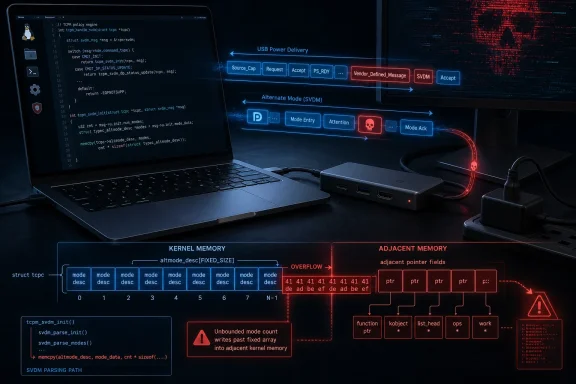
svdm_consume_modes() path, which processes mode information supplied during Structured Vendor Defined Message, or SVDM, discovery. The affected code stores discovered mode descriptors in a fixed-size array named altmode_desc[]. In the normal discovery sequence, protocol-imposed limits mean the array should fill cleanly without overflowing.The vulnerability exists because the code trusted that normal sequence too much. It performed a bounds check before entering a loop, but did not enforce the same limit for every mode descriptor added within that loop. A device that can send an unsolicited Discover Modes acknowledgement at the right state in the negotiation process may cause the kernel to cross the array’s boundary.
As of July 21, 2026, the published affected-version data identifies Linux kernels prior to 6.12.93, 6.18.35, and 7.0.12 as affected in their respective stable branches. The fix is also present in the upstream development line beginning with Linux 7.1. The NVD record was published on July 19, 2026, and its data was modified on July 20, 2026; it did not yet carry an NVD-assigned CVSS score at publication time.
Why a Small Patch Merits Attention
Security teams sometimes see one-line or few-line kernel fixes as evidence of a minor issue. That is not a safe conclusion. Memory-safety flaws often originate in extremely compact logic errors: a loop condition in the wrong place, an assumed state transition, or a counter checked before rather than during iteration.Here, the code correction is conceptually straightforward: stop consuming additional mode descriptors once the destination array reaches its maximum capacity. But the reason the check must occur inside the loop is what matters. The loop processes attacker-influenced protocol content, and its iteration count can be larger than the remaining free slots in the destination array.
The WindowsForum Perspective
This is a Linux kernel vulnerability, not a native Windows kernel vulnerability. Windows 11 systems do not become exposed merely because they have USB-C ports or support DisplayPort Alt Mode. However, WindowsForum readers increasingly operate mixed environments: Windows desktops with Linux virtual machines, dual-boot developer workstations, USB-C docks shared across operating systems, Linux-based appliances, and Windows Subsystem for Linux deployments.The immediate patching obligation falls on systems actually booting an affected Linux kernel. The practical lesson applies more broadly: USB-C accessories should be treated as active protocol participants, not passive cables. A dock, monitor, charger, adapter, or peripheral can influence more than charging and display routing.
Background
USB Type-C is a connector specification, but modern Type-C ports are much more than a physical plug. The same reversible connector can carry USB data, USB Power Delivery negotiation, DisplayPort signals, Thunderbolt or USB4 traffic, PCIe tunneling in certain platforms, vendor-specific functions, and power levels high enough to charge laptops and other equipment.That flexibility is enabled by a set of control messages exchanged over the Type-C Configuration Channel. USB Power Delivery adds more advanced negotiation capabilities, allowing a source and sink to agree on voltage, current, power role, and data role. It also provides a mechanism for vendor-defined communication that enables Alternate Mode discovery and activation.
Alternate Modes are the feature most relevant to CVE-2026-63962. An Alternate Mode allows a Type-C connection to repurpose high-speed lanes for a defined function, commonly DisplayPort output. The protocol must identify which Standard or Vendor IDs are supported, then query the modes available under each identifier.
TCPM and the Linux Type-C Stack
Linux separates many Type-C responsibilities among hardware drivers, controller drivers, the Type-C class framework, and TCPM. A dedicated Type-C Port Controller Interface driver may interact with a physical controller chip, while TCPM applies the higher-level USB Power Delivery state machine and message handling.This architecture has substantial benefits. It avoids duplicating complex Power Delivery policy logic across every controller implementation and creates a consistent framework for laptops, tablets, embedded products, docks, and development boards. It also concentrates complex parsing and state management in a common location, where a bug can have broad downstream relevance.
The affected source file,
drivers/usb/typec/tcpm/tcpm.c, is part of that shared logic. Whether a particular device is exposed depends on several factors, including kernel version, kernel configuration, the Type-C controller driver in use, and whether the platform routes its Type-C policy through the affected TCPM path.A Long-Lived Exposure Window
The affected-version information traces the vulnerable code back to Linux 4.19. That does not mean every Linux device released since that era is practically exploitable, nor does it mean every 4.19-derived enterprise kernel is currently unpatched. Vendors frequently backport security changes without changing the visible upstream version number.Still, the age of the affected code matters. Linux 4.19 has been widely used in long-support deployments, embedded appliances, industrial systems, Android-adjacent products, developer boards, network devices, and vendor-maintained kernels. The vulnerability’s durability illustrates a common kernel-security challenge: hardware-facing code can remain deployed for years after its initial introduction.
How the Vulnerability Works
At its core, CVE-2026-63962 is an out-of-bounds write caused by a mismatch between a pre-loop capacity check and per-item data processing. The Type-C Port Manager maintains a count of Alternate Modes already discovered. Before processing a batch of new mode descriptors, the old code checked whether the count was below the maximum.That check was not sufficient because a single received message could contain several Video Data Objects, or VDOs, describing modes. If only one slot remained and the incoming message carried multiple VDOs, the first write would use the final valid entry. Subsequent writes in the same iteration sequence could exceed the end of the
altmode_desc[] array.The public vulnerability description gives a concrete boundary case. An attacker-controlled or defective partner can guide the normal process until the count reaches one below the array maximum. It can then send an extra Discover Modes acknowledgement carrying seven VDOs. The initial check succeeds because one position remains, but the loop may write as many as five entries beyond the intended array.
What “Out-of-Bounds Write” Means Here
A fixed-size array has a defined amount of storage. Writing to index zero through its maximum valid index is expected behavior. Writing to the next position crosses into memory allocated for another field, object, or control structure.In C, this class of error is particularly serious because array indexing does not automatically provide run-time safety checks. The compiler generally assumes the program’s logic guarantees that every index is valid. If that logic is wrong, the write can silently corrupt adjacent memory.
The impact is not automatically equivalent to arbitrary kernel-code execution. Modern kernels use several defensive measures, including memory-layout randomization, read-only mappings, control-flow protections on some architectures, and hardening options. But an attacker-influenced kernel-memory overwrite is inherently more concerning than a simple application crash because the kernel has authority over the whole system.
The Adjacent partner_altmode[] Field
The disclosure identifies an especially important detail: in the relevant tcpm_port structure layout, memory after the mode-description storage can include the partner_altmode[] pointer array. In the described mode_data_prime configuration, data chosen by the connected partner can therefore overwrite bytes intended to represent pointers.That observation does not prove a universal, reliable exploitation technique. Memory layouts vary according to kernel release, compiler behavior, architecture, build configuration, and the exact structure definition selected by the platform. An overwritten pointer may later cause a crash, be rejected by mitigation features, or be difficult to turn into controlled code execution.
Nevertheless, pointer corruption changes the risk conversation. It means the fault is not merely an incorrect mode entry that produces a visual glitch. Depending on subsequent use, the overwritten data could destabilize the Type-C subsystem, trigger a kernel fault, or potentially provide a building block for deeper compromise.
The Protocol-State Problem Behind the Overflow
The overflow is only part of the story. The vulnerability description identifies a state-validation weakness in the handling of acknowledgement messages. Specifically, the relevant acknowledgement handler does not correlate an incoming ACK with a request that the local port actually sent.Once the port’s partner object has been created, an unsolicited Discover Modes ACK can reportedly be consumed unconditionally. In other words, the code can accept a response even if the local system did not have a matching request outstanding. That creates the opening for a device to feed additional mode descriptors beyond the expected discovery progression.
This is a classic protocol implementation problem. A parser can correctly interpret each individual field yet still be vulnerable if it accepts valid-looking messages in an invalid order. Security controls must validate not only what arrived, but also whether it was expected at that moment.
Normal Flow Versus Adversarial Flow
In normal operation, the discovery process is bounded by constants controlling the maximum number of Standard or Vendor IDs and the maximum modes associated with each identifier. Those upper limits align with the allocated storage for alternate-mode descriptors. The ordinary flow therefore provides an implicit safety guarantee.An adversarial partner is not required to honor the assumptions that made the normal design safe. If it can inject a nominally valid response at a point where the host does not expect it, it can create a message sequence outside that carefully bounded model. The receiving code must retain its own independent limit checks.
This distinction matters well beyond USB-C. Network daemons, Bluetooth stacks, storage drivers, firmware update engines, and virtualization interfaces all process stateful message exchanges. Validity cannot be determined only by the syntax of a packet; it depends on the entire transaction state.
Why Per-Iteration Checks Are the Correct Repair
The repaired behavior is to test the destination-array bound every time the loop is about to store another descriptor. Once the maximum is reached, the parser stops indexing the array regardless of how many VDOs remain in the message or why the function was called.That is defense in depth. Even if the state machine later acquires a separate fix that rejects unsolicited acknowledgements, the local storage operation remains protected. Conversely, if another unusual path reaches the mode-consumption function, the same capacity enforcement prevents a repeat of the overflow.
A sound general rule emerges: when a loop writes attacker-controlled or externally supplied data into a bounded structure, capacity must be checked at the point of every write. Pre-flight checks are useful, but they are not a substitute when one input unit can contain multiple destination entries.
Affected Systems and Scope
The CVE record lists Linux kernel versions before 6.12.93, 6.18.35, and 7.0.12 as affected. It also records the upstream fix in Linux 7.1. These numbers should be treated as upstream reference points, not as a complete inventory of every vulnerable operating-system product.Distribution maintainers commonly backport targeted patches into long-term kernels. A system reporting a kernel version that appears older than the upstream fixed release can still be protected if its vendor has integrated the correction. Conversely, a custom kernel based on an affected tree can remain vulnerable long after a distribution’s standard build has been fixed.
Hardware and Configuration Determine Practical Exposure
The bug is in Linux TCPM code, which means practical exposure depends on whether the system uses that code for its Type-C port. A desktop with no USB-C hardware, a server whose Type-C port is absent or disabled, or a platform using a separate policy implementation may not present the same reachable attack surface.Systems with active USB-C functionality deserve closer attention. The most relevant categories include laptops that support USB-C charging and docking, tablets and convertibles, compact PCs, developer hardware, embedded Linux systems, and appliances with externally reachable Type-C service or peripheral ports.
The direction of the port also matters operationally. A system that normally acts as a USB-C host and accepts docks, displays, chargers, adapters, storage devices, or peer devices may encounter a larger range of untrusted partners than a tightly controlled embedded deployment.
Linux in Virtualized and Mixed-OS Environments
Virtual machines generally do not expose a guest kernel directly to a physical USB-C Power Delivery controller unless the relevant device or controller function is passed through. Standard USB device redirection is not necessarily equivalent to forwarding Type-C controller-level protocol traffic.For Windows users, the nearest practical concern is a workstation that also boots Linux, runs a Linux host, uses USB passthrough for hardware testing, or administers Linux appliances. Windows Subsystem for Linux deserves separate consideration: WSL uses a Microsoft-supplied Linux kernel, but the presence and exposure of Type-C TCPM depend on how the Windows host represents hardware to the WSL environment. Administrators should verify the kernel package and the actual device path rather than assuming either blanket exposure or blanket immunity.
Enterprise Fleet Implications
Enterprises should treat this as a hardware-adjacent kernel patching event. Endpoint fleets often use USB-C docks as their primary desktop connection, and employees routinely connect chargers, monitors, conference-room equipment, travel adapters, and personal accessories.The risk profile rises in environments where users can connect unapproved accessories or where attackers may obtain brief physical access to unattended devices. It also rises for engineering groups that test hardware prototypes or use programmable USB-C and Power Delivery tools, because those environments naturally interact with malformed or nonstandard protocol behavior.
Assessing Exploitability Without Overstating It
The published record establishes an attacker-controlled out-of-bounds write in kernel memory, reachable through a malicious or broken USB-C partner under a defined message sequence. That is enough to justify prompt remediation. It is not, by itself, a public proof that every affected laptop can be compromised through a plug-in device with a dependable one-step exploit.Several practical conditions shape the actual severity. The target needs a compatible Type-C implementation that uses the vulnerable TCPM code path. The attacker needs physical access or a way to cause the target to connect to a malicious device, dock, cable assembly, charger, or intermediary. The device also needs to reach the relevant Power Delivery and Alternate Mode discovery state.
Physical Access Is Not the Same as Low Risk
Security discussions often downgrade physical-access bugs automatically. That is a mistake for modern laptops. USB-C is intentionally designed for frequent connection to untrusted infrastructure: airport charging points, hotel displays, loaner docks, shared meeting-room equipment, retail adapters, and USB-C hubs from uncertain supply chains.A threat requiring a malicious accessory is still different from a remotely exploitable network service. It usually requires proximity, preparation, compatible hardware, and a user action such as plugging in a device. But the practical prevalence of Type-C connections makes the attack surface more routine than a specialized debug port.
Denial of Service Is the Most Immediate Outcome
The most straightforward potential effect is a system crash, kernel panic, device disconnect, or Type-C subsystem instability. If corrupted adjacent data is later dereferenced, the result could be a fault rather than controlled execution.For many organizations, that is already operationally significant. A crash during a presentation, industrial workflow, kiosk operation, point-of-sale transaction, or developer build is disruptive. Repeated malformed traffic could create a reliable local denial-of-service condition even if exploitation beyond that proves difficult.
Why CVSS Is Not Yet the Final Word
At publication, the NVD record did not include a CVSS v3.x or CVSS v4 assessment. That absence should not be interpreted as a low-severity designation. It means a formal NVD score had not yet been supplied.Organizations should avoid postponing action while waiting for a numerical rating. Risk is better assessed from the technical facts: physical attack vector, local hardware interaction, a stateful protocol requirement, and an out-of-bounds kernel write that can affect adjacent pointer storage. In a managed environment, those facts support prioritizing the update in the normal expedited kernel-patching workflow.
Patch Status and Upgrade Guidance
The upstream stable fixes associated with CVE-2026-63962 are available in Linux 6.12.93, 6.18.35, and 7.0.12, with the correction present in the upstream line from Linux 7.1 onward. The best response is to install a vendor-provided kernel update that explicitly includes the fix or is based on a fixed upstream revision.Do not treat a manually compared version number as conclusive. Linux distributions can apply a security patch to an older visible kernel version, often retaining their own release suffix. The kernel’s changelog, security advisory, package metadata, or vendor tracker is the authoritative source for determining whether a packaged build contains this specific correction.
A Practical Verification Sequence
Administrators should use a controlled verification process rather than simply checking that a system received “some” updates.- Identify systems that boot Linux kernels and have active USB-C or Type-C Power Delivery functionality. Prioritize laptops, mobile workstations, embedded endpoints, developer devices, and appliances with externally accessible Type-C ports.
- Record the running kernel version and installed kernel packages. On most Linux distributions,
uname -ridentifies the currently running build, but installed package information may reveal a newer fixed kernel waiting for reboot. - Consult the operating system vendor’s security advisory or package changelog for CVE-2026-63962. Confirm inclusion by CVE identifier or by the underlying Type-C TCPM fix description.
- Install the vendor-supplied updated kernel and reboot into it. A downloaded kernel package does not remediate a currently running vulnerable kernel until the system boots the replacement image.
- Validate the post-reboot kernel and test normal dock, charging, display, and accessory behavior. Type-C changes should be tested against the accessories central to the organization’s workflow.
- Document exceptions for appliances or custom kernels. If immediate updates are unavailable, record compensating controls, owner responsibility, and a timeline for applying a backport.
Backporting for Custom Kernels
Organizations that build custom Linux kernels should take the upstream patch rather than attempting an ad hoc rewrite. The intended change is compact, but its value lies in preserving the existing behavior while moving the boundary check to the correct granularity.Backporting teams should also inspect nearby Type-C and SVDM changes in their tree. Code layout, helper functions, and state-machine behavior can vary across older branches. A patch that applies mechanically may still warrant compilation, static analysis, and controlled hardware validation before deployment.
Reboots Are a Security Control
Kernel vulnerabilities reinforce an inconvenient reality: reboot discipline matters. Live patching can reduce downtime in some environments, but not every organization uses it and not every kernel update is safely covered by the installed live-patching mechanism.For endpoints, a maintenance process that allows kernel updates to sit pending for weeks creates a gap between patch availability and actual protection. For servers and appliances, reboot scheduling must be balanced against uptime requirements, but the decision should be explicit rather than accidental.
Consumer Impact: What Everyday Users Should Do
For individual Linux users, the appropriate response is measured but prompt. Install current distribution updates, reboot, and be more selective about unfamiliar USB-C accessories until the system is confirmed patched. There is no basis to assume that every charger or monitor is malicious, but this flaw reinforces the value of treating unknown Type-C equipment with the same caution already applied to unknown USB storage devices.Users of laptops with USB-C charging or display output should pay particular attention because those capabilities commonly involve Power Delivery and Alternate Mode negotiation. A device that only exposes a Type-C-shaped low-speed USB connection may have a different risk profile, but the end user usually cannot determine the controller and software path with certainty.
Safer Accessory Habits
The following habits reduce exposure not only to this CVE but to the broader class of hostile-accessory attacks:- Use chargers, docks, and display adapters from trusted vendors and known sources. Supply-chain trust does not eliminate risk, but it reduces the chance of connecting intentionally malicious hardware.
- Avoid using unknown public charging equipment when a personal AC charger or power bank is available. A public USB-C outlet, cable, or dock should be regarded as an active device path, not merely a source of electricity.
- Keep the operating system and firmware current. USB-C behavior crosses boundaries between the operating system, embedded controller, dock firmware, BIOS or UEFI firmware, and dedicated Type-C controller firmware.
- Disconnect suspicious accessories if charging, display output, or device detection behaves erratically. A malfunction is not evidence of an attack, but it is a reason to stop trusting the accessory until it is inspected.
- Avoid disabling security controls merely to make an unfamiliar dock work. Changing kernel boot parameters, loading unsigned modules, or lowering endpoint protections can create risks far beyond compatibility inconvenience.
Windows Users in Dual-Boot Setups
A dual-boot PC patched in Windows but still running an older Linux installation remains vulnerable when booted into that Linux environment. The state of one operating system does not remediate the kernel of another.Users who primarily run Windows but maintain Linux for development, gaming, recovery, or hardware tools should include that Linux installation in their update routine. The same is true for bootable Linux media used for diagnostics: a long-neglected live image may contain an older kernel even if the main Windows installation is fully updated.
Enterprise Response and Operational Controls
Enterprise response should begin with asset discovery. Security and endpoint teams need a list of Linux endpoints, their kernel provenance, their update channel, and their physical Type-C exposure. In many organizations, this information is fragmented among endpoint management, engineering, facilities, and product teams.Prioritization should focus on portable devices and any system connecting to accessories outside a controlled environment. Linux workstations used by developers, media teams, security researchers, field engineers, and production operators can be especially exposed because they often rely heavily on docks, displays, adapters, test hardware, and external power.
Recommended Enterprise Actions
- Deploy fixed kernels through established change-management channels. Avoid creating a separate, improvised remediation path unless the vendor advisory indicates an urgent exploit pattern requiring it.
- Require reboots and report compliance. Package installation alone is not enough for a kernel flaw; endpoint management should distinguish between “update installed” and “fixed kernel running.”
- Review USB-C dock and adapter procurement. Standardizing on tested hardware makes compatibility validation easier and reduces exposure to low-quality or untraceable accessories.
- Apply device-control policy where business requirements allow it. Physical port restrictions, secure storage, kiosk enclosures, and controlled-access docking areas can limit untrusted accessory use.
- Coordinate with product and embedded teams. Shipping products may use long-lived custom kernels and externally accessible Type-C ports, making backport verification more important than desktop fleet patching alone.
Incident-Response Considerations
There are no universally distinctive signs that CVE-2026-63962 has been exploited. A crash while connecting a Type-C device, unexpected kernel log messages from the Type-C subsystem, failures in Alternate Mode negotiation, or unexplained dock instability are signals worth preserving, but they are not proof of compromise.If a suspicious device is involved, responders should retain the accessory and capture relevant logs before reconnecting it to additional systems. It is prudent to test unknown hardware only with isolated sacrificial equipment. Repeatedly plugging a suspected malicious device into production endpoints to reproduce behavior is poor incident-handling practice.
Firmware Is Related but Separate
Updating a Linux kernel is the direct remediation for this CVE. Updating laptop firmware, dock firmware, or Type-C controller firmware can be beneficial for other stability and security issues, but it should not be presented as a substitute for the kernel fix.Conversely, the kernel update does not eliminate every USB-C threat. The Type-C ecosystem includes firmware, authentication behavior, cabling, power negotiation, alternate transport modes, and peripheral functions. Each layer requires its own security assumptions and update process.
Strengths and Opportunities
CVE-2026-63962 also demonstrates several positive characteristics of the Linux security and maintenance ecosystem.- The vulnerability was identified with a concrete protocol sequence and a specific memory-safety consequence. This level of technical detail helps maintainers, vendors, and defenders understand why the patch matters.
- The repair is narrowly scoped and conceptually robust. Enforcing the bound for each array insertion prevents the described overflow irrespective of how the parser reaches that function.
- Stable-branch fixes are already identified. Clear fixed-version reference points make it easier for distribution maintainers and downstream kernel teams to map remediation work.
- The issue encourages better state-machine hardening. Even after the array bound is fixed, maintainers can review whether incoming responses should be strictly tied to outstanding requests.
- It provides a useful test case for hardware security programs. Teams can use it to assess whether they inventory Type-C exposure, test dock behavior after kernel updates, and manage physical accessory trust appropriately.
A Chance to Improve Defensive Design
The most durable mitigation is not merely one additional conditional statement. It is a development mindset that treats external hardware messaging as hostile until proven otherwise. That means validating message size, message order, state transitions, destination capacity, and later use of parsed values.For maintainers, fuzzing and malformed-message testing should cover both individual packet fields and cross-message sequences. Many protocol vulnerabilities arise only after a state machine has been brought near a boundary, then receives an out-of-order or redundant response.
Risks and Concerns
The vulnerability has meaningful limitations and uncertainties that organizations should acknowledge without allowing them to delay patching.- A public CVSS score was not available in the NVD record at publication. Organizations should avoid treating the absence of a score as evidence that the issue is low priority.
- Practical exploitability varies by hardware and software configuration. Not every system with a USB-C connector necessarily exercises the vulnerable TCPM path.
- Physical proximity is required, but USB-C accessories are routinely connected in ordinary work. The attack is not remotely reachable in the conventional sense, yet the required interaction is common enough to matter.
- The disclosed overwrite can affect nearby pointer storage in at least one cited structure layout. That elevates concern beyond a cosmetic protocol error, even though reliable privilege escalation has not been publicly established.
- Legacy and embedded systems may be difficult to update. Appliances, custom kernels, and long-support products often have the greatest patch-lag risk.
The Danger of Overcorrecting
It would be counterproductive to conclude that USB-C itself is unsafe or that organizations should abandon docking and charging infrastructure. Type-C remains essential to modern computing, and most users depend on it every day.The correct response is proportionate security engineering: patch the operating system, use trusted hardware, restrict unneeded access in sensitive contexts, and ensure accessory policies match the risk level of the environment. Security improves when convenience features are managed, not when they are treated as inherently suspect.
What to Watch Next
The first item to watch is distribution-level advisory coverage. Major Linux vendors will determine when and how the correction reaches their supported kernel streams, including enterprise long-term support releases whose visible version numbers may not match upstream stable numbering.The second is whether maintainers pursue an additional state-machine hardening change for unsolicited SVDM acknowledgements. The per-iteration array check directly prevents the memory overwrite, but correlating responses with issued requests would reduce the acceptance of anomalous protocol traffic at an earlier stage.
Questions Researchers May Explore
Security researchers will likely examine whether the described overwrite can be made deterministic across common Type-C controller and kernel configurations. Important variables include structure layout, compiler hardening, kernel memory protections, the availability of suitable follow-on code paths, and the behavior of different Power Delivery controllers.Researchers may also test whether similar pre-loop-only boundary checks exist elsewhere in the Type-C and Power Delivery stack. The vulnerable pattern is broadly recognizable: externally supplied batches are appended to a bounded destination after a single capacity check that assumes the batch cannot exceed remaining space.
Update Hygiene Beyond This CVE
This incident is another reminder that USB-C security cannot be evaluated solely at the connector level. An organization may have secure boot enabled, strong endpoint detection, encrypted storage, and good network segmentation, yet still overlook the kernel-facing protocol parsers activated by a physical accessory.A mature endpoint strategy combines operating-system patching with hardware inventory, trusted procurement, firmware maintenance, least-privilege access to ports where feasible, and clear user education. None of those controls alone is sufficient, but together they make physical-interface attacks harder to execute and easier to contain.
CVE-2026-63962 is ultimately a precise example of how a protocol edge case can become a kernel security problem: an unexpected USB-C message reaches a parser, a batch operation exceeds its remaining capacity, and a fixed array crosses into sensitive adjacent memory. The immediate remedy is straightforward—move to a kernel containing the per-iteration bounds check—but the lasting value lies in the broader discipline it reinforces. As USB-C continues to unite charging, data, display, docking, and device control in one everyday connector, both kernel developers and system administrators must assume that every negotiation path deserves the same rigor traditionally reserved for network-facing code.
References
- Primary source: NVD / Linux Kernel
Published: 2026-07-21T01:02:25-07:00
NVD - CVE-2026-63962
 nvd.nist.gov
- Security advisory: MSRC
Published: 2026-07-21T01:02:25-07:00
Original feed URL
Security Update Guide - Microsoft Security Response Center
 msrc.microsoft.com
