

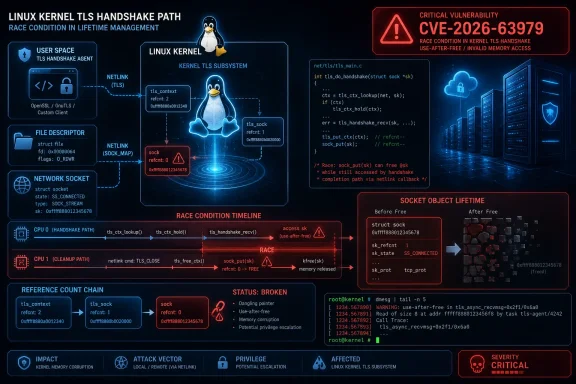
Linux kernel security issue CVE-2026-63979 highlights a subtle but serious lifetime-management flaw in the kernel’s newer TLS handshake infrastructure: a file descriptor reference could be released while an accept-side path was still preparing to hand the socket to a user-space handshake agent. The result was a race that could lead to a NULL-pointer dereference or use-after-free condition involving
CVE-2026-63979 affects the Linux kernel’s
The vulnerability was published to the CVE List on July 19, 2026, and the record was updated by kernel.org on July 20, 2026. The issue was resolved upstream through commits that change how the kernel transfers ownership of a pinned file reference during a handshake request’s accept operation.
A file object in Linux is not merely a bookkeeping record. It is the kernel object behind a process-visible file descriptor, and sockets are exposed to user space through that file abstraction. If code accesses a socket’s file after its last reference has been released, it can read stale memory, follow an invalid pointer, or operate on an object that has already been repurposed.
The practical exposure question is whether the environment uses the kernel handshake subsystem and a compatible user-space TLS handshake agent. That distinction is important: the severity score describes the impact assigned by the CNA, while real-world exposure depends on the deployment path.
Traditionally, the TLS handshake itself remains in user space. That design makes sense because the handshake handles certificates, protocol negotiation, identity verification, session resumption, and cryptographic policy. Those are areas where user-space libraries evolve quickly and where applications often need direct control.
This is an appealing architecture for specialized workloads. It allows a kernel networking client to request a TLS session without embedding an entire TLS handshake implementation in kernel space. It also keeps certificate and handshake policy outside the kernel while allowing the data path to transition into kernel TLS after successful negotiation.
The agent then performs TLS work in user space. If it succeeds, it prepares the socket for kernel TLS operation and sends a completion message. The kernel invokes the consumer’s completion callback, allowing the original kernel client to resume use of the socket.
That handoff is exactly where CVE-2026-63979 lives. The vulnerability is a reminder that moving a descriptor between kernel-managed request state and a user-space-facing file-descriptor table requires a precise ownership contract.
Before the fix, the accept-side code reached back through
According to the vulnerability description, a cancellation sequence can call
The accept-side code may then encounter one of two bad outcomes:
Linux networking code distinguishes between the socket protocol object, usually represented by
A reference to the protocol-level socket object can preserve
This is an easy conceptual trap. From a high-level programming perspective, holding “the socket” may seem sufficient. In kernel terms, however, the held object and the dereferenced object were different. The code was protecting one lifetime while later using another.
The fixed model makes this explicit. Rather than rediscovering the file by traversing
This shift has two benefits. First, it avoids relying on
The new contract is straightforward. When
This is more robust than merely switching from
The additional
The kernel’s descriptor-preparation path consumes the handed-off reference. On success, the reference becomes associated with the newly published file descriptor in the handshake agent’s descriptor table. On failure, the cleanup path releases the reference. In either case, the transfer has a defined owner and a defined release path.
This is a classic kernel resource-management pattern: one reference is acquired, ownership is transferred once, and every success or error path has a clear responsibility for it. Ambiguous “take another reference just in case” logic is replaced with a linear ownership chain that is easier to audit.
In this case,
That timing is subtle. The request has already left the pending queue, so a superficial review might assume acceptance owns it. But ownership of the request object did not automatically mean ownership of the file object embedded in its state.
The patch synchronizes those two concepts. Removing a request for acceptance now also transfers a file reference to the accept side under the same lock that protects the queue transition.
This is why the patch’s comments about
This may look like incidental test maintenance, but it is a useful indicator of patch quality. Reference-counting fixes are only as trustworthy as their modeling of success, cancellation, and cleanup paths.
Why the tests add
The updated tests call
Without that simulated consumption, the tests would report a leaked reference even though the production path would normally hand it to descriptor preparation. The test changes therefore document the new API contract in executable form: acceptance now receives a file reference and must consume or release it.
They cannot, by themselves, exhaust every scheduler interleaving that may occur on a production SMP system under heavy network load. Still, focused tests are valuable here because they enforce the accounting rule at the center of the fix.
For operators, the presence of adjusted tests should increase confidence that the patch was designed as a complete lifetime-model correction rather than as a one-line NULL check. A NULL check might suppress one crash signature while leaving freed-memory access possible. This patch instead addresses the ownership gap that allowed both outcomes.
That means administrators should avoid assuming that a kernel’s marketing version alone settles exposure. Distribution vendors often backport security fixes into older long-term-support kernels, while custom kernels, appliance kernels, and vendor-maintained images may differ substantially from upstream release numbering.
However, Windows administrators should not dismiss it entirely. Windows Server fleets often manage Linux virtual machines, containers, NAS appliances, Kubernetes workers, VPN appliances, or network appliances. Windows 11 and Windows Server environments may also host Linux workloads through WSL2, Hyper-V, or third-party virtualization platforms.
A WSL2 instance is relevant only if its Linux kernel and installed workload actually include and use the affected handshake infrastructure. The same principle applies to Docker Desktop’s Linux VM and development clusters running Linux nodes: presence of Linux alone is not enough, but an unpatched kernel in a specialized networking role may warrant review.
The CNA’s Critical rating indicates that the issue was assessed as potentially affecting confidentiality, integrity, and availability under a network-reachable, low-complexity, unauthenticated scenario. That severity should motivate rapid validation, but it should not be interpreted as proof that every Linux endpoint is remotely exploitable in the same manner.
Operators should prioritize hosts with externally reachable services, multi-tenant workloads, or workloads where a kernel panic would cause meaningful business interruption. A successful denial-of-service outcome can be operationally severe even when code execution has not been demonstrated publicly.
Appliance vendors should also consider the upgrade mechanics. A fixed kernel package does not protect a system until it is booted. Live patching may be available in some enterprise environments, but its suitability depends on whether the specific distribution has produced and validated a live patch for this change.
Still, users of bleeding-edge distributions, self-built kernels, experimental network stacks, and developer environments should pay attention. The vulnerability demonstrates that adoption of advanced kernel networking features brings responsibility for tracking low-level lifecycle fixes.
The relevant questions include:
The best validation method is to consult the Linux distribution’s security advisory, kernel changelog, or source package revision. Where necessary, compare the vendor’s patch state against the stable commits associated with the CVE.
Conversely, it would be a mistake to dismiss the issue because the subsystem is specialized. Specialized kernel features often appear in precisely the environments where reliability, performance, and security boundaries matter most: infrastructure services, storage platforms, network appliances, and containerized multi-tenant systems.
The main lesson is architectural: a Windows management plane does not change the security posture of the Linux kernel running beneath a hosted workload. Patch ownership follows the guest kernel and appliance firmware, not the operating system used to access its console.
Administrators should watch for clarification on which stable and long-term-support kernel builds contain the backported fix. The upstream CVE data references stable-tree commits, but distribution-specific mappings are what most operators need for change-management decisions.
As Linux continues to add high-performance networking facilities, the quality of reference-transfer contracts will remain as important as the correctness of protocol logic. Security improvements will increasingly depend on making ownership explicit—not just in comments, but in locking rules, API contracts, error paths, and tests that confirm resource counts remain balanced under contention.
CVE-2026-63979 should therefore be patched as a serious kernel flaw, but it should also be read as a useful engineering warning: holding a reference to something that sounds like “the socket” is not enough when the code later depends on a different object with a different lifetime. The upstream fix resolves that mismatch by transferring the actual file reference the accept path needs, turning a fragile race window into a defined and auditable ownership handoff.
struct socket and its associated file object. Kernel.org assigned the issue a CVSS 3.1 score of 9.8, rated Critical, while NVD enrichment had not yet supplied its own assessment as of July 21, 2026. Although the vulnerable code is specialized and does not automatically expose every Linux system, the bug matters for servers and appliances using in-kernel TLS consumers and the netlink-based handshake service model.
 Overview
CVE-2026-63979 affects the Linux kernel’s net/handshake subsystem, which coordinates TLS session establishment between in-kernel networking consumers and a user-space handshake agent. The problem is not a cryptographic failure in TLS itself. It is a concurrency and object-lifetime failure in the plumbing that transfers a socket file descriptor from the kernel’s queued handshake request to the user-space service responsible for completing the handshake.The vulnerability was published to the CVE List on July 19, 2026, and the record was updated by kernel.org on July 20, 2026. The issue was resolved upstream through commits that change how the kernel transfers ownership of a pinned file reference during a handshake request’s accept operation.
Why the wording matters
The commit title, “hand off the pinned file reference toaccept_doit,” sounds narrow because it is narrow. But narrow kernel races can have broad consequences when they occur in code that crosses process boundaries, manages file descriptors, and handles sockets carrying security-sensitive traffic.A file object in Linux is not merely a bookkeeping record. It is the kernel object behind a process-visible file descriptor, and sockets are exposed to user space through that file abstraction. If code accesses a socket’s file after its last reference has been released, it can read stale memory, follow an invalid pointer, or operate on an object that has already been repurposed.
The immediate takeaway
Administrators should treat this as a kernel update issue, not an application TLS-library issue. Updating OpenSSL, GnuTLS, a browser, or a Windows client will not remediate a vulnerable Linux kernel on a server, virtual machine, appliance, or WSL deployment using the affected functionality.The practical exposure question is whether the environment uses the kernel handshake subsystem and a compatible user-space TLS handshake agent. That distinction is important: the severity score describes the impact assigned by the CNA, while real-world exposure depends on the deployment path.
Background
Linux has supported kernel TLS, commonly called kTLS, for years. Its central purpose is to move portions of TLS record processing into the kernel after a TLS session has been negotiated. This can reduce overhead in high-throughput networking workloads and enable certain offload or zero-copy-oriented designs.Traditionally, the TLS handshake itself remains in user space. That design makes sense because the handshake handles certificates, protocol negotiation, identity verification, session resumption, and cryptographic policy. Those are areas where user-space libraries evolve quickly and where applications often need direct control.
A newer split between kernel and user space
Thenet/handshake framework extends that division of labor. An in-kernel consumer can submit a TLS handshake request, while a user-space agent performs the actual handshake work. The kernel passes an open socket to that agent through a netlink operation, and the agent later reports completion back to the kernel.This is an appealing architecture for specialized workloads. It allows a kernel networking client to request a TLS session without embedding an entire TLS handshake implementation in kernel space. It also keeps certificate and handshake policy outside the kernel while allowing the data path to transition into kernel TLS after successful negotiation.
The role of the handshake agent
The handshake agent listens for requests in a network namespace. When a request is ready, the agent uses the handshake netlink family’s accept operation to retrieve a socket descriptor and the accompanying parameters, such as timeout, authentication settings, peer identity information, certificates, keyring references, and peer name.The agent then performs TLS work in user space. If it succeeds, it prepares the socket for kernel TLS operation and sends a completion message. The kernel invokes the consumer’s completion callback, allowing the original kernel client to resume use of the socket.
That handoff is exactly where CVE-2026-63979 lives. The vulnerability is a reminder that moving a descriptor between kernel-managed request state and a user-space-facing file-descriptor table requires a precise ownership contract.
The Vulnerable Race Condition
The affected path begins whenhandshake_req_next() selects and removes a queued handshake request from a per-network-namespace pending list. It then returns that request to the accept side, which enters handshake_nl_accept_doit() to construct the response for the user-space handler.Before the fix, the accept-side code reached back through
req->hr_sk->sk_socket and then dereferenced sock->file. It did this once while preparing a new file descriptor and again when explicitly taking a file reference.What can happen between queue removal and acceptance
The key flaw is that the request is removed from the pending list and the handshake lock is released before the accept-side code safely obtains the file reference it needs. A separate consumer can cancel the handshake at precisely that moment.According to the vulnerability description, a cancellation sequence can call
tls_handshake_cancel() and then release the socket’s descriptor through paths such as sockfd_put(). Other kernel consumers may tear down the file using synchronous file-release paths. Once the final file reference disappears, socket cleanup can orphan the socket, clear sk_socket, and free the struct socket.The accept-side code may then encounter one of two bad outcomes:
- It can observe
sk_socketafter it has been cleared and dereference a NULL pointer. - It can follow an old pointer to a
struct socketthat has already been freed, creating a use-after-free condition.
Why this is a true lifetime bug
The vulnerability is not simply a missing lock. Locks coordinate access to shared state, but they do not by themselves keep an object alive after ownership has been relinquished. The core problem is that the accept path depended on a relationship between several separately reference-counted objects without holding the reference that protected the one it needed.Linux networking code distinguishes between the socket protocol object, usually represented by
struct sock, the higher-level struct socket, and the file object that backs the user-visible descriptor. These objects are related, but their lifetimes are not identical.A reference to the protocol-level socket object can preserve
struct sock while leaving the corresponding struct socket and struct file eligible for destruction. That distinction is the technical heart of CVE-2026-63979.Understanding Linux Socket Ownership
To understand the patch, it helps to separate the three objects involved. Kernel code often refers to “the socket” casually, but the implementation uses layers with different ownership and teardown rules.struct sock is generally the protocol-specific networking state. For TCP, it contains state used by the transport layer, buffers, callbacks, timers, and protocol operations. struct socket is a more generic socket-layer wrapper that connects the protocol object to the file-descriptor model. The file object, often reached as sock->file, represents the open descriptor itself.A socket reference is not a file reference
The vulnerable submit-side code usedsock_hold(), which takes a reference to the protocol-level struct sock. That can prevent protocol state from disappearing, but it cannot guarantee that the struct socket wrapper remains valid or that its file remains open.This is an easy conceptual trap. From a high-level programming perspective, holding “the socket” may seem sufficient. In kernel terms, however, the held object and the dereferenced object were different. The code was protecting one lifetime while later using another.
Why file descriptors are the crucial asset
The handshake accept operation has to deliver a valid descriptor to the user-space TLS agent. That means the file object must remain alive until the kernel either installs it into the agent’s descriptor table or unwinds the failed operation correctly.The fixed model makes this explicit. Rather than rediscovering the file by traversing
req->hr_sk->sk_socket->file, the code uses req->hr_file, the file reference pinned when the request was submitted.This shift has two benefits. First, it avoids relying on
sk_socket, which may no longer point to a valid struct socket. Second, it treats the file reference as the actual resource being transferred, which matches what the accept operation ultimately needs to provide.How the Fix Changes the Ownership Model
The remediation makes a targeted but meaningful change:handshake_req_next() now obtains an additional reference on req->hr_file while holding the handshake network lock. That extra reference is handed directly to the accept-side operation.The new contract is straightforward. When
handshake_req_next() returns a request, the caller owns an additional reference to hr_file. The accept path can safely use that reference even if another thread cancels the request immediately afterward.Handing off the reference under the lock
Taking the extra reference underhn_lock closes the critical timing window. A concurrent cancellation can no longer remove the last usable reference before the accept side begins its descriptor-preparation work.This is more robust than merely switching from
req->hr_sk->sk_socket->file to req->hr_file. The latter change alone would still leave a cancellation race: the cancellation path could drop the request’s pinned file reference after the request was removed from the pending list but before the accept path acquired its own reference.The additional
get_file() in handshake_req_next() supplies the missing ownership handoff. It converts an implicit, timing-dependent assumption into an explicit reference-counting guarantee.Letting descriptor preparation consume the reference
The patch also removes the explicitget_file() that previously followed descriptor preparation. That removal is not a reduction in protection. It reflects a corrected ownership model.The kernel’s descriptor-preparation path consumes the handed-off reference. On success, the reference becomes associated with the newly published file descriptor in the handshake agent’s descriptor table. On failure, the cleanup path releases the reference. In either case, the transfer has a defined owner and a defined release path.
This is a classic kernel resource-management pattern: one reference is acquired, ownership is transferred once, and every success or error path has a clear responsibility for it. Ambiguous “take another reference just in case” logic is replaced with a linear ownership chain that is easier to audit.
Why Cancellation Is Central to the Bug
Cancellation paths are where asynchronous systems often reveal their weakest ownership assumptions. A request may be valid when queued, invalid when processed, and partially transferred when cancellation arrives. Correct code must define which actor owns each resource at every state transition.In this case,
tls_handshake_cancel() can race with the user-space agent’s accept request. The consumer that requested the handshake may decide it no longer wants to wait, perhaps because a transport is being reset, an RPC operation is being aborted, a service is shutting down, or a timeout has expired.The important branch in cancellation
Oncehandshake_req_next() removes the request from the pending list, cancellation may take a branch indicating that it did not remove the request itself. Before the fix, that path could release hr_file while the accept side had not yet secured a durable reference for descriptor creation.That timing is subtle. The request has already left the pending queue, so a superficial review might assume acceptance owns it. But ownership of the request object did not automatically mean ownership of the file object embedded in its state.
The patch synchronizes those two concepts. Removing a request for acceptance now also transfers a file reference to the accept side under the same lock that protects the queue transition.
Error paths deserve equal attention
The change also correctly accounts for failure. It is not enough for the success path to install a descriptor safely. The code must also release the transferred reference if descriptor allocation, installation, or reply construction fails.This is why the patch’s comments about
FD_PREPARE() matter. The descriptor-preparation operation either transfers the reference into the process-visible descriptor table or ensures cleanup drops it. The reference must not be manually retained afterward, and it must not leak on an error branch.Testing the Reference-Counting Contract
The patch updates two KUnit tests,handshake_req_cancel_test2 and handshake_req_cancel_test3. The tests now simulate the fact that descriptor preparation consumes the file reference handed off by handshake_req_next().This may look like incidental test maintenance, but it is a useful indicator of patch quality. Reference-counting fixes are only as trustworthy as their modeling of success, cancellation, and cleanup paths.
Why the tests add fput()
The updated tests call fput() after retrieving the request, effectively modeling the consumption of the handed-off reference. That keeps the file-count assertions balanced.Without that simulated consumption, the tests would report a leaked reference even though the production path would normally hand it to descriptor preparation. The test changes therefore document the new API contract in executable form: acceptance now receives a file reference and must consume or release it.
What KUnit coverage can and cannot prove
KUnit tests can verify expected reference counts and certain controlled state transitions. They are especially effective for validating that cancellation branches do not produce underflows or leaks in known scenarios.They cannot, by themselves, exhaust every scheduler interleaving that may occur on a production SMP system under heavy network load. Still, focused tests are valuable here because they enforce the accounting rule at the center of the fix.
For operators, the presence of adjusted tests should increase confidence that the patch was designed as a complete lifetime-model correction rather than as a one-line NULL check. A NULL check might suppress one crash signature while leaving freed-memory access possible. This patch instead addresses the ownership gap that allowed both outcomes.
Affected Systems and Practical Exposure
The CVE record identifies Linux kernel code beginning with version 6.4 as affected, with fixed upstream and stable-tree commits referenced by kernel.org. The record also indicates that the issue is addressed in the post-fix kernel line identified as 7.1, while specific stable backports are represented by commit identifiers rather than a simple universal kernel-version list.That means administrators should avoid assuming that a kernel’s marketing version alone settles exposure. Distribution vendors often backport security fixes into older long-term-support kernels, while custom kernels, appliance kernels, and vendor-maintained images may differ substantially from upstream release numbering.
Systems most likely to care
The vulnerability is most relevant to environments that combine all or most of the following conditions:- The system runs a Linux kernel containing the
net/handshakecode introduced in the affected range. - An in-kernel consumer uses the TLS handshake API rather than performing the handshake entirely in a conventional user-space application.
- A user-space handshake agent is configured to receive and accept those requests through the handshake netlink interface.
- Attackers or untrusted tenants can influence handshake timing, connection teardown, workload concurrency, or the lifecycle of the relevant services.
Windows and WSL implications
For WindowsForum readers, native Windows systems are not directly affected by a Linux kernel CVE. Windows networking does not use the Linuxnet/handshake subsystem, and Windows applications using Schannel, OpenSSL, or other TLS stacks are outside this vulnerability’s code path.However, Windows administrators should not dismiss it entirely. Windows Server fleets often manage Linux virtual machines, containers, NAS appliances, Kubernetes workers, VPN appliances, or network appliances. Windows 11 and Windows Server environments may also host Linux workloads through WSL2, Hyper-V, or third-party virtualization platforms.
A WSL2 instance is relevant only if its Linux kernel and installed workload actually include and use the affected handshake infrastructure. The same principle applies to Docker Desktop’s Linux VM and development clusters running Linux nodes: presence of Linux alone is not enough, but an unpatched kernel in a specialized networking role may warrant review.
Enterprise Impact
For enterprise operators, the immediate concern is stability and privilege boundaries in services that use kernel-initiated TLS handshakes. A race involving a user-space handshake agent and kernel socket lifecycle can produce crashes, service interruption, or memory-safety consequences that are difficult to characterize without examining the exact deployment.The CNA’s Critical rating indicates that the issue was assessed as potentially affecting confidentiality, integrity, and availability under a network-reachable, low-complexity, unauthenticated scenario. That severity should motivate rapid validation, but it should not be interpreted as proof that every Linux endpoint is remotely exploitable in the same manner.
Infrastructure operators
High-value systems include storage clusters, RPC-heavy deployments, kernel-integrated network services, edge appliances, and specialized distributions that adopt new networking APIs early. The CVE description specifically references teardown paths associated with service socket cleanup and transport reset behavior, illustrating why asynchronous service infrastructure is a natural area for concern.Operators should prioritize hosts with externally reachable services, multi-tenant workloads, or workloads where a kernel panic would cause meaningful business interruption. A successful denial-of-service outcome can be operationally severe even when code execution has not been demonstrated publicly.
Distribution and appliance vendors
Vendors should determine whether their kernel configuration includes the handshake subsystem and whether their products ship or enable a matching user-space handshake agent. The correct response is not merely to scan for a package name: this is kernel code, and the relevant question is whether the shipped kernel contains the vulnerable commits or lacks the applicable stable fix.Appliance vendors should also consider the upgrade mechanics. A fixed kernel package does not protect a system until it is booted. Live patching may be available in some enterprise environments, but its suitability depends on whether the specific distribution has produced and validated a live patch for this change.
Consumer and Developer Impact
For consumers, this CVE is likely to be less immediately actionable than a browser or Wi-Fi vulnerability. Most people do not manually configure a kernel TLS handshake agent, and most consumer Linux applications perform TLS negotiation wholly in user space.Still, users of bleeding-edge distributions, self-built kernels, experimental network stacks, and developer environments should pay attention. The vulnerability demonstrates that adoption of advanced kernel networking features brings responsibility for tracking low-level lifecycle fixes.
Developers using kernel TLS features
Developers should review whether their software uses the TLS handshake API, not merely whether it enables kTLS after a regular user-space handshake. Those are distinct layers.The relevant questions include:
- Does the workload call the kernel’s TLS handshake request APIs?
- Does it rely on a handshake agent in each network namespace?
- Does it expose the service to untrusted peers or tenants?
- Can requests be canceled concurrently with agent acceptance?
- Are the deployed kernels patched with the upstream or vendor backport fix?
Security teams and vulnerability scanners
Security teams should expect early scanner results to be uneven. The NVD record was newly published, and its own assessment fields had not yet been populated. Asset-management platforms may initially match only by upstream version ranges and therefore generate false positives for backported enterprise kernels or false negatives for customized builds.The best validation method is to consult the Linux distribution’s security advisory, kernel changelog, or source package revision. Where necessary, compare the vendor’s patch state against the stable commits associated with the CVE.
Strengths and Opportunities
The response to CVE-2026-63979 has several positive technical characteristics that reduce the chance of a superficial fix creating a new resource-management problem.- The patch addresses the underlying ownership defect. It protects the file object that the accept path actually needs instead of merely retaining the protocol socket object.
- The transfer occurs under the queue-protection lock. This makes the handoff atomic with respect to the state transition that removes the request from the pending list.
- The new reference has a documented consumer. Descriptor preparation owns the reference on success and cleanup owns it on failure, reducing ambiguity in error handling.
- The redundant reference acquisition is removed. Eliminating the old balancing
get_file()makes the code’s lifetime model easier to audit and avoids unnecessary reference churn. - Tests were updated with the new contract. The KUnit adjustments model reference consumption and preserve file-count assertions across cancellation and completion scenarios.
A useful model for future kernel work
The larger opportunity is methodological. Kernel subsystems that bridge queued objects, cancellation, and file-descriptor transfer should document ownership at every state transition. The important questions are simple but demanding:- Which object is protected?
- Which reference preserves it?
- Which lock serializes transfer?
- Who consumes the reference on success?
- Who releases it on every failure and cancellation path?
Risks and Concerns
The fix is targeted, but the surrounding situation still presents operational and security concerns that administrators should manage carefully.- A Critical score can create overbroad remediation efforts. Teams should patch promptly while distinguishing specialized handshake-framework exposure from ordinary user-space TLS usage.
- Kernel version labels can be misleading. Stable backports, vendor kernels, and custom builds may contain the fix even if their visible version appears older than the upstream resolution line.
- A package update without a reboot may leave the vulnerable kernel active. Operators need to verify the running kernel, not just the installed package inventory.
- Early vulnerability-scanner detections may be incomplete. Newly published CVEs often require time before distribution metadata, scanner signatures, and cloud-image inventories converge.
- Race conditions can be difficult to reproduce. A system that appears stable under normal testing may still be vulnerable when cancellation, teardown, and accept operations overlap under load.
Avoid simplistic conclusions
It would be premature to claim that CVE-2026-63979 is broadly exploitable for arbitrary remote code execution across standard Linux systems. The public description establishes a serious race with use-after-free and NULL-dereference potential, and the CNA rating is severe, but practical exploitability depends on the enabled subsystem, calling patterns, memory-safety mitigations, and attacker control over the relevant timing.Conversely, it would be a mistake to dismiss the issue because the subsystem is specialized. Specialized kernel features often appear in precisely the environments where reliability, performance, and security boundaries matter most: infrastructure services, storage platforms, network appliances, and containerized multi-tenant systems.
Recommended Response for Administrators
The most effective response is a disciplined kernel-lifecycle review rather than an indiscriminate application patch cycle. Teams should identify systems running affected Linux kernels, determine whether the handshake subsystem is enabled and used, obtain the appropriate vendor kernel update, and reboot or otherwise activate the corrected kernel.A practical response sequence
- Inventory Linux kernels, not just Linux distributions. Record the actively running kernel version on servers, appliances, virtual machines, container hosts, and development environments.
- Check vendor security advisories and changelogs. Determine whether the distribution has backported the fix associated with CVE-2026-63979 into its supported kernel stream.
- Identify use of the handshake framework. Review specialized TLS, RPC, storage, and network-service deployments for use of the netlink handshake agent and kernel handshake APIs.
- Prioritize exposed and high-availability systems. External-facing services, multi-tenant systems, and workloads where a kernel crash has high impact should move first.
- Install the corrected kernel package. Use normal vendor-supported update channels rather than attempting an ad hoc source-level patch unless the environment is already maintained that way.
- Reboot and verify the active kernel. Confirm that the machine is actually running the updated image after maintenance.
- Monitor for anomalies. Watch for unexpected service restarts, kernel oops messages, panic events, handshake failures, or unusual cancellation patterns after the update.
Guidance for Windows-managed environments
Windows-centric IT teams should add this CVE to Linux infrastructure tracking rather than endpoint patching queues for ordinary Windows clients. Review Hyper-V guests, Azure or on-premises Linux VMs, Kubernetes Linux workers, WSL2 developer images, and vendor appliances managed from Windows administration consoles.The main lesson is architectural: a Windows management plane does not change the security posture of the Linux kernel running beneath a hosted workload. Patch ownership follows the guest kernel and appliance firmware, not the operating system used to access its console.
What to Watch Next
The CVE’s publication is recent, so several parts of the ecosystem will likely develop over the coming days and weeks. NVD may add its own CVSS enrichment, distributions may publish package-specific advisories, and vulnerability scanners may refine their detection rules.Administrators should watch for clarification on which stable and long-term-support kernel builds contain the backported fix. The upstream CVE data references stable-tree commits, but distribution-specific mappings are what most operators need for change-management decisions.
Signs of mature remediation
A mature remediation cycle will include several elements:- Distribution advisories that name corrected package versions.
- Cloud-image refreshes for managed Linux offerings.
- Updated kernel source packages in enterprise repositories.
- Scanner signatures that recognize vendor backports rather than relying only on upstream version comparisons.
- Operational guidance for workloads that use the TLS handshake agent.
- Additional regression testing around cancellation, descriptor transfer, and namespace teardown.
The broader kernel-security lesson
The wider significance of CVE-2026-63979 is not that Linux TLS is inherently unsafe. Rather, it shows how difficult the boundary between kernel and user space can become when asynchronous work, object lifetimes, descriptor tables, and cancellation all meet in one path.As Linux continues to add high-performance networking facilities, the quality of reference-transfer contracts will remain as important as the correctness of protocol logic. Security improvements will increasingly depend on making ownership explicit—not just in comments, but in locking rules, API contracts, error paths, and tests that confirm resource counts remain balanced under contention.
CVE-2026-63979 should therefore be patched as a serious kernel flaw, but it should also be read as a useful engineering warning: holding a reference to something that sounds like “the socket” is not enough when the code later depends on a different object with a different lifetime. The upstream fix resolves that mismatch by transferring the actual file reference the accept path needs, turning a fragile race window into a defined and auditable ownership handoff.
References
- Primary source: NVD / Linux Kernel
Published: 2026-07-21T01:04:40-07:00
NVD - CVE-2026-63979
 nvd.nist.gov
- Security advisory: MSRC
Published: 2026-07-21T01:04:40-07:00
Original feed URL
Security Update Guide - Microsoft Security Response Center
 msrc.microsoft.com
