

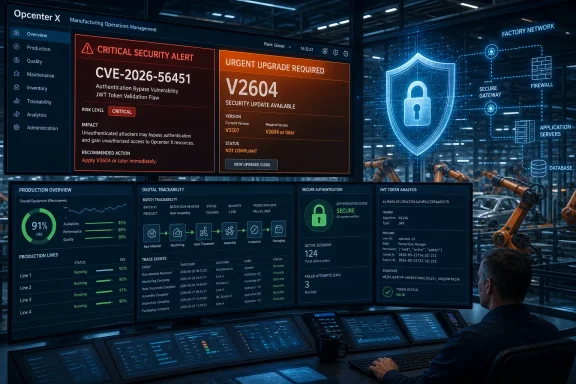
Siemens Opcenter X customers running releases earlier than V2604 face a critical authentication-bypass vulnerability that demands immediate attention from manufacturing IT, security, and operations teams. The flaw, tracked as CVE-2026-56451, can reportedly allow an unauthenticated remote attacker to forge JSON Web Tokens, impersonate arbitrary users—including administrators—and obtain full unauthorized access to the application. Siemens has issued a fix in Opcenter X V2604, while the U.S. Cybersecurity and Infrastructure Security Agency republished the vendor advisory on July 21, 2026, emphasizing the seriousness of a vulnerability rated CVSS 10.0.
Opcenter X is Siemens’ cloud-oriented manufacturing operations management platform, designed to give manufacturers a modular route into digital production systems. It combines functions commonly associated with manufacturing execution systems, quality management, traceability, scheduling, workflow coordination, and operational analytics. Siemens has positioned the service especially toward small and medium-sized manufacturers that need modern manufacturing software without necessarily undertaking a traditional, years-long MES deployment.
That business focus is important in the context of this vulnerability. A compromise of a conventional back-office application can expose documents, business records, or employee information. A compromise of a manufacturing operations platform can extend much further, potentially affecting work orders, production records, quality processes, operator permissions, equipment-adjacent workflows, and integration points that connect the factory floor to enterprise applications.
That approach lowers adoption barriers, but it also raises the importance of identity and access management. In a modular SaaS environment, authentication is not merely a gateway to a single application window. It becomes the trust boundary that governs access across business roles, connected services, APIs, workflow tools, customization features, and potentially sensitive manufacturing data.
A 10.0 score does not automatically mean every exposed environment will be compromised. It does mean that defenders should not treat the issue as a routine patch-cycle item. The combination of remote accessibility, unauthenticated exploitation, and administrative impersonation makes this the kind of defect that should trigger accelerated asset discovery, emergency change review, and verification that compensating controls are actually in place.
JWTs are widely used in modern web applications because they offer a compact way to carry signed identity and authorization claims between a user, an identity provider, and an application. They can be efficient and scalable, especially in distributed cloud services. Yet that efficiency depends on extremely strict token validation.
The receiving application must not simply accept the token’s self-described security characteristics. It must validate the signature using a securely configured, expected algorithm and trusted key material. If the application permits the token header to dictate an unsafe or unintended validation path, the entire trust model can fail.
That distinction explains the critical severity. Authentication systems are intended to establish who a user is before any privileged workflow begins. If an attacker can create a token that the service accepts as legitimate, normal account-level protections—strong passwords, multifactor authentication requirements, password rotation policies, and user provisioning controls—may no longer provide the expected defense at the affected application boundary.
It is essential not to assume that a compromised MES or MOM environment automatically gives an attacker direct control of programmable logic controllers or industrial equipment. Architectures vary widely, and sound industrial deployments separate business and manufacturing applications from direct control layers. Still, manipulation of execution data, work queues, quality status, traceability history, or connector behavior can create meaningful operational disruption even when direct equipment control remains isolated.
A malicious actor who gains administrator-level application access may be able to interfere with that chain of trust. The immediate effect might be digital rather than physical, but the business consequence can appear on the shop floor as confusion, delays, rework, scrapped material, shipment holds, or incorrect compliance evidence.
If operators cannot access a system, the disruption is apparent and escalation begins quickly. If an attacker silently changes records, alters process states, modifies permissions, or impersonates authorized personnel, the organization may continue operating based on corrupted information. That can make incident detection, root-cause analysis, and recovery substantially more difficult.
A platform compromise can call that audit trail into question. Even where an attacker does not alter records, unauthorized access can expose intellectual property, supplier details, product genealogy, production capacity information, and process know-how. For manufacturers competing on high-margin or highly regulated products, that information is often as strategically sensitive as traditional corporate data.
A critical Opcenter X vulnerability forces these priorities into the same decision. The organization needs a prompt update path, but it also needs to avoid an untested production change that disrupts a critical workflow. That is why Siemens’ V2604 release should be handled as an urgent security remediation with disciplined operational validation—not as either a casual software update or an excuse for indefinite delay.
The timing is notable. Siemens’ public information about the V2604 release describes a broad feature update for Opcenter X, including capabilities in track-and-trace workflows, operator terminals, skills management, quality processes, connectors, and deployment-related functions. Organizations should therefore plan for more than a tiny isolated hotfix; even where the security correction is the urgent objective, teams should assess the release through their normal production validation process.
Teams should not rely solely on an implementation schedule, a change ticket, or the belief that a SaaS service “must already be current.” They should validate the deployed release through the product’s supported administrative, support, or service-management mechanisms and document the result.
It is also prudent to ask Siemens or the organization’s implementation partner whether any deployment-specific prerequisites, integration compatibility checks, post-update validation tasks, or operational constraints apply. In industrial environments, the right question is not merely “Can we patch?” but “Can we prove the patched system still performs the required production and quality functions?”
The lesson is not that JWTs are inherently unsafe. Properly implemented, they are a mature and useful mechanism. The lesson is that identity validation must be treated as security-critical code, and that organizations must understand where applications enforce trust rather than assuming that a corporate identity provider alone eliminates risk.
For customers, these internal implementation details may feel outside their control. That is true to a degree, which is why timely vendor remediation matters. But customers can still reduce the blast radius through conditional access, least-privilege roles, restrictive network paths, tight API permissions, strong identity monitoring, and a clear understanding of which systems trust tokens issued for which applications.
Security leaders should therefore avoid the false assurance that “MFA protects the application” without considering the full authentication chain. MFA protects users during legitimate sign-in flows. It does not necessarily protect a service that fails to validate the credentials or tokens presented after that sign-in process.
Organizations should review whether integration credentials are segregated, rotated, least-privileged, and stored in approved secret-management systems. A security update should also be an opportunity to assess whether operational connectors have access only to the data and actions they actually require.
The response should be coordinated, evidence-driven, and time-bound. The goal is to remove exposure quickly while maintaining the operational control expected in production environments.
At a minimum, post-update testing should cover user authentication, role enforcement, operator access, production-order processing, quality workflows, reporting, key API calls, connected devices or connectors, and critical data exchanges with ERP, PLM, laboratory, warehouse, or analytics platforms. Testing should focus on business outcomes, not just whether the login page loads.
Logging availability will differ by deployment model. Some organizations may need Siemens or a managed-service partner to provide platform-level logs. That request should be made early, because retention periods can be short and incident-response value declines quickly if evidence is overwritten.
These principles do not replace the V2604 update. They limit exposure and reduce lateral-movement opportunities while the update is being planned, tested, or completed.
A useful distinction is between service availability and unrestricted availability. Business partners, remote engineers, and distributed plants may require access. They do not necessarily require access from every unmanaged device, every source network, or every account without contextual restrictions.
The correct response is not to abandon integration. It is to map and minimize the trust paths. A compromised corporate endpoint should not automatically gain a direct route into production-adjacent administrative systems. Likewise, a manufacturing application should not hold expansive credentials capable of changing unrelated enterprise services.
For critical manufacturing services, organizations should combine remote access with device posture checks, multifactor authentication, time-limited privileges, segmented access policies, and detailed session monitoring. The principle is straightforward: remote connectivity should be explicit, authenticated, narrowly scoped, and observable.
The verification process should be owned jointly by IT, security, manufacturing operations, quality, and the business process owners responsible for the affected modules.
Administrators should separately validate privileged workflows such as user provisioning, role assignment, configuration changes, connector management, and audit-log access. The purpose is twofold: confirm that legitimate privileges still work and ensure that improper privilege escalation is not introduced through configuration mistakes during the update.
Key questions include whether production orders arrive correctly, whether material or inventory information remains accurate, whether quality results flow to the intended systems, whether reporting reflects current data, and whether error handling is visible to the right support teams. In some environments, an integration failure can cause work to stop; in others, it can create a more dangerous mismatch between the digital record and physical production.
Depending on the organization’s risk assessment and the level of exposure, prudent follow-up may include rotating privileged credentials, reviewing integration secrets, invalidating existing sessions where supported, and requiring renewed authentication for high-privilege users. These decisions should be proportionate to the environment, but the baseline assumption should be that a bypass of authentication creates a reason to validate trust—not merely apply a patch and move on.
For an SMB, a critical SaaS vulnerability can be especially disruptive because the same small group may be responsible for infrastructure, identity, end-user support, production systems, compliance, and vendor coordination.
Security leaders should establish a centralized remediation dashboard that tracks environment ownership, version status, internet exposure, update scheduling, operational validation, integration checks, and investigation findings. Local teams should execute the work, but central governance should ensure that no environment disappears into an exception queue without a documented risk decision.
This event is a practical reminder that SaaS does not eliminate customer security responsibilities. It shifts them. Customers may not patch every component themselves, but they still need to know what they run, how access is governed, what logs exist, how vendor updates are applied, and how operational continuity is maintained.
Organizations should therefore treat the update as the beginning of closure, not the end. Closure requires version confirmation, operational testing, targeted investigation, privilege review, evidence retention, and a documented assessment of residual risk.
Security teams should also watch for changes in threat activity. Critical authentication issues tend to attract rapid attention because the potential value of successful exploitation is high and the initial barrier can be low. Even without a confirmed exploitation report, organizations should tune monitoring around administrator changes, suspicious authentication patterns, unexpected API behavior, and abnormal bulk access to manufacturing data.
Siemens Opcenter X V2604 should now be regarded as the minimum acceptable release for affected customers, not simply the next feature milestone. The underlying lesson is broader: as manufacturing platforms become more modular, connected, and identity-driven, secure authentication becomes inseparable from operational resilience. Organizations that move quickly to remediate CVE-2026-56451—and use the response to improve asset visibility, access governance, segmentation, and cross-functional validation—will be better positioned to protect both their digital systems and the production processes that depend on them.
 Background
Opcenter X is Siemens’ cloud-oriented manufacturing operations management platform, designed to give manufacturers a modular route into digital production systems. It combines functions commonly associated with manufacturing execution systems, quality management, traceability, scheduling, workflow coordination, and operational analytics. Siemens has positioned the service especially toward small and medium-sized manufacturers that need modern manufacturing software without necessarily undertaking a traditional, years-long MES deployment.That business focus is important in the context of this vulnerability. A compromise of a conventional back-office application can expose documents, business records, or employee information. A compromise of a manufacturing operations platform can extend much further, potentially affecting work orders, production records, quality processes, operator permissions, equipment-adjacent workflows, and integration points that connect the factory floor to enterprise applications.
A Newer Cloud Manufacturing Model
Siemens introduced Opcenter X as part of its broader Xcelerator portfolio and its push toward modular, cloud-delivered industrial software. Rather than treating MES as one enormous, static installation, Opcenter X is intended to let manufacturers adopt capabilities incrementally, including production execution, quality, traceability, and integration services.That approach lowers adoption barriers, but it also raises the importance of identity and access management. In a modular SaaS environment, authentication is not merely a gateway to a single application window. It becomes the trust boundary that governs access across business roles, connected services, APIs, workflow tools, customization features, and potentially sensitive manufacturing data.
Why This Advisory Stands Out
The Siemens advisory covers Opcenter X versions earlier than V2604. The vendor characterizes the issue as an improper verification of a cryptographic signature, corresponding to CWE-347. CISA’s republication assigns the vulnerability a CVSS v3.1 score of 10.0, with a vector indicating network reachability, low attack complexity, no required privileges, no user interaction, changed scope, and high potential impact on confidentiality, integrity, and availability.A 10.0 score does not automatically mean every exposed environment will be compromised. It does mean that defenders should not treat the issue as a routine patch-cycle item. The combination of remote accessibility, unauthenticated exploitation, and administrative impersonation makes this the kind of defect that should trigger accelerated asset discovery, emergency change review, and verification that compensating controls are actually in place.
The Vulnerability at a Glance
CVE-2026-56451 is an authentication-bypass issue associated with how affected Opcenter X versions validate JSON Web Tokens, or JWTs. According to the advisory, the affected application does not properly validate the algorithm specified in a JWT header. That weakness can permit an attacker to forge arbitrary tokens and bypass the authentication controls intended to protect the platform.JWTs are widely used in modern web applications because they offer a compact way to carry signed identity and authorization claims between a user, an identity provider, and an application. They can be efficient and scalable, especially in distributed cloud services. Yet that efficiency depends on extremely strict token validation.
What a JWT Is Supposed to Do
A JWT typically contains three elements: a header, a payload, and a signature. The header identifies information about the token, including the signing algorithm; the payload carries claims such as identity, role, audience, and expiration; and the signature is intended to prove that a trusted issuer created the token and that its contents have not been altered.The receiving application must not simply accept the token’s self-described security characteristics. It must validate the signature using a securely configured, expected algorithm and trusted key material. If the application permits the token header to dictate an unsafe or unintended validation path, the entire trust model can fail.
Why Algorithm Validation Matters
The specific condition described by Siemens is often called an algorithm-confusion or algorithm-validation failure. In practical terms, an application may fail to enforce which algorithm is allowed when it decides whether a token signature is valid. The attacker’s objective is not to guess a user’s password or break a cryptographic key by brute force; it is to exploit a logic error in the application’s handling of trust.That distinction explains the critical severity. Authentication systems are intended to establish who a user is before any privileged workflow begins. If an attacker can create a token that the service accepts as legitimate, normal account-level protections—strong passwords, multifactor authentication requirements, password rotation policies, and user provisioning controls—may no longer provide the expected defense at the affected application boundary.
The Potential Impact
The advisory states that an attacker could impersonate any user, including administrative accounts, and potentially gain full unauthorized access. The threat therefore spans both data exposure and operational manipulation. Depending on how a particular deployment is configured, a privileged Opcenter X session could expose manufacturing instructions, product and material records, quality documents, production order details, integration configurations, or user and role management functions.It is essential not to assume that a compromised MES or MOM environment automatically gives an attacker direct control of programmable logic controllers or industrial equipment. Architectures vary widely, and sound industrial deployments separate business and manufacturing applications from direct control layers. Still, manipulation of execution data, work queues, quality status, traceability history, or connector behavior can create meaningful operational disruption even when direct equipment control remains isolated.
Why Manufacturing Environments Face a Different Kind of Risk
The severity of an authentication bypass changes when the target application sits near production operations. Manufacturing depends on a chain of trust: design and planning systems feed orders into execution platforms; operators receive instructions; materials are consumed and tracked; quality checks are recorded; and production outcomes are sent back to planning, inventory, and compliance systems.A malicious actor who gains administrator-level application access may be able to interfere with that chain of trust. The immediate effect might be digital rather than physical, but the business consequence can appear on the shop floor as confusion, delays, rework, scrapped material, shipment holds, or incorrect compliance evidence.
Integrity Can Be More Important Than Availability
Many organizations instinctively measure cyber incidents in terms of downtime. For an Opcenter X deployment, availability remains critical because a production team may depend on the service for work instructions, traceability, or quality workflows. But integrity may be the more subtle and potentially more damaging concern.If operators cannot access a system, the disruption is apparent and escalation begins quickly. If an attacker silently changes records, alters process states, modifies permissions, or impersonates authorized personnel, the organization may continue operating based on corrupted information. That can make incident detection, root-cause analysis, and recovery substantially more difficult.
Traceability Is a High-Value Target
Traceability data is central to regulated and quality-sensitive industries. Electronics, automotive, medical-device, battery, aerospace, food, and semiconductor manufacturers may need to establish which materials were used, which operator completed a task, what inspection result was recorded, and whether a specific product lot passed a defined process step.A platform compromise can call that audit trail into question. Even where an attacker does not alter records, unauthorized access can expose intellectual property, supplier details, product genealogy, production capacity information, and process know-how. For manufacturers competing on high-margin or highly regulated products, that information is often as strategically sensitive as traditional corporate data.
Production Consequences Can Cross Departments
Manufacturing execution systems connect groups that often operate with different priorities. Security teams focus on exposure, identity, logging, and containment. Manufacturing engineers prioritize output and process stability. Quality teams care about approved procedures and defensible records. IT teams own availability, integrations, platforms, and patch windows.A critical Opcenter X vulnerability forces these priorities into the same decision. The organization needs a prompt update path, but it also needs to avoid an untested production change that disrupts a critical workflow. That is why Siemens’ V2604 release should be handled as an urgent security remediation with disciplined operational validation—not as either a casual software update or an excuse for indefinite delay.
Affected Versions and the V2604 Fix
Siemens identifies Opcenter X releases earlier than V2604 as affected and recommends updating to V2604 or later. The advisory does not present a workaround that removes the underlying defect. That makes the vendor-supported update the primary remediation rather than an optional hardening measure.The timing is notable. Siemens’ public information about the V2604 release describes a broad feature update for Opcenter X, including capabilities in track-and-trace workflows, operator terminals, skills management, quality processes, connectors, and deployment-related functions. Organizations should therefore plan for more than a tiny isolated hotfix; even where the security correction is the urgent objective, teams should assess the release through their normal production validation process.
Confirm the Actual Version, Not the Assumed Version
The first task is to determine whether each Opcenter X environment is truly below V2604. In manufacturing organizations, version information can become ambiguous because production, development, test, quality-assurance, training, regional, and partner-managed environments may not move in lockstep.Teams should not rely solely on an implementation schedule, a change ticket, or the belief that a SaaS service “must already be current.” They should validate the deployed release through the product’s supported administrative, support, or service-management mechanisms and document the result.
Treat Environment Inventory as a Security Control
A reliable inventory should include more than the main production tenant. It should account for:- Production environments that support active manufacturing operations.
- Quality-assurance and validation environments used for regulated or controlled testing.
- Development and customization environments that may contain broad privileges or representative data.
- Training and demonstration environments that are often overlooked but may use real identities or integrations.
- Connected services and integration endpoints that depend on Opcenter X authentication or API trust.
Understand the V2604 Baseline
For this advisory, V2604 is the security baseline rather than simply the latest feature label. Organizations that are already on V2604 should still verify the precise service version, the relevant tenant status, and any available Siemens maintenance guidance. Organizations below V2604 should prioritize upgrading according to the vendor’s supported path.It is also prudent to ask Siemens or the organization’s implementation partner whether any deployment-specific prerequisites, integration compatibility checks, post-update validation tasks, or operational constraints apply. In industrial environments, the right question is not merely “Can we patch?” but “Can we prove the patched system still performs the required production and quality functions?”
The Authentication Lesson Beyond Opcenter X
This incident is a reminder that modern enterprise and industrial software increasingly relies on web-native identity technologies. JWTs, OAuth, OpenID Connect, single sign-on, API gateways, service accounts, and cloud identity providers are now standard components of business applications. Manufacturing software is not exempt from the security assumptions that govern every other internet-connected workload.The lesson is not that JWTs are inherently unsafe. Properly implemented, they are a mature and useful mechanism. The lesson is that identity validation must be treated as security-critical code, and that organizations must understand where applications enforce trust rather than assuming that a corporate identity provider alone eliminates risk.
Secure Configuration Must Be Explicit
An application should explicitly define the accepted cryptographic algorithms, validate issuer and audience claims, reject unexpected token structures, enforce expiration, and use trusted signing keys obtained through secure configuration. It should never accept a token merely because the token header asserts a particular algorithm or because a superficially valid signature field is present.For customers, these internal implementation details may feel outside their control. That is true to a degree, which is why timely vendor remediation matters. But customers can still reduce the blast radius through conditional access, least-privilege roles, restrictive network paths, tight API permissions, strong identity monitoring, and a clear understanding of which systems trust tokens issued for which applications.
Single Sign-On Is Not a Substitute for Defense in Depth
Many organizations use single sign-on to centralize access controls and improve the user experience. That can be a major security benefit when managed well. However, an application-level token-validation flaw can create a path around the expected identity-provider interaction.Security leaders should therefore avoid the false assurance that “MFA protects the application” without considering the full authentication chain. MFA protects users during legitimate sign-in flows. It does not necessarily protect a service that fails to validate the credentials or tokens presented after that sign-in process.
API Security Deserves Equal Attention
Opcenter X’s modular model includes integrations and APIs that support interoperability with other systems. In a manufacturing setting, APIs may move work orders, material data, quality results, reporting data, or operational events between applications. If an attacker gains administrative application access, the risk may extend to configurations that determine how those connections work.Organizations should review whether integration credentials are segregated, rotated, least-privileged, and stored in approved secret-management systems. A security update should also be an opportunity to assess whether operational connectors have access only to the data and actions they actually require.
A Practical Response Plan for Windows and IT Teams
WindowsForum readers may not be the direct owners of a manufacturing execution platform, but Windows administrators, infrastructure engineers, and security operations teams are often essential to remediation. They may manage the endpoints used by operators, the Entra ID or Active Directory environment supporting identities, the network controls around production systems, the logging platform, and the virtualized or hybrid infrastructure connected to manufacturing applications.The response should be coordinated, evidence-driven, and time-bound. The goal is to remove exposure quickly while maintaining the operational control expected in production environments.
First 24 Hours: Establish Exposure
The following sequence gives organizations a practical starting point:- Identify every Opcenter X environment and validate its deployed version against the V2604 security baseline.
- Determine whether any affected environment is reachable from the public internet or accessible through broadly available remote-access paths.
- Confirm which identity providers, administrative accounts, service accounts, APIs, and connectors are associated with each environment.
- Engage Siemens support or the designated service provider to schedule or execute the vendor-supported update without unnecessary delay.
- Preserve relevant authentication, administrator, API, and integration logs before making major changes, in case retrospective investigation becomes necessary.
- Review high-risk activities and permissions for signs of unexpected administrative actions, unfamiliar accounts, configuration changes, or anomalous data access.
Coordinate the Change With Operations
A production deployment may require a defined change window, application backup or export procedures, an integration test plan, and a documented rollback or service-restoration process. In regulated environments, the update can also require validation evidence that critical workflows still behave as intended.At a minimum, post-update testing should cover user authentication, role enforcement, operator access, production-order processing, quality workflows, reporting, key API calls, connected devices or connectors, and critical data exchanges with ERP, PLM, laboratory, warehouse, or analytics platforms. Testing should focus on business outcomes, not just whether the login page loads.
Preserve Evidence Before and After Updating
Even if there is no confirmed exploitation, a CVSS 10 authentication bypass warrants a focused review of available evidence. Investigators should look for anomalous administrator sessions, impossible travel patterns, suspicious user changes, new API integrations, unexpected configuration updates, unusual token issuance behavior, unexplained bulk exports, and modifications to role assignments.Logging availability will differ by deployment model. Some organizations may need Siemens or a managed-service partner to provide platform-level logs. That request should be made early, because retention periods can be short and incident-response value declines quickly if evidence is overwritten.
Network Segmentation and Exposure Reduction
CISA’s general industrial-control-system guidance remains directly relevant even though Opcenter X is a software service rather than a physical controller. Organizations should minimize network exposure, avoid direct internet accessibility where possible, isolate operational environments from business networks, and use secured remote access methods when remote connectivity is required.These principles do not replace the V2604 update. They limit exposure and reduce lateral-movement opportunities while the update is being planned, tested, or completed.
Internet Exposure Is the Most Urgent Question
Because the vulnerability is described as remotely exploitable with no authentication required, public exposure deserves immediate scrutiny. That does not mean every application endpoint must be fully invisible to the internet; cloud services necessarily involve external access patterns. But administrators should understand exactly which routes exist, who can reach them, which reverse proxies or gateways are involved, and whether access is constrained by approved identity, device, network, or location controls.A useful distinction is between service availability and unrestricted availability. Business partners, remote engineers, and distributed plants may require access. They do not necessarily require access from every unmanaged device, every source network, or every account without contextual restrictions.
Separate Corporate IT From Production Trust
Manufacturing networks have historically emphasized segmentation between enterprise IT and operational technology. Cloud-connected MOM platforms complicate that model because the workflow may bridge enterprise applications, shop-floor users, local devices, and remote services.The correct response is not to abandon integration. It is to map and minimize the trust paths. A compromised corporate endpoint should not automatically gain a direct route into production-adjacent administrative systems. Likewise, a manufacturing application should not hold expansive credentials capable of changing unrelated enterprise services.
VPNs Help, But They Are Not the Entire Answer
CISA correctly notes that virtual private networks can improve remote-access security but must themselves be maintained and secured. A VPN is useful for reducing exposure, yet it should not be mistaken for a universal shield. If an authorized remote client is compromised, or if users receive excessive access after connecting, the VPN simply becomes part of the attack path.For critical manufacturing services, organizations should combine remote access with device posture checks, multifactor authentication, time-limited privileges, segmented access policies, and detailed session monitoring. The principle is straightforward: remote connectivity should be explicit, authenticated, narrowly scoped, and observable.
Operational Validation After the Upgrade
Installing V2604 is the decisive corrective action, but the work is incomplete until the organization verifies that the environment remains secure and operational. This is especially important for Opcenter X because the platform may underpin production sequencing, quality workflows, traceability, and integrations that cannot be evaluated through a generic IT smoke test.The verification process should be owned jointly by IT, security, manufacturing operations, quality, and the business process owners responsible for the affected modules.
Test the User Journey, Not Just the Service
A system can be technically online yet operationally unusable. Teams should validate real user journeys from sign-in through completion of key tasks. For example, an operator may need to authenticate, access an assigned work order, record production activity, complete an inspection, submit data, and receive the correct next-step instruction.Administrators should separately validate privileged workflows such as user provisioning, role assignment, configuration changes, connector management, and audit-log access. The purpose is twofold: confirm that legitimate privileges still work and ensure that improper privilege escalation is not introduced through configuration mistakes during the update.
Validate Integrations and Data Boundaries
Manufacturing applications often rely on integrations that fail quietly. A connector may appear healthy while delayed messages, rejected payloads, or unexpected field mappings create downstream problems. Post-update checks should therefore include representative transactions in both directions, not merely a connectivity test.Key questions include whether production orders arrive correctly, whether material or inventory information remains accurate, whether quality results flow to the intended systems, whether reporting reflects current data, and whether error handling is visible to the right support teams. In some environments, an integration failure can cause work to stop; in others, it can create a more dangerous mismatch between the digital record and physical production.
Review Identity and Privilege Changes
Any incident response to an authentication bypass should include a careful review of identities and privileges. Organizations should verify that no unexpected administrators, service accounts, API clients, identity-provider trusts, or role assignments exist. They should also inspect application configuration for unauthorized changes that could persist after the vendor update.Depending on the organization’s risk assessment and the level of exposure, prudent follow-up may include rotating privileged credentials, reviewing integration secrets, invalidating existing sessions where supported, and requiring renewed authentication for high-privilege users. These decisions should be proportionate to the environment, but the baseline assumption should be that a bypass of authentication creates a reason to validate trust—not merely apply a patch and move on.
Enterprise Impact and the SMB Reality
Opcenter X is designed in part to make advanced manufacturing operations capabilities accessible to smaller organizations. That is an opportunity, but it also creates a security challenge. Large manufacturers may have dedicated OT security teams, formal incident response playbooks, 24-hour monitoring, and established vendor-management processes. Smaller manufacturers often operate with lean IT staff and limited downtime tolerance.For an SMB, a critical SaaS vulnerability can be especially disruptive because the same small group may be responsible for infrastructure, identity, end-user support, production systems, compliance, and vendor coordination.
Smaller Teams Need Clear Priorities
The most productive response for a resource-constrained manufacturer is not an exhaustive security transformation during a crisis. It is a disciplined prioritization of actions that materially reduce risk:- Update affected Opcenter X instances to V2604 or later through the supported Siemens process.
- Restrict public and remote access paths to only those required for real operations.
- Verify privileged accounts, service accounts, integrations, and unusual recent administrative activity.
- Ensure that production and quality teams can validate essential workflows after remediation.
- Document the decision-making process and retain evidence for audit, insurance, and incident-response purposes.
Larger Enterprises Must Avoid Fragmentation
Large companies have a different failure mode: fragmented ownership. A global enterprise may have multiple Opcenter X tenants, local manufacturing sites, separate regional support teams, external integrators, and differing validation requirements. In that setting, the danger is not necessarily lack of expertise; it is lack of a single authoritative picture of exposure and progress.Security leaders should establish a centralized remediation dashboard that tracks environment ownership, version status, internet exposure, update scheduling, operational validation, integration checks, and investigation findings. Local teams should execute the work, but central governance should ensure that no environment disappears into an exception queue without a documented risk decision.
Strengths and Opportunities
The V2604 remediation path creates an opportunity for organizations to improve more than a single vulnerable component. A well-run response can strengthen manufacturing cyber resilience across identity, operations, and vendor management.- The vendor has identified affected versions and provided a clear fixed baseline in V2604 or later.
- The advisory gives security and operations teams a concrete reason to improve version inventory across all manufacturing environments.
- A focused access review can uncover excessive administrative permissions, dormant accounts, and overly broad integration credentials.
- Post-update validation can improve documentation of critical production workflows and recovery procedures.
- Network-path analysis can reduce unnecessary exposure between business systems, remote users, cloud services, and production-adjacent applications.
- Cross-functional remediation can improve cooperation between IT, OT, quality, engineering, and plant operations before a more disruptive incident occurs.
A Chance to Mature SaaS Governance
Industrial organizations increasingly depend on cloud services, but many still manage SaaS differently from traditional infrastructure. They may have strong patch management for Windows servers while lacking equivalent processes for service version tracking, security advisory intake, audit-log access, emergency vendor escalation, and third-party integration review.This event is a practical reminder that SaaS does not eliminate customer security responsibilities. It shifts them. Customers may not patch every component themselves, but they still need to know what they run, how access is governed, what logs exist, how vendor updates are applied, and how operational continuity is maintained.
Risks and Concerns
The most immediate concern is delayed remediation. Authentication-bypass vulnerabilities create risk precisely because they can undermine the controls organizations usually rely on to limit access. The absence of a disclosed public exploit should never be used as a reason to downgrade urgency; once a vulnerability is documented, attackers and researchers can independently analyze the affected behavior.- An unauthenticated attacker could reportedly forge a token and impersonate high-privilege users in affected releases.
- Unauthorized access could expose sensitive manufacturing, quality, traceability, or integration data.
- Integrity attacks may be harder to detect than outages because altered records can appear legitimate.
- A rushed update without operational validation could interrupt production or create data-flow issues across connected systems.
- An overlooked development, test, or training environment could remain vulnerable after the production tenant is updated.
- Overreliance on MFA, VPNs, or single sign-on could create false confidence if application-level token validation is flawed.
- Weak logging or short retention periods could make it difficult to determine whether unauthorized access occurred before remediation.
The Risk of “Patch and Forget”
A successful upgrade removes the known vulnerable condition, but it does not automatically establish that no unauthorized activity occurred beforehand. Nor does it guarantee that an environment has appropriate segmentation, least privilege, or incident-detection capabilities for the future.Organizations should therefore treat the update as the beginning of closure, not the end. Closure requires version confirmation, operational testing, targeted investigation, privilege review, evidence retention, and a documented assessment of residual risk.
What to Watch Next
The most important near-term development is whether Siemens provides additional implementation detail, service guidance, or clarification regarding affected deployment models and validation considerations. Customers should monitor their official Siemens support channels and product communications rather than relying on secondary descriptions of the flaw.Security teams should also watch for changes in threat activity. Critical authentication issues tend to attract rapid attention because the potential value of successful exploitation is high and the initial barrier can be low. Even without a confirmed exploitation report, organizations should tune monitoring around administrator changes, suspicious authentication patterns, unexpected API behavior, and abnormal bulk access to manufacturing data.
Questions Security Leaders Should Ask
After the immediate remediation, leadership teams should ask a short set of durable questions:- Can we identify all cloud and hybrid manufacturing applications, their owners, and their current security baselines?
- Do we know every path through which remote users, APIs, and partner systems reach production-adjacent services?
- Can we rapidly obtain meaningful application and identity logs when a vendor advisory is issued?
- Are our manufacturing applications segmented so that compromise of one environment does not automatically expose everything else?
- Do security, IT, quality, and plant operations have a rehearsed method for validating urgent changes?
Siemens Opcenter X V2604 should now be regarded as the minimum acceptable release for affected customers, not simply the next feature milestone. The underlying lesson is broader: as manufacturing platforms become more modular, connected, and identity-driven, secure authentication becomes inseparable from operational resilience. Organizations that move quickly to remediate CVE-2026-56451—and use the response to improve asset visibility, access governance, segmentation, and cross-functional validation—will be better positioned to protect both their digital systems and the production processes that depend on them.
References
- Primary source: CISA
Published: 2026-07-21T12:00:00+00:00

Siemens Opcenter X | CISA
www.cisa.gov
- Related coverage: blogs.sw.siemens.com
What´s new in Opcenter Execution Semiconductor 2604 - Opcenter
Opcenter™ Execution Semiconductor (EX SM) software serves as the foundation for leading global manufacturers and product innovators that want to enable rapidblogs.sw.siemens.com - Related coverage: siemens.com
Opcenter X
Opcenter X is our digital manufacturing software-as-a-service solution offering a modular, stepwise approach to manufacturing operations management (MOM). www.siemens.com
- Related coverage: news.siemens.com
Siemens to make MOM easier to access with Opcenter X
Opcenter X is Siemens' new accessible solution for digital manufacturing that is part of Siemens Xcelerator, delivering Siemens’ leading Manufacturing Execution news.siemens.com
- Related coverage: resources.sw.siemens.com
What’s new in Opcenter Execution Semiconductor 2404
Semiconductor software is a comprehensive manufacturing execution system (MES) that can be used to enable wafer fabrication factories and assembly and test sites. resources.sw.siemens.com
- Related coverage: newsroom.sw.siemens.com
西门子推出Opcenter X,使制造运营管理更易于访问
西门子数字化工业软件公今日宣布推出Opcenter™X软件,这是一种新的、更易于访问的数字制造解决方案,是西门子Xcelerator平台中工业软件组合的一部分,能在模块化、易于实施和固有的协作云环境中提供西门子制造执行系统(MES)、调度、质量和分析功能。 newsroom.sw.siemens.com
