

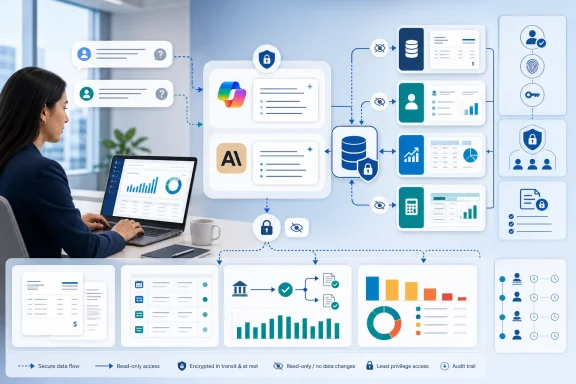
Billtrust announced its MCP Server on July 21, 2026, giving its accounts-receivable customers a way to query live invoice-to-cash information from Microsoft Copilot and Anthropic Claude using natural-language prompts. The initial release is designed for read-only analysis across invoicing, payments, cash application, and AR analytics rather than for autonomous changes to financial records.
For finance teams, the practical change is that AR questions can be asked inside the AI workspace they already use instead of requiring a separate Billtrust login, report export, or manual comparison of data sources. A CFO could request a quarter-end AR risk summary, while a collections manager could ask for accounts trending late and receive a prioritized response based on outstanding balances and days past due.
Billtrust says the MCP Server can combine Billtrust platform data with connected ERP, CRM, and FP&A sources. That matters because the most useful receivables questions often span more than one system: an invoice’s status may sit in an ERP, customer context in a CRM, and collections or payment behavior in the AR platform. MCP, or Model Context Protocol, provides the connection mechanism for an AI assistant to retrieve structured information from those systems.
The company describes the current access model as structured and read-only. AI tools receive the answers needed for a query rather than unrestricted raw-data access, according to Billtrust. Each customer’s data remains within its own environment, queries are recorded in an audit trail, and setup is tied to the organization’s existing identity provider.
Those safeguards are important, but they do not eliminate the normal governance work associated with connecting financial systems to generative AI. IT and finance administrators should still validate which users can invoke the connector, whether identity and role permissions carry through correctly, what data can appear in prompts and responses, and how audit records are retained and reviewed. Read-only access reduces the risk of erroneous updates, but inaccurate interpretation, overbroad access, or sensitive information shown in an AI conversation remain operational concerns.
Billtrust is also signaling that the connector will expand beyond analysis. The company plans to add an embedded Billtrust interface, a prompt library, and in-workspace actions such as sending collections outreach, applying payments, escalating disputes, and starting early-payment campaigns. Those capabilities are not part of the read-only foundation announced on July 21, so organizations should distinguish between what is available now and the transactional workflow features Billtrust says are forthcoming.
For Microsoft-oriented businesses, the announcement depends on the organization having both Billtrust and a supported Microsoft Copilot environment; it is not a general Windows feature or a standalone Copilot add-on. Microsoft has been expanding MCP-based third-party data connections in Microsoft 365 Copilot, making integrations such as Billtrust’s possible, but customer availability, licensing, administrative approval, and supported Copilot surfaces should be confirmed with Billtrust and Microsoft before deployment.
Billtrust’s “first AR platform” claim is a vendor claim, not an independently established industry certification. The more concrete development is the product capability: customers can connect Billtrust’s live AR intelligence to Claude and Microsoft Copilot for governed, read-only questions today, with action-oriented finance workflows planned for a later release.
For finance teams, the practical change is that AR questions can be asked inside the AI workspace they already use instead of requiring a separate Billtrust login, report export, or manual comparison of data sources. A CFO could request a quarter-end AR risk summary, while a collections manager could ask for accounts trending late and receive a prioritized response based on outstanding balances and days past due.
Billtrust says the MCP Server can combine Billtrust platform data with connected ERP, CRM, and FP&A sources. That matters because the most useful receivables questions often span more than one system: an invoice’s status may sit in an ERP, customer context in a CRM, and collections or payment behavior in the AR platform. MCP, or Model Context Protocol, provides the connection mechanism for an AI assistant to retrieve structured information from those systems.
The company describes the current access model as structured and read-only. AI tools receive the answers needed for a query rather than unrestricted raw-data access, according to Billtrust. Each customer’s data remains within its own environment, queries are recorded in an audit trail, and setup is tied to the organization’s existing identity provider.
Those safeguards are important, but they do not eliminate the normal governance work associated with connecting financial systems to generative AI. IT and finance administrators should still validate which users can invoke the connector, whether identity and role permissions carry through correctly, what data can appear in prompts and responses, and how audit records are retained and reviewed. Read-only access reduces the risk of erroneous updates, but inaccurate interpretation, overbroad access, or sensitive information shown in an AI conversation remain operational concerns.
Billtrust is also signaling that the connector will expand beyond analysis. The company plans to add an embedded Billtrust interface, a prompt library, and in-workspace actions such as sending collections outreach, applying payments, escalating disputes, and starting early-payment campaigns. Those capabilities are not part of the read-only foundation announced on July 21, so organizations should distinguish between what is available now and the transactional workflow features Billtrust says are forthcoming.
For Microsoft-oriented businesses, the announcement depends on the organization having both Billtrust and a supported Microsoft Copilot environment; it is not a general Windows feature or a standalone Copilot add-on. Microsoft has been expanding MCP-based third-party data connections in Microsoft 365 Copilot, making integrations such as Billtrust’s possible, but customer availability, licensing, administrative approval, and supported Copilot surfaces should be confirmed with Billtrust and Microsoft before deployment.
Billtrust’s “first AR platform” claim is a vendor claim, not an independently established industry certification. The more concrete development is the product capability: customers can connect Billtrust’s live AR intelligence to Claude and Microsoft Copilot for governed, read-only questions today, with action-oriented finance workflows planned for a later release.
 References
- Primary source: Financial IT
Published: 2026-07-22T15:50:08.604113
Billtrust Is the First AR Platform to Connect Live Invoice-to-Cash Intelligence to Claude and Microsoft Copilot
Billtrust, the B2B Cash Generation Platform, announced the launch of the Billtrust MCP Server, becoming the first AR platform to directly connect live invoice-to-cash intelligence to leading AI assistants via the Model Context Protocol (MCP). Finance teams can now query their live... financialit.net
- Related coverage: billtrust.com
Billtrust Launches First MCP Server for AR automation | Billtrust
Billtrust launches the first MCP server for AR automation. Get instant answers on cash flow and payment risk inside Claude and Copilot now. Learn more.www.billtrust.com - Official source: learn.microsoft.com
Release Notes for Microsoft 365 Copilot | Microsoft Learn
Lists the features that reach General Availability in each release of Microsoft 365 Copilot.learn.microsoft.com - Official source: cdn-dynmedia-1.microsoft.com
