

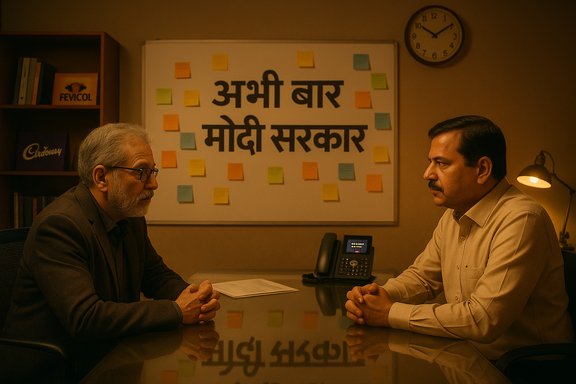
Piyush Goyal’s recent revelation — that the now‑ubiquitous 2014 election slogan “Abki Baar Modi Sarkar” almost never existed because advertising legend Piyush Pandey initially declined to work on the campaign — reframes a familiar story about political branding into a moment of human hesitation, principle and persuasion that helped shape modern Indian political communications. The anecdote, reported by Storyboard18, says Goyal spent seven hours convincing Pandey, who initially refused on principle because Ogilvy traditionally avoided direct political work; Pandey then called back the next morning and consented, saying “Yeh desh ki zaroorat hai”.
Piyush Pandey’s imprint on Indian advertising is enormous. Credited with making the vernacular “the language of Indian advertising,” Pandey’s body of work spans corporate icons such as Fevicol, Cadbury, Asian Paints — and, significantly, the 2014 political slogan that became a mass chant and a campaign architecture. Multiple outlets recount Pandey’s role in conceiving the line and his broader philosophy of simple, emotionally resonant messaging that speaks to ordinary people. The 2014 campaign’s success was not solely the result of a five‑word phrase, but the slogan functioned as a compact mnemonic that unified spokespeople, visuals, and a broader mobilization machine. Its value lay in rhythm, repetition and cultural idiom — factors Pandey had long honed in advertising. Contemporary coverage and retrospectives place Pandey’s authorship and influence at the center of how that campaign was remembered.
Pandey’s reported change of heart — framed as being motivated by purpose rather than partisan calculation — raises questions every agency must wrestle with:
Pandey’s work, by many accounts, was stylistically simple and linguistically open — which made it powerful — but those stylistic choices don’t relieve broader actors (campaign teams, party machines, platform distributors) of obligations to play fair in campaign ecosystems. Media saturation and the architecture of modern digital distribution amplify messages beyond the control of any individual creative.
Multiple retrospectives and obituaries attribute the slogan to Pandey and identify it as a turning point in the professionalization of Indian political advertising. The line’s success also demonstrated how corporate marketing discipline — A/B thinking, consistent creative assets, and omnichannel saturation — could be transplanted into political organizing.
Piyush Pandey’s legacy as a craftsman of vernacular persuasion is secure: his work reshaped advertising and contributed to a watershed political moment. But the anecdote also invites scrutiny: how do creative professionals decide when a political brief aligns with conscience and public interest? How should agencies guard reputation while preserving the right to work? And how should societies regulate the increasing professionalization of political persuasion?
Those debates will outlast any single slogan. They are the hard, necessary questions that arise when advertising’s craft meets politics’ stakes — and when five words have the power to echo across an electorate.
Source: Storyboard18 Piyush Goyal reveals ‘Abki Baar Modi Sarkar’ almost didn’t happen after Piyush Pandey initially said no
 Background: the slogan, the man, and why it still matters
Piyush Pandey’s imprint on Indian advertising is enormous. Credited with making the vernacular “the language of Indian advertising,” Pandey’s body of work spans corporate icons such as Fevicol, Cadbury, Asian Paints — and, significantly, the 2014 political slogan that became a mass chant and a campaign architecture. Multiple outlets recount Pandey’s role in conceiving the line and his broader philosophy of simple, emotionally resonant messaging that speaks to ordinary people. The 2014 campaign’s success was not solely the result of a five‑word phrase, but the slogan functioned as a compact mnemonic that unified spokespeople, visuals, and a broader mobilization machine. Its value lay in rhythm, repetition and cultural idiom — factors Pandey had long honed in advertising. Contemporary coverage and retrospectives place Pandey’s authorship and influence at the center of how that campaign was remembered. Overview: the Storyboard18 revelation and what it adds
- The Storyboard18 account reports Union Minister Piyush Goyal saying Piyush Pandey initially said no to the BJP’s request to craft the 2014 slogan, citing Ogilvy’s policy against working for political parties. After a seven‑hour meeting, Pandey still declined that night but rang back the next morning, saying the work was a national necessity — “Yeh desh ki zaroorat hai.” This anecdote frames the slogan not as an inevitable marketing artifact, but as the outcome of a moral decision by a creative professional.
- Independent reporting widely confirms that Pandey authored and led the creative direction of the 2014 catchphrase and that he had reservations about political work — a theme he has acknowledged in earlier interviews — but the specific detail of a seven‑hour meeting and the verbatim quote from Pandey as reported by Goyal appear primarily in the Storyboard18 piece and similar event coverage. Where broader reportage documents hesitance and Ogilvy’s rules, the Goyal anecdote adds a personal, behind‑the‑scenes flourish that has not been equally documented across major national outlets. That distinction matters for accuracy and for assessing the anecdote’s evidentiary weight.
Anatomy of a slogan: why “Abki Baar Modi Sarkar” worked
Simplicity and linguistic design
The slogan’s core strength was formal economy: five short Hindi words with a sing‑song cadence made it easy to repeat across languages and contexts. Pandey’s work historically relied on colloquial phrasing and everyday idiom to maximize recall and emotional resonance — a principle on display here. The slogan’s conversational tone avoided party jargon and instead sounded like a street‑level plea, which helped diffuse it beyond party rallies into marketplaces, sports channels, TV serials and social spaces.Brand discipline and campaign engineering
What elevated the phrase from a line to a movement was disciplined amplification:- Consistent visuals and colors across media.
- Coordinated placement on TV, radio, outdoor hoardings and grassroots literature.
- A unified “voice” across spokespeople, which turned the slogan into chantable refrain.
Emotional fit with a broader narrative
Slogans succeed when they resonate with an existing public mood. In 2014, the campaign pitched Modi as a decisive leader who offered development and governance competence — the slogan served as a unifying hashtag for that promise. Pandey later emphasized that the work was not magic; it succeeded because the political ground team and public sentiment had already primed an appetite for change. The slogan amplified a tide rather than creating it from nothing.Ethical contours: agencies, politics and the Ogilvy precedent
Why Pandey’s hesitation matters
Piyush Pandey’s initial reluctance — grounded in Ogilvy’s historical stance against directly working for political parties — is more than anecdote; it points to an institutional tension at the intersection of commerce, ethics and democracy. Many global and national agencies maintain policies limiting direct political work to protect reputations, preserve client neutrality, and avoid long‑term brand risk.Pandey’s reported change of heart — framed as being motivated by purpose rather than partisan calculation — raises questions every agency must wrestle with:
- When, if ever, is political work legitimately a public service?
- How do agencies protect editorial independence and avoid being co‑opted into partisan polarization?
- What governance and disclosure frameworks should govern creative professionals working on political assignments?
The line between persuasion and manipulation
Political advertising sits on a spectrum: informative persuasion on one end, manipulative messaging and targeted psychological nudges on the other. Effective slogans and tightly engineered campaigns can be democratically legitimate persuasion if they convey truthful, verifiable claims and foster informed choices. They cross ethical lines when they rely on factual distortion, targeted micro‑manipulation, or when the resources of the state are folded into partisan distribution.Pandey’s work, by many accounts, was stylistically simple and linguistically open — which made it powerful — but those stylistic choices don’t relieve broader actors (campaign teams, party machines, platform distributors) of obligations to play fair in campaign ecosystems. Media saturation and the architecture of modern digital distribution amplify messages beyond the control of any individual creative.
The impact: campaign mechanics, imitation, and legacy
From slogan to movement
The 2014 slogan didn’t just help a campaign—it became part of the cultural lexicon. Its repetition across contexts made it a symbol rather than an advertisement. That cultural migration is a defining characteristic of political slogans that endure: they become shorthand for a larger narrative and mobilize identity as much as policy.Multiple retrospectives and obituaries attribute the slogan to Pandey and identify it as a turning point in the professionalization of Indian political advertising. The line’s success also demonstrated how corporate marketing discipline — A/B thinking, consistent creative assets, and omnichannel saturation — could be transplanted into political organizing.
Cross‑border and cross‑campaign spillovers
The slogan’s form and mechanics made it an easy template for imitation. Exchange4media and other outlets noted how the cadence was even mimicked, in comedic or critical fashion, by other campaigns and public figures abroad — an example of political marketing language migrating across cultures. That imitation underscores both the portability of simple rhetorical frames and the risk that effective political communication techniques can be repurposed for contexts that differ dramatically in institutional checks and media standards.Critical analysis: strengths, dangers, and institutional lessons
Strengths — what the episode teaches communicators
- Design clarity: A five‑word slogan minimized cognitive load, maximizing recall and verbal transmission.
- Cultural fluency: Using colloquial Hindi (not party speak) expanded the audience beyond political insiders.
- Campaign engineering: Coordinated multimedia distribution made the message unavoidable, converting recall into momentum.
- Professional craft: Pandey’s discipline as a creative director put craft at the center of political persuasion, elevating the role of professional messaging in elections.
Dangers — democratic and reputational risks
- Agency neutrality vs. partisan work: Agencies that accept political clients risk losing commercial neutrality and attracting business or regulatory consequences. Leadership figures face personal reputational risk.
- Polarization and simplification: Slogans trade nuance for recall. When the public discourse becomes dominated by concise mantras, policy complexity is often flattened, making democratic accountability harder.
- Concentration of messaging power: Campaigns that combine disciplined creative with aggressive paid and earned media infrastructure can overwhelm oppositional voices, raising fairness concerns.
- Transparency and attribution: The opacity of paid amplification (and the growth of programmatic microtargeting) means that citizens may receive targeted persuasive content without clear disclosure. This undermines informed civic deliberation.
Institutional lessons for agencies and campaign managers
- Update governance: Agencies should codify political work policies, including approval gates, client‑blindness rules, and disclosure protocols.
- Apply ethical frameworks: Creative leaders should adopt a risk rubric assessing client intent, claims verifiability, and potential public harm.
- Preserve public interest norms: When political campaigns borrow commercial techniques, watchdogs and regulators must ensure those tools are used within legally and ethically defensible boundaries.
- Train creatives: Equip teams with ethics training to recognize when effective persuasion tips into manipulative practice.
The anecdote’s credibility and limits: what we can verify
- It is well‑documented across major outlets that Piyush Pandey provided creative direction and is widely credited with the slogan “Abki Baar Modi Sarkar.” This is affirmed repeatedly in obituaries and retrospective pieces.
- It is also established that Ogilvy historically maintained a cautionary stance on direct political work, and Pandey himself has publicly acknowledged the unusual nature of taking on a political assignment in earlier interviews.
- The specific claim that Piyush Goyal personally spent seven hours persuading Pandey, and that Pandey then phoned back the next morning saying “Yeh desh ki zaroorat hai”, is reported in Storyboard18 as part of event remarks. That anecdote adds a compelling human detail but, at the time of writing, does not appear widely corroborated across other major national outlets or archival records. Readers should treat the precise hours and the quoted phrase as a plausible but single‑source anecdote unless further confirmation emerges. In short: well sourced (Storyboard18) but not yet independently corroborated at scale.
Broader implications: political advertising, craft and the public sphere
The normalization of professional political marketing
Pandey’s involvement — and the subsequent professionalization of political messaging — marks a structural shift in Indian electoral politics. The transplantation of corporate brand techniques into campaigns raises questions about the balance of power between campaign infrastructure and civic institutions. Modern campaigns are not just rallies and manifestos; they are engineered perception machines. That reality requires new literacies among voters, journalists and regulators who must decode technique from substance.Memory, mythology and the maker’s agency
Stories like the Goyal‑Pandey anecdote contribute to political myth‑making. They humanize behind‑the‑scenes choices and can be read two ways: as evidence of a patriotic motive, or as a shaping of legacy that justifies partisan ends. For historians of communications, preserving the provenance of such claims matters: accurate archives and multi‑source corroboration protect the record from becoming a toolbox of unverifiable origin stories.The future of creative responsibility
As creative leaders increasingly shape civic narratives, the profession must articulate standards for political engagements. Those standards should include transparency, documentation of brief and claims, and retrospective audits when campaigns make verifiable factual assertions.Conclusion: what this story ultimately reveals
The Storyboard18 report that “Abki Baar Modi Sarkar” nearly didn’t exist because a creative titan initially declined the assignment reframes the slogan from an inevitability into a choice — a moral and professional crossroads. The episode underscores the power that individual creatives and agencies wield in democratic processes and the responsibilities that accompany that power.Piyush Pandey’s legacy as a craftsman of vernacular persuasion is secure: his work reshaped advertising and contributed to a watershed political moment. But the anecdote also invites scrutiny: how do creative professionals decide when a political brief aligns with conscience and public interest? How should agencies guard reputation while preserving the right to work? And how should societies regulate the increasing professionalization of political persuasion?
Those debates will outlast any single slogan. They are the hard, necessary questions that arise when advertising’s craft meets politics’ stakes — and when five words have the power to echo across an electorate.
Source: Storyboard18 Piyush Goyal reveals ‘Abki Baar Modi Sarkar’ almost didn’t happen after Piyush Pandey initially said no
