

The coming year will not be quiet for end‑user IT: agentic AI, baked‑in browser intelligence, and new classes of endpoint controls will reshape how knowledge workers interact with applications, how IT governs data, and where security investments land.
The desktop as a passive container is giving way to an active runtime: browsers and cloud‑streamed desktops are becoming assistant‑aware platforms, and AI agents are beginning to act on behalf of users inside managed environments. This is visible in product launches and platform roadmaps — notably Microsoft’s public preview of Windows 365 for Agents and the wider rollout of Copilot/agent features across Windows and Microsoft 365 — which position Cloud PCs as a controlled runtime for agentic workloads. At the same time, specialist security vendors and traditional endpoint players are converging on a new layer of controls aimed specifically at generative AI interactions: runtime prompt security, in‑browser DLP for prompts, and observability for agent actions. SentinelOne’s announced acquisition of Prompt Security is a high‑profile example of this trend and signals how security vendors are recomposing their stacks to include AI runtime protections. Taken together, these moves shift some of the most consequential end‑user risk and productivity questions from “which apps are installed” to “what agents can see, do, and learn” — and that will force a rethinking of policy, procurement, and monitoring in 2026.
Adoption will favor organizations that treat AI governance as an operational discipline — inventory, classify, enable, and audit — not as a binary policy choice. Vendors will continue to iterate quickly; the job for IT leaders is to design guardrails that let users work safely and productively, because the simplest path to eliminating shadow AI is giving users sanctioned tools that don’t get in the way.
Source: TechTarget How AI and the browser will change end-user IT in 2026 | TechTarget
 Background
The desktop as a passive container is giving way to an active runtime: browsers and cloud‑streamed desktops are becoming assistant‑aware platforms, and AI agents are beginning to act on behalf of users inside managed environments. This is visible in product launches and platform roadmaps — notably Microsoft’s public preview of Windows 365 for Agents and the wider rollout of Copilot/agent features across Windows and Microsoft 365 — which position Cloud PCs as a controlled runtime for agentic workloads. At the same time, specialist security vendors and traditional endpoint players are converging on a new layer of controls aimed specifically at generative AI interactions: runtime prompt security, in‑browser DLP for prompts, and observability for agent actions. SentinelOne’s announced acquisition of Prompt Security is a high‑profile example of this trend and signals how security vendors are recomposing their stacks to include AI runtime protections. Taken together, these moves shift some of the most consequential end‑user risk and productivity questions from “which apps are installed” to “what agents can see, do, and learn” — and that will force a rethinking of policy, procurement, and monitoring in 2026.Overview: what’s changing for end‑user IT in 2026
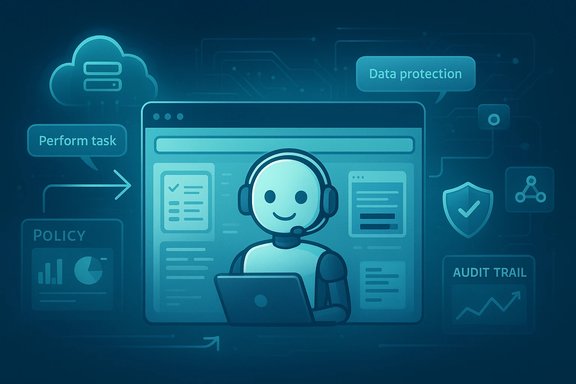
- Agents move from prototypes to managed runtimes. Agent workloads will increasingly be run inside auditable Cloud PCs and virtual desktops rather than ad‑hoc browser sessions. Microsoft’s Windows 365 for Agents public preview is explicitly designed to let organizations create, scale and govern agent sessions in a policy‑enforced Cloud PC model.
- Browsers become primary assistant surfaces. AI‑augmented browsers synthesize pages, keep persistent context (“memories”), and — in agentic modes — can automate multi‑step tasks like form fills or bookings. This turns the browser from a passive renderer into a potent execution layer with novel attack surfaces.
- Prompt security and GenAI DLP emerge as core controls. Runtime inspection of prompts and responses (prompt security), inline redaction/tokenization, and policy enforcement across browser and endpoint will be treated as first‑class security telemetry and control points. Vendor consolidation is already underway.
- Shadow AI governance becomes urgent. Multiple surveys and proprietary studies show significant unsanctioned AI use by knowledge workers; organizations will face pressure to offer safer sanctioned alternatives rather than rely solely on blocking. The ESG/TechTarget “AI at the Endpoint” research underlines the disconnect between IT perceptions and end‑user behavior.
Agentic AI: practical, immediate, and enterprise‑grade
What “agentic” means for end users
In enterprise practice, agentic AI is less about unconstrained autonomous systems and more about scripted or policy‑scoped assistants that can carry out multi‑step workflows: gathering information across tabs, filling forms, running queries in internal apps, and invoking connectors. These agents are already appearing in mainstream tooling and platform roadmaps. Microsoft’s Copilot Studio and related agent tooling aim to let non‑developers build agents that run with tenant governance and identity controls.Why Cloud PCs matter for agents
Running agents inside controlled Cloud PC environments gives organizations three immediate advantages:- Isolation and control. Agents execute in auditable, Intune‑managed VMs rather than on unmanaged user endpoints, reducing lateral credential exposure.
- Observability. Agent sessions can be logged and replayed; platforms expose session telemetry so IT and security can see what an agent did and why.
- Lifecycle governance. IT can provision, throttle, snapshot, and retire agent Runtimes centrally — a key for compliance in regulated verticals.
Implementation risks and mitigation
Agents that can act are materially different from assistants that only reply. The chief technical risks are:- Prompt injection and indirect prompt injection from ingested documents or web content.
- Credential or token exfiltration via agent‑initiated API calls.
- Unintended actions (e.g., erroneous transactions) due to brittle automation on dynamic web UIs.
Prompt security: the new control plane for generative tools
What prompt security does
Prompt security inspects prompts and responses in real time, enforces policies (block/redact/tokenize), and prevents attacks such as prompt injection and model‑mediated data leakage. Vendors like Prompt Security (now part of SentinelOne) are building runtime layers to monitor cross‑application AI interactions, whether in a browser, IDE, or API flow. Prompt security is to GenAI what EDR and DLP are to traditional endpoints: a focused enforcement point that understands the semantics of prompts and the unique failure modes of LLMs.How prompt security will integrate with existing controls
- EDR & EPP: will consume prompt metadata to correlate suspicious agent behavior with process and network activity.
- DLP & Purview‑style policies: will fold prompt inspection into data classification and enforcement, blocking or tokenizing sensitive fields before they leave the corporate perimeter.
- SIEM/SOAR: will ingest prompt events to automate playbooks for incident response around AI‑related leakage or exploitation.
Shadow AI: prevalence, perception gaps, and governance
The state of shadow AI
Research shows substantial unsanctioned AI adoption inside enterprises. The TechTarget/ESG “AI at the Endpoint” effort reports that a majority of end users admit to using unsupported AI tools for work tasks and that many believe their coworkers paste privileged data into unsanctioned tools. The same study reveals a meaningful mismatch between IT’s stated enforcement posture and end users’ experience of enforcement and trust. Independent surveys and industry commentary reinforce that shadow AI is widespread; a number of vendor and analyst studies in 2024–2025 reported that large fractions of employees use consumer AI tools and that a significant subset of those shares sensitive data. These corroborating signals make shadow AI both credible and urgent.Why blocking doesn’t scale
Blanket bans push users toward unsanctioned workarounds. Instead, organizations that offer safe, convenient, sanctioned alternatives — local inference options, tenant‑scoped agents, or inline protected assistants — see much better compliance and risk reduction. Policy and tooling must follow human workflows, not the other way around.Practical governance checklist
- Inventory actual AI usage (endpoints + browser telemetry + prompt logs).
- Classify workloads by sensitivity (local only, tenant cloud, or public cloud).
- Offer sanctioned alternatives with equivalent productivity (on‑device models, managed agents).
- Layer prompt security and DLP around sanctioned flows.
- Communicate clear, concrete guidance and run measurable pilot programs.
Productivity apps and the competitive shake‑up
The new playing field
Generative features have collapsed traditional product boundaries: office suites, creative platforms, and communications tools now overlap dramatically. Microsoft’s Copilot family, Google’s Gemini integration, and newer entrants with strong AI workflows create a multi‑vendor battle for the “assistant surface.”Canva and creative disruption
Canva’s Magic Studio and its Enterprise offering are credible challengers in the productivity mix: its low‑friction generative tools (Magic Design, Magic Media, Magic Write) and enterprise controls (SSO, Brand Kits, Canva Shield) make it easier for non‑creative knowledge workers to generate high‑quality assets quickly. Canva’s enterprise features — brand governance, admin controls, and indemnification for AI outputs at scale — make it feasible for large teams to adopt it beyond ad hoc use. The result: some workflows that historically began in Office or Google Docs will increasingly start in design‑first, AI‑driven creative platforms. That matters for procurement and security because it shifts sensitive content into a different set of vendors and clouds.What IT should do about app sprawl and integration
- Treat productivity platforms as part of the attack surface review — check model training, retention, indemnity, and admin controls.
- Evaluate connectors and integrate them into governance (who can publish, which data sources are allowed).
- Pilot multi‑vendor workflows to understand where policy friction occurs and where consolidation would actually help.
Autonomous IT: automation meets endpoint security
The vision and the vendors
Autonomous IT — automation that performs routine endpoint and workspace operations with minimal human intervention — is gaining traction. Vendors market solutions for autonomous patching, vulnerability triage, and incident remediation. The value proposition is removal of repetitive toil as environments proliferate in devices, OSes, and locations.What works today and what’s aspirational
- Proven gains: automated patch orchestration, targeted remediation playbooks, and self‑service remediation reduce ticket volume.
- Aspirational items: fully autonomous incident response that replaces human decision‑making in edge cases is not yet mature and carries risk without conservative human oversight.
Browser management and browser security: the new top priority
Why the browser matters more than ever
With a growing percentage of work delivered via web apps and AI assistants embedded in the browser, the browser has become the primary enterprise endpoint. Vendors across categories — enterprise browsers, remote browser isolation, virtualization, secure extensions, and zero‑trust network providers — are now competing to own the browser control plane. This elevates browser management from a desktop admin task to a core security and compliance priority.Key risks: extensions, agents, and zero‑click discovery
- Extensions remain a major vector for compromise; AI browsers add agentic behavior that can be tricked by prompt injection or adversarial web content.
- AI browsers create “zero‑click” discovery vectors where synthesized answers can remove referrals and concentrate economic control at assistant providers.
- Persistent context and memory increase the surface for leakage if default retention policies are permissive.
Controls that matter in 2026
- Enterprise‑managed browser builds and extension whitelists.
- Inline prompt DLP and enterprise prompt controls exposed to admins (e.g., Purview‑style policies).
- Remote browser isolation for high‑risk sessions.
- Allow/deny lists for agentic actions and mandatory step‑up authentication for cross‑system transactions.
Practical advice for IT and security teams
Short term (0–3 months)
- Inventory: capture which AI tools users actually use, not which tools are allowed.
- Pilot: stand up a controlled agent runtime (Cloud PC or VM) for high‑value automations.
- Train: run short, role‑specific training about “what not to paste” and safe AI usage.
Mid term (3–9 months)
- Deploy controls: add prompt filtering, inline DLP for AI interactions, and audited allow‑lists for agent connectors.
- Integrate telemetry: route prompt events into SIEM and EDR correlations.
- Update procurement: require vendor guarantees on non‑training of enterprise content unless explicitly contracted.
Longer term (9–18 months)
- Adopt hybrid model: local inference for the most sensitive workloads; managed cloud agents for standardized automations; public cloud for low‑sensitivity enrichment.
- Revisit identity: enforce strong authentication and per‑agent credentials; make agent actions auditable and revocable.
- Re‑architect workflows: where possible, design workflows so sensitive inputs stay local and only sanitized outputs cross vendor boundaries.
Strengths, opportunities and warning signs
Strengths and opportunities
- Productivity gains from collapsing multi‑step browsing and content tasks into agentic flows.
- Accessibility and UX improvements: summaries, voice, and multimodal interactions help diverse users.
- Operational elegance: running agents in Cloud PCs offers a tractable model for scaling safe automation.
Warning signs and risks
- Concentrated failure modes: agentic actions can convert content poisoning into operational incidents; indirect prompt injection is a real, observed attack vector.
- Regulatory and economic disruption: zero‑click answers and assistant‑led discovery could shrink referral traffic and create new regulatory scrutiny.
- Governance gap: the disconnect between IT perception and end‑user practice on shadow AI is large; policy without viable alternatives will fail.
What to watch in 2026
- Production rollouts of agent runtimes in regulated industries and the first security incidents tied to agentic browser actions.
- Enterprise adoption curves for integrated prompt security and GenAI DLP across major EDR and DLP vendors.
- Publisher and advertising market responses to AI browsers’ zero‑click dynamics.
- Maturation of local inference toolchains (WebGPU/WebLLM and on‑device copilot hardware) that shift privacy trade‑offs.
Conclusion
End‑user IT in 2026 will be defined less by the OS on the desktop and more by the policies and runtimes that govern assistants and browsers. The combination of managed Cloud PC agent runtimes, runtime prompt security, and enterprise‑grade browser management forms a coherent set of controls that can unlock the productivity of agentic AI while containing the obvious risks.Adoption will favor organizations that treat AI governance as an operational discipline — inventory, classify, enable, and audit — not as a binary policy choice. Vendors will continue to iterate quickly; the job for IT leaders is to design guardrails that let users work safely and productively, because the simplest path to eliminating shadow AI is giving users sanctioned tools that don’t get in the way.
Source: TechTarget How AI and the browser will change end-user IT in 2026 | TechTarget
