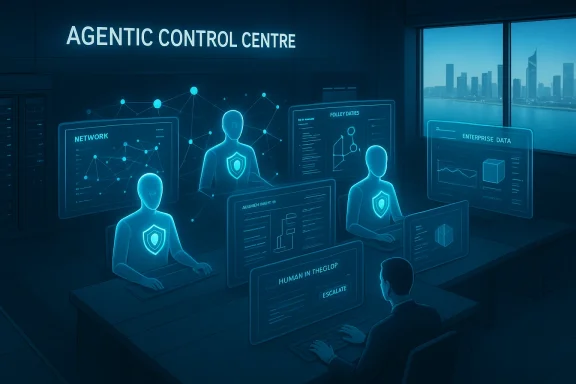
Microsoft used Web Summit Qatar 2026 to put a clear stake in the ground: agentic AI, governed enterprise platforms, and partner-built solutions on Microsoft Azure are the practical pathway Microsoft wants governments and large organizations in Qatar to follow — but the announcements also underline the governance, auditability, and local-capacity questions that will decide whether those promises become long-term public value or vendor-driven risk.
Microsoft leaders — including the company’s General Manager for Microsoft Qatar, Ahmad El Dandachi — emphasised the company’s long-standing partnership with Qatar and alignment with the country’s Digital Agenda 2030, while also pointing to ongoing investments in local cloud capacity, skilling programs, and partner ecosystems.
But healthy skepticism is required. Marketing materials and partner statements frequently highlight striking percentage gains and headline adoption figures without disclosing methods. Successful digital transformation in government is not just about platform capabilities — it is about transparency, auditability, long-term skills, and regulatory alignment. Technical wins (agentic orchestration, model routing, regional cloud capacity) must be matched by robust governance and independent verification of claimed outcomes.
At the same time, the published programme metrics and pilot success stories should be treated as programmatic claims that require transparent methodology and, where possible, independent validation. For IT leaders and policy-makers in Qatar and the wider region, the imperative is to pair speed with rigorous governance: demand measurement transparency, insist on identity- and audit-first architectures, and invest in skilling and certifiable validation workflows before scaling agentic systems into mission-critical services. That balanced approach is the difference between short-term headlines and durable, trustworthy digital transformation.
Source: Microsoft Source Microsoft at Web Summit Qatar 2026 - Source EMEA
 Background
What Microsoft announced at Web Summit Qatar 2026
Microsoft’s booth at the Doha Exhibition and Convention Center (February 1–4, 2026) showcased three headline elements: the Agentic Control Center on Microsoft Azure (demoing intelligent agents that monitor, recommend, and act autonomously or with human approval), AI360 (described as an enterprise AI accelerator unifying governance, learning, and adoption), and a partner showcase with Ghaia.ai demonstrating agentic scenarios for HR and procurement workflows. Microsoft framed these demos as the bridge from experimentation to production-ready AI that respects governance and security guardrails.Microsoft leaders — including the company’s General Manager for Microsoft Qatar, Ahmad El Dandachi — emphasised the company’s long-standing partnership with Qatar and alignment with the country’s Digital Agenda 2030, while also pointing to ongoing investments in local cloud capacity, skilling programs, and partner ecosystems.
Why it matters now
Public-sector and large-enterprise IT programs in the Gulf are explicitly moving beyond proofs of concept. The combination of rapid AI capability growth, national digital strategies, and the operational complexity of government services has produced an appetite for agentic systems that can orchestrate multi-step workflows — provided they can be governed, audited, and integrated with legacy systems. Microsoft’s demonstrations at Web Summit Qatar are an attempt to meet that demand with an integrated stack: Azure infrastructure, identity and governance primitives, and partner implementation playbooks.The technology on show: what to know
Agentic Control Center: promises and practicalities
Microsoft’s Agentic Control Center demo shows intelligent agents that can monitor environments, deliver real-time recommendations, and act either autonomously or under human approval through photorealistic avatars and map-based UIs. At a platform level, agentic systems require:- Identity-bound agents and scoped credentials for safe access.
- Grounding (contextual data and knowledge) to keep decisions business-relevant.
- Observability and immutable logging so actions are auditable.
AI360: an accelerator for enterprise adoption
AI360 is presented as an enterprise AI accelerator that unifies AI initiatives, governance, learning, and adoption insights into a single end-to-end experience. In short, AI360 is pitched as the organizational glue — not only a tooling layer but also a set of processes and metrics intended to move teams from experimental pilots to scaled rollouts. While Microsoft’s description emphasises unification and governance, the practical value for customers will depend on measurable adoption KPIs, integration patterns with existing identity and data governance, and the ability to export or audit all governance artefacts.Partner demos: Ghaia.ai and industry use cases
Microsoft’s partner showcase with Ghaia.ai demonstrated agentic AI applied to HR and procurement — from RFP generation and vendor evaluation to talent acquisition and onboarding. These are precisely the high-value, repetitive, multi-step processes where agents can deliver measurable time-savings if they are accurate and auditable. The regional event also highlighted sector pilots (energy, tourism, healthcare) that illustrate agentic AI’s cross-sector applicability.Verifying the claims: what’s documented and what’s vendor-reported
Microsoft and Qatar public-sector metrics
Public briefings connected to Microsoft’s regional programs include concrete figures: for example, the Qatar Adopt Microsoft Copilot programme reported figures such as roughly 9,000 active users, about 1.7 million Copilot-driven tasks, and an estimated 240,000 work hours saved during phase one. Multiple documents repeat these numbers as programme outcomes. However, these are company- and government-reported metrics and, while consistent across releases, are not accompanied by third-party audit reports or a publicly disclosed methodology that would allow independent verification of how headline numbers were calculated. Treat these as credible programme statements that still require methodological transparency to be independently validated.Agentic AI performance claims and pilot outcomes
Some partner pilots discussed at related regional summits include striking percentage improvements (for example, vendor materials attributed a 50% reduction in idle rig time for a drilling-scheduling pilot). Those pilot outcomes are corroborated across vendor and vendor-syndicated press copies, but again they appear as vendor-provided metrics without independent audits or detailed baseline definitions. Readers should therefore interpret such figures as indicative of potential value — but contingent on the release of measurement details and third-party verification.Strengths: where Microsoft’s approach has real upside
1) Architectural alignment with enterprise primitives
Microsoft’s strategy is pragmatic: reuse existing enterprise primitives — identity, RBAC, tenant-level controls, cloud regions — to lower the operational barrier. For organizations already standardized on Microsoft 365 and Azure, agent orchestration that integrates with Entra and Purview can materially reduce governance gaps compared with stitching multiple vendors together. This lowers friction for auditing, compliance, and single-sign-on requirements.2) End-to-end deployment playbooks and skilling
Microsoft and its partners are packaging not just software but deployment playbooks, governance templates, and skilling programs. Qatar’s public initiatives — including training through the Qatar Digital Academy and the expansion of Copilot adoption across ministries — are examples of this combined approach: technology plus workforce development. For governments, that integrated approach is essential for uptake and for building local capability.3) Local cloud capacity and data residency focus
Microsoft is investing in local cloud capacity (announced regional ambitions and Azure landing-zone approaches) that matter to governments operating under data residency rules. Onshore region capabilities reduce latency and help meet regulatory requirements when properly implemented. This is a pragmatic response to sovereign cloud concerns — though building an AI-grade region is infrastructure-heavy and multi-phased.4) Partner ecosystem that accelerates vertical use cases
Showcasing partners like Ghaia.ai demonstrates a funnel for industry-specific agentic solutions: system integrators and niche vendors can bring domain knowledge (e.g., procurement workflows or rig scheduling) while Microsoft provides the platform and governance scaffolding. This division of labor can accelerate time-to-value.Risks and caveats: what IT leaders must scrutinize
1) Metrics without transparent methodology
Headline metrics (users, tasks, hours saved, percent improvements) are useful but insufficient without a transparent methodology. Questions to insist on: What counts as a “Copilot-driven task”? How were time-savings measured and validated? Were there control groups? Without answers and independent audits, reported efficiencies remain vendor-reported outcomes, not independently verifiable evidence.2) Vendor lock-in and architectural coupling
The very benefits of integrated primitives — single-vendor identity, governance, and telemetry — can become lock-in risks. Organizations should explicitly evaluate the trade-offs between operational speed and long-term architectural flexibility, especially when procurement choices affect national digital sovereignty and vendor-dependence.3) Governance of autonomous agents
Agentic systems amplify consequences. A misconfigured agent can perform multi-step actions across HR, procurement, finance, or citizen services. Governance must include:- Scoped, ephemeral credentials for agent identities.
- Immutable audit trails and tamper-resistant logging.
- Model provenance and dataset lineage for decisions that affect citizens or finances.
- Fail-safe mechanisms and human-in-the-loop policies when confidence thresholds are breached.
4) Measurement, transparency, and public accountability
When agents influence public procurement or citizen-facing services, governments must ensure public accountability. That means open reporting on methodology, periodic third-party audits, transparency about datasets used for grounding, and the ability to explain and contest automated decisions. The absence of these elements threatens public trust.5) Energy, cost, and operational overhead
AI-grade regions, GPU clusters, and HPC infrastructure carry high energy and cost footprints. Governments and large enterprises must account for operating costs, renewable energy sourcing, and realistic TCO — not just upfront deployment speed. Success requires operational maturity and cost governance to prevent runaway expenses.Practical guidance: vetting and procurement checklist
If you are an IT leader or procurement officer evaluating agentic AI programs, consider this disciplined checklist:- Demand methodology disclosure for headline metrics and pilot outcomes (adoption rate, tasks counted, time-saved calculations). Require third-party or independent verification where possible.
- Insist on identity-first designs: agents must use short-lived credentials and integrate with enterprise identity management (Entra or equivalent).
- Require immutable, tamper-evident logs and a retention policy aligned with legal and audit requirements. Test those logs in red-team exercises.
- Validate model provenance: ask vendors to disclose model sources, fine-tuning datasets, and governance around training data used for agent grounding.
- Build human-in-the-loop thresholds: define which actions require explicit human approval, which can be performed automatically, and how escalation occurs when confidence is low.
- Negotiate SLAs and exit clauses that protect data portability — ensure your organization can extract data, governance artefacts, and audits if you change vendors.
- Model a realistic TCO that includes compute, energy, staff skilling, and audit costs before signing long-term commitments.
Case studies and illustrative pilots (what they teach us)
Qatar’s Copilot rollouts: skilling + scale
Qatar’s Adopt Microsoft Copilot programme — which expanded from an initial cohort into a larger phase two with training delivered through national skilling bodies — shows that technology rollouts are more successful when paired with structured training and Centre of Excellence models. The programme’s reported adoption statistics are encouraging, but the deeper lesson is organizational: success is as much about change management and capability-building as it is about software.Energy sector: Ghaia.ai + Microsoft in rig scheduling
Energy-sector pilots (for example, an agentic scheduling system involving Ghaia.ai and operator partners) point to immediate productivity gains where datasets and decision rules are well-defined. However, specific claims (like a 50% reduction in idle rig time) require careful scrutiny, including clarity on baseline definitions and measurement periods. The pilots are useful but need method transparency before being exported as a universal benchmark.Regulatory and policy angles: what governments should legislate or require
- Mandatory auditability: legal frameworks should require auditable trails for any automated decision-making used in public administration.
- Data-residency and sovereignty clauses: contracts should specify where data is stored and how cross-border transfer is handled, especially for citizen data.
- Certification and red-team testing: require independent validation (red teams, fairness testing, and safety testing) before agents enter production.
- Public transparency for high-impact agents: when agents affect procurement, benefits distribution, or citizen entitlements, publish non-sensitive aspects of the model provenance and decision logic.
How to read the marketing — balanced, pragmatic skepticism
Microsoft’s showcase at Web Summit Qatar 2026 is persuasive in one sense: it answers the recurring enterprise question, “How do we scale AI responsibly?” by offering an integrated platform, governance controls, and partner playbooks. That is real progress compared with ad‑hoc pilots.But healthy skepticism is required. Marketing materials and partner statements frequently highlight striking percentage gains and headline adoption figures without disclosing methods. Successful digital transformation in government is not just about platform capabilities — it is about transparency, auditability, long-term skills, and regulatory alignment. Technical wins (agentic orchestration, model routing, regional cloud capacity) must be matched by robust governance and independent verification of claimed outcomes.
Conclusion
Microsoft’s presence at Web Summit Qatar 2026 made one thing clear: agentic AI backed by a governed cloud platform is now the operational narrative vendors and governments are rallying around. The combination of Agentic Control Center, AI360, local Azure investments, and partner-built vertical solutions presents a credible route from pilot to production — especially for organizations already embedded in the Microsoft ecosystem.At the same time, the published programme metrics and pilot success stories should be treated as programmatic claims that require transparent methodology and, where possible, independent validation. For IT leaders and policy-makers in Qatar and the wider region, the imperative is to pair speed with rigorous governance: demand measurement transparency, insist on identity- and audit-first architectures, and invest in skilling and certifiable validation workflows before scaling agentic systems into mission-critical services. That balanced approach is the difference between short-term headlines and durable, trustworthy digital transformation.
Source: Microsoft Source Microsoft at Web Summit Qatar 2026 - Source EMEA