

Agentic AI has moved from marketing buzz to an engineering imperative: teams that want AI to do work—not just draft text—must design agents with planners, tools, memory, evals, and governance rather than relying on ever‑better prompts. rview
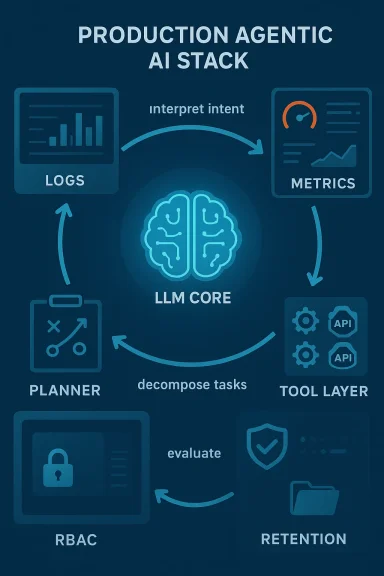
Agentic AI describes systems that set goals, plan, act, and iterate with limited human supervision. Unlike one‑shot generative models that return content when prompted, agentic systems implement a decision loop: interpret intent, decompose tasks, call tools or APIs, evaluate results, and repeat or escalate when necessary. This distinction is now explicit in vendor messaging and education: IBM frames agentic systems around autonomous, goal‑driven agents coordinated via orchestration, while modern practitioner curricula (e.g., DeepLearning.AI’s Agentic AI) teach the same core design patterns—planning, tool use, reflection, and multi‑agent orchestration.
The guide you provided underscores that same practical transition: shift from content generation to workflow execution, and build the operational scaffolding—tooling, evals, monitoring, and governance—that turns prototypes into safe, auditable
Agentic AI matters because it multiplies leverage. Where a human performs a sequence of tasks across tools and systems, an agent can:
The guide you provided is a practical handbook for that transition: it maps components, highlights evaluation as a core skill, and emphasizes governance and production readiness—exactly the priorities teams must internalize to move from demos to dependable digital teammates.
For readers building or operating agents today, the imperative is clear: treat agentic systems as software engineering plus operational risk management. When you do that, the promise of agents—faster workflows, fewer handoffs, and predictable business outcomes—moves from the lab into practical, auditable value.
Source: TheViralLines Mastering AI Agents & Agentic Systems (2026 Guide)
Agentic AI describes systems that set goals, plan, act, and iterate with limited human supervision. Unlike one‑shot generative models that return content when prompted, agentic systems implement a decision loop: interpret intent, decompose tasks, call tools or APIs, evaluate results, and repeat or escalate when necessary. This distinction is now explicit in vendor messaging and education: IBM frames agentic systems around autonomous, goal‑driven agents coordinated via orchestration, while modern practitioner curricula (e.g., DeepLearning.AI’s Agentic AI) teach the same core design patterns—planning, tool use, reflection, and multi‑agent orchestration.
The guide you provided underscores that same practical transition: shift from content generation to workflow execution, and build the operational scaffolding—tooling, evals, monitoring, and governance—that turns prototypes into safe, auditable
 Why Agentic Systems Matter: The Business Case
Agentic AI matters because it multiplies leverage. Where a human performs a sequence of tasks across tools and systems, an agent can:- Combine reasoning and tool calls to complete end‑to‑end workflows.
- Reduce handoffs and cycle time for repetitive, rules‑based decision processes.
- Surface consistent audit trails and decision traces when designed properly.
Core Architecture: The Components of a Production Agent
Most production agentic systems decompose into repeatable components. Here’s a concise architecture that is battle‑tested in enterprise pilots and emerging platform guidance:- LLM Core (Brain): Reasoning and natural language composition. Often multiple models are used (lightweight for parsing, larger models for complex planning).
- Planner / Orchestrator: Breaks goals into executable steps, sequences tool calls, manages retries, and allocates budgets.
- Tool Layer: Typed function interfaces that encapsulate external capabilities (APIs, databases, web automation, shell commands). Each tool defines inputs, outputs, error modes, and cost characteristics.
- Memory: Short‑term session memory for current task context and controlled long‑term memory for user/org knowledge, with clear retention policies and governance.
- Policy / Safety Layer: Approval gates, RBAC, PII filters, and action whitelists/blacklists. High‑impact actions require explicit escalation.
- Eval & Monitoring Stack: Unit and tool calls, policy checks, action logs, decision traces, and dashboards for performance and safety metrics.
Memory and State: Short vs Long Term
Memory must be engineered, not emergent. Short‑term memory (session traces) is essential for multi‑step plans; long‑term memory (preferences, account metadata) requires rigorous access controls and retention rules. Design patterns from enterprise platforms stress explicit data contracts and least‑privilege access for agent credentials. Failure to do so creates both privacy and compliance liabilities.Reliability & Safety: Evals, Guardrails, and Human‑in‑the‑Loop
The single biggest differentiator between a safe production agent and a dangerous experiment is evaluation discipline.- Evals as code: Unit tests for every tool call, regression tests for decision policies, policy checks for PII and harmful actions. Andrew Ng and other practitioner courses emphasize error analysis as the superpower of reliable agent builders.
- Runtime guardrails: Circuit breakers, backoff and retry logic, safe default execution modes (suggest vs. act), and runtime anomaly detecgates:* Define autonomy levels* per workflow (Level 1 = suggestions only, Level 2 = automated execution with approval, Level 3 = limited autonomous execution under strict policies). This keeps high‑impact actions under human control.
Tooling & The Practical Stack (2026 Reality)
In practice, agentic systems fail most often at integration boundaries—flaky APIs, permission errors, or unexpected data formats. The production checklist below addresses these operational realities:- Schema validation for every tool call (inputs/outputs).
- Retries with exponential backoff and circuit breakers.
- Safe‑mode execution for uncertain outpft instead of sending).
- Audit logs for every action with immutable trace IDs.
- Budget caps (token quotas, call limits) and cost observability.
- Secrets vaulting and least‑privilege credentials for agents.
Multi‑Agent Patterns: When to Use Multiple Specialized Agents
Multi‑agent architectures shine when tasks benefit from role separation, parallelism, or adversarial verification:- Planner + Researcher + Executor + Verifier: Role separation reduces single‑agent complexity and creates natural QA checkpoints.
- Parallel research agents: run multiple retrieval strategies concurrently and merge results.
- Red‑team verifier
 se job is to probe for hallucinations, bias, or policy violations before actions are taken.
Real‑World Examples: Where Agents Deliver Value
Below are realistic, high‑impact use cases organizations are already piloting.- Marketing Ops: generate campaign briefs, produce assets, run QA, schedule across channels, and produce performance reports.
- Customer Support: classify ticket → fetch account data → propose resolution → update CRM → escalate if needed.
- Finance: reconcile invoices → flag anomalies → prepare close packs for human approval.
- IT / SRE: incident triage → run diagnostics → propose remediation → open PR/rollback with operator confirmation.
- Healthcare (non‑clinical ops): form/document automation, triage admin tasks, and scheduling support with strict privacy constraints.
The AgentOps Playbook: Frotion
Operationalizing agents requires a staged, measurable approach.- Discover & Prioritize
- Catalog workflows, identify high‑volume, low‑risk targets.
- Map regulatory exposure and data dependencies.
- Architect & Govern
- Define autonomy levels, tool scopes, and approval gates.
- Establish logging, observability, and incident playbooks.
- Pilot with Strict Guardrails
- Start with recommendations only; instrument error analysis.
- Run red‑team adversarial tests focused on policy and safety failures.
- Iterate & Expand
- Add limited autonomous actions where teleme Standardize templates, tooling, and rollout patterns across teams.
- Scale & Optimize
- Introduce cost controls, model tiering, and lifecycle rules for agents.
Governance, Security & Privacy: The Non‑Negotiables
Agentic systems increase the attack surface. Practical controls include:- Least‑privilege identities for agents and Audit trails with immutable action logs and replayable decision traces.
- Secrets management and connector hardening.
- Data contracts for PII handling and controlled retention.
- Incident response playbooks that include rollback, disablement, and post‑incident analysis tied to decision traces.
Building a Hiring‑Grade Agent Portfolio (What to Show)
For teams and engineers demonstrating mastery, a deployable portfolio should include:- Architecture diagrams and component responsibilities.
- Tool specs with input/output schemas and error modes.
- Evals and error‑analysis reports and mitigation.
- Cost and latency notes per workflow.
- A demo (video or live) showing edge cases and recovery behavior.
- Governance artifacts: RBAC, retention rules, approval flows.
Website Strategy & Positioning for Agentic Products
If you sell agentic capabilities, your website must do more than hype features. Prioritize:- Clear statements of what workflows you automate and how autonomy levels map to real outcomes.
- “How it works” visuals sho→ approvals → audit trail.
- Safety and governance section that explains approvals, RBAC, and auditability.
- Demo flows and role‑based use cases to convert technical buyers.
- Technical SEO: definition blocks, FAQs, and fast Core Web Vitals to perform for 2026 search.
Vendor Landscape & Lessons from Major Players
- Google: Frames agentic AI as autonomous decision‑making systems and highlights the difference between chat‑only experiences and action‑oriented agents. This framing helps organizations move from prompt tinkering to architected systems.
- Microsoft: Copilot Studio and associated tooling provide low‑code agent builders, publishing channels, and centralized governance—helpful for enterprises but still requiring integration engineering at the connector level. Recent product writing and coverage emphasize “computer use” and UI automation to broaden tool reach.
- IBM & Enterprise Guidance: IBM explicitly defines multi‑agent orchestration and autonomy as central to agentic design, rei policy and orchestration layers.
Common Failure Modes & How to Avoid Them
- Overtrusting prompts: Prompts alone don’t create reliable agents. Build evals and safety checks first.
- Poor tool contracts: Undefined error modes and schema drift lead to silent failures. Validate and version tool schemas.
- Unbounded autonomy: Agents with broad scopes and no kill switches create compliance risks. Define autonomy levels and require approvals for high‑impact actions.
- Bad data in → bad decisions out: Garbage inputs break automated workflows; enforce data quality and provenance checks.
Practical Templates: A Minimal Production Checklist
- Define autonomy level for each workflow.
- Create tool spec documents: inputs, outputs, errors, rate limits.
- Implement unit and regression tests for tool calls.
- Add policy checks (PII, finance limits) that run pre‑action.
- Build observability: action logs, decision traces, and dashboards.
- Create a rollback plan and global kill switch.
- Train humans on supervision and escalation playbooks.
Conclusion: Build Agents Like Software, Govern Like Regulated Systems
Agentic AI shifts the question from “what prompts do we use?” to “how do we design resilient, auditable systems that take safe actions?” The technology stack—LLMs, tool rators—matters, but the decisive factors are evaluation discipline, integration rigor, and governance. Follow a staged AgentOps roadmap: start with tightly scoped pilots, instrument heavily, harvest lessons with error analysis, and expand autonomy only after safety signals are strong.The guide you provided is a practical handbook for that transition: it maps components, highlights evaluation as a core skill, and emphasizes governance and production readiness—exactly the priorities teams must internalize to move from demos to dependable digital teammates.
For readers building or operating agents today, the imperative is clear: treat agentic systems as software engineering plus operational risk management. When you do that, the promise of agents—faster workflows, fewer handoffs, and predictable business outcomes—moves from the lab into practical, auditable value.
Source: TheViralLines Mastering AI Agents & Agentic Systems (2026 Guide)
