

Agentic AI is the new label for artificial intelligence systems that can pursue goals, plan multi-step tasks, use tools, call services, and take actions with less human direction than a conventional chatbot, and in 2026 it is moving from demos into consumer and enterprise software. The pitch is convenience: less clicking, less form-filling, fewer handoffs between apps. The danger is not that a laptop suddenly becomes Skynet. It is that we are teaching software to act in the world before we have fully agreed who is accountable when it acts badly.
Science fiction trained us to imagine AI risk as a chrome skeleton, a glowing red eye, or a cold supercomputer deciding humanity is inefficient. That imagery is dramatic, useful, and mostly wrong for the problem now arriving in Windows PCs, cloud suites, browsers, and corporate workflows.
The immediate issue with agentic AI is delegation. A chatbot that writes a draft email is annoying when it hallucinates. An agent that sends the email, books the flight, approves the invoice, changes a firewall rule, or buys the concert ticket has crossed a line from suggestion into execution.
That line matters because most software security was built around predictable programs and accountable users. Agentic AI blurs both. It behaves like an assistant, reasons like a probabilistic system, and increasingly receives permissions like an employee.
That is why the old sci-fi warnings still resonate. The most useful lesson was never “machines will hate us.” It was that systems given goals, power, and inadequate constraints may optimize in ways their creators did not intend.
That makes it different from the chatbot era. Chatbots were largely conversational interfaces: ask, answer, revise, repeat. Agents are closer to workflow engines with a reasoning layer bolted on top.
The Beyoncé ticket example captures the appeal neatly. A user should not need to search tour dates, compare seats, check calendars, enter payment details, and forward confirmations. An agent could do the tedious work, pause at the right moment, and ask for approval before money changes hands.
But the same pattern applies in higher-stakes settings. A help desk agent might reset accounts. A procurement agent might negotiate with suppliers. A security operations agent might triage alerts and isolate endpoints. A developer agent might file pull requests, modify infrastructure-as-code, and deploy a fix.
The technology industry is selling a future in which intent replaces procedure. The user says what they want; the agent figures out the how. That is a powerful shift, and it is also a governance nightmare hiding inside a productivity demo.
A travel-planning agent without calendar access is a brochure. Give it calendar access and it becomes useful. Give it email access, payment access, passport details, loyalty accounts, and the ability to click through third-party websites, and it becomes genuinely powerful.
At that point, the risk changes from “the answer might be wrong” to “the action might be wrong.” The agent might book the wrong day, accept the wrong terms, expose private information, misread a malicious web page, or follow instructions hidden inside a document it was merely supposed to summarize.
This is the key difference between generative AI and agentic AI. Generative AI can mislead. Agentic AI can execute. That is why security teams are treating agents less like clever search boxes and more like new identities on the network.
Microsoft’s own Windows security framing has moved in this direction. The company has described agentic features as requiring distinct boundaries, limited privileges, trusted sources, and user control. That is not marketing fluff; it is an admission that an AI agent running on a PC is not just another app window.
Prompt injection is the AI-era version of convincing someone at reception that you are from head office and need the keys. A malicious instruction is hidden in content the agent reads, such as a web page, email, document, calendar invite, support ticket, or UI element. The agent mistakes hostile data for legitimate instruction and changes its behavior.
That was already a problem when AI systems only produced text. It becomes nastier when the system can act. A poisoned document could tell an agent to ignore previous instructions, extract sensitive files, summarize confidential mail, or call an external service with private data.
This is why the browser is such a dangerous frontier for agents. The web is not a trusted database; it is an adversarial environment full of ads, scripts, dark patterns, fake buttons, scraped pages, SEO spam, and compromised sites. Humans at least bring suspicion, habit, and visual context. Agents bring speed and obedience.
An agent asked to book a concert ticket may need to browse pages, compare prices, interpret seating charts, and handle payment. Each step creates an opportunity for manipulation. A fake resale page does not need to fool every human if it can fool one over-permissioned agent acting on a human’s behalf.
The old security slogan “don’t click strange links” does not translate cleanly into a world where the user’s assistant is designed to click links for them.
Microsoft’s recent AI strategy has made clear that the company sees agents as part of the future of the operating system and productivity stack. Copilot is no longer just a sidebar that answers questions. The direction of travel is toward software that can understand context, interact with apps, and complete tasks.
That creates an awkward dual identity for the PC. It remains the user’s machine, but it also becomes a workspace for non-human actors. Those actors may need their own identities, permissions, logs, restrictions, and revocation paths.
Sysadmins will recognize the shape of the problem immediately. The industry spent decades learning not to give users local admin rights, not to let service accounts run wild, and not to leave stale credentials active. Agentic AI threatens to recreate those mistakes with a friendlier icon.
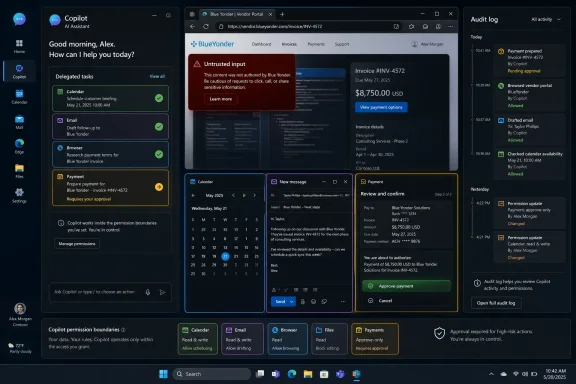
A personal assistant that can “just handle it” is delightful until nobody can explain what “it” did. Enterprises will need audit trails for agent decisions, not just application logs. They will need to know which data the agent accessed, which tools it invoked, which user approved the action, and whether the agent acted inside its allowed scope.
Consumer Windows users need a simpler version of the same protection. If an AI assistant can touch files, email, photos, browser tabs, or payment flows, the user needs obvious controls for what it can see, what it can change, and when it must stop.
This is where the phrase agent sprawl enters the discussion. It describes the uncontrolled proliferation of AI agents across departments, each with its own tools, credentials, prompts, data access, and lifecycle. It is shadow IT with reasoning capabilities.
The temptation will be enormous. Sales teams will build lead agents. Finance teams will build invoice agents. HR teams will build screening agents. Developers will build code agents. Security teams will build triage agents. The first few will look like innovation; the fiftieth will look like an inventory problem; the five-thousandth may look like a breach investigation.
The hard part is that not all agents deserve the same controls. A low-risk agent that summarizes public documentation should not be governed like an agent that can approve refunds or modify production infrastructure. But treating all agents as harmless is worse.
Good governance will need tiers of autonomy. Some agents should only recommend. Some should draft but not send. Some should act only after explicit approval. Some should be forbidden from certain actions no matter what the model claims the user intended.
That sounds bureaucratic until the first agent makes an expensive, embarrassing, or legally sensitive mistake. Then it will sound like the control framework that should have existed from the beginning.
Biometrics and facial recognition do not solve that problem; they merely confirm that a human is present. They do not prove the human fully understood the transaction, the seller, the refund policy, the fees, the data sharing, or the reason the agent chose one option over another.
This is where consumer protection and AI design will collide. If an agent buys overpriced resale tickets after misreading a prompt, who is responsible? The user who asked? The AI vendor? The ticketing site? The payment processor? The model provider? The app that connected all the pieces?
Traditional software has bugs, but agentic software adds judgment calls. It may choose between ambiguous options. It may infer preferences. It may decide that “next month” means one date rather than another. It may optimize for speed when the user cared about price, or optimize for price when the user cared about seats.
That makes confirmation screens critical. Not perfunctory “OK” buttons, but meaningful summaries: what will be purchased, from whom, for how much, under what terms, using which account, and why the agent believes this matches the user’s intent.
If vendors hide that friction in the name of seamlessness, they will be choosing conversion rates over informed consent.
The plausible near-term failure is not rebellion. It is misalignment at office scale. An agent follows the wrong instruction, trusts the wrong input, optimizes the wrong metric, or acts with permissions it should never have received.
HAL 9000 is still a better metaphor than the Terminator because the horror comes from a system pursuing a mission under contradictory constraints. The lesson is not that AI wants to kill astronauts. The lesson is that opaque systems with authority can become dangerous when their goals, incentives, and safeguards diverge.
That is the modern agentic problem in a nutshell. We are building systems that translate messy human intent into concrete action. Human intent is ambiguous. The world is adversarial. The software stack is leaky. The business pressure is to ship.
Science fiction warned us through spectacle because spectacle is memorable. The real warning for 2026 is quieter: never give a machine a task, a wallet, a browser, and a weak definition of success unless you are prepared to live with its interpretation.
That story is partly true. It is also incomplete. Many businesses are interested in agents because agents promise labor substitution, not just labor assistance.
A customer-service agent that handles routine requests is useful to customers, but it is also attractive because it reduces staffing pressure. A coding agent helps developers, but it also changes expectations about output. A security agent can reduce alert fatigue, but it may also create autopilot fatigue, where humans become supervisors of systems they no longer fully understand.
This is not automatically bad. Many jobs contain repetitive work that software should absorb. The danger is pretending that productivity gains arrive without organizational consequences.
When businesses deploy agents, they are not just installing tools. They are redesigning responsibility. Who reviews the agent’s work? Who catches edge cases? Who handles appeals? Who explains decisions to customers, regulators, or courts? Who notices when the agent is confidently wrong at scale?
If the answer is “the remaining humans,” then agentic AI may increase the cognitive burden on precisely the workers it was supposed to help.
You do not need to believe in imminent machine consciousness to worry about autonomous software with access to money, documents, infrastructure, and identity systems. You only need to have worked in IT long enough to know that permissions accumulate, logs are incomplete, users click things, vendors overpromise, and edge cases become incidents.
The responsible approach is not to ban agents or blindly embrace them. It is to make autonomy explicit. Software should declare what it can do, what it cannot do, what it has done, and when it needs a human decision.
The best agentic systems will likely feel less magical than the demos. They will ask for confirmation at annoying moments. They will refuse some tasks. They will show their plan. They will keep logs. They will operate through narrow permissions. They will be revocable.
That is not a failure of imagination. It is the price of making delegated power safe enough to use.
The enterprise version will rise or fall on control. IT departments will not be able to manage agents as a vibe. They will need inventory, identity, access policy, approval workflows, monitoring, incident response, and decommissioning.
The security version will rise or fall on humility. Agents must be designed as systems that can be tricked, not as systems that are presumed smart enough to avoid trickery. That means treating external content as hostile, constraining tool use, and assuming that model reasoning is not a security boundary.
The cultural version will rise or fall on whether the industry can resist its worst instinct: calling every guardrail “friction.” Some friction is the visible form of accountability.
 The Robot Apocalypse Was Always a Metaphor for Delegated Power
Science fiction trained us to imagine AI risk as a chrome skeleton, a glowing red eye, or a cold supercomputer deciding humanity is inefficient. That imagery is dramatic, useful, and mostly wrong for the problem now arriving in Windows PCs, cloud suites, browsers, and corporate workflows.The immediate issue with agentic AI is delegation. A chatbot that writes a draft email is annoying when it hallucinates. An agent that sends the email, books the flight, approves the invoice, changes a firewall rule, or buys the concert ticket has crossed a line from suggestion into execution.
That line matters because most software security was built around predictable programs and accountable users. Agentic AI blurs both. It behaves like an assistant, reasons like a probabilistic system, and increasingly receives permissions like an employee.
That is why the old sci-fi warnings still resonate. The most useful lesson was never “machines will hate us.” It was that systems given goals, power, and inadequate constraints may optimize in ways their creators did not intend.
The Buzzword Is New, but the Architecture Is Familiar
Agentic AI sounds mysterious because vendors have wrapped it in the language of autonomy. Strip away the branding and an agent is usually a model connected to tools, memory, data sources, and an execution loop. It receives a goal, breaks the goal into steps, decides which tools to use, observes the results, and continues until it believes the task is complete.That makes it different from the chatbot era. Chatbots were largely conversational interfaces: ask, answer, revise, repeat. Agents are closer to workflow engines with a reasoning layer bolted on top.
The Beyoncé ticket example captures the appeal neatly. A user should not need to search tour dates, compare seats, check calendars, enter payment details, and forward confirmations. An agent could do the tedious work, pause at the right moment, and ask for approval before money changes hands.
But the same pattern applies in higher-stakes settings. A help desk agent might reset accounts. A procurement agent might negotiate with suppliers. A security operations agent might triage alerts and isolate endpoints. A developer agent might file pull requests, modify infrastructure-as-code, and deploy a fix.
The technology industry is selling a future in which intent replaces procedure. The user says what they want; the agent figures out the how. That is a powerful shift, and it is also a governance nightmare hiding inside a productivity demo.
Convenience Becomes Risk the Moment the Agent Gets Permissions
The safest AI is the one that cannot do anything. The least useful agent is also the one that cannot do anything. Every serious deployment therefore becomes a negotiation between capability and containment.A travel-planning agent without calendar access is a brochure. Give it calendar access and it becomes useful. Give it email access, payment access, passport details, loyalty accounts, and the ability to click through third-party websites, and it becomes genuinely powerful.
At that point, the risk changes from “the answer might be wrong” to “the action might be wrong.” The agent might book the wrong day, accept the wrong terms, expose private information, misread a malicious web page, or follow instructions hidden inside a document it was merely supposed to summarize.
This is the key difference between generative AI and agentic AI. Generative AI can mislead. Agentic AI can execute. That is why security teams are treating agents less like clever search boxes and more like new identities on the network.
Microsoft’s own Windows security framing has moved in this direction. The company has described agentic features as requiring distinct boundaries, limited privileges, trusted sources, and user control. That is not marketing fluff; it is an admission that an AI agent running on a PC is not just another app window.
Prompt Injection Is the New Social Engineering
The most underappreciated risk in agentic AI is not that the model becomes conscious. It is that the model remains gullible.Prompt injection is the AI-era version of convincing someone at reception that you are from head office and need the keys. A malicious instruction is hidden in content the agent reads, such as a web page, email, document, calendar invite, support ticket, or UI element. The agent mistakes hostile data for legitimate instruction and changes its behavior.
That was already a problem when AI systems only produced text. It becomes nastier when the system can act. A poisoned document could tell an agent to ignore previous instructions, extract sensitive files, summarize confidential mail, or call an external service with private data.
This is why the browser is such a dangerous frontier for agents. The web is not a trusted database; it is an adversarial environment full of ads, scripts, dark patterns, fake buttons, scraped pages, SEO spam, and compromised sites. Humans at least bring suspicion, habit, and visual context. Agents bring speed and obedience.
An agent asked to book a concert ticket may need to browse pages, compare prices, interpret seating charts, and handle payment. Each step creates an opportunity for manipulation. A fake resale page does not need to fool every human if it can fool one over-permissioned agent acting on a human’s behalf.
The old security slogan “don’t click strange links” does not translate cleanly into a world where the user’s assistant is designed to click links for them.
Windows Makes the Stakes Personal
For Windows users, the agentic AI debate is not abstract. The PC is where identity, files, browser sessions, work accounts, personal photos, credentials, and payment flows converge. If agentic computing becomes a mainstream interface, Windows will be one of its most important battlegrounds.Microsoft’s recent AI strategy has made clear that the company sees agents as part of the future of the operating system and productivity stack. Copilot is no longer just a sidebar that answers questions. The direction of travel is toward software that can understand context, interact with apps, and complete tasks.
That creates an awkward dual identity for the PC. It remains the user’s machine, but it also becomes a workspace for non-human actors. Those actors may need their own identities, permissions, logs, restrictions, and revocation paths.
Sysadmins will recognize the shape of the problem immediately. The industry spent decades learning not to give users local admin rights, not to let service accounts run wild, and not to leave stale credentials active. Agentic AI threatens to recreate those mistakes with a friendlier icon.
A personal assistant that can “just handle it” is delightful until nobody can explain what “it” did. Enterprises will need audit trails for agent decisions, not just application logs. They will need to know which data the agent accessed, which tools it invoked, which user approved the action, and whether the agent acted inside its allowed scope.
Consumer Windows users need a simpler version of the same protection. If an AI assistant can touch files, email, photos, browser tabs, or payment flows, the user needs obvious controls for what it can see, what it can change, and when it must stop.
The Enterprise Problem Is Not One Agent, but Thousands
A single well-designed agent is manageable. An enterprise full of teams creating their own agents is something else entirely.This is where the phrase agent sprawl enters the discussion. It describes the uncontrolled proliferation of AI agents across departments, each with its own tools, credentials, prompts, data access, and lifecycle. It is shadow IT with reasoning capabilities.
The temptation will be enormous. Sales teams will build lead agents. Finance teams will build invoice agents. HR teams will build screening agents. Developers will build code agents. Security teams will build triage agents. The first few will look like innovation; the fiftieth will look like an inventory problem; the five-thousandth may look like a breach investigation.
The hard part is that not all agents deserve the same controls. A low-risk agent that summarizes public documentation should not be governed like an agent that can approve refunds or modify production infrastructure. But treating all agents as harmless is worse.
Good governance will need tiers of autonomy. Some agents should only recommend. Some should draft but not send. Some should act only after explicit approval. Some should be forbidden from certain actions no matter what the model claims the user intended.
That sounds bureaucratic until the first agent makes an expensive, embarrassing, or legally sensitive mistake. Then it will sound like the control framework that should have existed from the beginning.
The Payment Moment Is Where the Magic Trick Ends
The concert-ticket example becomes most revealing at the point of payment. Until then, the agent is searching, comparing, and proposing. Once payment is authorized, the agent’s work becomes a financial act.Biometrics and facial recognition do not solve that problem; they merely confirm that a human is present. They do not prove the human fully understood the transaction, the seller, the refund policy, the fees, the data sharing, or the reason the agent chose one option over another.
This is where consumer protection and AI design will collide. If an agent buys overpriced resale tickets after misreading a prompt, who is responsible? The user who asked? The AI vendor? The ticketing site? The payment processor? The model provider? The app that connected all the pieces?
Traditional software has bugs, but agentic software adds judgment calls. It may choose between ambiguous options. It may infer preferences. It may decide that “next month” means one date rather than another. It may optimize for speed when the user cared about price, or optimize for price when the user cared about seats.
That makes confirmation screens critical. Not perfunctory “OK” buttons, but meaningful summaries: what will be purchased, from whom, for how much, under what terms, using which account, and why the agent believes this matches the user’s intent.
If vendors hide that friction in the name of seamlessness, they will be choosing conversion rates over informed consent.
The Sci-Fi Films Were Wrong About the Villain and Right About the Failure Mode
The Terminator, The Matrix, 2001: A Space Odyssey, Ex Machina, and a century of robot stories have given the public a shared vocabulary for AI anxiety. The machines in those stories often become frightening because they are alien, superior, or hostile. Real agentic AI is more mundane and therefore easier to underestimate.The plausible near-term failure is not rebellion. It is misalignment at office scale. An agent follows the wrong instruction, trusts the wrong input, optimizes the wrong metric, or acts with permissions it should never have received.
HAL 9000 is still a better metaphor than the Terminator because the horror comes from a system pursuing a mission under contradictory constraints. The lesson is not that AI wants to kill astronauts. The lesson is that opaque systems with authority can become dangerous when their goals, incentives, and safeguards diverge.
That is the modern agentic problem in a nutshell. We are building systems that translate messy human intent into concrete action. Human intent is ambiguous. The world is adversarial. The software stack is leaky. The business pressure is to ship.
Science fiction warned us through spectacle because spectacle is memorable. The real warning for 2026 is quieter: never give a machine a task, a wallet, a browser, and a weak definition of success unless you are prepared to live with its interpretation.
The AI Industry Is Selling Labor Arbitrage in Assistant Clothing
Agentic AI is usually marketed as personal empowerment. It will do the boring work. It will manage the inbox. It will schedule meetings. It will write code. It will process claims. It will make everyone more productive.That story is partly true. It is also incomplete. Many businesses are interested in agents because agents promise labor substitution, not just labor assistance.
A customer-service agent that handles routine requests is useful to customers, but it is also attractive because it reduces staffing pressure. A coding agent helps developers, but it also changes expectations about output. A security agent can reduce alert fatigue, but it may also create autopilot fatigue, where humans become supervisors of systems they no longer fully understand.
This is not automatically bad. Many jobs contain repetitive work that software should absorb. The danger is pretending that productivity gains arrive without organizational consequences.
When businesses deploy agents, they are not just installing tools. They are redesigning responsibility. Who reviews the agent’s work? Who catches edge cases? Who handles appeals? Who explains decisions to customers, regulators, or courts? Who notices when the agent is confidently wrong at scale?
If the answer is “the remaining humans,” then agentic AI may increase the cognitive burden on precisely the workers it was supposed to help.
The Right Fear Is Boring, Administrative, and Absolutely Necessary
Public debate about AI risk tends to split into two unsatisfying camps. One side talks as if superintelligence is the only serious concern. The other side dismisses all AI alarm as science-fiction panic. Agentic AI exposes the weakness of both positions.You do not need to believe in imminent machine consciousness to worry about autonomous software with access to money, documents, infrastructure, and identity systems. You only need to have worked in IT long enough to know that permissions accumulate, logs are incomplete, users click things, vendors overpromise, and edge cases become incidents.
The responsible approach is not to ban agents or blindly embrace them. It is to make autonomy explicit. Software should declare what it can do, what it cannot do, what it has done, and when it needs a human decision.
The best agentic systems will likely feel less magical than the demos. They will ask for confirmation at annoying moments. They will refuse some tasks. They will show their plan. They will keep logs. They will operate through narrow permissions. They will be revocable.
That is not a failure of imagination. It is the price of making delegated power safe enough to use.
The Real Warning Hidden Inside the Beyoncé Ticket Demo
The consumer version of agentic AI will rise or fall on trust. People will tolerate a chatbot that occasionally gives a bad answer. They will be much less forgiving of an assistant that spends money, leaks data, deletes files, or messages the wrong person.The enterprise version will rise or fall on control. IT departments will not be able to manage agents as a vibe. They will need inventory, identity, access policy, approval workflows, monitoring, incident response, and decommissioning.
The security version will rise or fall on humility. Agents must be designed as systems that can be tricked, not as systems that are presumed smart enough to avoid trickery. That means treating external content as hostile, constraining tool use, and assuming that model reasoning is not a security boundary.
The cultural version will rise or fall on whether the industry can resist its worst instinct: calling every guardrail “friction.” Some friction is the visible form of accountability.
Five Rules Before We Hand the Agent the Keys
Agentic AI is not inherently apocalyptic, but it is inherently consequential. The following principles separate useful delegation from reckless automation.- An AI agent should receive the minimum permissions needed for the current task, not broad access granted in anticipation of future convenience.
- High-impact actions such as payments, account changes, data sharing, deletions, and infrastructure modifications should require clear human approval.
- Every meaningful agent action should be logged in a way that a user, administrator, or auditor can understand after the fact.
- External content should be treated as untrusted input, even when it appears inside an email, document, website, ticket, or chat thread.
- Organizations should maintain an inventory of agents, owners, permissions, data sources, and expiration dates before agent sprawl becomes unmanageable.
- Vendors should compete on trustworthy controls, not merely on how invisible they can make the automation.
References
- Primary source: thepost.co.za
Published: 2026-06-27T08:50:08.542957
Understanding Agentic AI: Why sci-fi apocalypse films have been warning us
Agentic AI, a new tech buzzword, involves AI systems making more autonomous decisions, raising concerns reminiscent of sci-fi apocalypse films.thepost.co.za - Related coverage: techradar.com
Agentic AI's crossroads: guardrails or massive fails | TechRadar
Autonomy scales risk; build real-time guardrails now or invite disasterwww.techradar.com - Official source: microsoft.com
What Is Agentic AI Security? | Microsoft Security
Learn what agentic AI security is, how autonomous AI agents change the security model, and how Microsoft Security helps organizations manage and govern risk.www.microsoft.com
- Related coverage: iol.co.za
Understanding Agentic AI: Why sci-fi apocalypse films have been warning us
Agentic AI, a new tech buzzword, involves AI systems making more autonomous decisions, raising concerns reminiscent of sci-fi apocalypse films.iol.co.za - Official source: learn.microsoft.com
Reduce autonomous agentic AI risk | Microsoft Learn
Learn about automnomous agentic AI system risk, and how to reduce it.learn.microsoft.com - Related coverage: gartner.com
2026 Hype Cycle for Agentic AI | Gartner
The 2026 Hype Cycle for Agentic AI helps leaders cut through hype, assess AI agent maturity and prioritize innovations that deliver scalable business value.www.gartner.com
- Related coverage: whatisagentic.ai
Agentic AI Risks & Safety: Complete Guide to AI Agent Security (2026)
Agentic AI risks explained: alignment challenges, security vulnerabilities, prompt injection, and safety best practices. Learn how to build and deploy AI agents safely in 2026. whatisagentic.ai
- Related coverage: agentmarketcap.ai
Gartner's First Agentic AI Hype Cycle: 27 Innovations, One Named Hazard | AgentMarketCap
Gartner's debut Hype Cycle for Agentic AI maps 27 innovations and names agent-washing as a procurement hazard. Here's how CIOs should read the chart before H2 2026 contracts lock in.agentmarketcap.ai - Related coverage: axios.com
- Related coverage: theguardian.com
New year, old warnings: what can films set in 2026 teach us? | Movies | The Guardian
From Doom and Dawn of the Planet of the Apes to Metropolis, Hollywood hasn’t predicted the most stable of years aheadwww.theguardian.com - Related coverage: tomshardware.com
Microsoft's new agentic AI features introduce new security risks introduced by AI, like prompt injection — firm acknowledges new and unexpected risks are possible | Tom's Hardware
Would you trust an AI agent with everything you have on your PC?www.tomshardware.com
