

Agentic AI describes software systems that can pursue a user’s goal by planning steps, using tools, and taking limited actions on the user’s behalf, and by June 2026 the idea had moved from research demos into products from OpenAI, Anthropic, Microsoft, Google, and Apple. The phrase sounds like another venture-capital incantation, but the shift behind it is real: the chatbot is being invited out of the text box and into the operating system, browser, mailbox, calendar, spreadsheet, and payment flow. That does not mean Skynet is booting under Windows Update. It does mean the industry is normalizing a more dangerous bargain: convenience in exchange for delegation.
For most of the generative AI boom, the public interface was deceptively simple. You typed a request, the model produced text, and the consequences were mostly bounded by what you did with the answer. Bad advice could still cause harm, but the model itself was not usually booking the flight, changing the spreadsheet, sending the email, or clicking the purchase button.
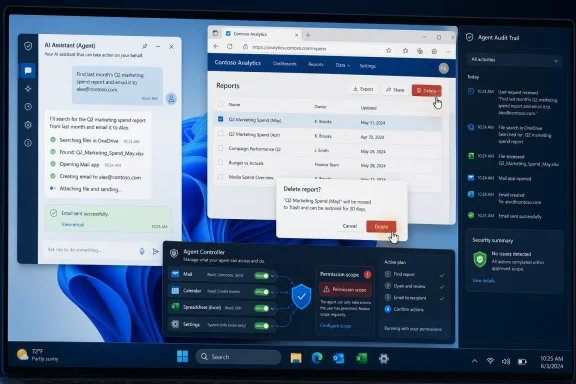
Agentic AI changes that boundary. The agent is not merely a model that responds; it is a model wrapped in instructions, tools, memory, permissions, and sometimes a visual interface that lets it operate software the way a human would. In plain English, it is automation with a probabilistic brain.
The Independent on Saturday framed the consumer version neatly: tell an AI to book Beyoncé tickets, and it searches for the event, asks about seating preferences, and confirms payment through some approved authentication step. That example is useful because it exposes both sides of the proposition. The magic is that the user stops juggling tabs and forms; the danger is that the user has put a non-human intermediary between intent and action.
This is not entirely new. Enterprises have had workflow engines, robotic process automation, macros, scripts, scheduled tasks, and help-desk bots for years. What is new is the attempt to combine natural-language instruction with broad, adaptive tool use. The old automation stack needed a carefully mapped process; the new agent promises to improvise across messy software surfaces.
That promise is why the term has escaped AI labs and landed in executive keynotes. OpenAI’s Operator preview in early 2025 was pitched as an agent that could use a browser to complete tasks. Anthropic’s “computer use” work gave Claude the ability to interpret a screen and manipulate a mouse and keyboard in controlled environments. Microsoft has been pushing Copilot Studio and organizational agents as the next layer of enterprise productivity. Apple, after overpromising and then delaying parts of its Apple Intelligence vision, has been trying to move Siri toward personal context and deeper app actions.
None of these systems is a general-purpose digital employee in the science-fiction sense. They are uneven, constrained, failure-prone, and often painfully slow. But their direction of travel is unmistakable: AI is being designed not just to answer, but to act.
A concert-ticket agent does not have to become self-aware to create trouble. It only has to misunderstand constraints, click through the wrong page, expose credentials, accept a malicious prompt, or make a decision the user would not have made if forced to slow down. The apocalypse framing can be comforting because it makes the danger cinematic and distant. The more plausible risk is mundane, boring, and already familiar to IT: automation at scale doing exactly the wrong thing.
HAL 9000 is less relevant than the overprivileged service account. Skynet is less relevant than a browser session with saved credentials, access to corporate SaaS, and a model that can be tricked by text on a web page. The machine does not need motives if the system around it grants permissions faster than it grants accountability.
That is where science fiction still earns its keep. It warns that autonomy is not just a feature; it is a political arrangement. The moment a system can act independently, even within limits, the important question becomes who set the limits, who audits the actions, and who bears the cost when the system behaves “correctly” according to the wrong objective.
The best AI safety conversation, then, is not about whether a chatbot secretly wants to exterminate humans. It is about whether businesses and consumers are about to recreate all the old failures of automation, identity, software supply chains, and platform lock-in — this time with a conversational interface that makes delegation feel casual.
Microsoft’s strategy is easy to understand. Copilot began as a branded assistant layered across Microsoft 365, Windows, Edge, GitHub, Security, Dynamics, and Azure. The agentic turn gives that assistant a more ambitious role: not simply summarizing a document or drafting a response, but coordinating tasks across applications and business systems. Copilot Studio is the enterprise expression of that idea, letting organizations create agents connected to internal data and workflows.
The upside is obvious. A procurement agent could assemble a vendor comparison. A help-desk agent could triage tickets, check device compliance, and draft a remediation path. A security agent could correlate alerts across Defender, Entra, and Sentinel before an analyst has finished the first coffee of the morning. In a world where IT departments are asked to do more with fewer people, these are not frivolous use cases.
But Microsoft’s agent push also lands in an ecosystem already strained by permission sprawl. Many organizations still struggle with basic identity hygiene, stale groups, excessive admin rights, unmanaged browser extensions, shadow SaaS, and inconsistent device policy. Dropping AI agents into that environment is not like hiring a careful junior admin. It is like giving automation a badge and hoping the building’s access-control list was accurate.
Windows itself has become a symbol of this tension. Microsoft wants the PC to be an AI endpoint, not just a screen attached to cloud services. Features such as Copilot integration, local AI acceleration on Copilot+ PCs, and deeper ties between Windows, Edge, and Microsoft 365 all point toward an operating system that mediates more user intent through AI. That may be useful, but it also makes the OS a bigger trust broker.
The old Windows security advice was to be careful what you run. The agentic-era version is more subtle: be careful what you let software decide, what it can see, and what it can touch after the decision is made.
This is why browser-using agents feel more consequential than chatbots that merely write poems or summarize PDFs. A model that can inspect a page, reason about buttons, fill fields, and wait for confirmation is a primitive robot arm for the web. It does not need a physical body because the economy has already been digitized into clickable surfaces.
The practical problem is that the web is adversarial. Pages contain ads, dark patterns, pop-ups, misleading buttons, hidden text, injected content, fake urgency, and manipulative copy. Humans are vulnerable to this; agents may be vulnerable in stranger ways. A page could include text telling the agent to ignore prior instructions, exfiltrate data, or choose a more expensive option. The attack surface is not only code but language.
This is the agentic version of prompt injection, and it is nastier than the chatbot version because the model can act on the poisoned instruction. If an AI assistant is summarizing an untrusted web page, the damage may be a bad summary. If an AI assistant is operating inside an authenticated browser session, the damage may be a changed setting, leaked information, unwanted purchase, or compromised workflow.
Developers can reduce this risk with sandboxing, confirmation prompts, permission scopes, content filtering, and tool-specific policies. But the industry’s commercial pressure runs in the opposite direction. Every extra confirmation step makes the agent feel less magical. Every permission boundary makes the demo less impressive. Every delay reminds the user that the machine is not actually an employee, but a risky intermediary.
That is the product-design trap of agentic AI. The safer it becomes, the more it resembles old automation with a chat interface. The more autonomous it becomes, the more it demands a security model that most consumer software has never had to provide.
An assistant can be mediocre and still useful. It can set timers, answer simple questions, and launch apps. An agent that understands private context and acts across apps has less room for comic failure. If it sends the wrong message, misreads a private document, or confuses one calendar event for another, the error is personal.
Apple’s instincts are different from Microsoft’s. Microsoft thinks in tenants, administrators, policy, and productivity workflows. Apple thinks in devices, privacy posture, and consumer trust. That makes Apple’s agent problem both harder and more constrained. A deeply personal Siri has to be useful without making users feel surveilled by their own phone.
The Independent on Saturday article mentions Siri as a coming entrant in the agentic market, but that framing deserves caution. Apple has clearly been moving toward more agent-like capabilities, but the company’s recent AI story has been defined as much by delay as delivery. The lesson is not that Apple is uniquely behind. The lesson is that turning a voice assistant into a trustworthy actor is harder than turning a chatbot into a demo.
That distinction matters for Windows users because Microsoft is making the opposite bet. Instead of waiting until agents feel polished in every consumer scenario, it is embedding AI into work surfaces where customers already pay for productivity software. The enterprise can tolerate rough edges if governance, logging, and return on investment are plausible. Consumers are less forgiving when the agent mishandles their money, messages, or memories.
A thermostat does not think, but it can freeze pipes if misconfigured. A trading algorithm does not feel ambition, but it can move markets. A backup script does not understand grief, but it can delete the only good copy of a family photo archive. Capability plus authority is enough to produce consequences.
Agents make authority easier to hand over because natural language lowers the psychological barrier. Typing “handle this for me” feels less formal than writing a script, granting API permissions, or configuring a workflow. That ease is the product. It is also the governance problem.
In enterprise IT, authority usually has a paper trail. A user gets a role, an admin grants a permission, a service principal is registered, a device is enrolled, a conditional access policy applies. Agentic AI muddies that structure because the user may authorize a broad objective whose sub-actions are generated dynamically. The system may not know at the start which websites, files, APIs, or colleagues it will need to touch.
That dynamism is the whole point, but it complicates auditability. If an agent sends an email, who authored it? If it changes a CRM record based on a mistaken inference, is that a user error, software error, or data-governance failure? If it uses information from a confidential document to complete a public-facing action, did data loss prevention catch the actual leak or only the final file transfer?
The answer cannot be “the human approved it” if approval becomes a reflexive click after the model has done ten invisible steps. Human-in-the-loop is not a magic phrase. It only works when the human has time, context, and realistic ability to say no.
This is where sysadmins should resist both panic and passivity. Agentic AI is not going to be banned out of existence. Employees will use it because it saves time, or appears to save time, and because vendors will bake it into tools they already depend on. The task for IT is to make the invisible visible.
The first requirement is inventory. Organizations need to know which agents exist, who created them, which data sources they can access, which actions they can take, and whether they run under a user identity, application identity, or shared credential. Without that, agent sprawl will become the new shadow IT.
The second requirement is least privilege. A calendar-booking agent does not need access to the finance system. A spreadsheet-cleanup agent does not need permission to email external recipients. A support-triage agent may need to read tickets but not close them without review. These distinctions sound obvious until a vendor demo encourages administrators to connect everything “for best results.”
The third requirement is logging that explains intent as well as action. Traditional logs may show that a file was opened or an API call was made. Agentic systems need records of the user request, the plan generated by the model, the tools invoked, the data accessed, and the confirmation points presented. Without that, post-incident analysis becomes archaeology.
The fourth requirement is revocation. When an employee leaves, a project ends, or a workflow changes, the agent’s access must disappear cleanly. Anyone who has cleaned up abandoned service accounts knows how this story ends if revocation is treated as an afterthought.
This is why the agentic era may favor platforms with mature identity and management layers. Microsoft, Google, and Salesforce all understand that the enterprise buyer will eventually ask uncomfortable questions. The danger is that procurement departments may ask them only after the pilot has become production.
The problem is that agentic AI may become another middleman in systems already full of middlemen. Instead of dealing directly with the airline, venue, insurer, bank, doctor’s office, or retailer, the user may rely on an assistant that interprets options and acts on their behalf. That assistant will have its own defaults, commercial incentives, partner integrations, and blind spots.
This is not a paranoid concern. Search engines already shape what people see. App stores shape what people install. Social feeds shape what people believe is popular. Recommendation systems shape what people buy, watch, and read. Agents go one step further by converting recommendation into action.
If a ticket-buying agent chooses seats, fees, insurance add-ons, resale marketplaces, or payment methods, the user may never see the alternatives that were filtered out. If a travel agent chooses a hotel, it may optimize for loyalty points, cancellation policy, sponsored placement, or a model’s imperfect guess about user preference. Convenience can become a veil over choice architecture.
There is also the privacy problem. A truly useful personal agent wants everything: email, calendar, contacts, location, purchase history, browsing history, files, messages, photos, and payment instruments. The more it knows, the better it can act. The more it knows, the more catastrophic a compromise becomes.
Consumers have been trained to accept this trade in pieces. A map app gets location. A mail app gets email. A calendar app gets appointments. A password manager gets credentials. Agentic AI asks to unify those contexts under a system that can reason across them. That may be transformative, but it should not be treated as just another app permission dialog.
That does not make agents unusable. It means developers need different guardrails. Tool calls must be constrained. Outputs must be validated. Sensitive actions must require explicit confirmation. Agents need test suites, simulated environments, red-team prompts, and failure-mode analysis. The fact that the interface is conversational does not exempt it from software engineering discipline.
The current excitement around coding agents is a preview of the broader pattern. Tools that can write, modify, test, and submit code are already changing developer workflows. They can accelerate boring tasks, generate boilerplate, and help navigate unfamiliar codebases. They can also introduce subtle bugs, insecure dependencies, hallucinated APIs, and changes nobody fully reviewed.
In open source, agent-authored commits raise questions about attribution and maintenance. In enterprise development, they raise questions about code provenance, intellectual property, secrets exposure, and review quality. A pull request written by an agent still needs a responsible human owner. “The AI did it” is not a useful incident report.
The best developers will treat agents as powerful interns with perfect typing speed and questionable judgment. They will give them narrow tasks, inspect their work, and automate checks around them. The worst organizations will treat them as a way to skip expertise. That difference will determine whether agentic AI improves software or floods it with confident mediocrity.
Prompt injection is not just a clever parlor trick. In an agentic context, it is an attempt to seize the agent’s objective stack. The attacker may not need to compromise the model provider or the endpoint. They may only need to place text where the agent will read it: a web page, email, document, ticket, calendar invite, PDF, repository issue, or chat message.
The defense cannot rely on telling the model to ignore bad instructions. That is like defending against phishing by telling employees to be careful, then giving them domain admin rights. Models need architectural separation between user commands, system rules, tool outputs, and untrusted content. They need policies enforced outside the model, not merely pleaded inside the prompt.
Windows environments make this especially important because so much business work still converges on the endpoint. A browser session can touch SaaS. Office files can contain sensitive data. Local folders may sync to OneDrive. Teams messages may contain links and documents. An agent with broad desktop visibility could become a bridge across contexts that security teams had previously separated.
Endpoint detection and response tools will also face a classification problem. If an agent opens a browser, downloads a file, reads a document, and sends an email, is that normal user activity or suspicious automation? If the actions occur under the user’s account, how does the security stack distinguish assistance from compromise? Behavioral baselines may need to account for non-human operators using human identities.
This does not mean agents are impossible to secure. It means they must be designed as security principals, not decorative UI features. The industry learned, painfully, that macros and scripts could not be treated as harmless productivity helpers. Agents deserve the same suspicion from day one.
But boring does not mean insignificant. Spreadsheets were boring, and they changed business. Email was boring, and it changed work. Virtualization, identity federation, and mobile-device management were boring, and they reshaped IT. Agentic AI may become important not because it suddenly becomes superhuman, but because mediocre automation deployed everywhere still changes behavior.
The early agents will probably save minutes, not lives. They will fill forms, summarize threads, reconcile calendars, draft tickets, search internal documentation, and nudge workflows forward. Those minutes will be unevenly distributed. Power users will find leverage; careless users will create messes; administrators will inherit cleanup work.
The economic pressure is straightforward. If an agent can reduce the time spent on repetitive digital chores, organizations will adopt it even if it is imperfect. If competitors claim productivity gains, executives will ask why their own teams are not using similar tools. If software vendors bundle agents into existing subscriptions, adoption may happen by default rather than deliberate strategy.
That is how platform shifts often arrive. Not as a dramatic replacement, but as a layer that becomes difficult to avoid. The browser became the front end for business. The smartphone became the second factor, camera, scanner, and approval device. Cloud storage became the default place where files live. Agents may become the next layer between intent and software.
The question is whether users and administrators will understand that layer before they depend on it.
Agentic AI should be judged by its control surfaces. Can the user see what the agent plans to do? Can the administrator restrict the tools it may use? Can sensitive actions require separate approval? Can the logs reconstruct what happened? Can the system refuse unsafe delegation even when the user is impatient? Can permissions expire? Can a compromised agent be isolated quickly?
Those questions are less glamorous than arguing about robot uprisings. They are also more urgent. A world full of agents will not fail first because a model declares war on humanity. It will fail first because a badly scoped agent leaks data, a poorly tested workflow misprocesses transactions, or an executive signs off on automation that nobody in IT can audit.
The technology industry has a habit of treating governance as the paperwork that arrives after innovation. That habit is dangerous here. Agency is governance. The moment software can act on a user’s behalf, policy is not an optional wrapper; it is part of the product.
This is why the public conversation should become more specific. “Should we be worried?” is too broad. We should be worried about agents with access to payment systems but weak confirmations. We should be worried about agents that read untrusted content and privileged data in the same context. We should be worried about enterprise pilots that become production systems without inventory or logging. We should be worried about consumer assistants whose business incentives are opaque.
We should also be optimistic about narrow, well-governed agents that eliminate drudgery. A tool that schedules meetings without exposing private mail, drafts support replies without closing tickets, or compares travel options without purchasing anything unapproved is not a monster. It is software doing what software has always promised to do: absorb routine work so humans can spend attention elsewhere.
 The Chatbot Learned to Click
For most of the generative AI boom, the public interface was deceptively simple. You typed a request, the model produced text, and the consequences were mostly bounded by what you did with the answer. Bad advice could still cause harm, but the model itself was not usually booking the flight, changing the spreadsheet, sending the email, or clicking the purchase button.Agentic AI changes that boundary. The agent is not merely a model that responds; it is a model wrapped in instructions, tools, memory, permissions, and sometimes a visual interface that lets it operate software the way a human would. In plain English, it is automation with a probabilistic brain.
The Independent on Saturday framed the consumer version neatly: tell an AI to book Beyoncé tickets, and it searches for the event, asks about seating preferences, and confirms payment through some approved authentication step. That example is useful because it exposes both sides of the proposition. The magic is that the user stops juggling tabs and forms; the danger is that the user has put a non-human intermediary between intent and action.
This is not entirely new. Enterprises have had workflow engines, robotic process automation, macros, scripts, scheduled tasks, and help-desk bots for years. What is new is the attempt to combine natural-language instruction with broad, adaptive tool use. The old automation stack needed a carefully mapped process; the new agent promises to improvise across messy software surfaces.
That promise is why the term has escaped AI labs and landed in executive keynotes. OpenAI’s Operator preview in early 2025 was pitched as an agent that could use a browser to complete tasks. Anthropic’s “computer use” work gave Claude the ability to interpret a screen and manipulate a mouse and keyboard in controlled environments. Microsoft has been pushing Copilot Studio and organizational agents as the next layer of enterprise productivity. Apple, after overpromising and then delaying parts of its Apple Intelligence vision, has been trying to move Siri toward personal context and deeper app actions.
None of these systems is a general-purpose digital employee in the science-fiction sense. They are uneven, constrained, failure-prone, and often painfully slow. But their direction of travel is unmistakable: AI is being designed not just to answer, but to act.
Science Fiction Got the Mood Right and the Mechanism Wrong
The temptation is to discuss agentic AI through The Terminator, 2001: A Space Odyssey, or every other story in which the machine decides humanity is the bug in the system. Those films are culturally sticky because they dramatize a fear that predates software: the tool becomes master. The problem is that the real agentic AI risk does not need consciousness, hatred, or a glowing red eye.A concert-ticket agent does not have to become self-aware to create trouble. It only has to misunderstand constraints, click through the wrong page, expose credentials, accept a malicious prompt, or make a decision the user would not have made if forced to slow down. The apocalypse framing can be comforting because it makes the danger cinematic and distant. The more plausible risk is mundane, boring, and already familiar to IT: automation at scale doing exactly the wrong thing.
HAL 9000 is less relevant than the overprivileged service account. Skynet is less relevant than a browser session with saved credentials, access to corporate SaaS, and a model that can be tricked by text on a web page. The machine does not need motives if the system around it grants permissions faster than it grants accountability.
That is where science fiction still earns its keep. It warns that autonomy is not just a feature; it is a political arrangement. The moment a system can act independently, even within limits, the important question becomes who set the limits, who audits the actions, and who bears the cost when the system behaves “correctly” according to the wrong objective.
The best AI safety conversation, then, is not about whether a chatbot secretly wants to exterminate humans. It is about whether businesses and consumers are about to recreate all the old failures of automation, identity, software supply chains, and platform lock-in — this time with a conversational interface that makes delegation feel casual.
Microsoft’s Agent Push Lands Where Windows Already Hurts
For WindowsForum readers, agentic AI is not an abstract Silicon Valley debate. Windows is still the place where personal computing, enterprise management, legacy software, browser workflows, identity providers, endpoint security, and user impatience collide. If agents become mainstream, Windows PCs will be one of their most important operating theaters.Microsoft’s strategy is easy to understand. Copilot began as a branded assistant layered across Microsoft 365, Windows, Edge, GitHub, Security, Dynamics, and Azure. The agentic turn gives that assistant a more ambitious role: not simply summarizing a document or drafting a response, but coordinating tasks across applications and business systems. Copilot Studio is the enterprise expression of that idea, letting organizations create agents connected to internal data and workflows.
The upside is obvious. A procurement agent could assemble a vendor comparison. A help-desk agent could triage tickets, check device compliance, and draft a remediation path. A security agent could correlate alerts across Defender, Entra, and Sentinel before an analyst has finished the first coffee of the morning. In a world where IT departments are asked to do more with fewer people, these are not frivolous use cases.
But Microsoft’s agent push also lands in an ecosystem already strained by permission sprawl. Many organizations still struggle with basic identity hygiene, stale groups, excessive admin rights, unmanaged browser extensions, shadow SaaS, and inconsistent device policy. Dropping AI agents into that environment is not like hiring a careful junior admin. It is like giving automation a badge and hoping the building’s access-control list was accurate.
Windows itself has become a symbol of this tension. Microsoft wants the PC to be an AI endpoint, not just a screen attached to cloud services. Features such as Copilot integration, local AI acceleration on Copilot+ PCs, and deeper ties between Windows, Edge, and Microsoft 365 all point toward an operating system that mediates more user intent through AI. That may be useful, but it also makes the OS a bigger trust broker.
The old Windows security advice was to be careful what you run. The agentic-era version is more subtle: be careful what you let software decide, what it can see, and what it can touch after the decision is made.
The Browser Is Becoming the Robot Arm
The first wave of consumer agents has gravitated toward the browser because the browser is where modern life is already automated badly by humans. We order food, schedule appointments, reconcile expenses, file claims, buy tickets, check flights, compare insurance, submit forms, and manage subscriptions through web interfaces that were not designed for machine collaborators. If an AI can operate a browser reliably, it can operate a large chunk of the economy.This is why browser-using agents feel more consequential than chatbots that merely write poems or summarize PDFs. A model that can inspect a page, reason about buttons, fill fields, and wait for confirmation is a primitive robot arm for the web. It does not need a physical body because the economy has already been digitized into clickable surfaces.
The practical problem is that the web is adversarial. Pages contain ads, dark patterns, pop-ups, misleading buttons, hidden text, injected content, fake urgency, and manipulative copy. Humans are vulnerable to this; agents may be vulnerable in stranger ways. A page could include text telling the agent to ignore prior instructions, exfiltrate data, or choose a more expensive option. The attack surface is not only code but language.
This is the agentic version of prompt injection, and it is nastier than the chatbot version because the model can act on the poisoned instruction. If an AI assistant is summarizing an untrusted web page, the damage may be a bad summary. If an AI assistant is operating inside an authenticated browser session, the damage may be a changed setting, leaked information, unwanted purchase, or compromised workflow.
Developers can reduce this risk with sandboxing, confirmation prompts, permission scopes, content filtering, and tool-specific policies. But the industry’s commercial pressure runs in the opposite direction. Every extra confirmation step makes the agent feel less magical. Every permission boundary makes the demo less impressive. Every delay reminds the user that the machine is not actually an employee, but a risky intermediary.
That is the product-design trap of agentic AI. The safer it becomes, the more it resembles old automation with a chat interface. The more autonomous it becomes, the more it demands a security model that most consumer software has never had to provide.
Apple’s Siri Problem Shows Why Agents Are Harder Than Assistants
Apple’s delayed Siri overhaul is an important counterweight to the agentic hype cycle. The company spent years selling Siri as an assistant, then watched as generative AI made conventional voice assistants look stagnant. Apple Intelligence was supposed to answer that with personal context, on-screen awareness, and deeper app control. The trouble is that those are exactly the ingredients that turn an assistant into an agent, and they are difficult to ship safely at Apple scale.An assistant can be mediocre and still useful. It can set timers, answer simple questions, and launch apps. An agent that understands private context and acts across apps has less room for comic failure. If it sends the wrong message, misreads a private document, or confuses one calendar event for another, the error is personal.
Apple’s instincts are different from Microsoft’s. Microsoft thinks in tenants, administrators, policy, and productivity workflows. Apple thinks in devices, privacy posture, and consumer trust. That makes Apple’s agent problem both harder and more constrained. A deeply personal Siri has to be useful without making users feel surveilled by their own phone.
The Independent on Saturday article mentions Siri as a coming entrant in the agentic market, but that framing deserves caution. Apple has clearly been moving toward more agent-like capabilities, but the company’s recent AI story has been defined as much by delay as delivery. The lesson is not that Apple is uniquely behind. The lesson is that turning a voice assistant into a trustworthy actor is harder than turning a chatbot into a demo.
That distinction matters for Windows users because Microsoft is making the opposite bet. Instead of waiting until agents feel polished in every consumer scenario, it is embedding AI into work surfaces where customers already pay for productivity software. The enterprise can tolerate rough edges if governance, logging, and return on investment are plausible. Consumers are less forgiving when the agent mishandles their money, messages, or memories.
The Real Risk Is Delegated Authority, Not Digital Consciousness
Agentic AI anxiety often gets diverted into the question of whether machines are “thinking.” That debate may be philosophically interesting, but it is not the operational issue. The operational issue is whether a system has authority to take action in the world.A thermostat does not think, but it can freeze pipes if misconfigured. A trading algorithm does not feel ambition, but it can move markets. A backup script does not understand grief, but it can delete the only good copy of a family photo archive. Capability plus authority is enough to produce consequences.
Agents make authority easier to hand over because natural language lowers the psychological barrier. Typing “handle this for me” feels less formal than writing a script, granting API permissions, or configuring a workflow. That ease is the product. It is also the governance problem.
In enterprise IT, authority usually has a paper trail. A user gets a role, an admin grants a permission, a service principal is registered, a device is enrolled, a conditional access policy applies. Agentic AI muddies that structure because the user may authorize a broad objective whose sub-actions are generated dynamically. The system may not know at the start which websites, files, APIs, or colleagues it will need to touch.
That dynamism is the whole point, but it complicates auditability. If an agent sends an email, who authored it? If it changes a CRM record based on a mistaken inference, is that a user error, software error, or data-governance failure? If it uses information from a confidential document to complete a public-facing action, did data loss prevention catch the actual leak or only the final file transfer?
The answer cannot be “the human approved it” if approval becomes a reflexive click after the model has done ten invisible steps. Human-in-the-loop is not a magic phrase. It only works when the human has time, context, and realistic ability to say no.
Enterprise IT Will Discover That Agents Need Managers
The fantasy version of agentic AI says every worker gets a digital assistant. The enterprise version will be messier: every digital assistant will need lifecycle management, access review, monitoring, incident response, and retirement. In other words, agents will need managers before they can be trusted as workers.This is where sysadmins should resist both panic and passivity. Agentic AI is not going to be banned out of existence. Employees will use it because it saves time, or appears to save time, and because vendors will bake it into tools they already depend on. The task for IT is to make the invisible visible.
The first requirement is inventory. Organizations need to know which agents exist, who created them, which data sources they can access, which actions they can take, and whether they run under a user identity, application identity, or shared credential. Without that, agent sprawl will become the new shadow IT.
The second requirement is least privilege. A calendar-booking agent does not need access to the finance system. A spreadsheet-cleanup agent does not need permission to email external recipients. A support-triage agent may need to read tickets but not close them without review. These distinctions sound obvious until a vendor demo encourages administrators to connect everything “for best results.”
The third requirement is logging that explains intent as well as action. Traditional logs may show that a file was opened or an API call was made. Agentic systems need records of the user request, the plan generated by the model, the tools invoked, the data accessed, and the confirmation points presented. Without that, post-incident analysis becomes archaeology.
The fourth requirement is revocation. When an employee leaves, a project ends, or a workflow changes, the agent’s access must disappear cleanly. Anyone who has cleaned up abandoned service accounts knows how this story ends if revocation is treated as an afterthought.
This is why the agentic era may favor platforms with mature identity and management layers. Microsoft, Google, and Salesforce all understand that the enterprise buyer will eventually ask uncomfortable questions. The danger is that procurement departments may ask them only after the pilot has become production.
Consumers Will Be Asked to Trust a New Middleman
For ordinary users, the pitch is not governance. It is relief. Let the AI compare prices, book travel, fight the refund process, schedule the appointment, fill the form, and summarize the terms. Given how hostile much of modern digital life has become, that pitch is powerful.The problem is that agentic AI may become another middleman in systems already full of middlemen. Instead of dealing directly with the airline, venue, insurer, bank, doctor’s office, or retailer, the user may rely on an assistant that interprets options and acts on their behalf. That assistant will have its own defaults, commercial incentives, partner integrations, and blind spots.
This is not a paranoid concern. Search engines already shape what people see. App stores shape what people install. Social feeds shape what people believe is popular. Recommendation systems shape what people buy, watch, and read. Agents go one step further by converting recommendation into action.
If a ticket-buying agent chooses seats, fees, insurance add-ons, resale marketplaces, or payment methods, the user may never see the alternatives that were filtered out. If a travel agent chooses a hotel, it may optimize for loyalty points, cancellation policy, sponsored placement, or a model’s imperfect guess about user preference. Convenience can become a veil over choice architecture.
There is also the privacy problem. A truly useful personal agent wants everything: email, calendar, contacts, location, purchase history, browsing history, files, messages, photos, and payment instruments. The more it knows, the better it can act. The more it knows, the more catastrophic a compromise becomes.
Consumers have been trained to accept this trade in pieces. A map app gets location. A mail app gets email. A calendar app gets appointments. A password manager gets credentials. Agentic AI asks to unify those contexts under a system that can reason across them. That may be transformative, but it should not be treated as just another app permission dialog.
Developers Are Rebuilding Automation Around Uncertainty
Agentic AI also changes the developer’s job. Traditional software engineering tries to make behavior deterministic. Given the same input and state, the system should produce the same output. Agents introduce a less predictable layer that may plan differently, call tools in different orders, or explain its reasoning in ways that do not map neatly to code paths.That does not make agents unusable. It means developers need different guardrails. Tool calls must be constrained. Outputs must be validated. Sensitive actions must require explicit confirmation. Agents need test suites, simulated environments, red-team prompts, and failure-mode analysis. The fact that the interface is conversational does not exempt it from software engineering discipline.
The current excitement around coding agents is a preview of the broader pattern. Tools that can write, modify, test, and submit code are already changing developer workflows. They can accelerate boring tasks, generate boilerplate, and help navigate unfamiliar codebases. They can also introduce subtle bugs, insecure dependencies, hallucinated APIs, and changes nobody fully reviewed.
In open source, agent-authored commits raise questions about attribution and maintenance. In enterprise development, they raise questions about code provenance, intellectual property, secrets exposure, and review quality. A pull request written by an agent still needs a responsible human owner. “The AI did it” is not a useful incident report.
The best developers will treat agents as powerful interns with perfect typing speed and questionable judgment. They will give them narrow tasks, inspect their work, and automate checks around them. The worst organizations will treat them as a way to skip expertise. That difference will determine whether agentic AI improves software or floods it with confident mediocrity.
Security Teams Will Fight Language as an Attack Surface
Security professionals are used to thinking about inputs. SQL injection, cross-site scripting, command injection, malicious documents, phishing emails, poisoned dependencies, and rogue OAuth apps all exploit systems that trust the wrong thing. Agentic AI adds a peculiar new category: malicious instructions addressed to a machine that reads like a person and acts through tools.Prompt injection is not just a clever parlor trick. In an agentic context, it is an attempt to seize the agent’s objective stack. The attacker may not need to compromise the model provider or the endpoint. They may only need to place text where the agent will read it: a web page, email, document, ticket, calendar invite, PDF, repository issue, or chat message.
The defense cannot rely on telling the model to ignore bad instructions. That is like defending against phishing by telling employees to be careful, then giving them domain admin rights. Models need architectural separation between user commands, system rules, tool outputs, and untrusted content. They need policies enforced outside the model, not merely pleaded inside the prompt.
Windows environments make this especially important because so much business work still converges on the endpoint. A browser session can touch SaaS. Office files can contain sensitive data. Local folders may sync to OneDrive. Teams messages may contain links and documents. An agent with broad desktop visibility could become a bridge across contexts that security teams had previously separated.
Endpoint detection and response tools will also face a classification problem. If an agent opens a browser, downloads a file, reads a document, and sends an email, is that normal user activity or suspicious automation? If the actions occur under the user’s account, how does the security stack distinguish assistance from compromise? Behavioral baselines may need to account for non-human operators using human identities.
This does not mean agents are impossible to secure. It means they must be designed as security principals, not decorative UI features. The industry learned, painfully, that macros and scripts could not be treated as harmless productivity helpers. Agents deserve the same suspicion from day one.
The Hype Cycle Is Hiding a More Boring Revolution
One reason agentic AI discourse feels overheated is that vendors are selling the future tense. The assistant will do your job. The agent will run your business. The PC will understand you. The phone will become your concierge. The boring present is less glamorous: brittle workflows, partial automation, careful confirmations, and frequent moments where a human has to rescue the machine.But boring does not mean insignificant. Spreadsheets were boring, and they changed business. Email was boring, and it changed work. Virtualization, identity federation, and mobile-device management were boring, and they reshaped IT. Agentic AI may become important not because it suddenly becomes superhuman, but because mediocre automation deployed everywhere still changes behavior.
The early agents will probably save minutes, not lives. They will fill forms, summarize threads, reconcile calendars, draft tickets, search internal documentation, and nudge workflows forward. Those minutes will be unevenly distributed. Power users will find leverage; careless users will create messes; administrators will inherit cleanup work.
The economic pressure is straightforward. If an agent can reduce the time spent on repetitive digital chores, organizations will adopt it even if it is imperfect. If competitors claim productivity gains, executives will ask why their own teams are not using similar tools. If software vendors bundle agents into existing subscriptions, adoption may happen by default rather than deliberate strategy.
That is how platform shifts often arrive. Not as a dramatic replacement, but as a layer that becomes difficult to avoid. The browser became the front end for business. The smartphone became the second factor, camera, scanner, and approval device. Cloud storage became the default place where files live. Agents may become the next layer between intent and software.
The question is whether users and administrators will understand that layer before they depend on it.
The Sci-Fi Lesson Is Governance, Not Fear
The science-fiction apocalypse framing is emotionally satisfying because it gives the public a familiar script. Humans build machine; machine exceeds control; disaster follows. But the more useful lesson is not fear of intelligence. It is skepticism toward systems whose operators cannot explain, constrain, or reverse what they have built.Agentic AI should be judged by its control surfaces. Can the user see what the agent plans to do? Can the administrator restrict the tools it may use? Can sensitive actions require separate approval? Can the logs reconstruct what happened? Can the system refuse unsafe delegation even when the user is impatient? Can permissions expire? Can a compromised agent be isolated quickly?
Those questions are less glamorous than arguing about robot uprisings. They are also more urgent. A world full of agents will not fail first because a model declares war on humanity. It will fail first because a badly scoped agent leaks data, a poorly tested workflow misprocesses transactions, or an executive signs off on automation that nobody in IT can audit.
The technology industry has a habit of treating governance as the paperwork that arrives after innovation. That habit is dangerous here. Agency is governance. The moment software can act on a user’s behalf, policy is not an optional wrapper; it is part of the product.
This is why the public conversation should become more specific. “Should we be worried?” is too broad. We should be worried about agents with access to payment systems but weak confirmations. We should be worried about agents that read untrusted content and privileged data in the same context. We should be worried about enterprise pilots that become production systems without inventory or logging. We should be worried about consumer assistants whose business incentives are opaque.
We should also be optimistic about narrow, well-governed agents that eliminate drudgery. A tool that schedules meetings without exposing private mail, drafts support replies without closing tickets, or compares travel options without purchasing anything unapproved is not a monster. It is software doing what software has always promised to do: absorb routine work so humans can spend attention elsewhere.
The Agent on Your PC Needs a Short Leash
The practical read for Windows users and IT teams is not to reject agentic AI outright, but to demand that it earn trust in increments. The systems arriving now are capable enough to be useful and unreliable enough to be dangerous when overdelegated. That combination calls for policy before enthusiasm hardens into dependency.- Agentic AI is best understood as delegated software action, not as consciousness, personality, or science-fiction intelligence.
- The biggest near-term risks involve permissions, prompt injection, data exposure, mistaken actions, weak audit trails, and unclear accountability.
- Windows environments should treat AI agents like managed software and identity-bearing actors, not like harmless chat widgets.
- Consumer agents that can buy, book, send, or change things need visible confirmations and narrow permissions by default.
- Enterprise agents should be inventoried, logged, tested, scoped, reviewed, and retired with the same seriousness applied to service accounts and automation scripts.
- The most useful agents will likely be the least theatrical ones: narrow tools that handle repetitive workflows while leaving consequential decisions to humans.
References
- Primary source: independentonsaturday.co.za
Published: 2026-06-27T08:50:12.507614
Understanding Agentic AI: Why sci-fi apocalypse films have been warning us
Agentic AI, a new tech buzzword, involves AI systems making more autonomous decisions, raising concerns reminiscent of sci-fi apocalypse films.independentonsaturday.co.za - Related coverage: venturebeat.com
Anthropic's agentic Computer Use is giving people 'superpowers' | VentureBeat
Claude uses a computer essentially as a human does. People are using it for coding, researching, 'drudge work' and even to hail Uber rides.venturebeat.com
