

Snowflake, Databricks, Microsoft, Google, OpenAI, Anthropic, Salesforce, SAP and other enterprise AI vendors are converging in June 2026 on the same strategic prize: control of the agentic client where work happens and the intelligence back end that teaches agents how a business actually runs. The fight is not really Snowflake versus Databricks, or copilots versus agents, or model makers versus application vendors. Those are the visible skirmishes. The deeper platform war is about who gets to observe enterprise work, encode its meaning, and turn that accumulated context into a durable system of advantage.
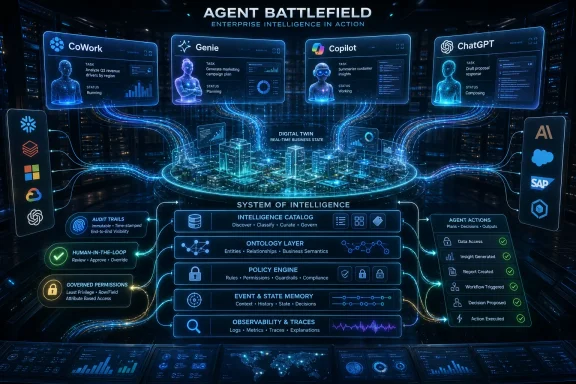
The old software stack assumed that systems of record held transactions, data platforms held analytics, and user-facing applications held workflows. Agentic AI is scrambling that neat division. A useful enterprise agent does not merely need access to data; it needs a governed representation of business state, policy, semantics, exceptions, and intent. That is why the new AI stack is being pulled toward a coupled architecture: an intelligent client on the front end, and a System of Intelligence on the back end.
The first wave of enterprise agents has the familiar smell of every previous enterprise software boom. There are vertical agents for legal intake, revenue operations, procurement, finance close, customer support, code review, field service, security triage, and nearly every other repeatable knowledge task with a budget owner. The reason is obvious: narrow agents can show ROI quickly, and the tooling for building them is now accessible enough that a small team can produce a credible demo in weeks.
But this is also how enterprises got into trouble in the first place. Departmental applications solved local problems, then left IT with fragmented data, inconsistent process logic, and a generation of integration debt. The agent wave risks doing the same thing at higher speed, with more autonomy, and with a more confusing audit trail.
A sales agent that understands pipeline, a support agent that understands tickets, and a finance agent that understands bookings can each be useful. But unless they share a common understanding of customers, contracts, entitlements, revenue recognition, permissions, and business state, the enterprise has not built intelligence. It has built another set of silos with better natural-language interfaces.
That is the core tension behind the current market. Vertical agents will proliferate because they are economically attractive. Yet sustainable enterprise value requires a shared intelligence layer underneath them, one that can reconcile the messy, contradictory, lived reality of how companies operate. Without that layer, the agentic enterprise becomes a zoo of clever assistants, each confident inside its own cage.
Snowflake’s CoWork and CoCo, Databricks Genie, Microsoft Copilot, Google Gemini Enterprise, OpenAI’s ChatGPT and Codex, Anthropic’s Claude, Salesforce’s agent layer, and SAP’s business AI push are all variations on the same strategic move. They want to become the place where users ask questions, build artifacts, approve actions, correct mistakes, and delegate workflows. In other words, they want to become the system of engagement for AI work.
That matters because the agentic client is not just an interface. It is a sensor. Every prompt, correction, approval, rejected recommendation, generated dashboard, reusable skill, and workflow trace tells the platform something about how the organization thinks and acts.
A traditional BI tool captured queries and reports. An agentic client captures intent. It sees not only what a user asked, but what the user meant, what context the model retrieved, what answer was trusted, what was corrected, and which action was eventually taken. That is far richer than clickstream telemetry or dashboard usage analytics.
This is why the battle cannot be understood as a feature checklist. The vendor that owns the client gains a privileged view of the work. The vendor that owns the intelligence back end gains a privileged ability to make that work repeatable, governable, and automatable. The real advantage comes when one platform can do both.
Snowflake is trying to turn governed data gravity into enterprise intelligence. That phrase sounds grand, but the product logic is straightforward. Snowflake already sits near large volumes of enterprise analytical data. If it can add business semantics, governance, unstructured context, agent telemetry, reusable skills, artifacts, and feedback loops, it can move from storing data about the business to modeling how the business works.
CoWork is the key front-end move. It gives business users a conversational, artifact-driven place to explore governed data, combine structured and unstructured knowledge, generate dashboards, and preserve the reasoning around decisions. CoCo gives builders a parallel surface for code, pipelines, semantic views, and technical workflows. Together, they give Snowflake two different kinds of interaction data: business intent from users and implementation intent from builders.
That is a serious strategic upgrade. Snowflake’s earlier “app store for data apps” vision assumed that applications would be built around data sharing and monetization. The new vision is more ambitious: the work surface itself becomes agentic, and the resulting interactions feed the back end. Snowflake is not just trying to host data apps. It is trying to host the feedback loop by which enterprise data becomes enterprise intelligence.
The risk is that Snowflake’s brand and architecture still pull it toward analytics. Business users may happily ask questions inside CoWork, but the deeper operating logic of the enterprise still lives in SAP, Salesforce, Workday, ServiceNow, Oracle, custom applications, spreadsheets, and human habit. Snowflake can infer a lot from data and metadata. It cannot simply declare ownership of the business process layer.
That puts Databricks on a collision course with Snowflake in the middle of the AI stack. Both companies know that open table formats, catalog strategies, governance, lineage, and semantic layers are no longer plumbing. They are ingredients in the intelligence layer. If the platform can define the customer, the account, the product, the metric, the permission, the lineage, and the trusted version of a business term, it has moved closer to becoming the reasoning substrate for agents.
Databricks has an advantage with technical builders and AI-native teams. Its heritage in notebooks, Spark, MLflow, MosaicML, and data science workflows makes it natural for teams building custom AI systems. Snowflake has an advantage with governed analytics, ease of use, and a large base of business-critical warehouse workloads. Both are trying to climb into the same semantic and agentic territory.
The timing matters. Databricks Data + AI Summit in mid-June 2026 will likely sharpen this comparison, especially around Genie, Unity Catalog, governance, AI/BI, and operational AI. Snowflake used Summit to argue that it can convert trusted data into agentic work. Databricks now has to show whether it can turn its lakehouse control plane into a broader intelligence layer, not just a better analytics and AI development platform.
The likely outcome is not a clean winner-take-all contest. Many large enterprises will run both platforms. But the strategic question is sharper than coexistence suggests: which platform becomes the place where business meaning is defined, corrected, reused, and trusted by agents?
That is both powerful and uncomfortable. Work IQ can draw on Microsoft 365 signals about documents, meetings, messages, collaboration patterns, and organizational context. Fabric IQ can provide a semantic foundation over structured business data. Foundry IQ and Foundry observability aim to make agents deployable, monitorable, and optimizable. Web IQ adds current web grounding. The architecture says: bring agents into Microsoft’s context fabric, and they will reason better because they know how work happens.
For WindowsForum readers, the Windows angle is not incidental. If agents become first-class participants in the operating environment, then Windows is not merely a desktop shell. It becomes a secure local runtime, a permission boundary, and a visibility layer for what agents can do on behalf of users. Microsoft’s renewed emphasis on agent security, sandboxing, and observability reflects the fact that agentic clients will need operating-system-level trust.
Microsoft also has the most obvious defensive problem: Office is the canonical enterprise canvas. If agentic tools can generate lightweight spreadsheet applets, presentation artifacts, dashboards, and workflow canvases outside Office, Microsoft has to protect the container where business work happens. Copilot is therefore not just a productivity add-on. It is Microsoft’s effort to keep the intelligent client inside its own estate.
The company’s advantage is distribution. Its challenge is heterogeneity. Many enterprises do not want Microsoft to become the sole interpreter of their business, especially when critical data and process logic live outside Microsoft’s stack. Microsoft can claim the work graph. Snowflake and Databricks can claim governed data gravity. Application vendors can claim process truth. The System of Intelligence will be contested because each vendor holds only part of the enterprise map.
But enterprise intelligence is not the same as model intelligence. A frontier model can reason impressively in the abstract, but a production enterprise agent must know which customer definition applies, which data source is certified, which policy blocks an action, which approval chain is required, and which exception pattern matters in a particular operating context. That knowledge is not contained in the model weights. It lives in the enterprise.
This is why protocols such as Model Context Protocol are strategically important. Tool connectivity is not enough; agents need structured ways to discover capabilities, invoke systems, receive context, and render useful interfaces. The client is becoming programmable, and the back end is becoming intelligent. The boundary between chat, app, workflow, data platform, and agent harness is blurring.
The model makers therefore face a choice. They can remain broadly horizontal reasoning engines that connect to everyone else’s context layers, or they can move down-stack into enterprise memory, governance, and process representation. The first path preserves neutrality but risks commoditization at the enterprise control point. The second path creates strategic depth but puts them in direct conflict with Microsoft, Google, Salesforce, SAP, Snowflake, Databricks, and every other vendor that believes it owns part of enterprise truth.
It is tempting to assume the best model wins. In consumer AI, that may sometimes be true. In enterprise AI, the best-grounded system often beats the most dazzling model. A good enough model with superior context, permissions, observability, and workflow integration can be more valuable than a frontier model operating through a fogged window.
A metric definition can tell an agent how to calculate revenue. An ontology can tell it how revenue relates to contracts, fulfillment, renewals, discounts, entitlements, channel partners, regions, and recognition rules. A process model can tell it what actions are allowed, what preconditions must hold, what systems must be updated, and what risks are introduced if the action fails. Institutional memory can tell it how similar exceptions were handled before.
Snowflake’s Horizon Context is a step toward this world. It collects metadata from Snowflake and adjacent systems, enriches it with lineage, popularity, semantic views, glossary terms, tags, and descriptions, and activates it through CoWork, CoCo, Cortex Agents, and BI tools. Cortex Sense pushes toward unstructured and tacit context. Observe adds an observability angle that becomes more valuable as agent reasoning traces become operational evidence.
Databricks’ Unity Catalog and metric views point in the same direction from the lakehouse side. Microsoft’s Fabric IQ and Work IQ do so from the productivity and business data side. Salesforce Data Cloud, SAP Business Data Cloud, ServiceNow, Celonis, Atlan, Collibra, Alation, Informatica, and others each attack parts of the same problem. Everyone is discovering that “AI-ready data” is a small phrase hiding a large architectural transformation.
The hard part is that business meaning is not merely discovered. It is negotiated. Finance and marketing may use different definitions of lifetime value. Sales and customer success may disagree on what counts as an active account. Regional operations may have legitimate exceptions to global policy. A useful System of Intelligence must surface these conflicts, show lineage and usage, ask humans to resolve ambiguity, and remember the resolution in context.
That makes human-in-the-loop design central rather than transitional. The goal is not to automate all meaning extraction. The goal is to make the normal act of work improve the shared model. When a user corrects an answer, promotes a dashboard, approves a workflow, rejects a recommendation, or turns a personal instruction into a reusable skill, the system should learn something durable.
A personal skill might summarize weekly pipeline movement for a sales manager. A team skill might reconcile support escalations with account renewal risk. A governed organizational skill might check whether a proposed discount violates margin policy, contract terms, or approval thresholds. The progression from personal shortcut to governed asset is where productivity becomes institutional intelligence.
This is also where the old distinction between application logic and analytics starts to collapse. If a skill pulls data, applies rules, uses context, invokes tools, produces an artifact, and recommends an action, it is no longer merely a prompt. It is executable knowledge. It belongs in a catalog, needs ownership, should be tested, and must be monitored for drift.
Snowflake’s CoWork and CoCo strategy makes more sense through this lens. CoWork captures business-user skills, artifacts, and corrections. CoCo captures builder workflows, code generation, semantic definitions, and data engineering intent. If Snowflake can promote useful patterns from those clients into Horizon Context and Cortex Sense, it gets a bottom-up path toward business modeling.
The danger is uncontrolled skill sprawl. Enterprises already struggle with spreadsheet macros, departmental workflows, unmanaged scripts, and BI logic copied across dashboards. Agentic skills could become the next shadow IT layer unless platforms provide promotion paths, governance, testing, lineage, and retirement mechanisms. A skill that influences a pricing decision should not be treated like a clever chat shortcut.
This is why Snowflake’s Observe acquisition looks more strategic in hindsight. It is not only about monitoring applications or infrastructure. In an agentic architecture, reasoning traces become the new exhaust. The web era gave enterprises clickstreams. The agent era gives them decision streams.
Those traces can feed evals, regression tests, incident response, compliance reviews, and continual improvement. A failed answer is not just a bad user experience; it is training material. A successful workflow is not just a completed task; it is a candidate for reuse. A repeated human correction is not just a support issue; it is evidence that the intelligence layer lacks a rule, definition, or context source.
Microsoft’s Build emphasis on Foundry observability and Agent DevOps reflects the same realization. Agents will not be trusted in production unless enterprises can monitor them across frameworks, evaluate their behavior, manage versions, and tie performance to business outcomes. The CFO will eventually ask whether these agents are saving money, reducing risk, accelerating revenue, or merely generating new operational noise.
This is where traditional IT disciplines return with a vengeance. CI/CD, SRE, access control, incident management, lineage, auditability, and policy enforcement do not disappear because the interface becomes conversational. They become more important because agents can act. A hallucinated paragraph is embarrassing. A hallucinated refund, contract change, infrastructure action, or compliance filing is a different category of problem.
This matters because a System of Intelligence cannot be built from analytical data alone. Analytical data often reflects the aftermath of business activity. The operating rules, approvals, constraints, and exception paths are frequently buried in application code, configuration, workflow engines, and human workarounds. Agents need to understand those rules before they can safely act.
Snowflake and Databricks can model a great deal from the data exhaust of these systems. They can infer relationships, identify patterns, standardize metrics, and surface anomalies. But there is a difference between observing that a process happened and understanding the legitimate action space inside that process. The latter is where application vendors have leverage.
Salesforce, SAP, ServiceNow, and others will argue that their domain context is the real intelligence layer. They may be right in specific domains. A customer service agent that lacks CRM and entitlement context is weak. A finance agent that lacks ERP rules is dangerous. A procurement agent that lacks supplier, contract, and approval context is incomplete.
The likely enterprise reality is federation. No single vendor will model the entire company. But the strategic fight is over which layer coordinates the federation. If Snowflake or Databricks becomes the neutral governed intelligence layer, application vendors become sources and action endpoints. If application vendors capture the agentic workflows, data platforms risk being reduced to analytical back ends. If Microsoft owns the user canvas and context graph, everyone else becomes a connected subsystem.
The maturity curve starts with familiar BI: siloed dashboards, aggregate metrics, and departmental definitions. It then moves toward canonical entities, temporal events, behavioral abstractions, predictions, knowledge graphs, modeled actions, live business state, and finally process definitions that can be inspected and modified as data. That last stage is far away for most enterprises, but the direction is clear.
Agents expose the limits of shallow models. A conversational dashboard can answer “what happened?” with metrics and dimensions. A diagnostic assistant can answer “why did it happen?” if events and relationships are captured. A decision agent can answer “what should we do?” only if predictions, policies, and action effects are represented. An autonomous agent can act safely only if live state and process boundaries are known.
This is why clean tables are no longer enough. The enterprise needs data that is human-readable, agent-readable, and eventually executable. That means lineage, semantics, business glossary, entity resolution, event context, process rules, permissions, evals, and feedback loops must all come together. The phrase AI-ready data undersells the scale of the work.
It also changes the role of data professionals. Moving data from source to warehouse remains necessary, but it is no longer the top of the value chain. The higher-value work is modeling business meaning, governing reusable logic, curating semantic assets, resolving conflicting definitions, testing agent behavior, and turning repeated workflows into trusted organizational capabilities.
That is a serious architecture. It is also early. Semantic views are not yet a full ontology. A business glossary is not a process model. Popularity signals are not institutional judgment. Artifacts are not automatically governed knowledge. Agent traces are not useful unless they are evaluated, connected to outcomes, and folded back into the intelligence layer.
Snowflake’s strongest position today remains governed data gravity. Its opportunity is to use that gravity to pull in context, interaction, semantics, and agentic workflows. Its danger is that a richer context layer emerges above it, supplied by Microsoft, Atlan, Salesforce, SAP, Databricks, or the model makers, leaving Snowflake as an indispensable but less strategic substrate.
Atlan is a particularly useful example because it shows where the context layer may go: cross-system metadata, semantics, knowledge graphs, skills, agents, and feedback loops that operate across heterogeneous estates. That is attractive to customers because real enterprises are messy. It is also strategically awkward for Snowflake because the richest intelligence layer may not be native to the data platform.
The best outcome for customers is interoperability without fragmentation. The worst outcome is a new generation of intelligence silos, where every vendor has its own memory, skill catalog, semantic layer, agent traces, and definition of truth. The industry has already lived through that movie with applications, dashboards, and data marts. Agents will make the sequel faster and more expensive.
Snowflake’s June 2026 moment is therefore bigger than a product cycle. It is a sign that the enterprise AI market is reorganizing around the coupled design of client and back end: the surface where people and agents work, and the intelligence layer that turns that work into context, rules, memory, and action. Databricks, Microsoft, Google, OpenAI, Anthropic, Salesforce, SAP, ServiceNow, Atlan, and others are all moving toward the same control point from different starting positions. The next phase will not be won by the vendor with the most agents, or even the best model in isolation, but by the platform that can make enterprise work observable, governable, learnable, and safe enough to execute.
The old software stack assumed that systems of record held transactions, data platforms held analytics, and user-facing applications held workflows. Agentic AI is scrambling that neat division. A useful enterprise agent does not merely need access to data; it needs a governed representation of business state, policy, semantics, exceptions, and intent. That is why the new AI stack is being pulled toward a coupled architecture: an intelligent client on the front end, and a System of Intelligence on the back end.
 The Agent Sprawl Is Recreating the Silo Problem It Promised to Fix
The first wave of enterprise agents has the familiar smell of every previous enterprise software boom. There are vertical agents for legal intake, revenue operations, procurement, finance close, customer support, code review, field service, security triage, and nearly every other repeatable knowledge task with a budget owner. The reason is obvious: narrow agents can show ROI quickly, and the tooling for building them is now accessible enough that a small team can produce a credible demo in weeks.But this is also how enterprises got into trouble in the first place. Departmental applications solved local problems, then left IT with fragmented data, inconsistent process logic, and a generation of integration debt. The agent wave risks doing the same thing at higher speed, with more autonomy, and with a more confusing audit trail.
A sales agent that understands pipeline, a support agent that understands tickets, and a finance agent that understands bookings can each be useful. But unless they share a common understanding of customers, contracts, entitlements, revenue recognition, permissions, and business state, the enterprise has not built intelligence. It has built another set of silos with better natural-language interfaces.
That is the core tension behind the current market. Vertical agents will proliferate because they are economically attractive. Yet sustainable enterprise value requires a shared intelligence layer underneath them, one that can reconcile the messy, contradictory, lived reality of how companies operate. Without that layer, the agentic enterprise becomes a zoo of clever assistants, each confident inside its own cage.
The New Client Is Where Work Becomes Training Data
The enterprise client is changing again. Windows defined the client-server era, the browser defined the web era, and mobile operating systems defined the smartphone era. The agentic era is searching for its own client, and every major vendor wants to make sure it is not reduced to a back-end utility when that client hardens.Snowflake’s CoWork and CoCo, Databricks Genie, Microsoft Copilot, Google Gemini Enterprise, OpenAI’s ChatGPT and Codex, Anthropic’s Claude, Salesforce’s agent layer, and SAP’s business AI push are all variations on the same strategic move. They want to become the place where users ask questions, build artifacts, approve actions, correct mistakes, and delegate workflows. In other words, they want to become the system of engagement for AI work.
That matters because the agentic client is not just an interface. It is a sensor. Every prompt, correction, approval, rejected recommendation, generated dashboard, reusable skill, and workflow trace tells the platform something about how the organization thinks and acts.
A traditional BI tool captured queries and reports. An agentic client captures intent. It sees not only what a user asked, but what the user meant, what context the model retrieved, what answer was trusted, what was corrected, and which action was eventually taken. That is far richer than clickstream telemetry or dashboard usage analytics.
This is why the battle cannot be understood as a feature checklist. The vendor that owns the client gains a privileged view of the work. The vendor that owns the intelligence back end gains a privileged ability to make that work repeatable, governable, and automatable. The real advantage comes when one platform can do both.
Snowflake’s Summit Message Was Bigger Than Data Cloud AI
Snowflake’s June announcements were framed as AI Data Cloud progress, but the more interesting story is architectural. CoWork, formerly Snowflake Intelligence, is aimed at business users and knowledge workers. CoCo, short for Cortex Code, is aimed at developers, data engineers, analysts, and technical builders. Horizon Context, Cortex Sense, Cortex Agents, semantic views, Polaris, and the Observe acquisition all point toward a broader ambition than simply adding AI features to a warehouse.Snowflake is trying to turn governed data gravity into enterprise intelligence. That phrase sounds grand, but the product logic is straightforward. Snowflake already sits near large volumes of enterprise analytical data. If it can add business semantics, governance, unstructured context, agent telemetry, reusable skills, artifacts, and feedback loops, it can move from storing data about the business to modeling how the business works.
CoWork is the key front-end move. It gives business users a conversational, artifact-driven place to explore governed data, combine structured and unstructured knowledge, generate dashboards, and preserve the reasoning around decisions. CoCo gives builders a parallel surface for code, pipelines, semantic views, and technical workflows. Together, they give Snowflake two different kinds of interaction data: business intent from users and implementation intent from builders.
That is a serious strategic upgrade. Snowflake’s earlier “app store for data apps” vision assumed that applications would be built around data sharing and monetization. The new vision is more ambitious: the work surface itself becomes agentic, and the resulting interactions feed the back end. Snowflake is not just trying to host data apps. It is trying to host the feedback loop by which enterprise data becomes enterprise intelligence.
The risk is that Snowflake’s brand and architecture still pull it toward analytics. Business users may happily ask questions inside CoWork, but the deeper operating logic of the enterprise still lives in SAP, Salesforce, Workday, ServiceNow, Oracle, custom applications, spreadsheets, and human habit. Snowflake can infer a lot from data and metadata. It cannot simply declare ownership of the business process layer.
Databricks Is Chasing the Same Control Point From the Lakehouse Side
Databricks approaches the same problem from a different origin story. It has long argued for the lakehouse as a unified foundation for data engineering, analytics, machine learning, and AI. Unity Catalog gives it a governance and metadata control plane, while Genie gives business users a conversational interface over governed data. Its metric views push business semantics into Unity Catalog, defining reusable measures that can be queried across tools and surfaced inside Genie spaces.That puts Databricks on a collision course with Snowflake in the middle of the AI stack. Both companies know that open table formats, catalog strategies, governance, lineage, and semantic layers are no longer plumbing. They are ingredients in the intelligence layer. If the platform can define the customer, the account, the product, the metric, the permission, the lineage, and the trusted version of a business term, it has moved closer to becoming the reasoning substrate for agents.
Databricks has an advantage with technical builders and AI-native teams. Its heritage in notebooks, Spark, MLflow, MosaicML, and data science workflows makes it natural for teams building custom AI systems. Snowflake has an advantage with governed analytics, ease of use, and a large base of business-critical warehouse workloads. Both are trying to climb into the same semantic and agentic territory.
The timing matters. Databricks Data + AI Summit in mid-June 2026 will likely sharpen this comparison, especially around Genie, Unity Catalog, governance, AI/BI, and operational AI. Snowflake used Summit to argue that it can convert trusted data into agentic work. Databricks now has to show whether it can turn its lakehouse control plane into a broader intelligence layer, not just a better analytics and AI development platform.
The likely outcome is not a clean winner-take-all contest. Many large enterprises will run both platforms. But the strategic question is sharper than coexistence suggests: which platform becomes the place where business meaning is defined, corrected, reused, and trusted by agents?
Microsoft Is Trying to Make Context an Operating System Feature
Microsoft’s position is different because it controls more of the daily work surface than any data platform vendor. Microsoft 365, Teams, Outlook, Excel, PowerPoint, Windows, GitHub, Azure, Fabric, and Copilot give it reach across end users, developers, administrators, and business data. At Build 2026, Microsoft’s message around Microsoft IQ, Work IQ, Fabric IQ, Foundry IQ, and Web IQ was essentially that agents need context, and Microsoft already sits on a large share of it.That is both powerful and uncomfortable. Work IQ can draw on Microsoft 365 signals about documents, meetings, messages, collaboration patterns, and organizational context. Fabric IQ can provide a semantic foundation over structured business data. Foundry IQ and Foundry observability aim to make agents deployable, monitorable, and optimizable. Web IQ adds current web grounding. The architecture says: bring agents into Microsoft’s context fabric, and they will reason better because they know how work happens.
For WindowsForum readers, the Windows angle is not incidental. If agents become first-class participants in the operating environment, then Windows is not merely a desktop shell. It becomes a secure local runtime, a permission boundary, and a visibility layer for what agents can do on behalf of users. Microsoft’s renewed emphasis on agent security, sandboxing, and observability reflects the fact that agentic clients will need operating-system-level trust.
Microsoft also has the most obvious defensive problem: Office is the canonical enterprise canvas. If agentic tools can generate lightweight spreadsheet applets, presentation artifacts, dashboards, and workflow canvases outside Office, Microsoft has to protect the container where business work happens. Copilot is therefore not just a productivity add-on. It is Microsoft’s effort to keep the intelligent client inside its own estate.
The company’s advantage is distribution. Its challenge is heterogeneity. Many enterprises do not want Microsoft to become the sole interpreter of their business, especially when critical data and process logic live outside Microsoft’s stack. Microsoft can claim the work graph. Snowflake and Databricks can claim governed data gravity. Application vendors can claim process truth. The System of Intelligence will be contested because each vendor holds only part of the enterprise map.
The Model Makers Have the Client, But Not Yet the Enterprise Memory
OpenAI and Anthropic have a different kind of leverage. Their clients are already where many users go to think, write, code, analyze, and prototype. ChatGPT, Codex, Claude, and Claude’s artifact-oriented workflows are training users to expect a general-purpose reasoning surface that can produce documents, software, dashboards, explanations, and plans. In raw user engagement, the model makers may have the most important early agentic clients.But enterprise intelligence is not the same as model intelligence. A frontier model can reason impressively in the abstract, but a production enterprise agent must know which customer definition applies, which data source is certified, which policy blocks an action, which approval chain is required, and which exception pattern matters in a particular operating context. That knowledge is not contained in the model weights. It lives in the enterprise.
This is why protocols such as Model Context Protocol are strategically important. Tool connectivity is not enough; agents need structured ways to discover capabilities, invoke systems, receive context, and render useful interfaces. The client is becoming programmable, and the back end is becoming intelligent. The boundary between chat, app, workflow, data platform, and agent harness is blurring.
The model makers therefore face a choice. They can remain broadly horizontal reasoning engines that connect to everyone else’s context layers, or they can move down-stack into enterprise memory, governance, and process representation. The first path preserves neutrality but risks commoditization at the enterprise control point. The second path creates strategic depth but puts them in direct conflict with Microsoft, Google, Salesforce, SAP, Snowflake, Databricks, and every other vendor that believes it owns part of enterprise truth.
It is tempting to assume the best model wins. In consumer AI, that may sometimes be true. In enterprise AI, the best-grounded system often beats the most dazzling model. A good enough model with superior context, permissions, observability, and workflow integration can be more valuable than a frontier model operating through a fogged window.
The System of Intelligence Is Part Catalog, Part Ontology, Part Memory
The emerging System of Intelligence is not just a data catalog with better branding. Catalogs matter because they map data assets, ownership, lineage, popularity, tags, and definitions. Semantic layers matter because they normalize metrics and dimensions. But agents require something richer: a living representation of the business that includes entities, relationships, events, actions, policies, exceptions, and feedback.A metric definition can tell an agent how to calculate revenue. An ontology can tell it how revenue relates to contracts, fulfillment, renewals, discounts, entitlements, channel partners, regions, and recognition rules. A process model can tell it what actions are allowed, what preconditions must hold, what systems must be updated, and what risks are introduced if the action fails. Institutional memory can tell it how similar exceptions were handled before.
Snowflake’s Horizon Context is a step toward this world. It collects metadata from Snowflake and adjacent systems, enriches it with lineage, popularity, semantic views, glossary terms, tags, and descriptions, and activates it through CoWork, CoCo, Cortex Agents, and BI tools. Cortex Sense pushes toward unstructured and tacit context. Observe adds an observability angle that becomes more valuable as agent reasoning traces become operational evidence.
Databricks’ Unity Catalog and metric views point in the same direction from the lakehouse side. Microsoft’s Fabric IQ and Work IQ do so from the productivity and business data side. Salesforce Data Cloud, SAP Business Data Cloud, ServiceNow, Celonis, Atlan, Collibra, Alation, Informatica, and others each attack parts of the same problem. Everyone is discovering that “AI-ready data” is a small phrase hiding a large architectural transformation.
The hard part is that business meaning is not merely discovered. It is negotiated. Finance and marketing may use different definitions of lifetime value. Sales and customer success may disagree on what counts as an active account. Regional operations may have legitimate exceptions to global policy. A useful System of Intelligence must surface these conflicts, show lineage and usage, ask humans to resolve ambiguity, and remember the resolution in context.
That makes human-in-the-loop design central rather than transitional. The goal is not to automate all meaning extraction. The goal is to make the normal act of work improve the shared model. When a user corrects an answer, promotes a dashboard, approves a workflow, rejects a recommendation, or turns a personal instruction into a reusable skill, the system should learn something durable.
Skills Are the New Shadow Business Logic
One of the most underrated ideas in the agentic stack is the skill. At first glance, a skill looks like a convenience: a saved instruction, a reusable workflow, a way to make an agent perform a familiar task. But inside the enterprise, repeated instructions have a habit of becoming process logic.A personal skill might summarize weekly pipeline movement for a sales manager. A team skill might reconcile support escalations with account renewal risk. A governed organizational skill might check whether a proposed discount violates margin policy, contract terms, or approval thresholds. The progression from personal shortcut to governed asset is where productivity becomes institutional intelligence.
This is also where the old distinction between application logic and analytics starts to collapse. If a skill pulls data, applies rules, uses context, invokes tools, produces an artifact, and recommends an action, it is no longer merely a prompt. It is executable knowledge. It belongs in a catalog, needs ownership, should be tested, and must be monitored for drift.
Snowflake’s CoWork and CoCo strategy makes more sense through this lens. CoWork captures business-user skills, artifacts, and corrections. CoCo captures builder workflows, code generation, semantic definitions, and data engineering intent. If Snowflake can promote useful patterns from those clients into Horizon Context and Cortex Sense, it gets a bottom-up path toward business modeling.
The danger is uncontrolled skill sprawl. Enterprises already struggle with spreadsheet macros, departmental workflows, unmanaged scripts, and BI logic copied across dashboards. Agentic skills could become the next shadow IT layer unless platforms provide promotion paths, governance, testing, lineage, and retirement mechanisms. A skill that influences a pricing decision should not be treated like a clever chat shortcut.
Observability Becomes the Audit Trail of Reasoning
Enterprise AI observability is moving from nice-to-have instrumentation to a core trust layer. In ordinary software, logs, traces, metrics, and deployment pipelines help teams understand whether a system is healthy. In agentic systems, observability must also answer harder questions: what did the agent know, what did it retrieve, what tool did it call, why did it choose that action, what alternatives were considered, and did the outcome satisfy policy?This is why Snowflake’s Observe acquisition looks more strategic in hindsight. It is not only about monitoring applications or infrastructure. In an agentic architecture, reasoning traces become the new exhaust. The web era gave enterprises clickstreams. The agent era gives them decision streams.
Those traces can feed evals, regression tests, incident response, compliance reviews, and continual improvement. A failed answer is not just a bad user experience; it is training material. A successful workflow is not just a completed task; it is a candidate for reuse. A repeated human correction is not just a support issue; it is evidence that the intelligence layer lacks a rule, definition, or context source.
Microsoft’s Build emphasis on Foundry observability and Agent DevOps reflects the same realization. Agents will not be trusted in production unless enterprises can monitor them across frameworks, evaluate their behavior, manage versions, and tie performance to business outcomes. The CFO will eventually ask whether these agents are saving money, reducing risk, accelerating revenue, or merely generating new operational noise.
This is where traditional IT disciplines return with a vengeance. CI/CD, SRE, access control, incident management, lineage, auditability, and policy enforcement do not disappear because the interface becomes conversational. They become more important because agents can act. A hallucinated paragraph is embarrassing. A hallucinated refund, contract change, infrastructure action, or compliance filing is a different category of problem.
Application Vendors Still Own Too Much Process Truth to Ignore
The data platform vendors have an appealing story, but systems of record remain powerful because that is where execution still happens. SAP knows the shape of many core business processes. Salesforce knows sales, service, and customer engagement workflows. Workday knows HR and finance processes. ServiceNow knows enterprise service management. Oracle remains deeply embedded in transactional systems. Celonis understands process mining and execution patterns across systems.This matters because a System of Intelligence cannot be built from analytical data alone. Analytical data often reflects the aftermath of business activity. The operating rules, approvals, constraints, and exception paths are frequently buried in application code, configuration, workflow engines, and human workarounds. Agents need to understand those rules before they can safely act.
Snowflake and Databricks can model a great deal from the data exhaust of these systems. They can infer relationships, identify patterns, standardize metrics, and surface anomalies. But there is a difference between observing that a process happened and understanding the legitimate action space inside that process. The latter is where application vendors have leverage.
Salesforce, SAP, ServiceNow, and others will argue that their domain context is the real intelligence layer. They may be right in specific domains. A customer service agent that lacks CRM and entitlement context is weak. A finance agent that lacks ERP rules is dangerous. A procurement agent that lacks supplier, contract, and approval context is incomplete.
The likely enterprise reality is federation. No single vendor will model the entire company. But the strategic fight is over which layer coordinates the federation. If Snowflake or Databricks becomes the neutral governed intelligence layer, application vendors become sources and action endpoints. If application vendors capture the agentic workflows, data platforms risk being reduced to analytical back ends. If Microsoft owns the user canvas and context graph, everyone else becomes a connected subsystem.
The Enterprise Digital Twin Is the Ambition Hiding in Plain Sight
The phrase “digital twin” is usually associated with factories, supply chains, buildings, and physical systems. But the agentic enterprise is pushing toward a broader idea: a live model of the business itself. Not a static enterprise data model drafted by architects and abandoned after reorganization number three, but a continuously updated representation of entities, events, rules, state, predictions, actions, and outcomes.The maturity curve starts with familiar BI: siloed dashboards, aggregate metrics, and departmental definitions. It then moves toward canonical entities, temporal events, behavioral abstractions, predictions, knowledge graphs, modeled actions, live business state, and finally process definitions that can be inspected and modified as data. That last stage is far away for most enterprises, but the direction is clear.
Agents expose the limits of shallow models. A conversational dashboard can answer “what happened?” with metrics and dimensions. A diagnostic assistant can answer “why did it happen?” if events and relationships are captured. A decision agent can answer “what should we do?” only if predictions, policies, and action effects are represented. An autonomous agent can act safely only if live state and process boundaries are known.
This is why clean tables are no longer enough. The enterprise needs data that is human-readable, agent-readable, and eventually executable. That means lineage, semantics, business glossary, entity resolution, event context, process rules, permissions, evals, and feedback loops must all come together. The phrase AI-ready data undersells the scale of the work.
It also changes the role of data professionals. Moving data from source to warehouse remains necessary, but it is no longer the top of the value chain. The higher-value work is modeling business meaning, governing reusable logic, curating semantic assets, resolving conflicting definitions, testing agent behavior, and turning repeated workflows into trusted organizational capabilities.
Snowflake’s Opening Is Real, But the Stack Will Not Wait
Snowflake has credible pieces across the emerging stack. Horizon and Polaris address mapping and open governance. Semantic views and Horizon Context address business meaning. Cortex Sense points toward unstructured and tacit context. CoWork and CoCo give Snowflake engagement surfaces for business users and builders. Observe and Cortex Training point toward feedback, evals, and learning.That is a serious architecture. It is also early. Semantic views are not yet a full ontology. A business glossary is not a process model. Popularity signals are not institutional judgment. Artifacts are not automatically governed knowledge. Agent traces are not useful unless they are evaluated, connected to outcomes, and folded back into the intelligence layer.
Snowflake’s strongest position today remains governed data gravity. Its opportunity is to use that gravity to pull in context, interaction, semantics, and agentic workflows. Its danger is that a richer context layer emerges above it, supplied by Microsoft, Atlan, Salesforce, SAP, Databricks, or the model makers, leaving Snowflake as an indispensable but less strategic substrate.
Atlan is a particularly useful example because it shows where the context layer may go: cross-system metadata, semantics, knowledge graphs, skills, agents, and feedback loops that operate across heterogeneous estates. That is attractive to customers because real enterprises are messy. It is also strategically awkward for Snowflake because the richest intelligence layer may not be native to the data platform.
The best outcome for customers is interoperability without fragmentation. The worst outcome is a new generation of intelligence silos, where every vendor has its own memory, skill catalog, semantic layer, agent traces, and definition of truth. The industry has already lived through that movie with applications, dashboards, and data marts. Agents will make the sequel faster and more expensive.
The Winners Will Make Individual Work Compound
The near-term lesson for IT leaders is not to pick a single winner too early. The market is moving too quickly, and the stack is still forming. The better move is to build promotion paths from individual productivity into governed organizational intelligence.- Enterprises should treat useful prompts, skills, dashboards, semantic views, evals, artifacts, and agent workflows as candidates for governed assets rather than disposable personal productivity outputs.
- Data teams should prioritize entity resolution, lineage, semantic consistency, and business glossary work because agents cannot reason reliably over contradictory definitions.
- Platform teams should demand observability, evals, versioning, and audit trails for agentic workflows before allowing agents to act in high-impact business processes.
- Business leaders should expect vertical agents to deliver quick wins while resisting architectures that trap context inside departmental tools.
- Buyers should ask every vendor how its agentic client feeds back into its intelligence layer, and how that feedback can be exported, governed, or shared across the enterprise.
Snowflake’s June 2026 moment is therefore bigger than a product cycle. It is a sign that the enterprise AI market is reorganizing around the coupled design of client and back end: the surface where people and agents work, and the intelligence layer that turns that work into context, rules, memory, and action. Databricks, Microsoft, Google, OpenAI, Anthropic, Salesforce, SAP, ServiceNow, Atlan, and others are all moving toward the same control point from different starting positions. The next phase will not be won by the vendor with the most agents, or even the best model in isolation, but by the platform that can make enterprise work observable, governable, learnable, and safe enough to execute.
References
- Primary source: SiliconANGLE
Published: 2026-06-07T16:39:07.618715
Snowflake, Databricks and the model makers: The battle for the agentic client and AI back end - SiliconANGLE
Snowflake, Databricks and the model makers: The battle for the agentic client and AI back end - SiliconANGLE siliconangle.com
- Related coverage: windowscentral.com
Build 2026 only makes sense if you remember Build 2025: a look back at the groundwork of the "age of AI agents" | Windows Central
Microsoft’s latest announcements build directly on the architecture it introduced a year ago.www.windowscentral.com - Related coverage: snowflake.com
Snowflake CoWork: The Personal Agent for Knowledge Workers
New Snowflake CoWork innovations empower enterprises to move faster from data to decisions to action, operationalizing intelligence across the business.www.snowflake.com - Official source: azure.microsoft.com
Microsoft Build 2026: Building agentic apps with Microsoft Fabric and Microsoft Databases | Microsoft Azure Blog
Microsoft Build 2026 highlights advancements in app development with Microsoft Fabric and Microsoft Databases, emphasizing a unified data and AI platform.azure.microsoft.com - Related coverage: us.nttdata.com

Databricks Data + AI Summit 2026 | NTT DATA
Join NTT DATA at Databricks Data + AI Summit 2026 in San Francisco. Explore the latest in AI, machine learning and Lakehouse innovation.
us.nttdata.com
- Related coverage: infosys.com
Unlock AI Value | Infosys at Databricks Data + AI Summit 2026
Discover how Infosys helps enterprises unlock real AI value at Databricks Data + AI Summit 2026—agentic AI, governed data platforms, and scalable AI in action.www.infosys.com
- Related coverage: docs.databricks.com
Unity Catalog metric views | Databricks on Google Cloud
Define business metrics once in Unity Catalog metric views by separating measures from dimensions, then govern and query them across BI, SQL, and AI tools.docs.databricks.com - Related coverage: datahub.com
Databricks Data+AI Summit 2026 - DataHub
Meet the DataHub team for hands-on demos, technical deep dives, and proven best practices from our community of 6300+ innovative data teams.datahub.com - Related coverage: unitedtechno.com
Databricks Data + AI Summit 2026 | Meet United Techno
Meet United Techno at Databricks Data + AI Summit 2026 to explore scalable data engineering, AI-ready analytics, and modern data solutions.www.unitedtechno.com - Related coverage: databricks.com
Unity Catalog: Open and Universal Governancefor the Lakehouse and Beyond
- Information systems -> Data management.- Security and privacy -> Database and storage security.www.databricks.com
- Related coverage: impetus.com
