

Accenture, Avanade and Microsoft are making a familiar industrial promise sound newly urgent: if factories can sense trouble earlier, reason over live data faster, and trigger better responses without waiting for a human to stitch together dashboards, downtime should fall. The companies’ new agentic factory concept is designed to do exactly that, combining Microsoft’s cloud and AI stack with Accenture and Avanade’s manufacturing expertise to help production teams diagnose issues, coordinate responses, and keep lines running more consistently. The timing matters because manufacturers are under pressure to improve throughput, resilience, and labor efficiency at the same time, while AI vendors are racing to show that agentic systems can move beyond chat into real operational control.
Manufacturing technology has spent the last decade moving from isolated automation toward connected, data-driven operations. The first wave of digital transformation focused on connecting PLCs, MES platforms, historians, and enterprise systems so managers could see what was happening on the shop floor in near real time. The second wave added analytics, predictive maintenance, and process mining, but those tools still depended heavily on humans to interpret the output and decide what to do next.
That limitation is why agentic AI has become such a powerful term in industrial software. The basic idea is that software should not only summarize conditions, but should also take context-aware action, route tasks, and coordinate responses across systems and roles. In manufacturing, that can mean flagging a quality deviation, surfacing the likely cause, recommending a maintenance check, and helping a supervisor communicate the issue before a minor fault becomes a costly outage.
Microsoft has been building this direction into its manufacturing portfolio for several years. In 2024, it highlighted Manufacturing Data Solutions in Fabric and a Copilot template for factory operations as part of Microsoft Cloud for Manufacturing, aiming to unify factory data and make it easier to query with natural language. In 2025, Microsoft continued to promote factory-focused AI, including Factory Operations Agent work and connected-factory reference architectures that center real-time intelligence, contextualization, and predictive maintenance.
The new Accenture-Avanade-Microsoft announcement builds on that foundation but shifts the emphasis from assisted analytics to operational orchestration. That matters because industrial buyers are increasingly skeptical of AI demos that stop at dashboards. They want fewer unplanned stops, faster mean time to repair, better first-time-right decisions, and a toolchain that fits existing production realities rather than requiring a greenfield redesign of the plant.
The announcement also reflects the broader competitive play in industrial AI. Every major cloud and automation vendor now wants to own the “factory brain” layer, where data, agents, and workflows converge. Microsoft’s answer is to fuse Fabric, Azure, Foundry, and Copilot into a governed intelligence stack; Accenture and Avanade bring implementation muscle, industry process knowledge, and the services relationships needed to make the story real in complex enterprises.
This is where Microsoft’s recent platform work matters. Fabric and its real-time intelligence capabilities are designed to unify and analyze operational data streams, while Copilot provides natural-language interaction, and Foundry supplies the agent-building environment. Together, they form the scaffolding for a factory system that can reason over live context rather than relying on static reports.
The practical implication is not glamorous, but it is valuable. A supervisor might ask why a line is drifting, a mechanic might get guided toward the most likely fault, and a quality leader might receive a contextual prompt that connects current output to known process variations. In manufacturing, those minutes matter, because small delays often compound into expensive downtime windows. That is the real business case here.
That distinction matters because manufacturing environments are messy. Data often lives in silos, line conditions change quickly, and the right answer may depend on the role of the person asking. A production supervisor, an electrician, and a quality controller may need different views of the same event, which is why the companies are emphasizing contextual, role-specific guidance instead of a one-size-fits-all chatbot.
The strongest version of this idea is not “AI runs the factory.” It is “AI reduces the friction between sensing a problem and acting on it.” If the system can compress that gap, manufacturers gain not only speed but also consistency across sites, shifts, and skill levels.
What makes the use case attractive is not just the size of the problem, but the structure of the decision-making. Many downtime events start with weak signals: a machine drifts, a sensor degrades, a process parameter changes, or an operator spots something unusual. An agentic system can be valuable because it is designed to watch continuously, correlate signals from multiple sources, and nudge the right people before the issue becomes a stop.
That matters because many factories already have alert fatigue. If every abnormal reading generates another notification, teams quickly learn to ignore the system. Agentic workflows can reduce that fatigue by prioritizing the highest-value issues, grouping related signals, and presenting them with enough context to be useful. The output has to be decisive, not noisy.
The new offering also aligns with a broader shift in industrial software from “visibility” to “velocity.” Knowing that a line is underperforming is useful; knowing why it is underperforming and what to do in the next five minutes is far more valuable. That is the difference between analytics as a report and analytics as an operational system.
At the enterprise level, agentic factory tooling could standardize best practices across plants. At the line level, it could help a mechanic or operator interpret signals without waiting for a specialist to connect the dots. This dual promise is one reason vendors keep emphasizing human-machine collaboration rather than full automation.
The challenge is that enterprise buyers usually purchase platforms, while plant teams live with the workflow consequences. If the system is too abstract, it will stay in the PowerPoint phase; if it is too rigid, operators will find ways around it. The best industrial AI products succeed when they make frontline work easier without forcing frontline teams into a brittle new process.
Fabric is particularly important because manufacturing AI depends on contextualized data. Shop-floor telemetry alone is not enough; the system also needs process, maintenance, quality, and planning data to explain what is happening. Microsoft’s connected-factory architecture explicitly highlights real-time data processing, factory contextualization, and predictive maintenance as core building blocks.
That simplicity is deceptive, because real industrial deployment still demands governance, access control, and reliability. Microsoft’s own documentation notes that Fabric Copilot behavior depends on tenant settings and regional considerations, underscoring that these systems are not “plug-and-play” in the consumer sense. In factories, where compliance and data residency can be critical, those controls are not optional.
This is where Microsoft’s platform strategy has an advantage over point solutions. A standalone analytics tool may be easier to demo, but it is harder to scale across plants, countries, and business units. A platform stack can be slower to implement, yet it is more likely to become the standard operating layer if the economics work.
The timing also follows the earlier deprecation of some preview manufacturing offerings, which hints that Microsoft is consolidating its industrial AI story around a smaller number of more integrated building blocks. That is often what happens when a platform matures: the company trims experimental surfaces and funnels partners toward a more coherent architecture.
For manufacturers, that can be reassuring and frustrating at the same time. Reassuring, because the stack looks more intentional; frustrating, because it confirms that this is still a moving target and not a finished, standardized industrial product. That uncertainty is part of the market right now.
Accenture brings scale, transformation credentials, and a deep client footprint across manufacturing and industrial sectors. Avanade, as the Microsoft-focused joint venture, gives the partnership a more direct bridge into Microsoft architectures, implementation patterns, and customer trust. Together, they can frame the project as both an engineering effort and an operational change program, which is often what enterprise buyers want to hear.
That also means the commercial model is likely to be attractive to the partners. Industrial AI platforms are easier to sell when they come with implementation, support, and a roadmap for expanding across facilities. In practice, that turns a software feature into a broader transformation program, which is where consulting economics thrive.
Still, services-led AI has a built-in tension: every deployment can become highly customized. Customization helps the first customer win, but it can slow replication. The long-term test will be whether this agentic factory can be packaged into repeatable patterns that scale across manufacturers instead of becoming another bespoke industrial integration project.
The result is likely to be a competitive split between platform breadth and operational depth. Microsoft, Accenture, and Avanade are betting that buyers want an integrated stack with partner support. Others may argue that the winning formula is tighter control of industrial workflows and deeper integration into automation hardware. Both approaches can succeed, but not for the same buyer.
The second change is more subtle: AI becomes a shared operational language. If the same context can be surfaced through conversational interfaces for different roles, then maintenance, production, and quality teams can coordinate more naturally. That could reduce handoff errors, speed up root-cause analysis, and make escalation less dependent on who happens to be on duty.
Another point of differentiation is maturity. Companies that already have strong data infrastructure will be able to move faster because they have the prerequisites in place. Others may need to spend months or years normalizing sensor data, aligning naming conventions, and connecting OT and IT systems before any agentic layer can deliver meaningful value.
That is why the partnership’s language about “unified data foundations” is so important. In manufacturing, the AI model is rarely the hardest part. The hardest part is making sure the underlying data is trustworthy, current, and semantically useful enough that an automated agent can act without making the wrong inference.
That said, the real transformation may come from shrinking the amount of routine judgment that humans must perform. If AI can reliably handle the first layer of diagnosis and context gathering, people can spend more time on exceptions, escalation, and process improvement. That is where productivity gains usually emerge.
The story also aligns with how many enterprises now want to buy AI. They are less interested in isolated copilots and more interested in governed systems that can plug into existing workflows. A factory agent that runs on a known cloud and data stack is easier to justify than a standalone experimental tool.
There is also a risk of complexity creep. The more layers involved—Azure services, Fabric pipelines, Foundry agents, Copilot interfaces, and consulting-led customization—the easier it becomes for deployments to stall or become expensive to maintain. A system that looks elegant in a keynote can become fragile once it encounters older machinery, inconsistent data, and local plant exceptions.
Privacy and residency considerations also matter, especially for multinational manufacturers. Microsoft’s own Fabric Copilot documentation notes regional and tenant settings that affect how data is processed, which reinforces the idea that governance is part of the product, not an afterthought. For regulated industries, that can be a deciding factor.
Another concern is vendor lock-in. A highly integrated stack can accelerate deployment, but it can also make it harder to swap components later. Manufacturers should be asking how portable the data, models, and workflows will be if they later want to diversify their cloud or AI strategy.
That is why demonstration value is not enough. The companies will need concrete evidence that the system improves uptime, shortens diagnosis time, and reduces costly interruptions over a meaningful period. Without that proof, “agentic factory” risks becoming another attractive phrase in a crowded industrial AI market.
Watch for how quickly the partners move from concept language to repeatable deployments. In industrial technology, the winners are not always the companies with the most compelling demo; they are the ones that can deploy consistently across messy, heterogeneous factory environments. That is where implementation discipline becomes more important than AI rhetoric.
In the end, the significance of this launch is not that factories are suddenly becoming fully autonomous. It is that the industry is inching closer to a practical version of AI that can watch, reason, and help act in the same operational moment. If that promise holds, the real breakthrough will not be a chatbot in a plant; it will be fewer interruptions, faster decisions, and a factory floor that becomes a little more self-aware every day.
Source: Redmond Channel Partner Accenture, Avanade and Microsoft Launch Agentic Factory to Reduce Manufacturing Downtime -- Redmond Channel Partner
 Background
Manufacturing technology has spent the last decade moving from isolated automation toward connected, data-driven operations. The first wave of digital transformation focused on connecting PLCs, MES platforms, historians, and enterprise systems so managers could see what was happening on the shop floor in near real time. The second wave added analytics, predictive maintenance, and process mining, but those tools still depended heavily on humans to interpret the output and decide what to do next.That limitation is why agentic AI has become such a powerful term in industrial software. The basic idea is that software should not only summarize conditions, but should also take context-aware action, route tasks, and coordinate responses across systems and roles. In manufacturing, that can mean flagging a quality deviation, surfacing the likely cause, recommending a maintenance check, and helping a supervisor communicate the issue before a minor fault becomes a costly outage.
Microsoft has been building this direction into its manufacturing portfolio for several years. In 2024, it highlighted Manufacturing Data Solutions in Fabric and a Copilot template for factory operations as part of Microsoft Cloud for Manufacturing, aiming to unify factory data and make it easier to query with natural language. In 2025, Microsoft continued to promote factory-focused AI, including Factory Operations Agent work and connected-factory reference architectures that center real-time intelligence, contextualization, and predictive maintenance.
The new Accenture-Avanade-Microsoft announcement builds on that foundation but shifts the emphasis from assisted analytics to operational orchestration. That matters because industrial buyers are increasingly skeptical of AI demos that stop at dashboards. They want fewer unplanned stops, faster mean time to repair, better first-time-right decisions, and a toolchain that fits existing production realities rather than requiring a greenfield redesign of the plant.
The announcement also reflects the broader competitive play in industrial AI. Every major cloud and automation vendor now wants to own the “factory brain” layer, where data, agents, and workflows converge. Microsoft’s answer is to fuse Fabric, Azure, Foundry, and Copilot into a governed intelligence stack; Accenture and Avanade bring implementation muscle, industry process knowledge, and the services relationships needed to make the story real in complex enterprises.
What Microsoft, Accenture, and Avanade Are Actually Building
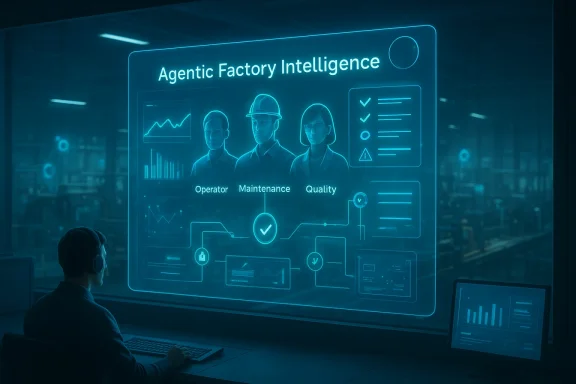
At the center of the project is an agentic factory intelligence system that is meant to sit above and between factory data sources, not replace them. According to the companies, the system combines the Factory Agents and Analytics offering with Microsoft Azure, Microsoft Fabric, Microsoft Foundry, and Copilot to create unified data foundations and role-specific guidance through conversational interfaces. The ambition is to let shop-floor personnel and managers interact with operational data in ways that are faster and more contextual than traditional BI tools.From dashboards to actions
The clearest shift is philosophical. Traditional manufacturing analytics tell you what happened; this model is meant to help decide what should happen next, and in some cases start the response. That does not mean autonomous machines replacing people, but it does mean agents can help triage faults, propose next steps, and move work forward with less delay.This is where Microsoft’s recent platform work matters. Fabric and its real-time intelligence capabilities are designed to unify and analyze operational data streams, while Copilot provides natural-language interaction, and Foundry supplies the agent-building environment. Together, they form the scaffolding for a factory system that can reason over live context rather than relying on static reports.
The practical implication is not glamorous, but it is valuable. A supervisor might ask why a line is drifting, a mechanic might get guided toward the most likely fault, and a quality leader might receive a contextual prompt that connects current output to known process variations. In manufacturing, those minutes matter, because small delays often compound into expensive downtime windows. That is the real business case here.
Why “agentic” is different
The “agentic” label is more than marketing language, even if vendors are using it aggressively. It implies a system that can invoke tools, make decisions within guardrails, and coordinate across data sources without requiring a human to manually connect each step. In a plant setting, that could mean monitoring an anomaly, checking a relevant work order, surfacing procedural context, and notifying the right person with suggested actions.That distinction matters because manufacturing environments are messy. Data often lives in silos, line conditions change quickly, and the right answer may depend on the role of the person asking. A production supervisor, an electrician, and a quality controller may need different views of the same event, which is why the companies are emphasizing contextual, role-specific guidance instead of a one-size-fits-all chatbot.
The strongest version of this idea is not “AI runs the factory.” It is “AI reduces the friction between sensing a problem and acting on it.” If the system can compress that gap, manufacturers gain not only speed but also consistency across sites, shifts, and skill levels.
Why Manufacturing Downtime Is the Right First Use Case
Manufacturing downtime is one of the most economically painful problems in industrial operations because it sits at the intersection of maintenance, quality, labor, supply chain, and energy use. A stopped line creates immediate losses, but it can also trigger missed shipments, overtime, rework, and customer dissatisfaction. That makes downtime an unusually good target for AI, because even modest improvements can justify substantial investment.What makes the use case attractive is not just the size of the problem, but the structure of the decision-making. Many downtime events start with weak signals: a machine drifts, a sensor degrades, a process parameter changes, or an operator spots something unusual. An agentic system can be valuable because it is designed to watch continuously, correlate signals from multiple sources, and nudge the right people before the issue becomes a stop.
Predictive maintenance is necessary but not sufficient
Predictive maintenance has been a major promise in industrial software for years, but it often stops at probability scores and alert lists. The value of the new Microsoft-led approach is that it tries to go further, connecting prediction to action. That may include contextual explanations, recommended escalation paths, and role-aware support for troubleshooting.That matters because many factories already have alert fatigue. If every abnormal reading generates another notification, teams quickly learn to ignore the system. Agentic workflows can reduce that fatigue by prioritizing the highest-value issues, grouping related signals, and presenting them with enough context to be useful. The output has to be decisive, not noisy.
The new offering also aligns with a broader shift in industrial software from “visibility” to “velocity.” Knowing that a line is underperforming is useful; knowing why it is underperforming and what to do in the next five minutes is far more valuable. That is the difference between analytics as a report and analytics as an operational system.
Enterprise impact versus plant-floor impact
For executives, the pitch is about uptime, consistency, and better capital utilization. For plant-floor teams, it is about reducing cognitive load and helping people make the right call faster. Both are valid, but they are not the same value proposition, and the rollout strategy will need to reflect that.At the enterprise level, agentic factory tooling could standardize best practices across plants. At the line level, it could help a mechanic or operator interpret signals without waiting for a specialist to connect the dots. This dual promise is one reason vendors keep emphasizing human-machine collaboration rather than full automation.
The challenge is that enterprise buyers usually purchase platforms, while plant teams live with the workflow consequences. If the system is too abstract, it will stay in the PowerPoint phase; if it is too rigid, operators will find ways around it. The best industrial AI products succeed when they make frontline work easier without forcing frontline teams into a brittle new process.
The Microsoft Stack Behind the Story
Microsoft’s manufacturing push is notable because it is not a single product play. It is a platform story stitched together from Azure, Fabric, Foundry, Copilot, and a growing manufacturing reference architecture. That gives Microsoft a chance to sell not only AI services, but also the data, governance, and deployment layers that factories need before agents can be trusted.Fabric is particularly important because manufacturing AI depends on contextualized data. Shop-floor telemetry alone is not enough; the system also needs process, maintenance, quality, and planning data to explain what is happening. Microsoft’s connected-factory architecture explicitly highlights real-time data processing, factory contextualization, and predictive maintenance as core building blocks.
Fabric, Foundry, and Copilot as the control plane
The value of Microsoft Fabric in this story is its ability to unify industrial data so it can be analyzed in near real time. Microsoft Foundry brings the agent-development side, while Copilot delivers the conversational layer that most users will actually touch. Together, they create a layered experience where the front end feels simple even if the back end is complex.That simplicity is deceptive, because real industrial deployment still demands governance, access control, and reliability. Microsoft’s own documentation notes that Fabric Copilot behavior depends on tenant settings and regional considerations, underscoring that these systems are not “plug-and-play” in the consumer sense. In factories, where compliance and data residency can be critical, those controls are not optional.
This is where Microsoft’s platform strategy has an advantage over point solutions. A standalone analytics tool may be easier to demo, but it is harder to scale across plants, countries, and business units. A platform stack can be slower to implement, yet it is more likely to become the standard operating layer if the economics work.
Why the timing is important
Microsoft has been steadily repositioning itself around agentic experiences across its portfolio. The company’s broader agent factory messaging, plus recent manufacturing updates and partner showcases, suggest it sees industrial AI as a major growth lane rather than a niche add-on. That makes the Accenture and Avanade collaboration part of a bigger strategic arc, not an isolated press release.The timing also follows the earlier deprecation of some preview manufacturing offerings, which hints that Microsoft is consolidating its industrial AI story around a smaller number of more integrated building blocks. That is often what happens when a platform matures: the company trims experimental surfaces and funnels partners toward a more coherent architecture.
For manufacturers, that can be reassuring and frustrating at the same time. Reassuring, because the stack looks more intentional; frustrating, because it confirms that this is still a moving target and not a finished, standardized industrial product. That uncertainty is part of the market right now.
Why Accenture and Avanade Matter
Microsoft can build a platform, but it cannot convert every factory by itself. That is why Accenture and Avanade are essential to the story: they provide the integration, change management, and domain-specific consulting that industrial customers usually require before they commit to a new operating model. The companies say the agentic factory builds on their existing Factory Agents and Analytics offering, which suggests this is an extension of an established go-to-market motion rather than a fresh invention.Accenture brings scale, transformation credentials, and a deep client footprint across manufacturing and industrial sectors. Avanade, as the Microsoft-focused joint venture, gives the partnership a more direct bridge into Microsoft architectures, implementation patterns, and customer trust. Together, they can frame the project as both an engineering effort and an operational change program, which is often what enterprise buyers want to hear.
Services are the real differentiator
A lot of industrial AI value is hidden in the services layer. Data must be cleaned, OT and IT systems must be mapped, roles must be defined, and workflows must be redesigned so the tool fits how a plant actually runs. Accenture and Avanade are valuable because they can do that messy work at enterprise scale, which is often harder than building the AI itself.That also means the commercial model is likely to be attractive to the partners. Industrial AI platforms are easier to sell when they come with implementation, support, and a roadmap for expanding across facilities. In practice, that turns a software feature into a broader transformation program, which is where consulting economics thrive.
Still, services-led AI has a built-in tension: every deployment can become highly customized. Customization helps the first customer win, but it can slow replication. The long-term test will be whether this agentic factory can be packaged into repeatable patterns that scale across manufacturers instead of becoming another bespoke industrial integration project.
Competitive implications for rivals
This partnership puts pressure on rival ecosystems that also want to own industrial AI. Cloud providers, automation vendors, MES companies, and industrial software firms are all converging on the same promise: use AI to make operations smarter, faster, and more resilient. Microsoft’s advantage is that it can connect AI to enterprise data and productivity tools; the competitors will try to counter with deeper plant-native specialization.The result is likely to be a competitive split between platform breadth and operational depth. Microsoft, Accenture, and Avanade are betting that buyers want an integrated stack with partner support. Others may argue that the winning formula is tighter control of industrial workflows and deeper integration into automation hardware. Both approaches can succeed, but not for the same buyer.
What Changes for Manufacturers
For manufacturers, the most obvious change is the shift from asking “what happened?” to asking “what should we do now?” In an ideal deployment, the agentic factory would help operators and supervisors close the loop more quickly, which could reduce downtime, improve quality, and make response more consistent across shifts. That is especially attractive in plants where experienced staff are stretched thin or retiring workers are taking tacit knowledge with them.The second change is more subtle: AI becomes a shared operational language. If the same context can be surfaced through conversational interfaces for different roles, then maintenance, production, and quality teams can coordinate more naturally. That could reduce handoff errors, speed up root-cause analysis, and make escalation less dependent on who happens to be on duty.
Consumer product companies versus heavy industry
Consumer goods manufacturers may see the quickest wins because they often operate high-volume, repeatable lines where small improvements compound quickly. Heavy industry, meanwhile, may value the approach for reliability and asset utilization, but integration complexity can be higher because equipment, safety, and compliance regimes are more demanding. The same AI concept will therefore produce different ROI curves depending on the sector.Another point of differentiation is maturity. Companies that already have strong data infrastructure will be able to move faster because they have the prerequisites in place. Others may need to spend months or years normalizing sensor data, aligning naming conventions, and connecting OT and IT systems before any agentic layer can deliver meaningful value.
That is why the partnership’s language about “unified data foundations” is so important. In manufacturing, the AI model is rarely the hardest part. The hardest part is making sure the underlying data is trustworthy, current, and semantically useful enough that an automated agent can act without making the wrong inference.
A human-in-the-loop future
The companies are careful to frame the system as collaboration rather than replacement. That is the right posture, because industrial customers are unlikely to accept autonomous decision-making for critical operations without strong guardrails. Human operators still need final authority, especially where safety, product quality, or regulatory compliance is involved.That said, the real transformation may come from shrinking the amount of routine judgment that humans must perform. If AI can reliably handle the first layer of diagnosis and context gathering, people can spend more time on exceptions, escalation, and process improvement. That is where productivity gains usually emerge.
Strengths and Opportunities
The strongest aspect of the announcement is that it ties a fashionable AI term to a concrete industrial pain point. Downtime is measurable, expensive, and urgent, which makes it easier to prove value than abstract productivity claims. The partnership also benefits from the combination of platform depth and services expertise, which is often what enterprise buyers need to move from pilot to production.- Clear business outcome: reduced downtime is easier to monetize than generic AI efficiency claims.
- Platform breadth: Azure, Fabric, Foundry, and Copilot cover data, inference, orchestration, and user interaction.
- Services credibility: Accenture and Avanade can help with integration and change management.
- Role-specific guidance: contextual outputs are more useful than generic dashboards.
- Scalability potential: a repeatable architecture could extend across plants and regions.
- Cross-functional value: maintenance, quality, production, and leadership can all use the same data backbone.
- Strategic timing: the market is actively looking for AI that performs beyond chat and content generation.
Why this could resonate now
Manufacturers are under pressure from labor shortages, energy costs, supply volatility, and rising customer expectations. A system that reduces the time between detection and action can help all four pressures at once, which makes the proposition unusually broad. That breadth gives the partnership a good chance of landing in strategic transformation conversations rather than being dismissed as a narrow AI pilot.The story also aligns with how many enterprises now want to buy AI. They are less interested in isolated copilots and more interested in governed systems that can plug into existing workflows. A factory agent that runs on a known cloud and data stack is easier to justify than a standalone experimental tool.
Risks and Concerns
The biggest risk is overpromising autonomy in an environment where mistakes are expensive. Factories are not office workflows, and a poor recommendation can lead to safety issues, scrap, or extended downtime. That means the agentic factory must be carefully bounded, extensively tested, and integrated with strong human oversight.There is also a risk of complexity creep. The more layers involved—Azure services, Fabric pipelines, Foundry agents, Copilot interfaces, and consulting-led customization—the easier it becomes for deployments to stall or become expensive to maintain. A system that looks elegant in a keynote can become fragile once it encounters older machinery, inconsistent data, and local plant exceptions.
Governance, data, and trust
Manufacturers will need confidence that the AI is making recommendations based on accurate and timely data. If upstream data quality is poor, the system can confidently amplify bad assumptions. In industrial environments, that is not a minor UX flaw; it is a trust problem that can undermine the whole initiative.Privacy and residency considerations also matter, especially for multinational manufacturers. Microsoft’s own Fabric Copilot documentation notes regional and tenant settings that affect how data is processed, which reinforces the idea that governance is part of the product, not an afterthought. For regulated industries, that can be a deciding factor.
Another concern is vendor lock-in. A highly integrated stack can accelerate deployment, but it can also make it harder to swap components later. Manufacturers should be asking how portable the data, models, and workflows will be if they later want to diversify their cloud or AI strategy.
- Autonomy risk: AI must not outrun safety or compliance controls.
- Data quality risk: bad inputs can produce confident but wrong recommendations.
- Integration risk: legacy OT environments can slow implementation.
- Cost risk: consulting-heavy projects can become expensive quickly.
- Lock-in risk: deep platform dependence may reduce flexibility later.
- Adoption risk: frontline users may resist tools that do not fit real workflows.
- Overreach risk: pilot success may not translate to multi-site scale.
The adoption hurdle
Even when the technology works, adoption is not guaranteed. Operators need to trust the recommendations, supervisors need to see faster outcomes, and leadership needs to believe the business case is real. If any one of those groups is unconvinced, the project can stall.That is why demonstration value is not enough. The companies will need concrete evidence that the system improves uptime, shortens diagnosis time, and reduces costly interruptions over a meaningful period. Without that proof, “agentic factory” risks becoming another attractive phrase in a crowded industrial AI market.
Looking Ahead
The next phase will be about credibility, not announcement volume. If Accenture, Avanade, and Microsoft can show measurable reductions in downtime and faster troubleshooting in real plants, the agentic factory will have a genuine market signal behind it. If not, the concept may remain a polished but narrow example of industrial AI ambition.Watch for how quickly the partners move from concept language to repeatable deployments. In industrial technology, the winners are not always the companies with the most compelling demo; they are the ones that can deploy consistently across messy, heterogeneous factory environments. That is where implementation discipline becomes more important than AI rhetoric.
Metrics that will matter most
- Reduction in unplanned downtime.
- Mean time to detect and mean time to repair.
- Operator and supervisor adoption rates.
- Quality yield improvements.
- Cross-site consistency in issue resolution.
- Integration time for new facilities.
- Evidence of measurable ROI rather than soft productivity claims.
In the end, the significance of this launch is not that factories are suddenly becoming fully autonomous. It is that the industry is inching closer to a practical version of AI that can watch, reason, and help act in the same operational moment. If that promise holds, the real breakthrough will not be a chatbot in a plant; it will be fewer interruptions, faster decisions, and a factory floor that becomes a little more self-aware every day.
Source: Redmond Channel Partner Accenture, Avanade and Microsoft Launch Agentic Factory to Reduce Manufacturing Downtime -- Redmond Channel Partner
