
Schneider Electric’s latest Hannover Messe push with Microsoft marks a notable shift from isolated industrial AI demos toward a more integrated agentic manufacturing story. The company is positioning EcoStruxure Automation Expert and Microsoft’s Azure AI stack as a single workflow for engineering, simulation, commissioning, and operations, with the promise of faster changes, better traceability, and less rework. If the claims hold up in broader deployments, this could become one of the clearest examples yet of software-defined automation meeting industrial AI at scale. Microsoft’s own Hannover Messe 2026 materials reinforce that Schneider Electric is part of a wider partner-led industrial intelligence push, while Schneider Electric’s 2025–2026 announcements show the collaboration has been building steadily rather than appearing overnight.
The center of gravity in industrial automation has been moving for years, but the pace has accelerated as manufacturers confront labor shortages, supply-chain volatility, and aging control infrastructure. Traditional automation systems are often tightly bound to specific hardware and fragmented across engineering tools, commissioning environments, and plant operations. Schneider Electric and Microsoft are now trying to collapse that fragmentation into a more continuous, software-led model.
That strategy is not new in concept, but the current messaging is sharper and more ambitious. Schneider Electric has long promoted open, software-defined automation through EcoStruxure Automation Expert, which it describes as a platform that separates control logic from hardware and supports reuse across environments. Microsoft, meanwhile, has been building an adaptive cloud manufacturing narrative around Azure, edge, and AI services that can analyze, orchestrate, and optimize operations across the industrial lifecycle.
What changes at Hannover Messe 2026 is the emphasis on agentic workflows. Instead of simply asking AI to summarize data or draft code, the pitch is that industrial AI can help validate logic, support engineering decisions, and accelerate deployment of changes without compromising traceability. In practical terms, that is a big claim: manufacturers do not just want smarter dashboards, they want fewer manual handoffs and a cleaner path from design intent to plant execution.
This is also a competitive signal. Vendors across automation, industrial software, and cloud are all converging on the same theme: the factory of the future will be more connected, more software-defined, and more AI-assisted. Schneider Electric is trying to differentiate by linking its automation stack tightly to Microsoft’s AI and cloud ecosystem while preserving interoperability claims that matter to industrial buyers. That matters because manufacturing customers rarely replace everything at once; they prefer platforms that can modernize incrementally while protecting uptime and safety.
Microsoft entered this industrial conversation through cloud, data, and AI rather than control hardware. Its manufacturing strategy increasingly centers on connecting shop-floor signals to cloud analytics, then using AI agents and copilots to make those signals more actionable. At Hannover Messe 2026, Microsoft described industrial intelligence as a combination of Work IQ, Fabric IQ, and Foundry IQ, framing the opportunity as a unified intelligence layer for people, assets, and institutional knowledge. That makes the Schneider Electric partnership especially relevant because it bridges Microsoft’s high-level intelligence model with a real automation runtime.
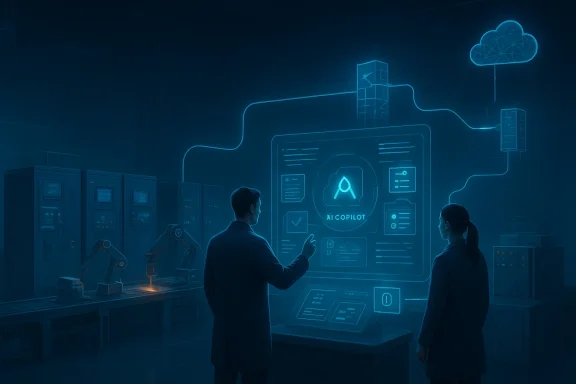
The timing matters. In 2025, Schneider Electric already introduced an AI Copilot for Industrial Automation in collaboration with Microsoft, with ARC Advisory Group noting that the solution combined Azure AI Foundry with Schneider Electric automation technologies to improve efficiency, diagnostics, and predictive maintenance. The new Hannover Messe 2026 messaging extends that concept from a copilot feature into a broader operational architecture. In other words, what started as an assistant for engineers is now being positioned as part of an end-to-end manufacturing platform.
There is also a broader industry backdrop. Industrial buyers have been conditioned by years of promises around digital twins, AI analytics, and “smart manufacturing,” but adoption often stalled because the tooling was not integrated enough to change day-to-day operations. The current wave of industrial AI appears different because it is increasingly tied to execution, not just insight. That distinction is critical: a model that predicts a problem is useful, but a workflow that can help validate a change, track it, and deploy it is far more valuable.
The article’s claims around efficiency are especially noteworthy. ARC reports that engineering teams may see up to a 50 percent reduction in configuration and documentation time, and that production changes that once took weeks could be implemented within hours. Those numbers should be treated cautiously because vendor-backed productivity claims often depend on the use case, but the directional point is credible: software reuse and AI-assisted validation can reduce the friction that slows industrial change. That caveat matters because manufacturing environments are not generic IT stacks; every site has its own constraints, safety requirements, and validation burden.
A second advantage is reuse. If logic and validation artifacts can travel more easily between sites or lines, manufacturers can standardize best practices instead of rebuilding them each time. That is not just an engineering convenience; it is a resilience strategy. Standardization makes it easier to respond to shifts in demand, regulation, and supply availability without reinventing the control architecture from scratch.
Azure’s value in this context is less about replacing the PLC or controller layer and more about extending context around it. The combination of Azure IoT-style data flow, Fabric-style analytics, and AI agents can help engineers and operators see patterns that were previously buried in siloed systems. That is a meaningful evolution because industrial teams often have data abundance but contextual scarcity.
This matters because industrial automation has traditionally been rule-bound and deterministic. Plants do not want experimental behavior from control systems, and they certainly do not want autonomous decisions in safety-critical contexts without oversight. So the value proposition for agentic AI is not “let the model run the plant.” It is assist the engineering and operations lifecycle in a way that keeps humans in the loop where judgment is required.
The language around trust is central here. Microsoft explicitly frames its industrial strategy around intelligence plus trust, while Schneider Electric’s workflow-centric pitch implies traceability, simulation, and validation before deployment. Those themes are not accidental. Industrial customers are wary of AI when it feels opaque, but they are much more receptive when the AI is wrapped in controls, versioning, and testability.
That is why this collaboration should be interpreted as augmentation, not automation in the purest sense. The industrial copilot model makes more sense when it is used for drafting, validation, troubleshooting, and knowledge retrieval. It becomes much less believable when described as a fully autonomous industrial brain. The distinction is not semantic; it is operational.
Historically, industrial engineering has been burdened by rework. A change to a machine line often requires edits across code, documentation, commissioning procedures, and operations manuals. When those artifacts live in different tools or teams, every change becomes slower and more error-prone. A unified platform is attractive precisely because it promises to turn repeated manual effort into reusable digital assets.
Another likely source of savings is earlier defect detection. Simulation and validation before deployment can prevent expensive late-stage changes, especially in complex process environments where downtime is costly. In industrial settings, catching a problem before commissioning is often worth far more than fixing it during live operations.
The ability to standardize and deploy logic across on-premises, edge, and hybrid environments is important because resilience increasingly means distribution. A plant may need local autonomy for real-time processes, cloud connectivity for analytics, and a consistent model for governance. If those layers do not align, resilience becomes fragile and upgrades become risky.
The H2E Power reference in the ARC article is instructive. The deployment reportedly supported more than 6,000 hours of stable autonomous operation in a high-temperature solid oxide electrolysis environment, with a cited reduction in levelized hydrogen cost of up to 10 percent for a typical 10 MW plant. Those figures should be viewed as a specific deployment claim, not a universal benchmark, but they show the collaboration is already being tied to real industrial scenarios rather than lab prototypes.
That is why the combination of edge deployment, local validation, and cloud-backed intelligence is strategically sound. It acknowledges that factories cannot depend on constant connectivity or remote inference alone. Industrial systems must fail gracefully, not creatively.
That puts pressure on multiple rival camps. Traditional automation incumbents must prove that their hardware-centric architectures can evolve into software-first platforms without losing reliability. Industrial software vendors must show they can move beyond dashboards and analytics into execution-aware workflows. Cloud rivals must answer the question of how they will support deterministic industrial requirements at the edge.
Schneider Electric’s angle is more specific. Its differentiation comes from software-defined automation and the promise of hardware-agnostic portability. If that works well, it gives manufacturers a modernization path that does not require ripping and replacing everything at once. That is appealing in a market where capital budgets are tight and plant upgrades must compete with production demands.
For enterprises, the impact is immediate and operational. Manufacturing leaders need tools that can improve throughput, reduce commissioning time, and preserve institutional knowledge when experienced engineers leave or retire. The promise of agentic workflows is especially attractive where labor is scarce and change velocity is high. The business case is not speculative there; it is tied to day-to-day execution.
That is why the collaboration is interesting as a platform play. It is not simply an AI app for one department. It is a bid to stitch together business, engineering, and operations into a shared system of record and action. That is harder to build, but much more valuable if it works.
Microsoft’s 2026 messaging makes it clear that industrial intelligence is now central to its manufacturing story. Schneider Electric appears prominently among the companies shaping that message, which suggests the collaboration is being treated as a flagship example of what agentic manufacturing can look like in practice. That kind of visibility matters because industrial buyers often judge maturity by who is willing to showcase real use cases on the main stage.
It also aligns with the industry’s direction of travel. Manufacturers want faster engineering, more reusable logic, better traceability, and more resilient operations. Those are concrete pain points, and the platform seems designed to address them in a cohesive way rather than through disconnected point tools.
A second concern is complexity. Adding AI, cloud services, simulation, governance, and software-defined control into one architecture can increase integration demands, even if it reduces manual work later. Enterprises may need new skills, new operating models, and stronger governance before they can realize the benefits. That transition cost is easy to underestimate.
It will also be worth watching how the ecosystem reacts. If the partnership attracts more SI, OEM, and software partners, it could become a de facto reference architecture for industrial AI workflows. If adoption remains confined to a few marquee customers, then the market may view it as an impressive but narrow showcase rather than a platform shift.
Source: ARCweb.com Schneider Electric Expands Agentic Manufacturing Capabilities with Microsoft Azure AI at Hannover Messe 2026
 Overview
The center of gravity in industrial automation has been moving for years, but the pace has accelerated as manufacturers confront labor shortages, supply-chain volatility, and aging control infrastructure. Traditional automation systems are often tightly bound to specific hardware and fragmented across engineering tools, commissioning environments, and plant operations. Schneider Electric and Microsoft are now trying to collapse that fragmentation into a more continuous, software-led model.That strategy is not new in concept, but the current messaging is sharper and more ambitious. Schneider Electric has long promoted open, software-defined automation through EcoStruxure Automation Expert, which it describes as a platform that separates control logic from hardware and supports reuse across environments. Microsoft, meanwhile, has been building an adaptive cloud manufacturing narrative around Azure, edge, and AI services that can analyze, orchestrate, and optimize operations across the industrial lifecycle.
What changes at Hannover Messe 2026 is the emphasis on agentic workflows. Instead of simply asking AI to summarize data or draft code, the pitch is that industrial AI can help validate logic, support engineering decisions, and accelerate deployment of changes without compromising traceability. In practical terms, that is a big claim: manufacturers do not just want smarter dashboards, they want fewer manual handoffs and a cleaner path from design intent to plant execution.
This is also a competitive signal. Vendors across automation, industrial software, and cloud are all converging on the same theme: the factory of the future will be more connected, more software-defined, and more AI-assisted. Schneider Electric is trying to differentiate by linking its automation stack tightly to Microsoft’s AI and cloud ecosystem while preserving interoperability claims that matter to industrial buyers. That matters because manufacturing customers rarely replace everything at once; they prefer platforms that can modernize incrementally while protecting uptime and safety.
Background
Schneider Electric’s software-defined automation effort predates the current AI boom. The company launched EcoStruxure Automation Expert as part of a broader universal automation vision, and its early public messaging focused on portability, reuse, and decoupling software from fixed hardware. The underlying logic was straightforward: if automation code can be developed once and deployed across more environments, engineering becomes faster, plants become more flexible, and lifecycle costs should fall.Microsoft entered this industrial conversation through cloud, data, and AI rather than control hardware. Its manufacturing strategy increasingly centers on connecting shop-floor signals to cloud analytics, then using AI agents and copilots to make those signals more actionable. At Hannover Messe 2026, Microsoft described industrial intelligence as a combination of Work IQ, Fabric IQ, and Foundry IQ, framing the opportunity as a unified intelligence layer for people, assets, and institutional knowledge. That makes the Schneider Electric partnership especially relevant because it bridges Microsoft’s high-level intelligence model with a real automation runtime.
The timing matters. In 2025, Schneider Electric already introduced an AI Copilot for Industrial Automation in collaboration with Microsoft, with ARC Advisory Group noting that the solution combined Azure AI Foundry with Schneider Electric automation technologies to improve efficiency, diagnostics, and predictive maintenance. The new Hannover Messe 2026 messaging extends that concept from a copilot feature into a broader operational architecture. In other words, what started as an assistant for engineers is now being positioned as part of an end-to-end manufacturing platform.
There is also a broader industry backdrop. Industrial buyers have been conditioned by years of promises around digital twins, AI analytics, and “smart manufacturing,” but adoption often stalled because the tooling was not integrated enough to change day-to-day operations. The current wave of industrial AI appears different because it is increasingly tied to execution, not just insight. That distinction is critical: a model that predicts a problem is useful, but a workflow that can help validate a change, track it, and deploy it is far more valuable.
What Schneider Electric Is Actually Showing
The most important thing about the Hannover Messe 2026 message is that it is not only about AI models. It is about a workflow that links engineering design, simulation, validation, commissioning, and runtime operations in a traceable sequence. Schneider Electric says EcoStruxure Automation Expert can be used to develop logic once, simulate it, validate it, and deploy it across different environments without reconfiguration. That is the kind of promise that sounds abstract until you consider how much industrial time is spent on repetitive engineering work.The article’s claims around efficiency are especially noteworthy. ARC reports that engineering teams may see up to a 50 percent reduction in configuration and documentation time, and that production changes that once took weeks could be implemented within hours. Those numbers should be treated cautiously because vendor-backed productivity claims often depend on the use case, but the directional point is credible: software reuse and AI-assisted validation can reduce the friction that slows industrial change. That caveat matters because manufacturing environments are not generic IT stacks; every site has its own constraints, safety requirements, and validation burden.
Why the workflow matters
The strategic value lies in continuity. In a traditional plant project, engineering, controls, testing, and operations can live in separate toolchains with separate records and different ownership. By tying them together into one traceable flow, Schneider Electric and Microsoft are effectively promising a digital thread for automation. That can improve accountability, speed audits, and reduce the risk of errors introduced during handoffs.A second advantage is reuse. If logic and validation artifacts can travel more easily between sites or lines, manufacturers can standardize best practices instead of rebuilding them each time. That is not just an engineering convenience; it is a resilience strategy. Standardization makes it easier to respond to shifts in demand, regulation, and supply availability without reinventing the control architecture from scratch.
The role of Azure AI
Microsoft’s side of the collaboration appears to focus on orchestration, reasoning, and data unification. Its Hannover Messe 2026 blog emphasizes a unified intelligence layer and industrial AI that can run at the edge or in the cloud depending on latency and connectivity needs. That matters because industrial AI cannot be cloud-only; many shop-floor tasks require fast local decision-making and reliable operation even when network conditions are imperfect.Azure’s value in this context is less about replacing the PLC or controller layer and more about extending context around it. The combination of Azure IoT-style data flow, Fabric-style analytics, and AI agents can help engineers and operators see patterns that were previously buried in siloed systems. That is a meaningful evolution because industrial teams often have data abundance but contextual scarcity.
- Design intent becomes more actionable when it is carried through simulation and commissioning.
- Operational data can feed back into engineering decisions faster.
- Change management becomes more auditable when logic, tests, and deployment are traceable.
- Reuse reduces repetitive configuration work across sites.
- Edge plus cloud flexibility supports both low-latency and analytics-heavy use cases.
Why Agentic Manufacturing Is More Than a Buzzword
“Agentic manufacturing” can sound like marketing language unless it is grounded in actual work. In this case, the term seems to refer to AI systems that do more than answer questions; they help execute tasks within a governed workflow. That means generating code, recommending changes, supporting simulation, and organizing knowledge in ways that reduce manual effort without removing human control.This matters because industrial automation has traditionally been rule-bound and deterministic. Plants do not want experimental behavior from control systems, and they certainly do not want autonomous decisions in safety-critical contexts without oversight. So the value proposition for agentic AI is not “let the model run the plant.” It is assist the engineering and operations lifecycle in a way that keeps humans in the loop where judgment is required.
The language around trust is central here. Microsoft explicitly frames its industrial strategy around intelligence plus trust, while Schneider Electric’s workflow-centric pitch implies traceability, simulation, and validation before deployment. Those themes are not accidental. Industrial customers are wary of AI when it feels opaque, but they are much more receptive when the AI is wrapped in controls, versioning, and testability.
Human oversight still matters
The strongest industrial AI systems are likely to be the ones that reduce toil rather than replace expertise. Engineers still need to understand edge cases, safety interlocks, and process constraints. AI can help surface options, but the final decision remains tied to risk tolerance, compliance obligations, and plant knowledge.That is why this collaboration should be interpreted as augmentation, not automation in the purest sense. The industrial copilot model makes more sense when it is used for drafting, validation, troubleshooting, and knowledge retrieval. It becomes much less believable when described as a fully autonomous industrial brain. The distinction is not semantic; it is operational.
The Engineering Efficiency Argument
The efficiency case is one of the most compelling parts of the story. Schneider Electric’s platform approach aims to reduce the time engineers spend recreating logic, re-entering documentation, and revalidating changes across multiple systems. ARC’s reporting suggests the company is targeting meaningful reductions in engineering overhead, and that can translate into faster project delivery and lower lifecycle costs.Historically, industrial engineering has been burdened by rework. A change to a machine line often requires edits across code, documentation, commissioning procedures, and operations manuals. When those artifacts live in different tools or teams, every change becomes slower and more error-prone. A unified platform is attractive precisely because it promises to turn repeated manual effort into reusable digital assets.
Where the time savings may come from
The most obvious wins are in repetitive tasks. If AI can help draft boilerplate logic, generate documentation, suggest parameter changes, and validate dependencies against known templates, the human engineer can focus on exceptions and performance tuning. That is a better use of expertise and, in many plants, a necessary response to workforce shortages.Another likely source of savings is earlier defect detection. Simulation and validation before deployment can prevent expensive late-stage changes, especially in complex process environments where downtime is costly. In industrial settings, catching a problem before commissioning is often worth far more than fixing it during live operations.
- Repeatable logic reduces custom coding.
- Simulation first reduces commissioning surprises.
- Traceable changes improve accountability.
- Documentation automation lowers administrative load.
- Context-aware recommendations shorten troubleshooting cycles.
The Industrial Resilience Case
If efficiency is the short-term selling point, resilience may be the longer-term one. Manufacturers are under pressure to modernize without sacrificing uptime, and that is particularly difficult in high-availability environments where every change carries risk. Schneider Electric’s message suggests that software-defined automation combined with Azure AI can make change management safer by making it more observable and more consistent.The ability to standardize and deploy logic across on-premises, edge, and hybrid environments is important because resilience increasingly means distribution. A plant may need local autonomy for real-time processes, cloud connectivity for analytics, and a consistent model for governance. If those layers do not align, resilience becomes fragile and upgrades become risky.
The H2E Power reference in the ARC article is instructive. The deployment reportedly supported more than 6,000 hours of stable autonomous operation in a high-temperature solid oxide electrolysis environment, with a cited reduction in levelized hydrogen cost of up to 10 percent for a typical 10 MW plant. Those figures should be viewed as a specific deployment claim, not a universal benchmark, but they show the collaboration is already being tied to real industrial scenarios rather than lab prototypes.
Why resiliency matters to industrial buyers
For plant operators, resilience is not a slogan. It means shorter recovery times, fewer unplanned shutdowns, easier replications across sites, and better control over changes introduced under pressure. AI that improves situational awareness but cannot survive real-world constraints will not gain trust.That is why the combination of edge deployment, local validation, and cloud-backed intelligence is strategically sound. It acknowledges that factories cannot depend on constant connectivity or remote inference alone. Industrial systems must fail gracefully, not creatively.
Competitive Implications for Microsoft and Schneider Electric
This collaboration is not just about product enhancement; it is a positioning battle. Microsoft wants to be seen as the industrial intelligence layer that sits above a broad ecosystem of automation and manufacturing partners. Schneider Electric wants to be seen as the open automation anchor that makes AI useful in real plants. Together, they are trying to create an industrial stack that is modular enough to fit existing operations but integrated enough to be sticky.That puts pressure on multiple rival camps. Traditional automation incumbents must prove that their hardware-centric architectures can evolve into software-first platforms without losing reliability. Industrial software vendors must show they can move beyond dashboards and analytics into execution-aware workflows. Cloud rivals must answer the question of how they will support deterministic industrial requirements at the edge.
Who feels the pressure?
Vendors such as Siemens, Rockwell Automation, ABB, and other industrial ecosystem players all face similar questions: how tightly should their products integrate with hyperscaler AI, and how much openness can they support without diluting platform control? Microsoft’s Hannover Messe partner framing suggests that the company wants to be a common layer across these ecosystems rather than a replacement for them. That is a powerful strategy because it lowers friction for customers while expanding Microsoft’s influence.Schneider Electric’s angle is more specific. Its differentiation comes from software-defined automation and the promise of hardware-agnostic portability. If that works well, it gives manufacturers a modernization path that does not require ripping and replacing everything at once. That is appealing in a market where capital budgets are tight and plant upgrades must compete with production demands.
- Hyperscalers gain relevance when they touch actual plant workflows.
- Automation vendors must prove software openness without sacrificing reliability.
- Industrial software firms need deeper execution integration.
- System integrators may benefit from new lifecycle services.
- End users get more modernization options, but also more platform choices to evaluate.
Enterprise Versus Consumer Impact
For consumers, this story is indirect. Most people will never interact with EcoStruxure Automation Expert or Azure AI in a factory setting, but they may benefit from the downstream effects: more reliable products, fewer supply disruptions, and potentially lower costs if manufacturers become more efficient. In that sense, industrial AI has a quiet consumer story even when it never appears on a retail shelf.For enterprises, the impact is immediate and operational. Manufacturing leaders need tools that can improve throughput, reduce commissioning time, and preserve institutional knowledge when experienced engineers leave or retire. The promise of agentic workflows is especially attractive where labor is scarce and change velocity is high. The business case is not speculative there; it is tied to day-to-day execution.
Different buying centers, different priorities
CIOs may care most about data governance, cloud integration, and identity controls. OT leaders will care about deterministic behavior, safety, and uptime. Engineering leaders will care about reuse, validation, and documentation burden. A successful industrial AI platform has to satisfy all three without overpromising in any one direction.That is why the collaboration is interesting as a platform play. It is not simply an AI app for one department. It is a bid to stitch together business, engineering, and operations into a shared system of record and action. That is harder to build, but much more valuable if it works.
Why Hannover Messe Matters
Hannover Messe remains the industrial world’s major stage for proving that ideas are real enough to sell. The event is where vendors signal roadmap maturity, ecosystem breadth, and customer traction. Schneider Electric and Microsoft are using the 2026 show to demonstrate not just a partnership, but a narrative about where industrial transformation is heading next.Microsoft’s 2026 messaging makes it clear that industrial intelligence is now central to its manufacturing story. Schneider Electric appears prominently among the companies shaping that message, which suggests the collaboration is being treated as a flagship example of what agentic manufacturing can look like in practice. That kind of visibility matters because industrial buyers often judge maturity by who is willing to showcase real use cases on the main stage.
The optics are as important as the demos
The public staging of a joint Schneider Electric-Microsoft story helps signal that the partnership is strategic, not merely opportunistic. It also tells customers that both vendors are willing to align around open ecosystems and hybrid deployment models. In a market where platform trust is hard-won, that reassurance can be nearly as important as the underlying feature set.- Visibility validates the partnership.
- Live demos reduce perceived abstraction.
- Customer references build credibility.
- Ecosystem breadth signals longevity.
- Hybrid deployment addresses real-world plant constraints.
Strengths and Opportunities
The biggest strength of this collaboration is that it connects a credible automation foundation with a credible cloud-AI stack. Schneider Electric brings industrial execution realism, while Microsoft brings orchestration, analytics, and AI scale. That combination gives the partnership a stronger story than either company could tell alone.It also aligns with the industry’s direction of travel. Manufacturers want faster engineering, more reusable logic, better traceability, and more resilient operations. Those are concrete pain points, and the platform seems designed to address them in a cohesive way rather than through disconnected point tools.
- Software-defined automation offers long-term flexibility.
- Azure AI integration brings scalable intelligence and orchestration.
- Simulation and validation reduce deployment risk.
- Reuse across sites can lower engineering costs.
- Hybrid edge-cloud support matches factory realities.
- Customer demos provide real-world proof points.
- Open ecosystem framing may ease adoption.
Risks and Concerns
The biggest risk is overpromising. Industrial AI has a long history of sounding transformative in demonstrations but delivering more modest gains in production, especially where safety, regulation, or custom processes limit automation. The performance claims cited around engineering time savings and hydrogen economics are promising, but they should not be generalized too quickly.A second concern is complexity. Adding AI, cloud services, simulation, governance, and software-defined control into one architecture can increase integration demands, even if it reduces manual work later. Enterprises may need new skills, new operating models, and stronger governance before they can realize the benefits. That transition cost is easy to underestimate.
- Pilot success may not scale across diverse plants.
- Vendor lock-in risk can grow as workflows become more integrated.
- Skills shortages may slow adoption.
- Safety validation remains non-negotiable.
- Data quality issues can undermine AI recommendations.
- Governance overhead may rise before efficiency improves.
- Legacy system integration could limit portability claims.
Looking Ahead
The most important thing to watch next is whether these announcements translate into repeatable deployments beyond showcase customers. A single hydrogen project or a polished engineering demo is useful, but broad market adoption will depend on whether Schneider Electric and Microsoft can prove the model works across sectors, geographies, and plant maturity levels. That is where the real test begins.It will also be worth watching how the ecosystem reacts. If the partnership attracts more SI, OEM, and software partners, it could become a de facto reference architecture for industrial AI workflows. If adoption remains confined to a few marquee customers, then the market may view it as an impressive but narrow showcase rather than a platform shift.
Key signals to watch
- New customer references outside early showcase deployments.
- Broader availability of AI-assisted engineering features.
- Evidence that traceability and validation tools reduce commissioning time.
- Expansion of hybrid edge-cloud industrial workloads.
- Competitive responses from Siemens, Rockwell, ABB, and others.
- Clearer pricing and implementation models for enterprise buyers.
Source: ARCweb.com Schneider Electric Expands Agentic Manufacturing Capabilities with Microsoft Azure AI at Hannover Messe 2026
