

AI-powered answer surfaces are no longer an experimental fringe of search—they are an advertising frontier, and brands that ignore AI search engine advertising risk being invisible where many purchase-ready people first ask questions.
Generative assistants and "answer engines" have remapped the search landscape from link-based discovery to synthesized answers and conversational journeys. Instead of clicking a list of blue links, users increasingly get a single, composed response (sometimes with citations) and a small set of follow‑ups. That shift has created new ad inventory: ads placed inside or adjacent to AI-generated answers, not only at the top of a traditional results page. Industry briefings, platform documentation and recent reporting confirm this is a real, accelerating market change — Microsoft and Google are actively placing ads in assistant surfaces, OpenAI has begun limited ad tests inside ChatGPT, and smaller answer engines have experimented with ad models before pivoting based on trust concerns.
This article is a practical, platform‑aware guide for marketers and technical teams: what AI search engine advertising is, which placements exist today, how those placements behave technically and commercially, what performance claims you can reasonably expect, and the measurement, privacy and trust trade‑offs you must manage.
Don’t treat platform claims as gospel: verify with controlled tests, prepare data and creative for conversational contexts, and build governance into campaigns so that performance gains don’t come at the expense of long‑term brand trust. The platforms are evolving fast; advertisers who move early but carefully — grounded in measurement and ethical guardrails — will find the most durable advantage.
Quick reference: key platform notes
Source: Kansas City Star https://www.kansascity.com/news/business/article314806211.html
 Background / Overview
Generative assistants and "answer engines" have remapped the search landscape from link-based discovery to synthesized answers and conversational journeys. Instead of clicking a list of blue links, users increasingly get a single, composed response (sometimes with citations) and a small set of follow‑ups. That shift has created new ad inventory: ads placed inside or adjacent to AI-generated answers, not only at the top of a traditional results page. Industry briefings, platform documentation and recent reporting confirm this is a real, accelerating market change — Microsoft and Google are actively placing ads in assistant surfaces, OpenAI has begun limited ad tests inside ChatGPT, and smaller answer engines have experimented with ad models before pivoting based on trust concerns.This article is a practical, platform‑aware guide for marketers and technical teams: what AI search engine advertising is, which placements exist today, how those placements behave technically and commercially, what performance claims you can reasonably expect, and the measurement, privacy and trust trade‑offs you must manage.
What exactly is AI search engine advertising?
Definition and what it is not
- AI search engine advertising means placing pay‑per‑click or sponsored placements inside AI‑powered search and answer experiences — for example, within Microsoft Copilot conversations, Google’s AI Overviews/AI Mode responses, or assistant answers from other platforms. These are ad placements in AI‑generated answers, not simply using AI to create or optimize your ads.
- This is distinct from:
- Using LLMs to write ad copy (creative augmentation).
- Programmatic display buys that simply retarget users off an AI surface.
- In‑app or in‑chat sponsored content that isn’t integrated into the assistant’s answer flow.
Why this matters now
AI assistants compress user journeys: many queries that would have produced multiple clicks now produce one synthesized answer. If an ad can be placed inside that answer — or introduced by the assistant as a helpful option — it commands a first-moment-of-attention that can shorten purchase funnels and increase conversion likelihood. Platform docs and vendor research claim measurable uplifts for assistant‑native placements. However, the size and stability of those uplifts vary by platform and by the ad formats used.The major advertising surfaces today
Microsoft Copilot
- About: Copilot is Microsoft’s conversational AI layered across Windows, Edge and Microsoft 365, and it surfaces answers and suggestions in multi‑turn dialogs. Microsoft has built ad primitives into Copilot that can appear at the bottom of an answer or as contextual suggestions inside a conversation.
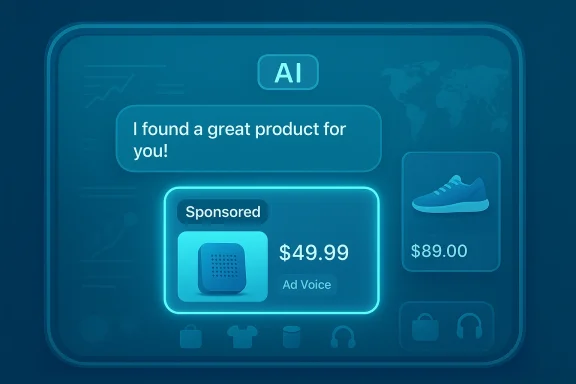
- How ads show: Copilot evaluates the entire conversational context before deciding whether to present an ad; when it does, it may include a short explanation of why it recommended the advertiser (Microsoft calls this an “ad voice”). Ads are labeled (“Sponsored”) and Microsoft reports stronger engagement metrics for ads shown in Copilot vs. traditional search placements in its own research. Advertiser assets that already run in Microsoft Advertising can be eligible to appear in Copilot placements, subject to relevance.
- Performance claims (what Microsoft reports): Microsoft’s marketing materials have cited double‑digit to double‑digit‑plus improvements in click‑through and conversion metrics when comparing Copilot placements to equivalent traditional search placements (examples reported include CTR uplifts in the ~60–73% range and conversion improvements reported in platform materials). These are platform‑supplied figures and should be validated against your own tests before committing scale.
Google AI Overviews (AI Mode / AI Overviews)
- About: Google’s generative summaries (branded AI Overviews or AI Mode in some UIs) appear directly in Search results and are designed to synthesize content from multiple sources into a single answer. Google has opened placements so that Search text ads and Shopping ads can appear above, below or inside those Overviews under specific conditions.
- Eligibility and technical constraints: To be eligible to appear inside an AI Overview, campaigns typically must allow Google’s AI‑led matching methods (for example, broad match, AI Max for Search, Performance Max, or Dynamic Search Ads). Ads shown inside an Overview are selected based on both the raw query and the content of the Overview — not only literal keyword matching. Google explicitly excludes certain sensitive verticals from AI Overview ads and lists specific geographic and language rollouts.
- Ad disclosure and “ad voice”: Google’s assistant surfaces use an explanatory transition — an ad voice — when introducing promotional content, and ads are labeled “Sponsored,” similar to other ad placements. That labeling and explanatory context matter for both compliance and brand perception.
Perplexity and other answer engines
- About and status: Perplexity popularized the idea of an answer‑first search interface and experimented with advertising and publisher revenue sharing. However, recent reporting shows Perplexity pivoting away from advertising as a primary monetization route — citing user trust concerns — and focusing instead on subscriptions and enterprise offerings. That pivot underscores an important fact: not all AI answer providers will accept ads, and the landscape is fluid. Marketers must track platform policy changes closely.
- Measurement constraints: When Perplexity or smaller answer engines have offered placements, they have not always provided full conversion tracking. Advertisers had to rely on post‑click traffic metrics, branded search lift and unified measurement platforms (e.g., server‑side stitching or first‑party data integration) to assess ad effectiveness. Expect similar constraints on smaller or emerging platforms.
ChatGPT (OpenAI) — live tests (February 2026)
- About: OpenAI began limited testing of ads inside ChatGPT for logged‑in adult users on free and lower‑cost tiers; paid tiers remain ad‑free during tests. OpenAI’s stated design aims to keep ads separate from the model’s answers, protect conversation privacy from advertisers, and offer controls for users to dismiss or manage personalized ads. This represents a major shift in how assistant platforms are monetized and how marketers can buy placement in a high‑engagement chat surface.
How AI placements differ technically and operationally from traditional search ads
Contextual matching vs. keyword matching
AI placements depend on the assistant’s understanding of intent and the synthesis content. That means:- Ads must compete to be relevant to both the raw query and the generated answer.
- Traditional exact‑match keyword tactics often underperform; automated, intent‑oriented campaign types (broad match, AI Max, Performance Max, Dynamic Search) are usually the path to eligibility.
“Ad voice” and disclosure mechanics
Assistants may preface or follow an ad with a short justification (ad voice), explaining why the ad is relevant given the user’s question or the assistant’s reasoning. This is meant to preserve transparency, but it also requires new creative considerations: your ad copy may be read as part of a conversational narrative rather than as a standalone search snippet.Placement locations and formats
- Inside the AI answer (embedded suggestion or product box).
- Above or below the AI Overview (traditional ad slots adjacent to the generative response).
- On an extended “answer page” or related questions surface for answer‑engine providers.
Each placement has different creative, click behavior and attribution characteristics. Platforms may support responsive text, shopping cards, multimedia assets and, in some cases, integrated checkout flows.
Measurement, attribution and reporting challenges
AI search engine advertising creates measurement friction that advertisers must plan for:- Attribution windows compress: several platform reports show shorter customer journeys when an assistant is involved; that can boost short‑window conversions but complicate long‑tail attribution. Microsoft’s internal research, for instance, has highlighted shorter journeys for Copilot users versus traditional search journeys. Platform numbers are useful directional signals but are not a substitute for your own A/B tests.
- Ad surface visibility in reporting: some platforms currently do not segment reporting for impressions/clicks that appeared inside the generative answer vs. adjacent ad slots. Google’s help documentation warns advertisers that not all placements are separately reported today. That means you may need to infer impact from aggregate Search/Shopping/Performance Max metrics, GA4 post‑click funnels and brand lift studies.
- Conversion tracking limitations on emerging networks: smaller answer engines have in the past lacked pixel‑style conversion tracking and have relied on impressions, unique impressions and qualifying queries as proxies. Third‑party measurement vendors can stitch behavior across sessions to model post‑click conversions, but expect noise.
- Privacy and data flows: assistant platforms are experimenting with privacy‑preserving ad measurement and aggregate reporting. When planning campaigns, validate whether advertisers receive only aggregated metrics (views/clicks) or whether there’s support for deterministic, first‑party attribution. OpenAI, for example, stated ad tests would preserve chat privacy and only provide aggregate performance to advertisers.
Creative and campaign strategy: practical guidance
Advertisers must treat AI placements as a hybrid of search, discovery and conversation. Below is a practical playbook.1) Prepare your data foundations
- Ensure first‑party conversion tracking is working (GA4 or a server‑side solution).
- Consolidate audiences and conversion events into a single measurement layer.
- Audit your shopping feed and product data — AI placements often surface Shopping assets for product queries.
2) Use AI‑friendly campaign types
- Favor broad match, AI Max for Search, Performance Max and Dynamic Search Ads where the platform requires it. These give the platform freedom to match intent rather than literal keywords. But: don’t abandon negative keyword hygiene or placement exclusions — AI matching can surface unexpected placements.
3) Loosen exact‑match rigidity — but monitor closely
- Give automated learners some room to optimize, but keep a close watch on search terms and placements. The learning curve for AI placements may require a different cadence of bidding and budget allocation than legacy search campaigns. Industry practitioners recommend relaxing exact match constraints while keeping exclusions active.
4) Re‑write creative for conversational context
- Create short, helpful assets that read naturally within a sentence (because assistants may introduce ads inline).
- Prepare both micro‑conversions (newsletter signups, resource downloads) and direct response assets to fit different user intents surfaced in AI answers.
5) Test small, measure, then scale
- Run pilot tests with a limited budget and tightly defined KPIs.
- Use control groups (campaigns without AI placements) to measure incremental lift.
- Scale once you validate CPA/ROAS expectations and post‑click experience.
6) Protect brand safety and trust
- Monitor where assistant narratives reference your brand; an ad placed within an assistant‑generated answer alters perceived endorsement.
- Use placement exclusions, creative review and strong merchant reputation signals to avoid appearing next to inappropriate or misleading assistant responses.
Privacy, legal and ethical considerations
- User privacy: Platforms claim to keep conversational content private from advertisers and to only share aggregate ad performance; nevertheless, any ad that appears inside a personal assistant surface raises new privacy questions. Check each platform’s ad‑privacy and data‑sharing terms before scaling campaigns. OpenAI and other platforms have published test programs describing privacy safeguards for ads.
- Regulatory risk: Advertising within synthesized answers—especially when the assistant’s answer is indistinguishable from editorial content—has already triggered debate in newsrooms and regulatory circles. Publishers and platforms are negotiating revenue shares; some publishers have sued or threatened action over content use and monetization. Expect regulators and industry groups to examine disclosure practices and algorithmic transparency.
- Trust and product impact: The risk of eroding user trust is real. Perplexity’s recent decision to pull back from advertising (citing trust concerns) is a reminder that some product leaders believe ads can damage perceived accuracy — and that those decisions will affect where advertisers can buy placements. Advertisers should weigh short‑term performance against longer‑term brand risk.
Publisher and SEO implications
AI Overviews and answer engines reduce raw organic traffic to some publishers by answering queries directly. That has sparked a publisher push for:- revenue‑sharing deals with AI platforms,
- clearer citation and attribution mechanisms, and
- participation in ad revenue when content is used to inform an assistant answer.
Risks and downside scenarios advertisers must plan for
- Volatile policy changes: Platforms are experimenting rapidly. Eligibility rules, reporting granularity and ad formats can change with little notice. Keep contingency budgets and be ready to redirect spend.
- Measurement overclaim risk: Platform supplied uplift figures are useful for benchmarking but can be optimistic, based on selected verticals and in‑house tests. Always replicate success via controlled experiments.
- Reputation and trust: Being “promoted” inside an assistant’s answer can reframe consumer perception. Ads that feel intrusive or irrelevant in a conversational surface can cause disproportionate brand backlash. Monitor sentiment and feedback channels closely.
- Fragmentation: Multiple assistants with different ad models (some ad‑based, some subscription‑first) create fragmentation. You’ll need a diversified AI ad strategy and a way to measure cross‑platform reach.
A practical 8‑step checklist to get started (for PPC teams)
- Audit current search and shopping campaigns; mark which campaigns use broad match, Performance Max, or Dynamic Search Ads.
- Ensure GA4 / server‑side conversion tagging is active and that you can stitch sessions across devices.
- Run a small test with dedicated budgets for AI placements (start with 5–10% of your search budget).
- Use liberal asset variation (multiple headlines, descriptions, rich shopping images) to give assistants diverse material to present.
- Monitor search terms and placement reports daily for the first 30 days; dial negative keywords and exclusions quickly.
- Measure both short‑window conversions and post‑click behavior (bounce rate, pages per session, assisted conversions).
- Conduct a control experiment: run identical audiences with and without AI placement eligibility to measure incremental lift.
- Build a privacy and brand‑safety review checklist: content alignment, disclosure language, and ad‑voice compatibility.
Conclusion: act, but test and guard trust
Advertising on AI search engines is a generational shift in how brands can be discovered: ads can now sit inside the narrative of an answer, appearing at the moment a user receives a synthesized recommendation. That offers powerful advantages—first‑moment attention, shorter purchase journeys, and potentially higher intent matches—but it also introduces novel measurement, privacy and trust risks.Don’t treat platform claims as gospel: verify with controlled tests, prepare data and creative for conversational contexts, and build governance into campaigns so that performance gains don’t come at the expense of long‑term brand trust. The platforms are evolving fast; advertisers who move early but carefully — grounded in measurement and ethical guardrails — will find the most durable advantage.
Quick reference: key platform notes
- Microsoft Copilot: conversational ad placements, ad voice, reported CTR/conversion uplifts — test small and validate.
- Google AI Overviews / AI Mode: ads can appear above/below/inside Overviews; broad match / AI Max / Performance Max / DSA are relevant eligibility pathways.
- Perplexity: experimented with ads but has publicly pulled back to protect user trust; watch for shifts between ad and subscription models.
- ChatGPT / OpenAI: live ad tests for select tiers — advertisers should follow OpenAI’s test program closely for eligibility and privacy design.
Source: Kansas City Star https://www.kansascity.com/news/business/article314806211.html
