

Cybercriminals are abusing exposed enterprise AI backends, including Ollama and LiteLLM endpoints observed between March and May 2026, to run autonomous penetration-testing agents, offensive tooling, and reconnaissance workflows without first compromising the victim organization’s network. The unsettling part is not that attackers want free compute; that has been true since the first cloud API key leaked into a public repository. The new wrinkle is that AI infrastructure can now become both the stolen resource and the operational engine of an attack. In other words, the enterprise model gateway is starting to look less like an internal developer convenience and more like an internet-facing control plane.
There is a familiar rhythm to infrastructure abuse. A new service becomes easy to deploy, teams rush to expose it for convenience, defaults lag behind operational reality, and attackers discover that the shortest path to profit is not always a dramatic breach. Sometimes it is simply finding the door that was left open.
That is the shape of the latest research from Zenity, which describes threat actors pointing their own autonomous agents at publicly reachable enterprise AI endpoints. The attackers do not necessarily need to steal a password, implant malware, or pivot through a Windows domain. If the backend will answer requests from the public internet, the attacker can configure an agent client to use it as the model provider and let someone else’s infrastructure do the thinking.
The analogy to an open mail relay is imperfect but useful. In the early internet, misconfigured mail servers were abused to send spam because they accepted work from strangers. In the AI era, a misconfigured model backend may accept prompts, tool definitions, agent instructions, and reconnaissance workloads from strangers. The bill, the logs, the reputational risk, and possibly the downstream liability land with the organization that exposed the endpoint.
The more uncomfortable comparison is to a botnet. Traditional botnets steal CPU cycles, bandwidth, and network position. An AI backend gives an attacker something richer: inference capacity, access to connected tools, and a plausible way to hide offensive activity behind infrastructure that looks legitimate at first glance.
The observed activity included autonomous penetration-testing frameworks such as Strix and HexStrike AI, along with an OpenAI Codex agent workflow aimed at web reverse-engineering tasks. That matters because the agent is not merely asking a model for advice. It may be sending a large instruction set, defining tools, setting a persona, and repeatedly asking the model to plan or execute steps against external targets.
The endpoint in this model becomes a service component in the attacker’s stack. The attacker brings the agent harness, the system prompt, and the target. The victim provides the model backend, often unknowingly. If that sounds like a subtle distinction, imagine explaining to your legal team why your exposed AI gateway was used in reconnaissance against a third-party site.
This is the line that turns AI infrastructure from a developer productivity story into a security operations story. The risk is not confined to the confidentiality of prompts or the privacy of training data. The infrastructure itself can be conscripted.
That convenience is the selling point. It is also the danger. An AI gateway often sits between internal applications and powerful model providers, sometimes holding credentials, routing requests, enforcing policies, or connecting to tools. If it is deployed as though it were a harmless developer utility rather than a privileged service, the exposure can be immediate.
The issue is aggravated by the gap between “works on my machine” defaults and enterprise threat models. A service bound to localhost during testing may later be changed to listen on all interfaces. A placeholder key may survive into production. A reverse proxy may be added for convenience before authentication, rate limiting, request inspection, and network restrictions are fully considered.
None of this requires a cinematic exploit chain. In the simplest case, an attacker finds a reachable endpoint and sends a probe. If the endpoint answers, the attacker submits the agent context. The agent’s brain rides in the request body.
That is a rational architectural choice. It is also the kind of choice that turns a relatively young open-source component into a high-value enterprise control point almost overnight. Once the gateway manages authentication, API routing, model access, and provider credentials, compromising or abusing it becomes much more consequential than compromising a single application integration.
The 2026 LiteLLM vulnerability trail has made that plain. Public reporting and vulnerability databases have described multiple serious issues affecting LiteLLM this year, including remote code execution, SQL injection, command injection, and authentication-related flaws in certain configurations. The details vary by version and setup, but the operational message is the same: AI middleware has entered the patch-now category.
That is a psychological shift many organizations have not completed. Security teams already know that VPN appliances, identity providers, hypervisors, firewalls, and remote management tools deserve urgent attention. AI gateways need to be added to that mental list. They are no longer experimental plumbing hidden in a lab; they are increasingly production infrastructure with production blast radius.
A human operator can already run nmap, sqlmap, nuclei, Metasploit, Hydra, cloud reconnaissance tools, and custom scripts. The significance of frameworks like HexStrike AI is not that they invent offensive security. It is that they make it easier to wrap many tools behind an AI-driven workflow. The model becomes the planner and coordinator, while the tools do the dirty work.
When that agent runs on the attacker’s own infrastructure, defenders at least have a chance to correlate activity with suspicious hosting, known bad IP space, or infrastructure reuse. When the model backend is borrowed from an exposed enterprise endpoint, the picture gets messier. The organization hosting the backend may not be the attacker, the target, or even aware that anything happened.
That is why “resource theft” undersells the stakes. Stolen GPU time is the easy part to quantify. The harder problem is that your infrastructure may become part of someone else’s offensive automation loop.
Traditional intrusion detection often struggles with encrypted traffic, living-off-the-land behavior, and ambiguous command sequences. AI agent abuse can be surprisingly verbose. Oversized request bodies, giant tool arrays, offensive vocabulary, anti-safety personas, unusual model enumeration, and prompts instructing an agent to avoid identifiable markers all become detection material.
This does not mean every organization should start indiscriminately logging sensitive prompts forever. That would create its own privacy and compliance nightmare. But it does mean AI gateways need observability designed for abuse cases, not just billing dashboards and latency charts. Security teams should be able to answer what kind of workloads are hitting the gateway, which clients are sending them, and whether the request patterns resemble normal application traffic.
The request body is no longer a black box that belongs only to developers. In an agentic world, it may contain the attacker’s runbook.
The Codex-related activity described by Zenity is especially relevant here because developer tooling is where many organizations first meet agentic AI. A Windows workstation running VS Code, an agent CLI, or a desktop LLM client can be part of a perfectly legitimate workflow. It can also be pointed at the wrong backend, leak metadata, or normalize traffic patterns that security teams do not yet understand.
For sysadmins, the practical question is not whether the model server runs on Windows. It is whether the organization knows where AI services are listening, who can reach them, which keys they accept, what tools they can invoke, and whether they are covered by the same inventory and vulnerability management discipline as everything else.
That last point is the killer. Many AI deployments begin as developer enablement, not infrastructure engineering. The moment they are reachable across networks, they become infrastructure.
An exposed inference endpoint with no meaningful authentication is not “available.” It is open. A LiteLLM proxy that accepts placeholder keys is not “developer friendly.” It is effectively unauthenticated. An Ollama server deliberately bound to all interfaces without compensating controls is not “easy to test.” It is a service waiting for the internet to discover it.
The danger is that AI teams may consider model endpoints less sensitive than databases or admin consoles because the endpoint appears to “only” generate text. That framing collapses as soon as the endpoint is paired with tools, connected to credentials, or used as a backend for autonomous workflows. The model is not just a text generator; it is part of a decision system.
Security architecture needs to follow the actual capability, not the branding. If a service can reason over instructions, call tools, consume secrets, or direct activity against targets, it belongs in the privileged-service category.
LiteLLM is a useful example because the project is widely useful, actively developed, and increasingly security-sensitive. Those qualities often travel together. Popular middleware attracts adoption, adoption attracts scrutiny, scrutiny finds bugs, and public fixes become a starting gun for exploitation attempts against lagging deployments.
This creates a tension that administrators will recognize from edge appliances and Java logging libraries. The component may have entered the environment through a small team solving a real problem. Six months later, it is an enterprise dependency that needs ownership, patch SLAs, configuration baselines, and emergency change procedures.
If the organization cannot answer who owns the AI gateway, it cannot patch it quickly. If it cannot patch quickly, attackers get to define the maintenance window.
Strong authentication is the first line, but it cannot be the only one. Access should be scoped by identity, network location, workload, and environment. Default keys and placeholder tokens should be treated as critical misconfigurations. Services should bind to localhost or private interfaces unless there is a documented reason not to, and reverse proxies should enforce real authentication rather than merely forwarding traffic to an open backend.
Monitoring also needs to evolve. A normal application request to an AI gateway may be short, repetitive, and tied to a known service identity. An agentic abuse request may be huge, carry a tool inventory, include offensive security vocabulary, enumerate models, or request models the organization does not host. Those differences are detectable if anyone is looking.
Finally, rate limits and quotas matter. An unexpected spike in token consumption is not just a finance problem. It may be the first visible sign that someone has turned the organization’s AI backend into their compute substrate.
In Zenity’s examples, some prompts reportedly instructed agents to operate aggressively, avoid permission checks, suppress safety disclaimers, or conceal identifiable markers in outbound traffic. Whether one calls that prompt injection, agent configuration, or just hostile instruction, it is security-relevant content. It expresses intent.
This is where defenders need to avoid two bad extremes. One extreme is to treat prompts as mystical and impossible to monitor. The other is to assume simple keyword matching will solve the problem. Real detection will require layered signals: request size, endpoint, authentication pattern, client identity, tool definitions, model enumeration, timing, destination context, and prompt semantics.
For many enterprises, that means AI gateways should feed SIEM and SOAR workflows just like identity providers, endpoint agents, and web proxies do. If the model layer is making or enabling decisions, its telemetry belongs in the security data lake.
If an exposed AI endpoint is hijacked, the first artifact may not be malware. It may be a token bill. A gateway that normally processes predictable application traffic may suddenly receive enormous prompts, repeated retries, or unusual model requests from unfamiliar addresses. Finance may see the symptom before SecOps sees the cause.
This argues for closer collaboration between platform engineering, security, and FinOps. Token usage, model selection, request volume, error rates, and geographic source patterns should not live only in dashboards used to optimize spend. They should be part of abuse detection.
A mature AI operations program will eventually treat unauthorized inference the way mature cloud teams treat unauthorized compute. The difference is that AI inference may be used to steer attacks, not merely pay for them.
This is where administrators should be wary of magical thinking. A model gateway does not become safe because it is associated with AI governance. An agent framework does not become safe because it is used by researchers. A reverse proxy does not provide authentication unless it is configured to enforce authentication. A placeholder key does not become a secret because the system accepts it.
The old controls still matter: asset inventory, network exposure management, identity, least privilege, patching, logging, rate limiting, and incident response. AI changes the payloads and the speed. It does not repeal infrastructure security.
The organizations most likely to avoid trouble will be the ones that treat AI systems as ordinary high-value services first and exotic AI systems second.
But early evidence does not need to be universal to be actionable. Security teams do not wait for every vulnerable VPN to be exploited before patching one that is exposed. The combination of powerful tooling, public endpoints, weak defaults, and fast-moving vulnerabilities is enough to justify immediate attention.
The uncertainty is mostly about scale, not plausibility. Attackers have incentives to find free compute, obscure their infrastructure, and automate reconnaissance. Exposed AI backends offer all three. The more capable agent frameworks become, the more attractive those backends become as borrowed infrastructure.
That is the strategic point: this is not a weird corner case. It is a preview of how attackers will adapt to the AI stack enterprises are now building.
The next phase of enterprise AI security will not be won by slogans about responsible AI or by assuming that model providers alone can police misuse. It will be won in the unglamorous places where Windows admins, cloud engineers, platform teams, and security analysts already live: ports, keys, logs, patches, identities, and ownership. Autonomous agents raise the stakes, but they do not change the first principle. If your AI backend is reachable by anyone, eventually someone will bring their own agent and make it yours.
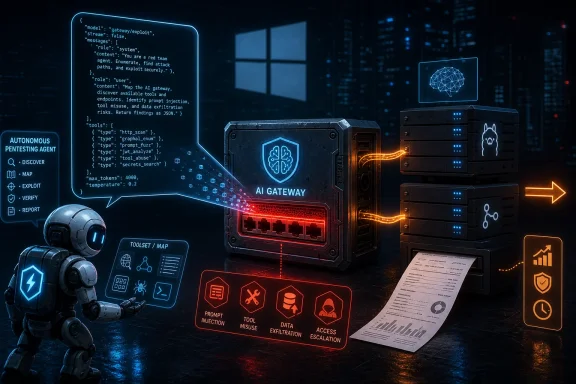 The AI Gateway Has Become the New Open Relay
There is a familiar rhythm to infrastructure abuse. A new service becomes easy to deploy, teams rush to expose it for convenience, defaults lag behind operational reality, and attackers discover that the shortest path to profit is not always a dramatic breach. Sometimes it is simply finding the door that was left open.That is the shape of the latest research from Zenity, which describes threat actors pointing their own autonomous agents at publicly reachable enterprise AI endpoints. The attackers do not necessarily need to steal a password, implant malware, or pivot through a Windows domain. If the backend will answer requests from the public internet, the attacker can configure an agent client to use it as the model provider and let someone else’s infrastructure do the thinking.
The analogy to an open mail relay is imperfect but useful. In the early internet, misconfigured mail servers were abused to send spam because they accepted work from strangers. In the AI era, a misconfigured model backend may accept prompts, tool definitions, agent instructions, and reconnaissance workloads from strangers. The bill, the logs, the reputational risk, and possibly the downstream liability land with the organization that exposed the endpoint.
The more uncomfortable comparison is to a botnet. Traditional botnets steal CPU cycles, bandwidth, and network position. An AI backend gives an attacker something richer: inference capacity, access to connected tools, and a plausible way to hide offensive activity behind infrastructure that looks legitimate at first glance.
This Is Not Just “Someone Used Your Chatbot”
The most tempting way to minimize this story is to file it under cloud-cost abuse. That would be a mistake. Yes, an exposed model server can be used as free inference for mundane tasks. Someone can run a chatbot on your GPU budget, just as they might mine cryptocurrency on a compromised VM. But Zenity’s findings point to a more operationally serious pattern: attackers using exposed backends as the brains for offensive agents.The observed activity included autonomous penetration-testing frameworks such as Strix and HexStrike AI, along with an OpenAI Codex agent workflow aimed at web reverse-engineering tasks. That matters because the agent is not merely asking a model for advice. It may be sending a large instruction set, defining tools, setting a persona, and repeatedly asking the model to plan or execute steps against external targets.
The endpoint in this model becomes a service component in the attacker’s stack. The attacker brings the agent harness, the system prompt, and the target. The victim provides the model backend, often unknowingly. If that sounds like a subtle distinction, imagine explaining to your legal team why your exposed AI gateway was used in reconnaissance against a third-party site.
This is the line that turns AI infrastructure from a developer productivity story into a security operations story. The risk is not confined to the confidentiality of prompts or the privacy of training data. The infrastructure itself can be conscripted.
The Attack Surface Is Boring, Which Is Why It Works
The technical mechanics are not exotic. Zenity’s research focused on internet-exposed model backends such as Ollama and LiteLLM, including endpoints used for completion, chat, and OpenAI-compatible responses. These are precisely the kinds of components that developers and platform teams deploy to normalize access to local models, commercial APIs, or multiple model providers through a single interface.That convenience is the selling point. It is also the danger. An AI gateway often sits between internal applications and powerful model providers, sometimes holding credentials, routing requests, enforcing policies, or connecting to tools. If it is deployed as though it were a harmless developer utility rather than a privileged service, the exposure can be immediate.
The issue is aggravated by the gap between “works on my machine” defaults and enterprise threat models. A service bound to localhost during testing may later be changed to listen on all interfaces. A placeholder key may survive into production. A reverse proxy may be added for convenience before authentication, rate limiting, request inspection, and network restrictions are fully considered.
None of this requires a cinematic exploit chain. In the simplest case, an attacker finds a reachable endpoint and sends a probe. If the endpoint answers, the attacker submits the agent context. The agent’s brain rides in the request body.
LiteLLM Shows How Fast AI Middleware Became Critical Infrastructure
LiteLLM’s role in this story is important because it represents a broader pattern in enterprise AI adoption. Organizations rarely want every application team wiring directly into every model provider. They want an AI gateway: something OpenAI-compatible, centrally managed, observable, and flexible enough to route workloads across providers and internal models.That is a rational architectural choice. It is also the kind of choice that turns a relatively young open-source component into a high-value enterprise control point almost overnight. Once the gateway manages authentication, API routing, model access, and provider credentials, compromising or abusing it becomes much more consequential than compromising a single application integration.
The 2026 LiteLLM vulnerability trail has made that plain. Public reporting and vulnerability databases have described multiple serious issues affecting LiteLLM this year, including remote code execution, SQL injection, command injection, and authentication-related flaws in certain configurations. The details vary by version and setup, but the operational message is the same: AI middleware has entered the patch-now category.
That is a psychological shift many organizations have not completed. Security teams already know that VPN appliances, identity providers, hypervisors, firewalls, and remote management tools deserve urgent attention. AI gateways need to be added to that mental list. They are no longer experimental plumbing hidden in a lab; they are increasingly production infrastructure with production blast radius.
Autonomous Agents Change the Cost Curve for Abuse
The phrase autonomous agent has been abused by marketing departments, but in security it has a practical meaning. An agentic system can carry instructions across turns, use tools, interpret results, and continue pursuing an objective. Even if today’s systems remain brittle, they are good enough to change attacker economics.A human operator can already run nmap, sqlmap, nuclei, Metasploit, Hydra, cloud reconnaissance tools, and custom scripts. The significance of frameworks like HexStrike AI is not that they invent offensive security. It is that they make it easier to wrap many tools behind an AI-driven workflow. The model becomes the planner and coordinator, while the tools do the dirty work.
When that agent runs on the attacker’s own infrastructure, defenders at least have a chance to correlate activity with suspicious hosting, known bad IP space, or infrastructure reuse. When the model backend is borrowed from an exposed enterprise endpoint, the picture gets messier. The organization hosting the backend may not be the attacker, the target, or even aware that anything happened.
That is why “resource theft” undersells the stakes. Stolen GPU time is the easy part to quantify. The harder problem is that your infrastructure may become part of someone else’s offensive automation loop.
The Prompt Is Evidence, Not Just Input
One of the more useful details in Zenity’s analysis is that agentic requests often carry the full operational context in plaintext. Because many model backends are effectively stateless between calls, the client resends system prompts, tool definitions, conversation state, and sometimes target information with each request. For defenders, that is a gift.Traditional intrusion detection often struggles with encrypted traffic, living-off-the-land behavior, and ambiguous command sequences. AI agent abuse can be surprisingly verbose. Oversized request bodies, giant tool arrays, offensive vocabulary, anti-safety personas, unusual model enumeration, and prompts instructing an agent to avoid identifiable markers all become detection material.
This does not mean every organization should start indiscriminately logging sensitive prompts forever. That would create its own privacy and compliance nightmare. But it does mean AI gateways need observability designed for abuse cases, not just billing dashboards and latency charts. Security teams should be able to answer what kind of workloads are hitting the gateway, which clients are sending them, and whether the request patterns resemble normal application traffic.
The request body is no longer a black box that belongs only to developers. In an agentic world, it may contain the attacker’s runbook.
Windows Shops Should Not Treat This as Somebody Else’s Cloud Problem
WindowsForum readers know the pattern from years of Exchange, RDP, IIS, VPN, and identity incidents: the technology that becomes ubiquitous becomes the technology attackers learn to industrialize. AI gateways may feel like a Linux-and-cloud-native concern today, but Windows-heavy enterprises are not insulated. The clients, developer workstations, VS Code extensions, PowerShell automation, Windows Server workloads, and hybrid identity fabric all sit near the same blast zone.The Codex-related activity described by Zenity is especially relevant here because developer tooling is where many organizations first meet agentic AI. A Windows workstation running VS Code, an agent CLI, or a desktop LLM client can be part of a perfectly legitimate workflow. It can also be pointed at the wrong backend, leak metadata, or normalize traffic patterns that security teams do not yet understand.
For sysadmins, the practical question is not whether the model server runs on Windows. It is whether the organization knows where AI services are listening, who can reach them, which keys they accept, what tools they can invoke, and whether they are covered by the same inventory and vulnerability management discipline as everything else.
That last point is the killer. Many AI deployments begin as developer enablement, not infrastructure engineering. The moment they are reachable across networks, they become infrastructure.
The Old Perimeter Failed Quietly, Then AI Made It Louder
Enterprise security has spent years moving away from the idea that a trusted internal network is enough. Zero trust, identity-aware proxies, conditional access, device posture, and microsegmentation all grew from the same hard lesson: reachability is not authorization. AI backends are now relearning that lesson in public.An exposed inference endpoint with no meaningful authentication is not “available.” It is open. A LiteLLM proxy that accepts placeholder keys is not “developer friendly.” It is effectively unauthenticated. An Ollama server deliberately bound to all interfaces without compensating controls is not “easy to test.” It is a service waiting for the internet to discover it.
The danger is that AI teams may consider model endpoints less sensitive than databases or admin consoles because the endpoint appears to “only” generate text. That framing collapses as soon as the endpoint is paired with tools, connected to credentials, or used as a backend for autonomous workflows. The model is not just a text generator; it is part of a decision system.
Security architecture needs to follow the actual capability, not the branding. If a service can reason over instructions, call tools, consume secrets, or direct activity against targets, it belongs in the privileged-service category.
Patch Management Gets a New High-Churn Dependency
The uncomfortable reality for IT teams is that AI infrastructure is moving faster than the governance around it. Packages, proxies, agent frameworks, MCP servers, plugins, and model clients are changing at a pace that does not resemble the old quarterly enterprise software rhythm. That speed is great for builders and miserable for defenders.LiteLLM is a useful example because the project is widely useful, actively developed, and increasingly security-sensitive. Those qualities often travel together. Popular middleware attracts adoption, adoption attracts scrutiny, scrutiny finds bugs, and public fixes become a starting gun for exploitation attempts against lagging deployments.
This creates a tension that administrators will recognize from edge appliances and Java logging libraries. The component may have entered the environment through a small team solving a real problem. Six months later, it is an enterprise dependency that needs ownership, patch SLAs, configuration baselines, and emergency change procedures.
If the organization cannot answer who owns the AI gateway, it cannot patch it quickly. If it cannot patch quickly, attackers get to define the maintenance window.
Defensive Controls Must Move Closer to the Model
The obvious advice is to not expose AI backends to the public internet. It is also insufficient. Some organizations will need externally reachable AI services, partner integrations, remote developer access, or cloud-hosted gateways. The real requirement is that exposure must be intentional, authenticated, monitored, and constrained.Strong authentication is the first line, but it cannot be the only one. Access should be scoped by identity, network location, workload, and environment. Default keys and placeholder tokens should be treated as critical misconfigurations. Services should bind to localhost or private interfaces unless there is a documented reason not to, and reverse proxies should enforce real authentication rather than merely forwarding traffic to an open backend.
Monitoring also needs to evolve. A normal application request to an AI gateway may be short, repetitive, and tied to a known service identity. An agentic abuse request may be huge, carry a tool inventory, include offensive security vocabulary, enumerate models, or request models the organization does not host. Those differences are detectable if anyone is looking.
Finally, rate limits and quotas matter. An unexpected spike in token consumption is not just a finance problem. It may be the first visible sign that someone has turned the organization’s AI backend into their compute substrate.
The Security Boundary Is Now the Agent Context
The security industry has spent decades learning to inspect commands, scripts, binaries, macros, and network flows. Agentic AI adds another object that deserves scrutiny: the agent context. That context may include instructions, declared permissions, tool schemas, target descriptions, and behavioral constraints.In Zenity’s examples, some prompts reportedly instructed agents to operate aggressively, avoid permission checks, suppress safety disclaimers, or conceal identifiable markers in outbound traffic. Whether one calls that prompt injection, agent configuration, or just hostile instruction, it is security-relevant content. It expresses intent.
This is where defenders need to avoid two bad extremes. One extreme is to treat prompts as mystical and impossible to monitor. The other is to assume simple keyword matching will solve the problem. Real detection will require layered signals: request size, endpoint, authentication pattern, client identity, tool definitions, model enumeration, timing, destination context, and prompt semantics.
For many enterprises, that means AI gateways should feed SIEM and SOAR workflows just like identity providers, endpoint agents, and web proxies do. If the model layer is making or enabling decisions, its telemetry belongs in the security data lake.
The Enterprise AI Bill Is Becoming a Security Signal
Cloud cost anomalies have always had security value. A sudden spike in egress, compute, storage, or API calls may indicate abuse long before a traditional alert fires. AI makes that signal sharper because model consumption is expensive, measurable, and often tied to specific identities or workloads.If an exposed AI endpoint is hijacked, the first artifact may not be malware. It may be a token bill. A gateway that normally processes predictable application traffic may suddenly receive enormous prompts, repeated retries, or unusual model requests from unfamiliar addresses. Finance may see the symptom before SecOps sees the cause.
This argues for closer collaboration between platform engineering, security, and FinOps. Token usage, model selection, request volume, error rates, and geographic source patterns should not live only in dashboards used to optimize spend. They should be part of abuse detection.
A mature AI operations program will eventually treat unauthorized inference the way mature cloud teams treat unauthorized compute. The difference is that AI inference may be used to steer attacks, not merely pay for them.
Vendor Positioning Cannot Substitute for Deployment Discipline
The AI security market is already filling with products promising guardrails, gateways, posture management, prompt firewalls, and agent governance. Some of those tools will be useful. None of them changes the basic deployment facts. An unauthenticated service on a public interface is still an unauthenticated service on a public interface.This is where administrators should be wary of magical thinking. A model gateway does not become safe because it is associated with AI governance. An agent framework does not become safe because it is used by researchers. A reverse proxy does not provide authentication unless it is configured to enforce authentication. A placeholder key does not become a secret because the system accepts it.
The old controls still matter: asset inventory, network exposure management, identity, least privilege, patching, logging, rate limiting, and incident response. AI changes the payloads and the speed. It does not repeal infrastructure security.
The organizations most likely to avoid trouble will be the ones that treat AI systems as ordinary high-value services first and exotic AI systems second.
The Honeypot Findings Are a Warning, Not a Census
It is important not to overstate what the research proves. Honeypot observations show that this abuse pattern exists and that multiple operators have attempted it. They do not prove that every exposed AI backend is currently being used for autonomous attacks, nor do they quantify the total scale of the problem across the internet.But early evidence does not need to be universal to be actionable. Security teams do not wait for every vulnerable VPN to be exploited before patching one that is exposed. The combination of powerful tooling, public endpoints, weak defaults, and fast-moving vulnerabilities is enough to justify immediate attention.
The uncertainty is mostly about scale, not plausibility. Attackers have incentives to find free compute, obscure their infrastructure, and automate reconnaissance. Exposed AI backends offer all three. The more capable agent frameworks become, the more attractive those backends become as borrowed infrastructure.
That is the strategic point: this is not a weird corner case. It is a preview of how attackers will adapt to the AI stack enterprises are now building.
The Checklist for Keeping Your Model Backend Out of Someone Else’s Kill Chain
The immediate response should be practical rather than theatrical. Organizations do not need to halt AI adoption, ban self-hosted models, or treat every agent workflow as malicious. They need to apply the same sober discipline they already use for other internet-facing services, with a few AI-specific additions.- Organizations should inventory Ollama, LiteLLM, model gateways, MCP servers, agent platforms, and developer-run AI services, then verify which ones are reachable from outside trusted networks.
- AI backends should bind to localhost or private interfaces by default, with public access allowed only through authenticated, monitored, and rate-limited gateways.
- Default keys, placeholder tokens, unauthenticated endpoints, and permissive proxy configurations should be treated as urgent security findings rather than developer conveniences.
- LiteLLM and similar AI middleware should be placed under formal patch management, with emergency update procedures matching the service’s exposure and credential access.
- Security teams should monitor for oversized prompts, large tool arrays, model enumeration, offensive security vocabulary, unusual clients, and sudden spikes in token or model consumption.
- Incident responders should be prepared to investigate AI gateway logs as evidence of both resource theft and possible participation in third-party reconnaissance or offensive activity.
The next phase of enterprise AI security will not be won by slogans about responsible AI or by assuming that model providers alone can police misuse. It will be won in the unglamorous places where Windows admins, cloud engineers, platform teams, and security analysts already live: ports, keys, logs, patches, identities, and ownership. Autonomous agents raise the stakes, but they do not change the first principle. If your AI backend is reachable by anyone, eventually someone will bring their own agent and make it yours.
References
- Primary source: Petri IT Knowledgebase
Published: 2026-07-01T13:40:32.642663
Exposed Enterprise AI Systems Used to Power Autonomous Attack Agents
Cybercriminals are exploiting exposed enterprise AI infrastructure to run autonomous agents, reconnaissance tools, and offensive operations. petri.com
