

AI’s arrival in classrooms has stopped being hypothetical: by 2025 generative systems are deeply woven into student workflows, teacher practice, and district procurement decisions, producing rapid gains in productivity and personalization alongside hard questions about assessment validity, data governance, and equity.
The last 18 months have rewritten the adoption curve for artificial intelligence in education. Large language models and multimodal copilots moved from novelty status into everyday use for millions of learners and educators, driven by free and freemium consumer tools, integrated productivity assistants, and education‑grade offerings from major cloud vendors. This shift is visible in repeated survey snapshots that place AI usage among students and teachers at levels that would have seemed improbable only a few years earlier. At the same time, institutional responses have matured. Bans and blanket prohibitions gave way to “managed adoption” models: centralized procurement of education editions, course‑level AI policies, and deliberate assessment redesigns that emphasize process and provenance over product. Those themes – adoption, governance, and assessment redesign – are the organizing pillars shaping how schools plan and operate in an AI‑enabled era.
Notable product patterns:
Practitioners must treat high‑profile percentage claims as directional signals rather than immutable facts, verifying the primary studies behind any headline before making procurement or policy decisions. The coming 12–24 months will be decisive: vendors will scale education offerings, researchers will publish more rigorous longitudinal studies, and accreditation bodies may begin to formalize expectations for AI‑aware assessment. Districts that pair careful governance with teacher support will be best positioned to turn generative AI from a disruptive risk into a durable educational advantage.
Source: DemandSage 71 AI in Education Statistics 2025 – Global Trends
 Background
The last 18 months have rewritten the adoption curve for artificial intelligence in education. Large language models and multimodal copilots moved from novelty status into everyday use for millions of learners and educators, driven by free and freemium consumer tools, integrated productivity assistants, and education‑grade offerings from major cloud vendors. This shift is visible in repeated survey snapshots that place AI usage among students and teachers at levels that would have seemed improbable only a few years earlier. At the same time, institutional responses have matured. Bans and blanket prohibitions gave way to “managed adoption” models: centralized procurement of education editions, course‑level AI policies, and deliberate assessment redesigns that emphasize process and provenance over product. Those themes – adoption, governance, and assessment redesign – are the organizing pillars shaping how schools plan and operate in an AI‑enabled era.Overview: What the DemandSage compilation presents
The DemandSage piece assembles 71 statistics and trend points describing the global state of AI in education for 2025, portraying a technology that is simultaneously ubiquitous and uneven in its institutional readiness. The list covers five broad areas:- Student adoption and behavior (how and why students use AI)
- Teacher and leader adoption (who uses AI and how schools manage it)
- Institutional governance, procurement and data protections
- Evidence of learning impact, teacher productivity and pilot outcomes
- Risks: integrity, hallucination, equity and privacy
Student adoption: scale, tasks and tool preferences
How many students use AI?
Multiple surveys cited in 2024–2025 show broad student uptake, but the exact share varies by study and geography. One commonly repeated headline — that roughly 86% of students use AI for study purposes and more than half use it weekly — appears in several aggregated summaries and education reports, reflecting large global or multi‑country surveys. However, regional studies tell different stories: for example, a UK YouGov poll of undergraduates reported 66% usage for degree work and 33% weekly use; other national and institutional surveys report usage rates from the mid‑50s to the low‑90s depending on sample and framing. This makes it more accurate to speak of very high and rapidly growing student adoption with substantial regional variation rather than a single global percentage. Why the spread? Differences in:- Sample composition (secondary vs. tertiary students)
- Question phrasing (ever used vs. used weekly)
- Geographic mix and local device/infrastructure access
What students ask AI to do
Across studies, the most common tasks students report are:- Explaining difficult concepts and summarizing readings
- Brainstorming and drafting outlines
- Grammar, style checks and revision suggestions
- Generating practice questions and personalized revision plans
Teachers, leaders and training: rapid uptake, uneven preparedness
Teacher adoption patterns
Teacher and leader adoption diverges by sector. K–12 educators have shown especially high engagement with generative tools for lesson planning, differentiation and administrative work, while higher‑education faculty adoption has been more mixed — concentrated among early adopters and digitally native instructors. Several district case studies and surveys report that a majority of teachers use AI in some capacity (a commonly referenced figure is around 83% for K–12 teachers using generative AI in some capacity), but a majority of those teachers report no structured professional development that prepares them to manage AI‑enabled assessment or verify model outputs. That combination — heavy use, weak training — is a policy red flag.What effective teacher training looks like
Districts and universities that show promising early outcomes pair short, practical technical modules (prompt design, hallucination checks, vendor privacy settings) with pedagogical sessions focused on assessment redesign and scaffolding. Peer networks, prompt repositories and protected redesign time are highlighted as critical components of successful training pipelines. Plans alone are insufficient: measured completion rates and learning outcomes should be published to validate that training converts into classroom practice.Institutional responses: procurement, data governance and assessment redesign
Managed adoption is the emerging default
Top universities and many progressive districts now adopt a pragmatic strategy:- Centralize procurement to gain enterprise/education contracts
- Require course‑level AI policy statements (disclosure plus permitted uses)
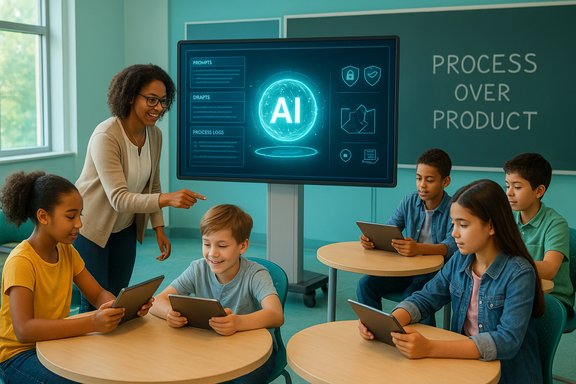
- Redesign assessments to emphasize process evidence (draft logs, oral defenses, annotated revisions)
- Insist on contract terms: non‑training clauses, retention/deletion rights, audit access and tenant isolation
Assessment redesign — from product to process
High‑stakes assessment is the most consequential battleground for AI in education. Institutions that successfully maintain learning validity are shifting to:- Staged submissions and process logs that document student drafts and verification steps.
- Oral defenses, vivas and in‑person demonstrations for summative tasks.
- Portfolios and annotated revisions that require students to critique and verify AI outputs.
Early evidence of learning impact and teacher productivity
Several pilot studies and institutional reports point to measurable short‑term gains when AI is integrated with strong pedagogy and teacher oversight:- Teacher time savings on administrative tasks and lesson planning (often double‑digit weekly hours reclaimed in pilot reports)
- Increased capacity for differentiated instruction in trial classrooms
- Modest improvements in exam performance and pass rates in carefully controlled pilots
Risks, gaps and equity concerns
Academic integrity and “mode abuse”
Generative AI increases the temptation to submit AI‑produced work as original. Detection tools are imperfect and can produce false positives; blanket bans are often ineffective because students can access consumer models outside of managed environments. The balanced strategy for many institutions is to redesign assessment and teach students ethical, citation‑aware AI use — shifting from a punitive to a pedagogical response.Hallucinations and misinformation
Large language models sometimes produce confident but incorrect outputs. If students treat these outputs as authoritative, errors can propagate through assignments and learning. Citation‑aware assistants help but do not eliminate the need for verification training and source‑checking habits.Equity and access
Access to premium AI features, faster models and compute‑heavy multimodal systems is uneven. Underfunded districts may lag behind, widening the digital divide. Similarly, the benefits of AI for personalized practice can only be realized if schools have the infrastructure, bandwidth and professional development needed to use the tools effectively. Equity must be an explicit part of procurement and policy planning, not an afterthought.Data governance and vendor lock‑in
Contracts matter more than marketing. Institutions should insist on:- Explicit non‑training clauses when student inputs must not be used to train public models
- Data retention and deletion rights
- Audit and export capabilities for telemetry and logs
- Role‑based access controls and tenant isolation
Cross‑checking the big numbers: verification and caution
The DemandSage compilation echoes many figures repeated across education reporting, but cross‑checking with independent research highlights variance:- The commonly cited 86% student usage figure appears in large global or multi‑country datasets reported by industry summaries and aggregated outlets; independent national surveys (for example, a UK YouGov poll) report lower figures (around 66% for degree work in the UK), and academic journal studies report other ranges depending on sample and timing. The upshot: student AI usage is very high and growing quickly, but exact percentages vary significantly by region and survey method.
- The 83% figure for K–12 teachers using generative AI in some capacity is drawn from aggregated district reporting and pilot surveys; while many districts report high adoption, the depth of use (occasional prompts vs. integrated pedagogy) and formal training rates differ dramatically. Treat such headline teacher‑use numbers as indicators of prevalence, not proof of consistent, effective classroom integration.
- Claims about precise learning‑gain percentages or exact market valuations in secondary summaries should be flagged as unverifiable without the original methodology and raw data. In several cases, press compilations repackage vendor press releases or single‑site pilot results; those are useful leads but insufficient for policy decisions without access to primary studies.
Practical checklist for districts and IT leaders
For Windows‑centric IT teams, edtech directors and procurement officers planning or running pilots, the operational agenda is immediate and practical:- Centralize procurement for core AI tools to secure education‑grade contracts and contractual protections.
- Require course‑level AI disclosure language for assignments where AI contributes.
- Redesign high‑stakes assessments to require process evidence, oral defenses, or in‑class demonstrations.
- Invest in short, mandatory teacher PD that pairs technical prompting with assessment redesign coaching.
- Insist on contract clauses for non‑training of public models, clear retention/deletion terms, audit rights, and exportable logs.
- Track disaggregated usage and outcome metrics to monitor equity impacts and learning outcomes.
Case studies and vendor tooling: who’s offering what
Major cloud vendors and education platforms have launched education‑specific products that promise additional administrative controls and contractual protections. Examples include education editions of large models embedded in productivity suites that pledge not to use student inputs to train public models when accessed through managed education tenancies. District pilots that embed such enterprise offerings report simpler administration and tighter governance — but the contractual fine print matters and must be verified by legal and privacy teams.Notable product patterns:
- Copilot and integrated assistants in productivity suites for drafting, summarization and document analysis.
- Citation‑focused assistants (Perplexity‑style) for research support.
- Pedagogy‑first agents (Khanmigo‑style) that include guardrails to avoid doing student work for them.
- Domain‑specific tools (Wolfram for symbolic math, Photomath for stepwise problem solving).
What to watch next: near‑term signals and research priorities
- Vendor enterprise offerings and procurement clarity — whether major vendors standardize education tenancy protections and transparent telemetry export will shape district adoption choices.
- Longitudinal, peer‑reviewed studies on learning outcomes — policymakers and accreditation bodies need robust evidence on retention and higher‑order skills, not just small pilot results.
- Assessment design becoming accreditation policy — if accreditation bodies emphasize process‑based assessment, that could institutionalize the redesigns many districts are now piloting.
- Equity metrics embedded in procurement — will districts require vendors to report on access gaps, usage by demographic groups, and outcome differentials? That reporting would materially shift how adoption is evaluated.
Strengths and benefits: what AI in education does well
- Personalized practice at scale: AI can deliver tailored explanations, adaptive quizzes and revision plans to large cohorts, addressing a perennial gap in scalable individual feedback.
- Teacher productivity: Automating routine tasks like lesson templating, translation, and formative quiz generation frees time for high‑impact, in‑person instruction. District pilots report measurable time savings when AI is used judiciously.
- Workforce readiness: Teaching students how to verify, prompt and critique AI outputs aligns curricula with emerging workplace expectations for AI literacy. UNESCO‑style competency frameworks provide a useful blueprint for what those skills should look like.
Risks and shortcomings: where the system still fails
- Evidence gaps: Many headline effects are derived from small pilots or vendor reports. Robust, reproducible research on long‑term learning effects is limited; treat single‑site percentage claims with caution.
- Assessment integrity: Detection tools are imperfect and can generate false positives; redesigning assessments is more effective but requires time and training.
- Privacy and contract risk: Vendor marketing claims are not contracts. Without explicit non‑training clauses and audit rights, districts risk exposure of student data or loss of bargaining power.
- Equity: Unequal access to models and professional development can deepen existing gaps if adoption is not accompanied by resourcing and inclusive policy.
Conclusion
AI in education in 2025 is both a mainstream reality and a governance challenge. The technology delivers clear, practical benefits — personalized practice, teacher productivity, and new pathways for workforce readiness — but those benefits materialize only when institutions invest in pedagogy, training, procurement rigor and careful assessment design. The most constructive path forward is not to choose between banning or unleashing AI, but to choose how to integrate it: centrally procured, pedagogically framed, contractually defended and equity‑oriented.Practitioners must treat high‑profile percentage claims as directional signals rather than immutable facts, verifying the primary studies behind any headline before making procurement or policy decisions. The coming 12–24 months will be decisive: vendors will scale education offerings, researchers will publish more rigorous longitudinal studies, and accreditation bodies may begin to formalize expectations for AI‑aware assessment. Districts that pair careful governance with teacher support will be best positioned to turn generative AI from a disruptive risk into a durable educational advantage.
Source: DemandSage 71 AI in Education Statistics 2025 – Global Trends
