

The AI sector may be moving into what investors and some analysts are calling a cavitation period — a moment when gargantuan infrastructure spending collides with modest, still-maturing commercial revenues — and the consequences will test strategy, balance sheets, and the future shape of digital labor markets.
Over the past two years hyperscalers and cloud providers have shifted from curiosity to full-scale industrialization of AI. Capital expenditure plans for 2025–2026 among the largest hyperscalers have been revised upward repeatedly, driven by the need to deploy vast GPU farms, high-density data centers, and the power and cooling systems to run them. Estimates from major investment banks and market analysts put the aggregated hyperscaler capex for 2026 in the high hundreds of billions of dollars—figures that have been quoted as roughly $500–$750 billion depending on the methodology and which companies are included. At the same time, adoption of paid AI features at the application layer—what most enterprises and consumers actually pay for—remains small relative to installed user bases. A visible example: Microsoft now reports about 15 million paid Copilot seats against an installed base of roughly 450 million Microsoft 365 commercial seats, a penetration near 3.3% for the paid Copilot add-on. The mismatch between gargantuan infrastructure outlays and muted immediate monetization is the tension at the heart of today's debate.
This article synthesizes recent reporting, corporate disclosures, and industry analysis to explain why the industry is in this state, what the $600–700 billion capex estimates actually mean, why the application layer lags, how different regional ecosystems (notably the U.S. and China) are positioned, and what would realistically end the so‑called air pocket: the rise of agentic, outcome‑oriented AI that sells labor and results rather than tokens and features.
Why does penetration remain modest? Several factors combine:
That is why many investors and strategists see the shift to agentic AI—as autonomous, outcome-driven services that do the work on behalf of customers—as the key inflection. When the billing model moves from token/seat to outcome or labor substitution, the addressable market expands to the multitrillion-dollar labor economy.
There’s a classic prisoner’s dilemma logic at work:
Advantages:
Implications:
Similarly, if the cost of inference falls by an order of magnitude (or more) and latency/availability improves, entire categories of applications become economically viable. This is the infrastructure-first thesis: build cheap compute and pipelines now so that a future application layer can flourish without being throttled by cost.
For now, the safest framing is probabilistic: the infrastructure bets are logical responses to a technology curve where scale and access to compute matter enormously, but those bets are also contingent. The single most important variable to watch—one that could flip the industry from linear revenue growth to exponential—remains whether AI moves from selling software (Copilot) to selling labor and outcomes (Autopilot/Agents). When agents can convincingly and safely replace routine human labor and are priced to reflect labor economics, the mismatch between capex and revenue will start to resolve.
Until that point, expect a period of high-investment tension: corporations building fences of compute and power, startups and incumbents experimenting with agentic products, and markets debating whether today's spending is a visionary foundation or an expensive bet. Both interpretations can be true simultaneously—this is why the next 12–24 months will be decisive for who captures the economics of the AI era.
Source: 36 Kr Is the Cavitation Period of the AI Industry Approaching?
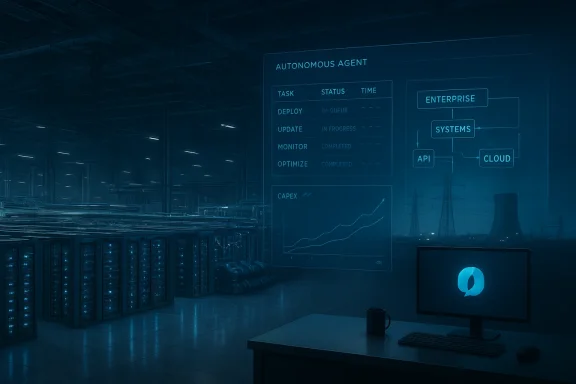 Background
Over the past two years hyperscalers and cloud providers have shifted from curiosity to full-scale industrialization of AI. Capital expenditure plans for 2025–2026 among the largest hyperscalers have been revised upward repeatedly, driven by the need to deploy vast GPU farms, high-density data centers, and the power and cooling systems to run them. Estimates from major investment banks and market analysts put the aggregated hyperscaler capex for 2026 in the high hundreds of billions of dollars—figures that have been quoted as roughly $500–$750 billion depending on the methodology and which companies are included. At the same time, adoption of paid AI features at the application layer—what most enterprises and consumers actually pay for—remains small relative to installed user bases. A visible example: Microsoft now reports about 15 million paid Copilot seats against an installed base of roughly 450 million Microsoft 365 commercial seats, a penetration near 3.3% for the paid Copilot add-on. The mismatch between gargantuan infrastructure outlays and muted immediate monetization is the tension at the heart of today's debate.This article synthesizes recent reporting, corporate disclosures, and industry analysis to explain why the industry is in this state, what the $600–700 billion capex estimates actually mean, why the application layer lags, how different regional ecosystems (notably the U.S. and China) are positioned, and what would realistically end the so‑called air pocket: the rise of agentic, outcome‑oriented AI that sells labor and results rather than tokens and features.
The scale of the infrastructure bet
How the headline numbers are built
The big-capex narratives are not invented by YouTube pundits; they arise from repeated upward revisions of analysts’ consensus estimates and from public company guidance. Large research houses and investment banks tracking hyperscalers’ announced projects and their balance sheets have produced a cluster of estimates for combined capex in the 2025–2026 window that land in the mid‑hundreds of billions. Different methods yield different totals:- Some estimates aggregate the announced or guided capex figures for hyperscalers (Amazon, Google/Alphabet, Microsoft, Meta, and others) for a single year or a two‑year window.
- Others add likely incremental infrastructure spending tied specifically to GPU purchases, high-density sites, and energy contracts needed to feed AI workloads.
- Historical comparisons are informative: to match the peaks of previous technology investment cycles, some analysts calculate that hyperscaler capex would need to reach roughly $700 billion in 2026.
Where the money goes — GPUs, data halls, and power
The lion’s share of these expenditures is being directed at three categories:- GPUs and accelerators: Modern generative AI models require large GPU clusters. Hyperscalers are buying H100/H200-class accelerators and similar chips in massive volumes, and they are also making long-term supply arrangements with chip vendors and OEMs.
- High-density data centers: Building racks that host hundreds or thousands of accelerators requires dedicated designs for power delivery, cooling, and dense rack-to-rack networking. These are not typical cloud expansions; they are bespoke AI "factories."
- Power and grid integration: The energy draw of concentrated GPU clusters is enormous. Hyperscalers are signing long-term power purchase agreements, building dedicated substations, and, in some notable cases, underwriting or contracting for new generation capacity, including nuclear projects.
The application-side lag: users, pricing, and perceived value
Low penetration despite strong distribution
At the product level, paid AI features remain a small fraction of addressable user pools for many flagship services. Microsoft’s publicly reported data—roughly 15 million paid Copilot seats versus roughly 450 million Microsoft 365 commercial seats—nicely illustrates the point. That conversion ratio is strikingly low if you view the Copilot product as a premium add-on bundled into ubiquitous, established productivity software.Why does penetration remain modest? Several factors combine:
- Price sensitivity: Many businesses and individuals evaluate add-ons against headcount and license economics. A per‑month add-on with a significant per-seat price faces friction in mass deployment decisions, especially in cost-conscious organizations.
- Perceived value and trust: Early AI assistants perform well on a range of tasks but still require human verification. When a feature accelerates but does not remove human work or legal responsibility, buyers treat it as a productivity tool rather than a labor substitute—and that constrains willingness to pay.
- Performance and latency: High inference costs and model latencies still shape the user experience. Where AI responses are slow, costlier, or inconsistent, adoption slows.
Pricing and monetization models
Current monetization models are largely still SaaS-like: seat fees, per-user subscriptions, or usage-based billing for API calls and tokens. This approach maps to a world where AI augments human work rather than replacing it. If AI remains framed and priced as software, its revenue ceiling is constrained by traditional software economics and buyer psychology.That is why many investors and strategists see the shift to agentic AI—as autonomous, outcome-driven services that do the work on behalf of customers—as the key inflection. When the billing model moves from token/seat to outcome or labor substitution, the addressable market expands to the multitrillion-dollar labor economy.
The “survival tax” and the prisoner’s dilemma of hyperscalers
Why hyperscalers are doubling down
When industry leaders say "the risk of under-investing is dramatically greater than the risk of over‑investing," they are speaking from a strategic framing not fully captured by a single year’s income statement. Missing the infrastructure wave risks ceding not only efficiency advantages but also control of the physical stack: data halls, power contracts, and the economics of inference. That can be existential in a world where marginal improvements in model scale and deployment speed translate into outsized first-mover advantages.There’s a classic prisoner’s dilemma logic at work:
- If a hyperscaler stops accelerating capex while rivals continue, it risks losing access to scale economics and to a strategic moat.
- If all hyperscalers race to build capacity, each binds capital into operations whose returns may take years to materialize or may be realized only if application monetization accelerates.
Infrastructure as national-scale strategic asset
Some of the investments cross over into what amounts to national-scale infrastructure: long-term power deals, grid upgrades, and the re-commissioning or construction of generation capacity. When corporate capex reaches the scale of national infrastructure projects, the risk profile shifts. Returns are less about near-term product uptake and more about securing a place in the future compute economy. That’s why we now see technology companies entering into multi-decade energy purchase agreements and even underwriting nuclear restarts in service of compute-intensive AI.Regional contrasts: the United States vs China
U.S. ecosystem: capital-rich and GPU-heavy
In the United States, hyperscalers generally benefit from deep balance sheets, strong capital markets, and direct access to advanced accelerators and OEM ecosystems. This capital abundance creates a “rich-man’s disease”: more money and GPUs than immediate application revenue to digest, which can produce short-term dissonance between infrastructure and monetization.Advantages:
- Access to latest accelerators (H100/H200 and new chips).
- Ability to pre-book supply and negotiate large-scale OEM deals.
- Capital to underwrite long-term energy and real estate plays.
- Large upfront commitments create investor scrutiny if revenue doesn’t follow.
- The concentration of power demand strains local grids and can prompt regulatory and public pushback.
China ecosystem: cost pressure, aggressive price competition
China’s domestic AI market faces a different set of constraints. GPU supply and international component access have been more volatile; domestic players often compete fiercely on price and velocity rather than margin. The result is a "low-blood-sugar" environment: intense competition (including price wars) and a race to bring down inference costs quickly.Implications:
- Domestic providers may be forced to pursue high-volume, low-margin models to secure traffic and user bases.
- Companies with closed loops—owning traffic, data, models, and products—(e.g., companies with large social platforms) can monetize differently and extract better unit economics.
- Homogenization of model capabilities (convergence on baseline LLM performance) increases the value of distribution and unique data assets.
Will cheaper compute and better models end the air pocket?
The historical analogy: optical fiber and the bandwidth boom
There is a useful precedent in the late-1990s/early-2000s telecom bubble. Massive investments in fiber and backbone capacity were derided at the time because utilization rates were low. Yet the oversupply of bandwidth, and the resulting dramatic fall in per-bit costs, enabled services like streaming video and rich mobile experiences that were previously infeasible.Similarly, if the cost of inference falls by an order of magnitude (or more) and latency/availability improves, entire categories of applications become economically viable. This is the infrastructure-first thesis: build cheap compute and pipelines now so that a future application layer can flourish without being throttled by cost.
How much cheaper is necessary?
There is no single threshold number, but the economics change meaningfully when AI becomes able to replace routine labor tasks at scale. If inference costs for common enterprise workloads fall to the point where an autonomous agent can be offered at a price materially below the cost of a human worker—while delivering reliable, auditable, and compliant results—the revenue model shifts from incremental SaaS to large-scale labor substitution. That is when the revenue curves can rapidly steepen.The Agent transition: Copilot to Autopilot
What an Agent is versus a Copilot
- Copilot: an assistant that augments human work. It answers, drafts, and suggests, but the human remains the decision-maker and executor.
- Agent: an autonomous system that plans, acts, sequences multi-step tasks, integrates with business systems, and delivers outcomes without continuous human intervention.
Practical agent use cases that unlock labor substitution value
- Receivables collection: an agent that autonomously queries CRM data, sequences outreach (email, voice), negotiates terms by policy, and reconciles payments.
- Customer support escalation: an agent that handles complex multi-step issue resolution across systems and closes tickets with measurable SLA improvements.
- Sales qualification and lead follow-up: an agent that identifies high-priority leads, schedules demos, and moves opportunities through the funnel.
Barriers to agent adoption
- Trust and governance: businesses require audit trails, deterministic behavior, and guardrails to ensure compliance.
- Integration complexity: agents must operate across legacy systems via robust APIs and vetted credentials.
- Liability and accountability: who signs off on decisions made by an agent? Legal and regulatory frameworks are still catching up.
- Data quality: agents need structured, high-quality data to operate reliably.
Risks and downside scenarios
- Mispriced capex and stranded assets
- If demand for AI compute softens or models and architectures shift dramatically, hyperscalers may hold underutilized facilities and specialized hardware. That creates impairment risk and investor pushback.
- Supply-chain and geopolitical disruptions
- Access to advanced accelerators, memory, and specialized components is geopolitically sensitive. Export controls, trade frictions, or manufacturing bottlenecks could raise costs and delay deployment.
- Grid strain and social license
- Large energy draws provoke regulatory scrutiny and local resistance. Long-term power contracts and new generation projects can mitigate this but require time and capital.
- Application adoption lag
- If user expectations for reliability, privacy, and accountability are not met, the anticipated conversion from Copilot-class tools to agentic labor may be slower than investors hope.
- Speculative AGI framing
- Assertions that a particular company will develop AGI imminently are speculative. Betting corporate strategy and cumulative capex on a narrow timeline for AGI is risky. It’s more prudent to see the investments as hedges for multiple technological futures—not unique certainties.
What to watch in the next 12–18 months
- Capex pacing and guidance from hyperscalers: Are companies maintaining, accelerating, or pulling back 2026 capex plans?
- GPU supply trajectory and new accelerator announcements: Are next-gen chips materially lowering energy per inference?
- Agent productization and enterprise case studies: Firms that can show repeatable, audited ROI for agentic AI in production will lead monetization.
- Energy contracts and grid approvals: Large power purchase agreements and generation projects (including non‑traditional sources) will be a bellwether for long-horizon commitment.
- Pricing evolution at the application layer: Will companies move toward outcome/pricing models rather than token- or seat-based pricing?
Strategic implications for companies and investors
For corporate strategists:- Focus on integrating agents into mission‑critical workflows where labor substitution produces measurable ROI. Early wins in finance, customer service, and operations are strategic priorities.
- Build rigorous governance stacks—auditing, explainability, and compliance—before wide agent rollout.
- Negotiate energy and supply contracts in a way that reduces tail risk and keeps optionality.
- Differentiate between infrastructure plays (hardware, power, data halls) and application plays (platforms that monetize outcomes). Both can be winners, but their risk-return profiles differ.
- Watch for companies that combine scale (capex access) with distribution (own traffic and data). Those full‑stack players are best positioned to capture upside when agent economics materialize.
- Be cautious where capex is heavily debt-funded and where operating earnings are under pressure without clear monetization roadmaps.
Conclusion
Yes, the industry is facing a real and definable cavitation: record infrastructure investments versus still-nascent application monetization. But this moment is not just a single problem to be solved—it is a crucible. If hyperscalers succeed in driving down inference cost, resolving grid and supply-chain constraints, and deploying agentic AI that reliably delivers outcomes, the current “air pocket” could be the calm before a Cambrian explosion of services. If they fail to translate capacity into value, the market will punish overcommitment.For now, the safest framing is probabilistic: the infrastructure bets are logical responses to a technology curve where scale and access to compute matter enormously, but those bets are also contingent. The single most important variable to watch—one that could flip the industry from linear revenue growth to exponential—remains whether AI moves from selling software (Copilot) to selling labor and outcomes (Autopilot/Agents). When agents can convincingly and safely replace routine human labor and are priced to reflect labor economics, the mismatch between capex and revenue will start to resolve.
Until that point, expect a period of high-investment tension: corporations building fences of compute and power, startups and incumbents experimenting with agentic products, and markets debating whether today's spending is a visionary foundation or an expensive bet. Both interpretations can be true simultaneously—this is why the next 12–24 months will be decisive for who captures the economics of the AI era.
Source: 36 Kr Is the Cavitation Period of the AI Industry Approaching?
