

Sophos X-Ops says it observed a threat actor using AI-assisted development tools, including Cursor and Claude Opus agents, to build and test an EDR-evasion framework inside a Windows-heavy lab tied to post-exploitation tooling, ransomware deployment, and data theft operations. The important part is not that artificial intelligence suddenly became a criminal mastermind. It is that familiar attacker tradecraft is being reorganized around faster engineering loops, cheaper testing, and more disciplined experimentation. For defenders, that is a less cinematic problem than “autonomous malware,” but it is also the one more likely to matter.
The Sophos report lands at a moment when the security industry is still arguing about what “AI-powered cybercrime” actually means. Vendors have every incentive to dramatize the phrase, while attackers have every incentive to use whatever reduces friction. The case Sophos describes is valuable because it is not a vague warning about future malware; it is a snapshot of an actual development environment where AI helped an operator iterate on evasion.
That distinction matters. The observed framework did not appear to be an independently reasoning large language model roaming through a network, making strategic decisions on its own. The automated Active Directory discovery component worked more like a branching workflow: gather results, choose a predefined next step, dispatch work to agents, and reassess when the output came back.
That is still dangerous. In enterprise security, speed and repeatability are often more important than novelty. An attacker who can compress trial-and-error into a tighter loop can discover weak points more quickly, test against multiple defensive products, and turn public research into working modules with less manual effort.
The lesson is uncomfortable because it cuts against two easy narratives. AI did not magically invent EDR bypasses from nothing. But it also did not need to. It helped industrialize the process of reading, translating, testing, documenting, and revising attack techniques that already existed in the open.
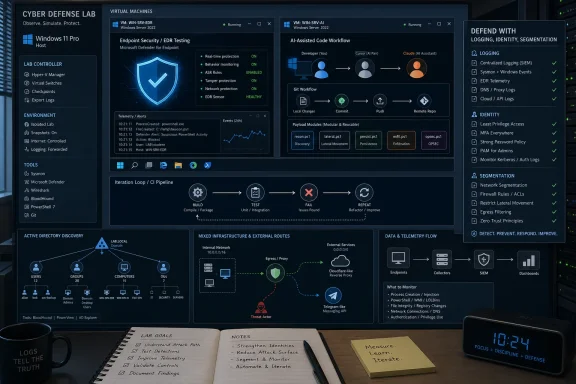
The attacker used a virtualized lab environment with multiple Windows Server 2022 machines. One VM tested payloads against Sophos. Another tested against CrowdStrike. A third ran without EDR as a control. A fourth Ubuntu system acted as a Sliver command-and-control server.
That arrangement is not amateurish. It mirrors the way legitimate red teams, malware analysts, and security vendors test assumptions before deploying tools in the field. The difference is intent and downstream use. Sophos says the activity was linked by its Counter Threat Unit to known ransomware deployment and data theft operations, which puts the “red team framework” label under obvious suspicion.
The alleged abuse of red-team language is also worth pausing on. Sophos argues that the attacker likely used such terminology to get around model guardrails against malware development. That does not prove the AI system knowingly assisted crime. It does suggest that policy filters built around vocabulary will struggle when offensive security and criminal post-exploitation share overlapping language, tools, and lab practices.
This is where the story becomes less about chatbots and more about engineering discipline. A modular generator lets an operator vary techniques without rewriting the entire toolchain. Each run can test a different evasion module, compile a new payload, deploy it into a target VM, observe what the security product does, and feed the result back into the next round.
Sophos says nearly 80 modules were developed to test more than 70 techniques. The attacker’s own reported results allegedly claimed that the modules moved from high failure rates to near-universal success after iteration, though Sophos notes that the documented output did not necessarily support that conclusion. That discrepancy is important because attacker dashboards can be as self-flattering as vendor dashboards.
Even if the success claims were inflated, the workflow is still the point. The framework did not have to beat every product every time to be useful. It only had to identify which combinations worked often enough, quietly enough, or long enough for post-exploitation objectives.
That is a grim inversion of how defenders use threat intelligence. A blue team reads research to understand risk, hunt for indicators, and strengthen controls. Here, the same research pipeline appears to have been used as raw material for implementation and evasion testing.
This does not mean security researchers should stop publishing. The industry has been through that argument for decades, and secrecy rarely favors defenders at scale. But it does reinforce the need to publish with clear defensive framing, avoid unnecessary weaponization detail, and assume that sufficiently motivated operators will use public material as a requirements document.
The automation angle changes the economics. A human no longer has to manually triage every article, extract every technique, and decide which ones are worth reproducing. An AI-assisted workflow can do the first pass, organize the backlog, and hand a narrower set of tasks to the operator. That is not intelligence in the human sense, but it is leverage.
That has practical implications for defenders. Security products are no longer being bypassed only by a clever one-off trick discovered in the wild. They are being tested in adversary labs that can simulate detection conditions before the tool is ever pointed at a real target.
For Windows administrators, this means the endpoint agent cannot be treated as a magic shield. EDR remains essential, but it is one layer in a control system that must assume some payloads will evade, some alerts will be delayed, and some activity will look enough like legitimate administration to create ambiguity.
The same lesson applies to identity. The report’s mention of automated Active Directory discovery should make domain administrators sit up. Once an attacker is inside, fast enumeration of users, groups, privileges, hosts, and trust relationships is often what turns a single endpoint compromise into an enterprise incident.
Telegram is widely used for communication, automation, and bot workflows. Cloudflare Workers can be part of perfectly legitimate web architectures. Cobalt Strike profiles can be tuned to make beacon traffic resemble normal web requests. None of those facts make the activity benign.
This is where enterprise defense gets hard. Blocking every abused service is rarely realistic, especially in organizations with distributed teams and cloud-heavy workflows. Allowing everything because it is “legitimate infrastructure” is equally untenable.
The answer is context. A Windows server that suddenly reaches out through odd paths, a workstation that starts generating payload-like files in a user documents directory, or a system that behaves like a lab node inside a production tenant should not be judged only by domain reputation. It should be judged by behavior, identity, device role, process ancestry, and the organization’s own baseline.
For defenders, the problem is not deciding whether Sliver, Cobalt Strike, Impacket-style behavior, Kerberoasting tests, or BloodHound-like discovery are “good” or “bad” in the abstract. The problem is deciding whether that activity is authorized, expected, scoped, and attributable inside a specific environment at a specific time.
Organizations that run real red teams need cleaner internal hygiene because attacker mimicry is now a feature of the threat landscape. If defenders cannot distinguish an approved exercise from hostile activity, attackers benefit from the confusion. If approved tooling is left lying around, poorly segmented, or insufficiently logged, criminals inherit a ready-made excuse.
This is also where AI complicates policy enforcement. If a model refuses to help “write malware” but assists with “red team payload loader testing,” the line can become a prompt-engineering exercise. The security industry will need better abuse detection in AI platforms, but enterprises cannot outsource their risk model to an LLM vendor’s content filter.
The lab Sophos described reflects that reality. Windows Server 2022 VMs gave the actor a controlled space to test against endpoint defenses. Payloads written in Rust and Go, wrapped by a Python generator, targeted Windows execution paths. The broader framework focused on post-exploitation behavior that would be familiar to anyone who has investigated ransomware intrusions.
For WindowsForum readers, the practical lesson is not to panic over Cursor or Claude. It is to recognize that attackers are studying the same Windows defensive stack that administrators rely on. They are not merely asking “does Defender catch this file?” They are asking which execution path, payload format, encryption wrapper, staging method, and network route survives long enough to matter.
That puts pressure on configuration quality. Microsoft Defender, third-party EDR, attack surface reduction rules, PowerShell logging, AMSI visibility, credential protections, local admin controls, and identity monitoring all become more valuable when they reinforce each other. A single weak setting can become the gap an AI-assisted lab discovers faster.
The Sophos case shows AI being used for coordination, documentation, software creation, testing, and performance evaluation. That is not glamorous. It is exactly the kind of work that consumes time in any development project. Removing friction from that work gives attackers more cycles to spend on target selection, access, persistence, and monetization.
This is why “the fundamentals still matter” is not a comforting cliché. It is a warning. If an organization has weak MFA coverage, stale internet-facing systems, overprivileged service accounts, flat networks, poor logging, and unmanaged endpoints, AI-assisted attackers do not need science fiction. They need a checklist.
The flip side is that defenders can use the same operational logic. Patch prioritization, exposure management, detection engineering, log summarization, alert triage, and purple-team automation can also be accelerated. The question is whether enterprises will apply AI to reduce their own attack surface as systematically as attackers are applying it to find seams.
Content moderation alone cannot solve that ambiguity. Stronger model policies, abuse monitoring, account-level risk signals, and controls around tool access will help. But there will always be a gap between a model’s understanding of a task and the real-world intent behind it.
That is why the most serious risk comes from tool integration. A chatbot that gives bad advice is one problem. An agent that can read a repo, open issues, modify code, run tests, update documentation, and commit changes is a different operational class. Model Context Protocol and similar approaches are powerful because they make AI useful; they are risky for the same reason.
Enterprises adopting agentic coding tools should learn from this. The concern is not that developers will accidentally become criminals. It is that autonomous or semi-autonomous workflows need permissions, audit trails, data boundaries, and policy enforcement. If AI agents can touch code, infrastructure, credentials, or tickets, they belong inside the same governance model as any other privileged automation.
That means defenders should respond with process of their own. Security teams should assume that commodity and semi-custom tools will be tested against mainstream EDR products before deployment. They should also assume that attackers will use public cloud and communications platforms as camouflage, not because those services are inherently malicious, but because they blend into modern networks.
The operational response starts with visibility. Endpoint detections should be correlated with identity events, network telemetry, cloud logs, and administrative activity. Alerts from a suspicious path such as a user documents test directory are useful, but the larger question is what that endpoint did before and after the alert.
It also requires skepticism toward “blocked” counts. An EDR console that shows many prevented events can still miss the one technique that succeeds. Conversely, an attacker’s lab report claiming universal bypass may be overstated. Both sides need evidence, not vibes.
That workflow does not guarantee success, but it increases tempo. Security teams that patch quarterly, review detections annually, and treat identity cleanup as a future project are operating on the wrong clock. Attackers are moving toward daily or hourly iteration.
This does not mean every organization must build a malware lab. It does mean defenders should run more regular control validation. If the business depends on EDR, then EDR should be tested. If the business depends on MFA, then MFA coverage should be measured. If the business depends on segmentation, then lateral movement paths should be challenged before an intruder challenges them.
The uncomfortable truth is that attackers are becoming better software teams. Defenders have to become better system owners.
 The AI Malware Story Is Less Skynet Than Software Factory
The Sophos report lands at a moment when the security industry is still arguing about what “AI-powered cybercrime” actually means. Vendors have every incentive to dramatize the phrase, while attackers have every incentive to use whatever reduces friction. The case Sophos describes is valuable because it is not a vague warning about future malware; it is a snapshot of an actual development environment where AI helped an operator iterate on evasion.That distinction matters. The observed framework did not appear to be an independently reasoning large language model roaming through a network, making strategic decisions on its own. The automated Active Directory discovery component worked more like a branching workflow: gather results, choose a predefined next step, dispatch work to agents, and reassess when the output came back.
That is still dangerous. In enterprise security, speed and repeatability are often more important than novelty. An attacker who can compress trial-and-error into a tighter loop can discover weak points more quickly, test against multiple defensive products, and turn public research into working modules with less manual effort.
The lesson is uncomfortable because it cuts against two easy narratives. AI did not magically invent EDR bypasses from nothing. But it also did not need to. It helped industrialize the process of reading, translating, testing, documenting, and revising attack techniques that already existed in the open.
Cursor Becomes the Workbench, Not the Weapon
Cursor, the AI-native development environment named in the report, is not malware. Nor is Claude, Git, Model Context Protocol, Ludus, Rust, Go, Python, Cloudflare Workers, Telegram, or Windows Server 2022. The unsettling part of the Sophos finding is precisely that the stack looks, at first glance, like modern software development.The attacker used a virtualized lab environment with multiple Windows Server 2022 machines. One VM tested payloads against Sophos. Another tested against CrowdStrike. A third ran without EDR as a control. A fourth Ubuntu system acted as a Sliver command-and-control server.
That arrangement is not amateurish. It mirrors the way legitimate red teams, malware analysts, and security vendors test assumptions before deploying tools in the field. The difference is intent and downstream use. Sophos says the activity was linked by its Counter Threat Unit to known ransomware deployment and data theft operations, which puts the “red team framework” label under obvious suspicion.
The alleged abuse of red-team language is also worth pausing on. Sophos argues that the attacker likely used such terminology to get around model guardrails against malware development. That does not prove the AI system knowingly assisted crime. It does suggest that policy filters built around vocabulary will struggle when offensive security and criminal post-exploitation share overlapping language, tools, and lab practices.
The Payload Generator Is the Center of Gravity
At the heart of the framework was a Python tool that generated Windows payload loaders. Those loaders reportedly wrapped raw payloads in combinations of encryption, evasion, and alternative execution methods, producing custom executables or DLLs designed to resist sandboxing, antivirus, and EDR detection.This is where the story becomes less about chatbots and more about engineering discipline. A modular generator lets an operator vary techniques without rewriting the entire toolchain. Each run can test a different evasion module, compile a new payload, deploy it into a target VM, observe what the security product does, and feed the result back into the next round.
Sophos says nearly 80 modules were developed to test more than 70 techniques. The attacker’s own reported results allegedly claimed that the modules moved from high failure rates to near-universal success after iteration, though Sophos notes that the documented output did not necessarily support that conclusion. That discrepancy is important because attacker dashboards can be as self-flattering as vendor dashboards.
Even if the success claims were inflated, the workflow is still the point. The framework did not have to beat every product every time to be useful. It only had to identify which combinations worked often enough, quietly enough, or long enough for post-exploitation objectives.
Public Research Becomes an Input Feed
Sophos says artifacts in the Git repository suggested the actor drew on research from security organizations and blogs, including sources associated with established offensive and defensive security communities. The AI orchestration playbook reportedly instructed agents to read articles, extract techniques, map them to MITRE ATT&CK, identify reproduction steps, prepare a lab, execute techniques, and report results.That is a grim inversion of how defenders use threat intelligence. A blue team reads research to understand risk, hunt for indicators, and strengthen controls. Here, the same research pipeline appears to have been used as raw material for implementation and evasion testing.
This does not mean security researchers should stop publishing. The industry has been through that argument for decades, and secrecy rarely favors defenders at scale. But it does reinforce the need to publish with clear defensive framing, avoid unnecessary weaponization detail, and assume that sufficiently motivated operators will use public material as a requirements document.
The automation angle changes the economics. A human no longer has to manually triage every article, extract every technique, and decide which ones are worth reproducing. An AI-assisted workflow can do the first pass, organize the backlog, and hand a narrower set of tasks to the operator. That is not intelligence in the human sense, but it is leverage.
EDR Evasion Is Becoming a Continuous Integration Problem
The most consequential idea in the Sophos report is that EDR evasion is being treated like continuous integration. Build, deploy, test, fail, revise, commit, repeat. The attacker’s use of Git issues and commits through Model Context Protocol shows how natural it is for AI agents to plug into the same tooling that developers already use.That has practical implications for defenders. Security products are no longer being bypassed only by a clever one-off trick discovered in the wild. They are being tested in adversary labs that can simulate detection conditions before the tool is ever pointed at a real target.
For Windows administrators, this means the endpoint agent cannot be treated as a magic shield. EDR remains essential, but it is one layer in a control system that must assume some payloads will evade, some alerts will be delayed, and some activity will look enough like legitimate administration to create ambiguity.
The same lesson applies to identity. The report’s mention of automated Active Directory discovery should make domain administrators sit up. Once an attacker is inside, fast enumeration of users, groups, privileges, hosts, and trust relationships is often what turns a single endpoint compromise into an enterprise incident.
Telegram, Cloudflare, and the Problem of Legitimate Infrastructure
The files Sophos observed included a Telegram bot API-based command-and-control mechanism and a Cloudflare Worker used as a front-end redirector. That is a familiar pattern in modern intrusion work: route malicious activity through infrastructure that defenders are reluctant to block outright.Telegram is widely used for communication, automation, and bot workflows. Cloudflare Workers can be part of perfectly legitimate web architectures. Cobalt Strike profiles can be tuned to make beacon traffic resemble normal web requests. None of those facts make the activity benign.
This is where enterprise defense gets hard. Blocking every abused service is rarely realistic, especially in organizations with distributed teams and cloud-heavy workflows. Allowing everything because it is “legitimate infrastructure” is equally untenable.
The answer is context. A Windows server that suddenly reaches out through odd paths, a workstation that starts generating payload-like files in a user documents directory, or a system that behaves like a lab node inside a production tenant should not be judged only by domain reputation. It should be judged by behavior, identity, device role, process ancestry, and the organization’s own baseline.
The Red-Team Cover Story Has a Detection Problem
The actor’s framework was framed, at least internally, as red-team tooling. That ambiguity is not going away. The modern offensive security ecosystem contains legitimate adversary simulation, commercial penetration testing, open-source post-exploitation frameworks, exploit research, training labs, and criminal reuse of all of the above.For defenders, the problem is not deciding whether Sliver, Cobalt Strike, Impacket-style behavior, Kerberoasting tests, or BloodHound-like discovery are “good” or “bad” in the abstract. The problem is deciding whether that activity is authorized, expected, scoped, and attributable inside a specific environment at a specific time.
Organizations that run real red teams need cleaner internal hygiene because attacker mimicry is now a feature of the threat landscape. If defenders cannot distinguish an approved exercise from hostile activity, attackers benefit from the confusion. If approved tooling is left lying around, poorly segmented, or insufficiently logged, criminals inherit a ready-made excuse.
This is also where AI complicates policy enforcement. If a model refuses to help “write malware” but assists with “red team payload loader testing,” the line can become a prompt-engineering exercise. The security industry will need better abuse detection in AI platforms, but enterprises cannot outsource their risk model to an LLM vendor’s content filter.
The Windows Angle Is Bigger Than One Vendor
Windows is central to this story not because Windows is uniquely broken, but because Windows remains the enterprise operating system attackers most want to master after initial access. Active Directory, Windows Server, endpoint agents, administrative tooling, DLLs, executable loaders, memory injection, and credential access remain the terrain on which many intrusions are won or lost.The lab Sophos described reflects that reality. Windows Server 2022 VMs gave the actor a controlled space to test against endpoint defenses. Payloads written in Rust and Go, wrapped by a Python generator, targeted Windows execution paths. The broader framework focused on post-exploitation behavior that would be familiar to anyone who has investigated ransomware intrusions.
For WindowsForum readers, the practical lesson is not to panic over Cursor or Claude. It is to recognize that attackers are studying the same Windows defensive stack that administrators rely on. They are not merely asking “does Defender catch this file?” They are asking which execution path, payload format, encryption wrapper, staging method, and network route survives long enough to matter.
That puts pressure on configuration quality. Microsoft Defender, third-party EDR, attack surface reduction rules, PowerShell logging, AMSI visibility, credential protections, local admin controls, and identity monitoring all become more valuable when they reinforce each other. A single weak setting can become the gap an AI-assisted lab discovers faster.
AI Lowers the Floor Before It Raises the Ceiling
There is a temptation to say AI makes elite attackers more elite. Sometimes it will. But the more immediate shift is that it lowers the floor for operators who can assemble a workflow, borrow public research, and let agents handle repetitive tasks.The Sophos case shows AI being used for coordination, documentation, software creation, testing, and performance evaluation. That is not glamorous. It is exactly the kind of work that consumes time in any development project. Removing friction from that work gives attackers more cycles to spend on target selection, access, persistence, and monetization.
This is why “the fundamentals still matter” is not a comforting cliché. It is a warning. If an organization has weak MFA coverage, stale internet-facing systems, overprivileged service accounts, flat networks, poor logging, and unmanaged endpoints, AI-assisted attackers do not need science fiction. They need a checklist.
The flip side is that defenders can use the same operational logic. Patch prioritization, exposure management, detection engineering, log summarization, alert triage, and purple-team automation can also be accelerated. The question is whether enterprises will apply AI to reduce their own attack surface as systematically as attackers are applying it to find seams.
Guardrails Are Necessary, but They Are Not a Security Boundary
The report’s suggestion that red-team terminology may have helped the actor circumvent AI guardrails should worry AI platform providers, but it should not surprise anyone in security. Dual-use language is everywhere. “Payload,” “loader,” “beacon,” “agent,” “implant,” “evasion,” and “post-exploitation” can appear in legitimate training, academic work, vendor testing, and criminal development.Content moderation alone cannot solve that ambiguity. Stronger model policies, abuse monitoring, account-level risk signals, and controls around tool access will help. But there will always be a gap between a model’s understanding of a task and the real-world intent behind it.
That is why the most serious risk comes from tool integration. A chatbot that gives bad advice is one problem. An agent that can read a repo, open issues, modify code, run tests, update documentation, and commit changes is a different operational class. Model Context Protocol and similar approaches are powerful because they make AI useful; they are risky for the same reason.
Enterprises adopting agentic coding tools should learn from this. The concern is not that developers will accidentally become criminals. It is that autonomous or semi-autonomous workflows need permissions, audit trails, data boundaries, and policy enforcement. If AI agents can touch code, infrastructure, credentials, or tickets, they belong inside the same governance model as any other privileged automation.
Defenders Should Read This as an Operations Memo
The Sophos findings do not demand a new security religion. They demand less magical thinking about both AI and endpoint protection. The attacker’s apparent advantage came from process: structured testing, multiple environments, modular payload generation, and iterative refinement.That means defenders should respond with process of their own. Security teams should assume that commodity and semi-custom tools will be tested against mainstream EDR products before deployment. They should also assume that attackers will use public cloud and communications platforms as camouflage, not because those services are inherently malicious, but because they blend into modern networks.
The operational response starts with visibility. Endpoint detections should be correlated with identity events, network telemetry, cloud logs, and administrative activity. Alerts from a suspicious path such as a user documents test directory are useful, but the larger question is what that endpoint did before and after the alert.
It also requires skepticism toward “blocked” counts. An EDR console that shows many prevented events can still miss the one technique that succeeds. Conversely, an attacker’s lab report claiming universal bypass may be overstated. Both sides need evidence, not vibes.
The Real Warning Is the Shorter Feedback Loop
The most concrete warning from the Sophos case is that attackers can now shorten the distance between idea and field-ready experiment. A research post can become a mapped technique. A mapped technique can become a module. A module can become a compiled payload. A payload can be tested against named products in a lab. The results can be fed back into the next commit.That workflow does not guarantee success, but it increases tempo. Security teams that patch quarterly, review detections annually, and treat identity cleanup as a future project are operating on the wrong clock. Attackers are moving toward daily or hourly iteration.
This does not mean every organization must build a malware lab. It does mean defenders should run more regular control validation. If the business depends on EDR, then EDR should be tested. If the business depends on MFA, then MFA coverage should be measured. If the business depends on segmentation, then lateral movement paths should be challenged before an intruder challenges them.
The uncomfortable truth is that attackers are becoming better software teams. Defenders have to become better system owners.
The Cursor Case Leaves Windows Defenders With a Narrower Margin
The clearest lessons from this incident are practical rather than philosophical. AI did not replace the attacker, but it made the attacker’s workflow look more like a disciplined development shop with a hostile product roadmap.- Organizations should assume that payloads used in serious intrusions may have been tested against major EDR products before deployment.
- Windows endpoint security should be reinforced by identity controls, application control, logging, segmentation, and least-privilege administration.
- Red-team and penetration-testing activity should be tightly scoped, documented, and communicated so defenders can distinguish exercises from hostile mimicry.
- AI coding agents used internally should have constrained permissions, auditable actions, and clear boundaries around repositories, credentials, and infrastructure.
- Public research remains essential, but defenders should assume that attackers can now ingest and operationalize it faster than before.
- The best response is not to ban modern development tools, but to reduce the number of weak controls an automated workflow can discover.
References
- Primary source: Sophos
Published: 2026-06-02T11:40:07.520101
Pointing a Cursor at evading detection
AI accelerated tool development and testing, but humans drove the workflowwww.sophos.com
