

NVIDIA, Microsoft, Uber, Amazon and Meta are all confronting the same 2026 reality: as employees push AI coding assistants and agents harder, the token and compute bills can outrun even payroll-style cost assumptions inside some of the world’s most technically sophisticated companies. The old sales pitch was that software would eat routine work. The new invoice says the software is hungry, metered, and not especially sentimental about quarterly budgets. For Windows users, developers, and IT departments, the story is not simply that AI is expensive; it is that the industry is discovering the difference between adoption and governance after the bill has already arrived.
For the last two years, enterprise AI has been sold with a productivity vocabulary: copilots, agents, digital workers, code acceleration, operational leverage. That vocabulary still matters, because many of these tools really do make skilled employees faster at specific tasks. But a second vocabulary is now forcing its way into the room: tokens, inference, utilization caps, license consolidation, and internal chargeback.
Bryan Catanzaro’s reported comment that compute costs for his NVIDIA team exceed employee costs is striking less because it proves AI is “more expensive than people” in a universal sense, and more because of where it came from. NVIDIA is not a naïve AI buyer dazzled by a vendor demo. It is the company selling the core hardware behind much of the boom, and its applied deep learning teams are among the people least likely to misunderstand what heavy AI usage entails.
That context cuts both ways. NVIDIA’s internal R&D compute is not the same thing as a help desk department using a chatbot, and it would be misleading to flatten the comparison into a simple worker-versus-machine spreadsheet. Still, the quote lands because it punctures a lazy assumption: that once an AI workflow “works,” its economics naturally become trivial at scale.
In the cloud era, IT leaders learned to fear the surprise bill. AI brings that problem into everyday knowledge work. The meter no longer runs only when someone spins up a forgotten VM or leaves a test database exposed to the internet. It runs when an engineer asks an agent to inspect a codebase, when a designer iterates through prototypes, when a manager pastes meeting notes into a model, and when an autonomous workflow decides it needs three more passes before producing a confident answer.
That pricing model creates a subtle inversion. In normal enterprise software, a seat license often encourages usage because marginal use feels free after purchase. In token-priced AI, heavier use is the product succeeding and the cost center expanding at the same time. The same enthusiastic adoption slide that makes a CIO look forward-thinking can make procurement ask why a pilot behaved like an uncapped commodity trade.
The industry’s cultural signals have made the problem worse. Reports of Amazon encouraging workers to “tokenmaxx,” or Meta employees gamifying usage through dashboards, show how quickly consumption became a proxy for ambition. It is easy to understand why. In the early phase of any platform shift, organizations fear being left behind more than they fear inefficiency.
But measuring token consumption as a sign of seriousness is like measuring cloud maturity by how many instances a team launches. It rewards motion before discipline. The hard question is not whether employees are using AI; it is whether the tokens map to durable output, reduced cycle time, fewer defects, better customer outcomes, or work that could not otherwise have been done.
That distinction matters especially for Windows-heavy enterprises, where AI features are increasingly woven into developer tooling, productivity suites, endpoint management, security workflows, and help desk operations. If AI becomes a default layer across the stack, token governance becomes as basic as identity management or software asset management. The bill will not care that the prompt came from a sanctioned workflow rather than a shadow IT experiment.
That is precisely why the reversal matters. If Microsoft opens a third-party coding assistant to thousands of employees, watches adoption spread quickly, and then pulls back within roughly half a year, the lesson is not that AI coding tools are useless. The lesson is that even the most AI-committed organizations are going to rationalize tool choice when usage leaves the pilot phase and enters the operating budget.
There is also a platform politics layer. Claude Code’s popularity inside Microsoft reportedly risked competing with GitHub Copilot CLI, Microsoft’s own developer product. Steering engineers toward the in-house option supports dogfooding, reduces dependence on a rival interface, and keeps more strategic telemetry and product pressure inside Microsoft’s ecosystem. But the timing around fiscal-year cost control makes the money story hard to ignore.
The irony is rich but not contradictory. Microsoft can deepen commercial relationships with Anthropic, support Claude models through cloud and model-catalog arrangements, and still decide that broad internal access to a standalone Anthropic coding tool is too expensive or strategically awkward. In hyperscale AI, partnership and competition frequently occupy the same conference room.
For enterprise customers, this is a useful warning. Vendor enthusiasm does not exempt the vendor from procurement logic. If Microsoft can urge customers into an AI future while pruning its own tool sprawl, CIOs should feel no shame in asking sharper questions about utilization, duplication, retention, auditability, and whether each AI assistant is actually the right assistant for the job.
That usefulness is exactly the budget risk. A coding assistant that engineers ignore is a failed pilot with a small bill. A coding assistant that engineers love can become a runaway line item before finance has built the model for what “normal” usage looks like.
Uber’s reported experience makes the point with unusual clarity. The company’s CTO reportedly said Uber burned through its entire 2026 AI coding tools budget within four months, after management had encouraged heavy use and even ranked internal usage competitively. That is not a story about employees secretly wasting company money. It is a story about management asking for adoption, getting adoption, and discovering that the success metric was coupled to an invoice.
This is a pattern many WindowsForum readers will recognize from earlier platform transitions. Virtualization, public cloud, SaaS collaboration tools, and container platforms all had a phase where the technology spread faster than governance. The difference with AI coding tools is that the marginal action is almost frictionless: ask, generate, inspect, refine, repeat.
Developers do not experience this as “spending tokens.” They experience it as staying in flow. That means blunt restrictions can feel like sabotage, especially if teams have already integrated AI assistance into daily work. Once the habit forms, a license cancellation or per-user cap is not a spreadsheet tweak; it changes how people write, review, test, and reason about software.
Agentic systems are also token machines. A chatbot might answer once. An agent may read a ticket, search documentation, inspect source code, call an API, run a test, summarize an error, choose another path, and ask the model to reason again. Each step can consume tokens, and the most valuable tasks often involve the largest context and the most iteration.
That is why forecasts of explosive token growth should not be dismissed as vendor hype. If enterprises deploy agents across engineering, customer support, sales operations, compliance, finance, and security, token consumption can rise far faster than headcount. A single employee supervising many agents sounds efficient until each agent behaves like a tiny, metered contractor with a taste for long meetings.
Gartner’s warning that inference costs per unit may fall sharply while total bills still rise captures the central tension. Commodity token prices can decline, model-serving efficiency can improve, chips can get faster, and caching can reduce waste. None of that guarantees lower enterprise spending if the industry simultaneously expands the number of tasks, agents, retries, context windows, and model calls.
This is the same paradox that has shaped computing for decades. Cheaper compute does not necessarily reduce spending; it often makes new workloads possible. The cloud did not end infrastructure budgets. It made infrastructure elastic enough that every team could become an infrastructure consumer.
What is less obvious in executive-stage rhetoric is the denominator. If every employee gets dozens or hundreds of agents, the relevant comparison is not the price of one chatbot query against one human task. It is the aggregate cost of continuous machine activity across the organization, including failed attempts, redundant work, security checks, orchestration overhead, storage, logging, and governance.
The strongest version of the AI bull case says those costs will be worth it. If agents expand output dramatically, reduce time-to-market, find bugs earlier, and automate miserable work, higher compute spending could be a rational substitution. Companies already spend heavily on salaries, contractors, cloud platforms, observability, security, and compliance because the output matters.
The weaker version says enterprises are about to mistake activity for leverage. If internal dashboards celebrate usage, if leaders reward token volume, and if teams lack outcome-based evaluation, the agentic future risks turning into a very expensive autocomplete culture. Everyone will feel faster, but no one will be quite sure whether the company is better.
For Windows administrators and enterprise architects, this is where the conversation becomes practical. AI agents tied into identity, endpoints, repositories, Microsoft 365, Azure, GitHub, ServiceNow, security tooling, and internal knowledge bases will need controls that look more like production systems than productivity experiments. Rate limits, audit trails, policy scopes, data boundaries, model selection, and cost attribution are not optional features; they are the difference between a platform and a budget incident.
Microsoft is in a unique position because it sits on so many of the doors through which enterprise AI will enter. Windows, Office, Teams, Azure, GitHub, Visual Studio, Defender, Intune, and Power Platform all create natural surfaces for AI assistance. That integration can reduce friction and improve governance, but it can also normalize AI consumption across more workflows than finance anticipated.
This creates an old Microsoft dilemma in a new costume. Standardizing on the Microsoft stack may simplify procurement and compliance, especially for organizations already committed to Entra ID, Purview, Defender, and Azure billing. But standardization can also obscure whether a specific AI workload is best served by Microsoft’s model, Anthropic’s model, OpenAI’s model, a local model, or no model at all.
The internal Claude Code episode is instructive because it shows Microsoft wrestling with the same choice its customers face. Use the tool engineers like, use the tool the platform owner wants to grow, or use the tool that keeps costs predictable. In a perfect world, all three are the same. In 2026, they often are not.
Admins should expect more policy friction as AI becomes embedded in client and cloud software. The era of “turn it on and see what happens” is closing. The next phase will involve per-user caps, approved model lists, data classification rules, chargeback by department, logging requirements, and uncomfortable meetings about whether a tool that saves engineering time is still worth its monthly burn rate.
The better question is whether AI compute behaves like capital investment, operating expense, or waste. In practice, it will be all three. Training frontier models and building internal AI platforms may look like strategic capital spending. Running approved copilots across engineering may be a productivity expense. Letting every team spray tokens at poorly defined tasks may be waste with a futuristic user interface.
This is why the salary comparison is rhetorically powerful but analytically incomplete. A high-performing engineering team may be worth giving expensive tools if those tools compress release cycles or reduce defects. A support organization may justify agentic workflows if they reduce resolution time without degrading customer experience. A legal or compliance department may need narrower, auditable systems where unrestricted usage is not merely expensive but risky.
The industry has spent too long asking whether AI will replace workers. The more immediate enterprise question is whether AI will become another class of worker-like cost: always on, constantly managed, sometimes productive, sometimes idle, and never free. That shift makes management quality more important, not less.
If AI agents become part of the workforce, they need workforce-style accountability. Someone must define their job, measure their output, limit their authority, review their failures, and decide when they are no longer worth the budget. Without that discipline, the future of work becomes the future of unbounded inference.
A virtual machine has a shape. A database has storage. A Kubernetes cluster has nodes. Tokens are more abstract, and that abstraction makes them dangerous. An employee can burn meaningful budget through perfectly normal-looking work: asking an agent to analyze too much context, retrying with a bigger model, letting an autonomous loop run longer than needed, or using a frontier model for a task a smaller model could handle.
The first wave of AI governance focused heavily on data leakage, hallucinations, copyright, and compliance. Those concerns remain real. But cost governance is now joining them as a first-class risk, because an AI deployment that is secure and popular can still be financially unsustainable.
IT leaders should also resist the temptation to treat all tokens equally. Some tokens generate code that ships, detect vulnerabilities, resolve customer issues, or save hours of expert labor. Others are exploratory noise. The hard work is not merely reducing usage; it is distinguishing valuable consumption from decorative consumption.
That distinction will require better telemetry than most organizations currently have. Usage dashboards should not become leaderboards for AI enthusiasm. They should connect model consumption to projects, teams, ticket outcomes, incident resolution, code quality, customer satisfaction, and measurable cycle-time changes. Otherwise, enterprises will be managing the cheapest number they can see rather than the most important number they need.
But the cheapest model is not always the least expensive system. A weaker model that needs five retries, produces subtle bugs, or forces employees to spend extra time validating output may cost more in total than a stronger model used carefully. The right comparison is task cost, not token price.
This is especially true in software development. A coding assistant that generates plausible but flawed code can create downstream review burden, test failures, security risk, and maintenance debt. A more expensive assistant that understands a codebase better may be cheaper if it reduces rework. The economics are not captured by the invoice alone.
Model routing will therefore become a serious enterprise architecture problem. Organizations will need policies that decide which model handles which class of task, under what data constraints, with what context size, and with what approval path. That sounds bureaucratic, but it is the natural consequence of putting metered reasoning into critical workflows.
The same logic applies to Windows environments. A local or smaller model might be appropriate for endpoint triage, log summarization, or basic scripting assistance. A more capable hosted model may be justified for complex incident analysis or code modernization. The winning architecture will be hybrid, policy-driven, and deliberately boring.
Still, customers should read the move as a signal. The age of indiscriminate AI experimentation is giving way to a phase of consolidation, preferred tooling, fiscal-year discipline, and platform lock-in. Microsoft will continue to sell AI everywhere, but it will also nudge customers toward the tools that strengthen its own ecosystem and cost model.
That is not nefarious; it is how platform companies behave. The burden is on customers to avoid outsourcing their AI architecture entirely to vendor defaults. A Microsoft-centric shop may still choose Copilot for most users, GitHub Copilot for developers, Azure OpenAI for custom workloads, and selected third-party models for specialized tasks. The point is to choose, not drift.
For developers, the lesson is more personal. A tool that becomes beloved can still vanish if procurement, platform strategy, or licensing economics change. Teams should avoid building undocumented workflows around any single AI assistant without considering portability. Prompts, evaluation sets, internal coding standards, and automation scaffolding should be treated as assets that can move across tools where possible.
For sysadmins, the lesson is operational. AI tools need inventory. They need ownership. They need budget codes. They need conditional access, retention settings, data handling rules, and exit plans. The fact that a tool feels like a chat window should not exempt it from the controls applied to every other enterprise system.
The industry is also learning that adoption campaigns can create their own hangover. If leaders ask employees to use more AI, celebrate consumption, and treat experimentation as a cultural virtue, they should not be shocked when the bill reflects that behavior. Incentives work.
The next generation of successful AI deployments will likely look less glamorous than the first. They will have caps, routing rules, internal pricing, model benchmarks, approved workflows, and boring dashboards that measure outcomes rather than vibes. They will ask whether the agent completed the task, whether the human saved time, whether quality improved, and whether the same result could have been achieved with fewer tokens.
That may disappoint people who imagined AI adoption as a frictionless acceleration curve. But it should reassure anyone responsible for real systems. Technology becomes durable when it becomes governable.
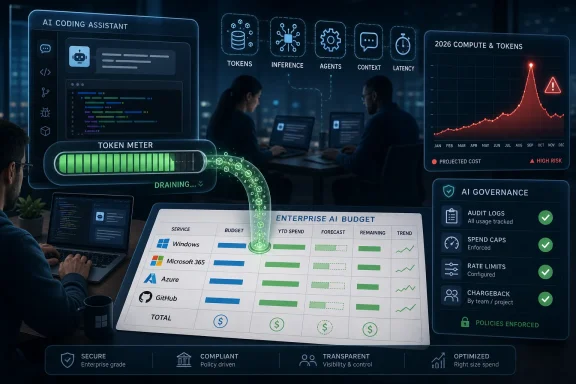 The AI Efficiency Story Has Met Its First Serious Accountant
For the last two years, enterprise AI has been sold with a productivity vocabulary: copilots, agents, digital workers, code acceleration, operational leverage. That vocabulary still matters, because many of these tools really do make skilled employees faster at specific tasks. But a second vocabulary is now forcing its way into the room: tokens, inference, utilization caps, license consolidation, and internal chargeback.Bryan Catanzaro’s reported comment that compute costs for his NVIDIA team exceed employee costs is striking less because it proves AI is “more expensive than people” in a universal sense, and more because of where it came from. NVIDIA is not a naïve AI buyer dazzled by a vendor demo. It is the company selling the core hardware behind much of the boom, and its applied deep learning teams are among the people least likely to misunderstand what heavy AI usage entails.
That context cuts both ways. NVIDIA’s internal R&D compute is not the same thing as a help desk department using a chatbot, and it would be misleading to flatten the comparison into a simple worker-versus-machine spreadsheet. Still, the quote lands because it punctures a lazy assumption: that once an AI workflow “works,” its economics naturally become trivial at scale.
In the cloud era, IT leaders learned to fear the surprise bill. AI brings that problem into everyday knowledge work. The meter no longer runs only when someone spins up a forgotten VM or leaves a test database exposed to the internet. It runs when an engineer asks an agent to inspect a codebase, when a designer iterates through prototypes, when a manager pastes meeting notes into a model, and when an autonomous workflow decides it needs three more passes before producing a confident answer.
Tokens Turn Productivity Into a Metered Utility
The token is the tiny accounting unit that makes large language models feel conversational and finance departments feel hunted. Models read and generate text as tokens, and most commercial pricing turns those tokens into a bill. A short prompt can be cheap; a full repository scan, long context window, multi-step coding session, or agentic loop can be very much not cheap.That pricing model creates a subtle inversion. In normal enterprise software, a seat license often encourages usage because marginal use feels free after purchase. In token-priced AI, heavier use is the product succeeding and the cost center expanding at the same time. The same enthusiastic adoption slide that makes a CIO look forward-thinking can make procurement ask why a pilot behaved like an uncapped commodity trade.
The industry’s cultural signals have made the problem worse. Reports of Amazon encouraging workers to “tokenmaxx,” or Meta employees gamifying usage through dashboards, show how quickly consumption became a proxy for ambition. It is easy to understand why. In the early phase of any platform shift, organizations fear being left behind more than they fear inefficiency.
But measuring token consumption as a sign of seriousness is like measuring cloud maturity by how many instances a team launches. It rewards motion before discipline. The hard question is not whether employees are using AI; it is whether the tokens map to durable output, reduced cycle time, fewer defects, better customer outcomes, or work that could not otherwise have been done.
That distinction matters especially for Windows-heavy enterprises, where AI features are increasingly woven into developer tooling, productivity suites, endpoint management, security workflows, and help desk operations. If AI becomes a default layer across the stack, token governance becomes as basic as identity management or software asset management. The bill will not care that the prompt came from a sanctioned workflow rather than a shadow IT experiment.
Microsoft’s Claude Code Pullback Shows the Vendor Is Also a Customer
Microsoft’s reported decision to cancel most direct Claude Code licenses internally and steer engineers toward GitHub Copilot CLI is the cleanest illustration of the new AI economics. This is not a company hostile to AI. Microsoft has bet its cloud strategy, developer platform, Office franchise, Windows roadmap, and Wall Street narrative on generative AI.That is precisely why the reversal matters. If Microsoft opens a third-party coding assistant to thousands of employees, watches adoption spread quickly, and then pulls back within roughly half a year, the lesson is not that AI coding tools are useless. The lesson is that even the most AI-committed organizations are going to rationalize tool choice when usage leaves the pilot phase and enters the operating budget.
There is also a platform politics layer. Claude Code’s popularity inside Microsoft reportedly risked competing with GitHub Copilot CLI, Microsoft’s own developer product. Steering engineers toward the in-house option supports dogfooding, reduces dependence on a rival interface, and keeps more strategic telemetry and product pressure inside Microsoft’s ecosystem. But the timing around fiscal-year cost control makes the money story hard to ignore.
The irony is rich but not contradictory. Microsoft can deepen commercial relationships with Anthropic, support Claude models through cloud and model-catalog arrangements, and still decide that broad internal access to a standalone Anthropic coding tool is too expensive or strategically awkward. In hyperscale AI, partnership and competition frequently occupy the same conference room.
For enterprise customers, this is a useful warning. Vendor enthusiasm does not exempt the vendor from procurement logic. If Microsoft can urge customers into an AI future while pruning its own tool sprawl, CIOs should feel no shame in asking sharper questions about utilization, duplication, retention, auditability, and whether each AI assistant is actually the right assistant for the job.
The Coding Assistant Has Become the New Cloud Cost Center
Coding assistants are where the economics become visible first because developers are unusually good at consuming compute in ways that look rational. They work with large context, complex dependencies, test loops, logs, build failures, unfamiliar APIs, and sprawling repositories. A model that can ingest more context and iterate longer is genuinely useful to them.That usefulness is exactly the budget risk. A coding assistant that engineers ignore is a failed pilot with a small bill. A coding assistant that engineers love can become a runaway line item before finance has built the model for what “normal” usage looks like.
Uber’s reported experience makes the point with unusual clarity. The company’s CTO reportedly said Uber burned through its entire 2026 AI coding tools budget within four months, after management had encouraged heavy use and even ranked internal usage competitively. That is not a story about employees secretly wasting company money. It is a story about management asking for adoption, getting adoption, and discovering that the success metric was coupled to an invoice.
This is a pattern many WindowsForum readers will recognize from earlier platform transitions. Virtualization, public cloud, SaaS collaboration tools, and container platforms all had a phase where the technology spread faster than governance. The difference with AI coding tools is that the marginal action is almost frictionless: ask, generate, inspect, refine, repeat.
Developers do not experience this as “spending tokens.” They experience it as staying in flow. That means blunt restrictions can feel like sabotage, especially if teams have already integrated AI assistance into daily work. Once the habit forms, a license cancellation or per-user cap is not a spreadsheet tweak; it changes how people write, review, test, and reason about software.
Agentic AI Is Where the Spreadsheet Gets Scary
The industry’s next promise is not a better chatbot. It is agentic AI: systems that can plan, call tools, inspect results, revise their approach, and work through multi-step tasks with limited human intervention. That is the version of AI most often invoked when executives talk about digital workers or swarms of assistants around every employee.Agentic systems are also token machines. A chatbot might answer once. An agent may read a ticket, search documentation, inspect source code, call an API, run a test, summarize an error, choose another path, and ask the model to reason again. Each step can consume tokens, and the most valuable tasks often involve the largest context and the most iteration.
That is why forecasts of explosive token growth should not be dismissed as vendor hype. If enterprises deploy agents across engineering, customer support, sales operations, compliance, finance, and security, token consumption can rise far faster than headcount. A single employee supervising many agents sounds efficient until each agent behaves like a tiny, metered contractor with a taste for long meetings.
Gartner’s warning that inference costs per unit may fall sharply while total bills still rise captures the central tension. Commodity token prices can decline, model-serving efficiency can improve, chips can get faster, and caching can reduce waste. None of that guarantees lower enterprise spending if the industry simultaneously expands the number of tasks, agents, retries, context windows, and model calls.
This is the same paradox that has shaped computing for decades. Cheaper compute does not necessarily reduce spending; it often makes new workloads possible. The cloud did not end infrastructure budgets. It made infrastructure elastic enough that every team could become an infrastructure consumer.
Jensen Huang’s Hundred-Agent Future Has a Meter Attached
NVIDIA CEO Jensen Huang’s vision of large numbers of AI agents working alongside every human employee is not science fiction in the narrow technical sense. Many companies are already experimenting with agentic workflows that draft code, triage tickets, summarize incidents, write tests, generate reports, and monitor systems. The direction of travel is obvious.What is less obvious in executive-stage rhetoric is the denominator. If every employee gets dozens or hundreds of agents, the relevant comparison is not the price of one chatbot query against one human task. It is the aggregate cost of continuous machine activity across the organization, including failed attempts, redundant work, security checks, orchestration overhead, storage, logging, and governance.
The strongest version of the AI bull case says those costs will be worth it. If agents expand output dramatically, reduce time-to-market, find bugs earlier, and automate miserable work, higher compute spending could be a rational substitution. Companies already spend heavily on salaries, contractors, cloud platforms, observability, security, and compliance because the output matters.
The weaker version says enterprises are about to mistake activity for leverage. If internal dashboards celebrate usage, if leaders reward token volume, and if teams lack outcome-based evaluation, the agentic future risks turning into a very expensive autocomplete culture. Everyone will feel faster, but no one will be quite sure whether the company is better.
For Windows administrators and enterprise architects, this is where the conversation becomes practical. AI agents tied into identity, endpoints, repositories, Microsoft 365, Azure, GitHub, ServiceNow, security tooling, and internal knowledge bases will need controls that look more like production systems than productivity experiments. Rate limits, audit trails, policy scopes, data boundaries, model selection, and cost attribution are not optional features; they are the difference between a platform and a budget incident.
The Windows Enterprise Will Inherit the Bill Through Familiar Doors
Most Windows shops will not experience this debate first as an abstract token forecast. They will experience it through line items attached to Microsoft 365 Copilot, GitHub Copilot, Azure OpenAI, security copilots, third-party coding tools, CRM assistants, support bots, and automation platforms. The invoices will arrive through familiar procurement channels, which may make the underlying change easier to miss.Microsoft is in a unique position because it sits on so many of the doors through which enterprise AI will enter. Windows, Office, Teams, Azure, GitHub, Visual Studio, Defender, Intune, and Power Platform all create natural surfaces for AI assistance. That integration can reduce friction and improve governance, but it can also normalize AI consumption across more workflows than finance anticipated.
This creates an old Microsoft dilemma in a new costume. Standardizing on the Microsoft stack may simplify procurement and compliance, especially for organizations already committed to Entra ID, Purview, Defender, and Azure billing. But standardization can also obscure whether a specific AI workload is best served by Microsoft’s model, Anthropic’s model, OpenAI’s model, a local model, or no model at all.
The internal Claude Code episode is instructive because it shows Microsoft wrestling with the same choice its customers face. Use the tool engineers like, use the tool the platform owner wants to grow, or use the tool that keeps costs predictable. In a perfect world, all three are the same. In 2026, they often are not.
Admins should expect more policy friction as AI becomes embedded in client and cloud software. The era of “turn it on and see what happens” is closing. The next phase will involve per-user caps, approved model lists, data classification rules, chargeback by department, logging requirements, and uncomfortable meetings about whether a tool that saves engineering time is still worth its monthly burn rate.
The Real Divide Is Not Human Versus Machine
The most misleading framing is that companies are discovering AI costs more than employees and will therefore abandon it. That is too simple. Companies spend more than employee salaries on many things when those things magnify output: factories, data centers, sales channels, logistics systems, cloud platforms, and software licenses.The better question is whether AI compute behaves like capital investment, operating expense, or waste. In practice, it will be all three. Training frontier models and building internal AI platforms may look like strategic capital spending. Running approved copilots across engineering may be a productivity expense. Letting every team spray tokens at poorly defined tasks may be waste with a futuristic user interface.
This is why the salary comparison is rhetorically powerful but analytically incomplete. A high-performing engineering team may be worth giving expensive tools if those tools compress release cycles or reduce defects. A support organization may justify agentic workflows if they reduce resolution time without degrading customer experience. A legal or compliance department may need narrower, auditable systems where unrestricted usage is not merely expensive but risky.
The industry has spent too long asking whether AI will replace workers. The more immediate enterprise question is whether AI will become another class of worker-like cost: always on, constantly managed, sometimes productive, sometimes idle, and never free. That shift makes management quality more important, not less.
If AI agents become part of the workforce, they need workforce-style accountability. Someone must define their job, measure their output, limit their authority, review their failures, and decide when they are no longer worth the budget. Without that discipline, the future of work becomes the future of unbounded inference.
AI Governance Is Becoming FinOps With a Prompt Box
Cloud financial operations matured because cloud waste became impossible to ignore. Organizations learned to tag resources, right-size instances, reserve capacity, shut down idle systems, and make teams see the cost of their choices. AI now needs a similar operating model, but the resource being governed is less visible to ordinary users.A virtual machine has a shape. A database has storage. A Kubernetes cluster has nodes. Tokens are more abstract, and that abstraction makes them dangerous. An employee can burn meaningful budget through perfectly normal-looking work: asking an agent to analyze too much context, retrying with a bigger model, letting an autonomous loop run longer than needed, or using a frontier model for a task a smaller model could handle.
The first wave of AI governance focused heavily on data leakage, hallucinations, copyright, and compliance. Those concerns remain real. But cost governance is now joining them as a first-class risk, because an AI deployment that is secure and popular can still be financially unsustainable.
IT leaders should also resist the temptation to treat all tokens equally. Some tokens generate code that ships, detect vulnerabilities, resolve customer issues, or save hours of expert labor. Others are exploratory noise. The hard work is not merely reducing usage; it is distinguishing valuable consumption from decorative consumption.
That distinction will require better telemetry than most organizations currently have. Usage dashboards should not become leaderboards for AI enthusiasm. They should connect model consumption to projects, teams, ticket outcomes, incident resolution, code quality, customer satisfaction, and measurable cycle-time changes. Otherwise, enterprises will be managing the cheapest number they can see rather than the most important number they need.
The Cheapest Model Will Not Always Win
One predictable reaction to rising bills is model downgrading. Route simple tasks to cheaper models, reserve frontier systems for complex reasoning, use local models where privacy or cost requires it, and cache repeated context aggressively. This is sensible, and many organizations will do it.But the cheapest model is not always the least expensive system. A weaker model that needs five retries, produces subtle bugs, or forces employees to spend extra time validating output may cost more in total than a stronger model used carefully. The right comparison is task cost, not token price.
This is especially true in software development. A coding assistant that generates plausible but flawed code can create downstream review burden, test failures, security risk, and maintenance debt. A more expensive assistant that understands a codebase better may be cheaper if it reduces rework. The economics are not captured by the invoice alone.
Model routing will therefore become a serious enterprise architecture problem. Organizations will need policies that decide which model handles which class of task, under what data constraints, with what context size, and with what approval path. That sounds bureaucratic, but it is the natural consequence of putting metered reasoning into critical workflows.
The same logic applies to Windows environments. A local or smaller model might be appropriate for endpoint triage, log summarization, or basic scripting assistance. A more capable hosted model may be justified for complex incident analysis or code modernization. The winning architecture will be hybrid, policy-driven, and deliberately boring.
Microsoft’s Customers Should Read the Internal Memo Between the Lines
Microsoft’s reported Claude Code retreat does not undermine its AI strategy. If anything, it makes the strategy more mature. A company that never prunes internal AI tools is not leading confidently; it is confusing abundance with direction.Still, customers should read the move as a signal. The age of indiscriminate AI experimentation is giving way to a phase of consolidation, preferred tooling, fiscal-year discipline, and platform lock-in. Microsoft will continue to sell AI everywhere, but it will also nudge customers toward the tools that strengthen its own ecosystem and cost model.
That is not nefarious; it is how platform companies behave. The burden is on customers to avoid outsourcing their AI architecture entirely to vendor defaults. A Microsoft-centric shop may still choose Copilot for most users, GitHub Copilot for developers, Azure OpenAI for custom workloads, and selected third-party models for specialized tasks. The point is to choose, not drift.
For developers, the lesson is more personal. A tool that becomes beloved can still vanish if procurement, platform strategy, or licensing economics change. Teams should avoid building undocumented workflows around any single AI assistant without considering portability. Prompts, evaluation sets, internal coding standards, and automation scaffolding should be treated as assets that can move across tools where possible.
For sysadmins, the lesson is operational. AI tools need inventory. They need ownership. They need budget codes. They need conditional access, retention settings, data handling rules, and exit plans. The fact that a tool feels like a chat window should not exempt it from the controls applied to every other enterprise system.
The First AI Budget Shock Is Teaching the Industry to Count
The useful thing about the NVIDIA, Microsoft, and Uber stories is that they make AI economics concrete. They move the discussion from abstract fear about job replacement to practical concern about operating leverage. AI may still change work profoundly, but it will do so through budgets, procurement, governance, and platform choices as much as through demos.The industry is also learning that adoption campaigns can create their own hangover. If leaders ask employees to use more AI, celebrate consumption, and treat experimentation as a cultural virtue, they should not be shocked when the bill reflects that behavior. Incentives work.
The next generation of successful AI deployments will likely look less glamorous than the first. They will have caps, routing rules, internal pricing, model benchmarks, approved workflows, and boring dashboards that measure outcomes rather than vibes. They will ask whether the agent completed the task, whether the human saved time, whether quality improved, and whether the same result could have been achieved with fewer tokens.
That may disappoint people who imagined AI adoption as a frictionless acceleration curve. But it should reassure anyone responsible for real systems. Technology becomes durable when it becomes governable.
The Meter Is Now Part of the Machine
The emerging lesson is not that enterprises should use less AI by default. It is that they should stop pretending AI usage is inherently virtuous just because it is modern.- NVIDIA’s internal compute-cost comparison shows that even expert AI organizations can spend more on machine resources than many outsiders expect.
- Microsoft’s reported Claude Code pullback shows that popular AI developer tools can still lose access when cost, strategy, and platform control collide.
- Uber’s budget overrun shows that management-driven adoption can become a finance problem when usage is gamified without outcome controls.
- Falling inference prices will not automatically lower enterprise AI bills if agentic systems multiply the number of model calls per task.
- Windows and Microsoft-centric IT shops should treat AI assistants as managed enterprise services, not as harmless productivity add-ons.
- The winning AI programs will measure shipped work, reduced defects, faster resolution, and real business outcomes instead of celebrating raw token volume.
References
- Primary source: Goodreturns
Published: 2026-06-24T16:42:07.649288
From NVIDIA and Microsoft to Uber: AI Compute Costs Are Now Higher Than Employee Salaries as Token Usage Explode - Goodreturns
Explore how rising AI compute costs surpass staff salaries, the impact of token pricing, and how firms like Microsoft, Uber and Goldman Sachs respond to growing AI budgets.www.goodreturns.in - Related coverage: gartner.com
Gartner Predicts That by 2030, Performing Inference on an LLM With 1 Trillion Parameters Will Cost GenAI Providers Over 90% Less Than in 2025
By 2030, performing inference on a large language model (LLM) with one trillion parameters will cost GenAI providers over 90% less than it did in 2025, according to Gartner, Inc. a business and technology insights company.www.gartner.com - Related coverage: agent-wars.com
Uber's $3.4B AI Budget Gone by March, CTO Scrambles
Agent Wars — Tracking the rise of AI agents. The definitive directory of AI agent platforms, tools, and frameworks. www.agent-wars.com
- Related coverage: techcrunch.com
Uber caps employee AI spending after blowing through budget in 4 months | TechCrunch
Uber's cutback has occurred after the company had reportedly encouraged staff to use AI as much as possible.techcrunch.com - Related coverage: forbes.com
Uber Burns Its 2026 AI Budget In Four Months On Claude Code
Uber exhausted its 2026 AI budget in four months on Claude Code, exposing how token pricing breaks enterprise finance assumptions.www.forbes.com - Related coverage: moneycontrol.com
- Related coverage: ai-blogs.org
Goldman Sachs forecasts 24× token-consumption explosion by 2030 — 120 quadrillion tokens per month if the agent thesis holds — ai-blogs.org
Goldman Sachs published a research note forecasting that agentic AI workloads could drive a 24-fold increase in monthly token consumption by 2030, reaching 120 quadrillion tokens per month. The number lands as Microsoft pulls back on internal Claude Code licensing and Uber report…ai-blogs.org - Related coverage: intellectia.ai
- Related coverage: windowscentral.com
Microsoft cancels Claude Code licenses, shifting developers to GitHub Copilot CLI — a move likely driven by financial motives | Windows Central
Claude Code was popular among Microsoft engineers, but the company now wants them to shift to GitHub Copilot CLI.www.windowscentral.com - Related coverage: wwwatch.dev
Microsoft Drops Claude Code, Pushes Thousands of Devs to Copilot CLI · wwwatch
Microsoft is canceling Claude Code licenses for its internal developers and redirecting them to GitHub Copilot CLI instead. The move signals how quickly enterprise AI tooling decisions can shift beneath teams building on third-party coding agents.www.wwwatch.dev - Related coverage: news.designrush.com
Claude Code Drained Uber's AI Budget in Months
Uber burned through its 2026 AI budget in four months after Claude Code adoption surged, exposing the limits of token-based pricing and AI scaling.news.designrush.com
- Related coverage: insights.itdukes.com
Microsoft Drops Claude Code by June 30, 2026: Inside the AI Budget Blowout | IT Dukes
Microsoft is cancelling most internal Claude Code licenses across its Experiences + Devices group (Windows, M365, Outlook, Teams, Surface) by June 30, 2026 — the end of its fiscal year — and pushing engineers to GitHub Copilot CLI. The Verge's Tom Warren broke the story on May 14, 2026: sources...insights.itdukes.com
- Related coverage: techradar.com
‘The cost of compute is far beyond the costs of the employees': Nvidia continues to stress importance of human workers - but how long can we all hang on? | TechRadar
It might not be the end for human workers just yetwww.techradar.com - Related coverage: pcgamer.com
Nvidia's VP of deep learning says AI workers are already 'far beyond the costs of the employees' | PC Gamer
How much will AI workers really cost in the end?www.pcgamer.com - Related coverage: tomshardware.com
Nvidia exec says AI is more expensive than actual workers — yet some companies don't see the extra costs as a negative | Tom's Hardware
It's easy to point and laugh, but the picture might be more nuanced than it seems.www.tomshardware.com - Related coverage: itpro.com
Uber’s eye-watering AI bill shows enterprises are ‘still measuring AI success through consumption rather than outcomes’ – and it's warping our perception of ROI and productivity | IT Pro
‘Tokenmaxxing’ might pad the stats, but it’s a trend that could come back to haunt enterprises – and Uber learned that the hard way.www.itpro.com
