

Theta Lake’s June 5, 2026, argument is that enterprises now need to monitor “aiComms” — human-to-AI and agent-to-agent workplace interactions — as a distinct communications risk category spanning tools such as Microsoft Copilot, Zoom AI Companion, Claude, and Gemini. The important part is not the branding. It is the admission that AI has crossed from software feature to workplace participant, and that old compliance plumbing was not built for conversations that reason, summarize, infer, omit, hallucinate, and act.
For WindowsForum readers, the Microsoft angle is obvious. Copilot is not just another app on the taskbar or a chat box inside Microsoft 365; it is becoming an interface to enterprise memory. Once AI can read documents, summarize meetings, draft replies, invoke agents, and sit inside collaboration workflows, the audit question changes from “who sent what to whom?” to “who asked which system to infer what, based on which data, and what did it do next?”
That is the governance gap Theta Lake is trying to name. Whether “aiComms” becomes the industry’s preferred term is almost beside the point. The workplace has created a new class of record, and regulators, security teams, and administrators are going to have to treat it like one.
Enterprise AI adoption has been sold as a productivity story: faster summaries, cleaner drafts, better search, fewer meetings, more automation. That framing is comforting because it makes AI sound like an upgraded spellchecker. But the actual behavior of modern AI platforms is closer to a new communications layer sitting between employees, business data, and external systems.
That layer is messy. A prompt may contain customer data, privileged legal strategy, source code, financial projections, or a careless paste from a Teams thread. A response may synthesize information from several files, misstate a policy, generate a misleading meeting summary, or create text that later gets copied into an email, ticket, report, or regulatory filing.
Traditional digital communications governance was designed around relatively stable artifacts: emails, chats, recordings, files, and transcripts. Those records can be archived, searched, classified, and produced in litigation. AI interactions are different because they are often sprawling, iterative, and context-dependent.
A single problematic prompt may not look risky in isolation. The risk may emerge only after a dozen interactions, when a user tests the edges of a policy, gradually extracts sensitive data, or steers a summary away from inconvenient facts. That is why behavior-based monitoring matters. AI governance cannot be only about blocking forbidden words at the front door.
In a Microsoft 365 environment, this is especially consequential. Copilot’s usefulness depends on access to organizational data: documents, mail, meetings, chats, calendars, and permissions. If those underlying permissions are too broad, Copilot may surface the consequences faster than a human auditor ever could.
Security teams already understand this pattern from search, eDiscovery, and insider-risk investigations. The difference is that AI does not simply retrieve a file. It can summarize, combine, transform, and explain information in a way that may obscure the original source and make downstream investigation harder.
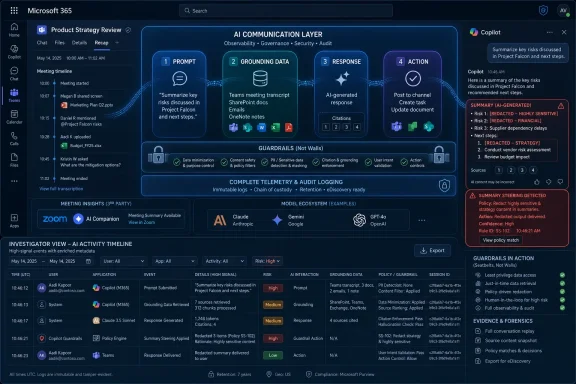
That is where the “full context” argument becomes important. A flat log entry saying that a user interacted with an AI assistant at 10:32 a.m. is not enough. Investigators need to know the prompt, the response, the grounding sources, the attachments, the meeting context, the user’s role, the data classifications involved, and whether the exchange was part of a larger pattern.
The prompt has become both an instruction and a disclosure. Treating it as anything less is a governance failure waiting to be discovered during an incident.
A guardrail can block obvious leakage of payment card data, detect a prompt injection attempt, or warn a user before sending sensitive content to an AI assistant. But the hardest problems in AI communications are rarely that tidy. A user may be trying to perform legitimate work with too much data. A model may comply with a request that is technically allowed but contextually dangerous. An agent may operate within its permissions while still producing an unacceptable outcome.
Theta Lake’s emphasis on forensic investigation is therefore the more interesting part of the pitch. The point is not merely to stop bad prompts. It is to reconstruct what happened when controls failed, partially worked, or generated too much noise for analysts to handle.
That is a familiar pattern in cybersecurity. Firewalls did not eliminate the need for SIEMs. Endpoint protection did not eliminate incident response. Data loss prevention did not eliminate insider-risk programs. AI guardrails will not eliminate AI investigations.
The real test is whether organizations can turn investigations back into better controls. If a compliance team discovers that employees are repeatedly asking meeting assistants to soften or omit certain discussion points, that should not remain a one-off finding. It should inform policy, training, detection rules, retention decisions, and perhaps the configuration of the AI tool itself.
That ambiguity is the central challenge. Legacy compliance tools often assume the suspicious artifact is self-contained: an email with prohibited language, a file sent externally, a recording with a missed disclosure. AI interactions are more behavioral. They involve intent, sequence, and context.
Consider “summary steering,” one of the misuse patterns Theta Lake highlights. A user might ask an AI meeting assistant to generate a summary that omits discussion of customer complaints, regulatory concerns, pricing disputes, or internal disagreement. In a traditional meeting transcript, the record exists even if the summary is polished. In an AI-driven workflow, the summary may become the artifact everyone reads.
That creates a subtle but serious governance problem. The risk is not that the AI invented a lie from nothing, although hallucination remains a concern. The risk is that the AI can be instructed to produce a conveniently incomplete version of reality, and that version may travel farther than the underlying record.
For regulated industries, this is not an abstract worry. Financial services, healthcare, legal, public sector, and critical infrastructure organizations already live under recordkeeping, supervision, privacy, and disclosure obligations. If AI-generated summaries, drafts, and recommendations become part of business communications, then the controls around them need to be more than aspirational.
For administrators, this is both convenient and dangerous. Convenient, because Microsoft can connect AI monitoring to identity, data classification, endpoint telemetry, audit logs, compliance workflows, and security operations. Dangerous, because the organization may assume that buying Copilot automatically means governing Copilot.
It does not. Copilot reflects the state of the tenant it enters. If SharePoint permissions are sprawling, sensitivity labels are inconsistent, retention policies are stale, and external sharing is poorly understood, AI will not create those problems so much as reveal and accelerate them.
This is why Purview and related controls matter. Microsoft’s own governance direction points toward visibility into prompts, responses, referenced files, AI app activity, data security posture, and risky usage patterns. But tooling alone does not answer the policy questions. Who is allowed to review prompt content? What AI interactions should be retained? Which events belong in Sentinel? When does a risky prompt become an HR matter, a compliance matter, or a security incident?
The answers will vary by industry, jurisdiction, and risk tolerance. What will not vary is the need to decide before the first major AI incident.
A log is a trail of events. A forensic view is an explanation space. It lets an investigator replay the interaction, see the sequence, understand the context, and connect the dots between user behavior, AI output, data sources, policy alerts, and downstream communications.
AI systems generate too much language for traditional alert queues. A verbose prompt injection attempt, a long meeting transcript, a multi-agent workflow, and a lengthy model response can produce a record that is both rich and exhausting. Dumping that into a SIEM without normalization risks turning AI governance into another source of alert fatigue.
The better approach is enrichment before escalation. Security operations should receive the high-signal event, not a haystack of conversational sludge. Compliance reviewers should see the relevant exchange in timeline form, not a scattered pile of JSON, transcript fragments, and disconnected DLP hits.
This is where third-party governance vendors see an opening. Microsoft, Zoom, Cisco, Google, Anthropic, OpenAI, and others will each provide native controls within their own ecosystems. But enterprises rarely live inside one ecosystem. They use Teams and Zoom, Microsoft 365 and Google Workspace, internal copilots and external models, sanctioned agents and shadow AI.
A governance layer that can normalize across those systems is attractive because the risk is cross-platform. The prompt starts in one tool, the source file lives in another, the meeting was hosted in a third, and the output gets pasted into email. The record of what happened cannot be trapped in one vendor’s dashboard.
Under-retention is just as dangerous. If an organization cannot reconstruct how an AI-generated recommendation was produced, why a customer-facing statement was drafted, or whether an employee intentionally bypassed policy, it may have no defensible answer when regulators, litigants, or executives ask.
That means AI retention has to become dynamic. Some interactions may deserve short-lived operational logging. Others may need preservation because they involve regulated communications, legal holds, sensitive data, customer commitments, or incident investigations. The retention decision should be tied to risk, role, content, jurisdiction, and business process.
This will be painful for organizations that still treat records management as an afterthought. AI does not merely add a new content type. It forces companies to revisit what a record is. Is the prompt a record? Is the response? Is the grounding metadata? Is the model version? Is the user’s attempt to rephrase a blocked prompt relevant? Is an agent-to-agent exchange discoverable?
The answer may not always be yes. But “we never thought about it” will not be a persuasive position for long.
If an AI notetaker joins a regulated meeting, is its presence visible to all participants? Are participants warned that the transcript may be processed by an AI system? Is the summary subject to review? Can the bot capture screen shares, chat messages, or attachments? What happens if a participant joins from another jurisdiction with stricter recording rules?
The hidden-participant problem is not only legal. It is behavioral. If employees know an AI summary will become the de facto record, they may attempt to shape it. If they do not know a bot is present, they may disclose information under assumptions that are no longer true.
This is where governance must become practical. Policies buried in employee handbooks will not manage meeting bots in real time. Organizations need controls that can detect AI participants, apply meeting-specific rules, preserve records where necessary, and notify users when AI is being used.
The meeting room has become a data pipeline. Enterprises should govern it accordingly.
That does not remove accountability. It makes accountability harder to observe.
A multi-agent workflow might include a customer-service agent summarizing a complaint, a retrieval system pulling account records, a policy agent checking eligibility, and a drafting agent preparing a response. Each step may be reasonable on its own. The combined workflow may still produce an unfair, inaccurate, noncompliant, or privacy-invasive result.
This is why normalized timelines matter. Investigators need to see not just the final answer but the chain of interaction that produced it. Which agent requested what? Which data was accessed? Which policy checks fired? Which guardrails were bypassed, ignored, or unavailable? Which human approved the outcome?
Without that visibility, enterprises will be left auditing the residue of automation rather than the automation itself. That is not governance. It is archaeology.
The agentic future also complicates identity. Human users have accounts, roles, managers, departments, and disciplinary processes. Agents need comparable identity boundaries: ownership, permissions, logging, purpose, expiration, and review. An orphaned agent with broad access may become the AI-era equivalent of a forgotten service account, except with a better command of natural language.
Classifiers can detect patterns like jailbreaking, prompt injection, sensitive data sharing, missing disclosures, or attempts to manipulate summaries. They cannot decide the company’s risk appetite. They cannot determine whether a business unit is allowed to use a public model for customer data. They cannot resolve tensions between employee privacy and compliance monitoring.
Those are governance decisions. They require legal, security, compliance, HR, IT, and business leadership to agree on rules that can actually be enforced. If they do not, AI monitoring becomes either performative or oppressive. It either catches nothing meaningful or watches everything without a clear mandate.
The best programs will start with a narrow set of concrete risks. Regulated communications. Sensitive customer data. Meeting summaries used as records. AI-generated external statements. Agent access to high-value repositories. Shadow AI use involving confidential files. These are governable domains.
Trying to monitor every AI interaction with equal intensity is a recipe for noise, resentment, and failure. Behavior-based risk works only when the organization knows which behaviors matter.
If an employee attempts to paste source code into an unsanctioned AI tool, that may belong in a DLP workflow. If a user repeatedly asks an assistant how to bypass internal controls, that may belong in insider-risk review. If a prompt injection attack causes an AI agent to retrieve sensitive files, that may belong in incident response. If an AI-generated summary omits required disclosures, that may belong in compliance supervision.
The same AI event can have different meanings depending on context. That is why enrichment matters. Security teams need the who, what, when, where, and why-adjacent signals: user identity, device posture, data sensitivity, app involved, prompt content, response content, source files, previous behavior, and downstream action.
Windows administrators have learned this lesson many times. Raw event logs are useful only when correlated with identity, endpoint, network, and application context. AI interactions are no different, except the evidence is written in human language and can be intentionally manipulative.
The SOC will not become an AI governance team by magic. But if AI activity is excluded from security telemetry, the SOC will be blind to one of the fastest-growing enterprise attack and leakage surfaces.
For IT leaders, the immediate task is not to buy whatever product shouts “AI governance” the loudest. It is to inventory where AI interactions are already happening. Microsoft 365 Copilot, Copilot Chat, Teams meeting summaries, Zoom AI Companion, Webex AI features, Slack integrations, Claude, Gemini, ChatGPT Enterprise, internal RAG systems, Copilot Studio agents, and unsanctioned browser-based tools may all be present in the same organization.
Once that map exists, the organization can decide what must be captured, what must be blocked, what must be retained, and what must be reviewed. That is the foundation for any serious aiComms program.
The hardest part may be cultural. Employees have been encouraged to “use AI” and “move faster,” often before policy caught up. If governance arrives only as surveillance, users will route around it. If governance arrives as enablement — clear rules, visible notices, approved tools, fast review, and sensible defaults — it has a better chance of working.
AI governance is not anti-AI. Done well, it is what lets organizations use AI in places where trust, auditability, and accountability matter.
For WindowsForum’s audience, that means the AI rollout checklist should look less like a feature launch and more like a security program.
For WindowsForum readers, the Microsoft angle is obvious. Copilot is not just another app on the taskbar or a chat box inside Microsoft 365; it is becoming an interface to enterprise memory. Once AI can read documents, summarize meetings, draft replies, invoke agents, and sit inside collaboration workflows, the audit question changes from “who sent what to whom?” to “who asked which system to infer what, based on which data, and what did it do next?”
That is the governance gap Theta Lake is trying to name. Whether “aiComms” becomes the industry’s preferred term is almost beside the point. The workplace has created a new class of record, and regulators, security teams, and administrators are going to have to treat it like one.
 AI Has Become a Coworker Before Governance Became a Discipline
Enterprise AI adoption has been sold as a productivity story: faster summaries, cleaner drafts, better search, fewer meetings, more automation. That framing is comforting because it makes AI sound like an upgraded spellchecker. But the actual behavior of modern AI platforms is closer to a new communications layer sitting between employees, business data, and external systems.That layer is messy. A prompt may contain customer data, privileged legal strategy, source code, financial projections, or a careless paste from a Teams thread. A response may synthesize information from several files, misstate a policy, generate a misleading meeting summary, or create text that later gets copied into an email, ticket, report, or regulatory filing.
Traditional digital communications governance was designed around relatively stable artifacts: emails, chats, recordings, files, and transcripts. Those records can be archived, searched, classified, and produced in litigation. AI interactions are different because they are often sprawling, iterative, and context-dependent.
A single problematic prompt may not look risky in isolation. The risk may emerge only after a dozen interactions, when a user tests the edges of a policy, gradually extracts sensitive data, or steers a summary away from inconvenient facts. That is why behavior-based monitoring matters. AI governance cannot be only about blocking forbidden words at the front door.
The Prompt Is Now a Business Record
The uncomfortable implication is that prompts and responses are becoming business records. That does not mean every casual AI exchange deserves permanent retention. It does mean enterprises can no longer pretend these interactions are ephemeral side conversations.In a Microsoft 365 environment, this is especially consequential. Copilot’s usefulness depends on access to organizational data: documents, mail, meetings, chats, calendars, and permissions. If those underlying permissions are too broad, Copilot may surface the consequences faster than a human auditor ever could.
Security teams already understand this pattern from search, eDiscovery, and insider-risk investigations. The difference is that AI does not simply retrieve a file. It can summarize, combine, transform, and explain information in a way that may obscure the original source and make downstream investigation harder.
That is where the “full context” argument becomes important. A flat log entry saying that a user interacted with an AI assistant at 10:32 a.m. is not enough. Investigators need to know the prompt, the response, the grounding sources, the attachments, the meeting context, the user’s role, the data classifications involved, and whether the exchange was part of a larger pattern.
The prompt has become both an instruction and a disclosure. Treating it as anything less is a governance failure waiting to be discovered during an incident.
Guardrails Are Necessary, but They Are Not the Investigation
Vendors like to talk about guardrails because the word implies order. It suggests a clean boundary between allowed and forbidden behavior. In practice, guardrails are closer to seatbelts than walls: essential, imperfect, and most useful when paired with crash analysis.A guardrail can block obvious leakage of payment card data, detect a prompt injection attempt, or warn a user before sending sensitive content to an AI assistant. But the hardest problems in AI communications are rarely that tidy. A user may be trying to perform legitimate work with too much data. A model may comply with a request that is technically allowed but contextually dangerous. An agent may operate within its permissions while still producing an unacceptable outcome.
Theta Lake’s emphasis on forensic investigation is therefore the more interesting part of the pitch. The point is not merely to stop bad prompts. It is to reconstruct what happened when controls failed, partially worked, or generated too much noise for analysts to handle.
That is a familiar pattern in cybersecurity. Firewalls did not eliminate the need for SIEMs. Endpoint protection did not eliminate incident response. Data loss prevention did not eliminate insider-risk programs. AI guardrails will not eliminate AI investigations.
The real test is whether organizations can turn investigations back into better controls. If a compliance team discovers that employees are repeatedly asking meeting assistants to soften or omit certain discussion points, that should not remain a one-off finding. It should inform policy, training, detection rules, retention decisions, and perhaps the configuration of the AI tool itself.
The New Insider Risk May Look Like Productivity
One reason AI communications risk is difficult to govern is that suspicious behavior can resemble ordinary productivity. A financial analyst asking Copilot to summarize sensitive deal documents may be doing legitimate work. The same pattern, repeated across unusual files and followed by requests to produce sanitized summaries, may deserve scrutiny.That ambiguity is the central challenge. Legacy compliance tools often assume the suspicious artifact is self-contained: an email with prohibited language, a file sent externally, a recording with a missed disclosure. AI interactions are more behavioral. They involve intent, sequence, and context.
Consider “summary steering,” one of the misuse patterns Theta Lake highlights. A user might ask an AI meeting assistant to generate a summary that omits discussion of customer complaints, regulatory concerns, pricing disputes, or internal disagreement. In a traditional meeting transcript, the record exists even if the summary is polished. In an AI-driven workflow, the summary may become the artifact everyone reads.
That creates a subtle but serious governance problem. The risk is not that the AI invented a lie from nothing, although hallucination remains a concern. The risk is that the AI can be instructed to produce a conveniently incomplete version of reality, and that version may travel farther than the underlying record.
For regulated industries, this is not an abstract worry. Financial services, healthcare, legal, public sector, and critical infrastructure organizations already live under recordkeeping, supervision, privacy, and disclosure obligations. If AI-generated summaries, drafts, and recommendations become part of business communications, then the controls around them need to be more than aspirational.
Microsoft Shops Will Feel This First Because Copilot Sits Where the Data Lives
The Windows and Microsoft 365 ecosystem is likely to be one of the first places this governance fight becomes operational rather than theoretical. Microsoft has been steadily positioning Copilot, Copilot Studio agents, Security Copilot, Purview, Defender, Entra, and Sentinel as pieces of a broader enterprise AI control plane. That makes sense. The company that owns the productivity stack also wants to own the governance layer around AI-powered productivity.For administrators, this is both convenient and dangerous. Convenient, because Microsoft can connect AI monitoring to identity, data classification, endpoint telemetry, audit logs, compliance workflows, and security operations. Dangerous, because the organization may assume that buying Copilot automatically means governing Copilot.
It does not. Copilot reflects the state of the tenant it enters. If SharePoint permissions are sprawling, sensitivity labels are inconsistent, retention policies are stale, and external sharing is poorly understood, AI will not create those problems so much as reveal and accelerate them.
This is why Purview and related controls matter. Microsoft’s own governance direction points toward visibility into prompts, responses, referenced files, AI app activity, data security posture, and risky usage patterns. But tooling alone does not answer the policy questions. Who is allowed to review prompt content? What AI interactions should be retained? Which events belong in Sentinel? When does a risky prompt become an HR matter, a compliance matter, or a security incident?
The answers will vary by industry, jurisdiction, and risk tolerance. What will not vary is the need to decide before the first major AI incident.
Flat Logs Cannot Explain a Conversation
The article Theta Lake placed with FinTech Global makes a useful distinction between logs and forensic views. That distinction deserves more attention because it is where many AI governance projects will either succeed or drown.A log is a trail of events. A forensic view is an explanation space. It lets an investigator replay the interaction, see the sequence, understand the context, and connect the dots between user behavior, AI output, data sources, policy alerts, and downstream communications.
AI systems generate too much language for traditional alert queues. A verbose prompt injection attempt, a long meeting transcript, a multi-agent workflow, and a lengthy model response can produce a record that is both rich and exhausting. Dumping that into a SIEM without normalization risks turning AI governance into another source of alert fatigue.
The better approach is enrichment before escalation. Security operations should receive the high-signal event, not a haystack of conversational sludge. Compliance reviewers should see the relevant exchange in timeline form, not a scattered pile of JSON, transcript fragments, and disconnected DLP hits.
This is where third-party governance vendors see an opening. Microsoft, Zoom, Cisco, Google, Anthropic, OpenAI, and others will each provide native controls within their own ecosystems. But enterprises rarely live inside one ecosystem. They use Teams and Zoom, Microsoft 365 and Google Workspace, internal copilots and external models, sanctioned agents and shadow AI.
A governance layer that can normalize across those systems is attractive because the risk is cross-platform. The prompt starts in one tool, the source file lives in another, the meeting was hosted in a third, and the output gets pasted into email. The record of what happened cannot be trapped in one vendor’s dashboard.
Retention Is a Risk Decision, Not a Storage Setting
The retention problem is more complicated than “save everything.” In fact, saving everything may be reckless. AI interactions can contain sensitive personal data, trade secrets, privileged material, credentials, health information, source code, and confidential customer records. Over-retention can increase breach impact, discovery cost, and privacy exposure.Under-retention is just as dangerous. If an organization cannot reconstruct how an AI-generated recommendation was produced, why a customer-facing statement was drafted, or whether an employee intentionally bypassed policy, it may have no defensible answer when regulators, litigants, or executives ask.
That means AI retention has to become dynamic. Some interactions may deserve short-lived operational logging. Others may need preservation because they involve regulated communications, legal holds, sensitive data, customer commitments, or incident investigations. The retention decision should be tied to risk, role, content, jurisdiction, and business process.
This will be painful for organizations that still treat records management as an afterthought. AI does not merely add a new content type. It forces companies to revisit what a record is. Is the prompt a record? Is the response? Is the grounding metadata? Is the model version? Is the user’s attempt to rephrase a blocked prompt relevant? Is an agent-to-agent exchange discoverable?
The answer may not always be yes. But “we never thought about it” will not be a persuasive position for long.
The Meeting Bot Is the Canary in the Conference Room
AI notetakers are a useful symbol of the broader problem because they look harmless. They join meetings, transcribe conversation, summarize action items, and promise to rescue everyone from calendar overload. In practice, they also create new questions about consent, disclosure, retention, access, and surveillance.If an AI notetaker joins a regulated meeting, is its presence visible to all participants? Are participants warned that the transcript may be processed by an AI system? Is the summary subject to review? Can the bot capture screen shares, chat messages, or attachments? What happens if a participant joins from another jurisdiction with stricter recording rules?
The hidden-participant problem is not only legal. It is behavioral. If employees know an AI summary will become the de facto record, they may attempt to shape it. If they do not know a bot is present, they may disclose information under assumptions that are no longer true.
This is where governance must become practical. Policies buried in employee handbooks will not manage meeting bots in real time. Organizations need controls that can detect AI participants, apply meeting-specific rules, preserve records where necessary, and notify users when AI is being used.
The meeting room has become a data pipeline. Enterprises should govern it accordingly.
Agent-to-Agent Workflows Move the Risk Out of Human Sight
The next stage is more difficult: agent-to-agent communications. Human prompts are at least visible as human behavior. Agentic workflows may involve systems calling other systems, generating intermediate outputs, retrieving documents, invoking tools, and making decisions at machine speed.That does not remove accountability. It makes accountability harder to observe.
A multi-agent workflow might include a customer-service agent summarizing a complaint, a retrieval system pulling account records, a policy agent checking eligibility, and a drafting agent preparing a response. Each step may be reasonable on its own. The combined workflow may still produce an unfair, inaccurate, noncompliant, or privacy-invasive result.
This is why normalized timelines matter. Investigators need to see not just the final answer but the chain of interaction that produced it. Which agent requested what? Which data was accessed? Which policy checks fired? Which guardrails were bypassed, ignored, or unavailable? Which human approved the outcome?
Without that visibility, enterprises will be left auditing the residue of automation rather than the automation itself. That is not governance. It is archaeology.
The agentic future also complicates identity. Human users have accounts, roles, managers, departments, and disciplinary processes. Agents need comparable identity boundaries: ownership, permissions, logging, purpose, expiration, and review. An orphaned agent with broad access may become the AI-era equivalent of a forgotten service account, except with a better command of natural language.
Compliance Automation Will Not Save Bad Policy
There is a temptation to imagine AI governance as another automation problem. Feed prompts into classifiers, route alerts to reviewers, sync high-risk events to SIEM and SOAR tools, and let the machine sort the mess. That will help, but only if the organization has already made hard policy choices.Classifiers can detect patterns like jailbreaking, prompt injection, sensitive data sharing, missing disclosures, or attempts to manipulate summaries. They cannot decide the company’s risk appetite. They cannot determine whether a business unit is allowed to use a public model for customer data. They cannot resolve tensions between employee privacy and compliance monitoring.
Those are governance decisions. They require legal, security, compliance, HR, IT, and business leadership to agree on rules that can actually be enforced. If they do not, AI monitoring becomes either performative or oppressive. It either catches nothing meaningful or watches everything without a clear mandate.
The best programs will start with a narrow set of concrete risks. Regulated communications. Sensitive customer data. Meeting summaries used as records. AI-generated external statements. Agent access to high-value repositories. Shadow AI use involving confidential files. These are governable domains.
Trying to monitor every AI interaction with equal intensity is a recipe for noise, resentment, and failure. Behavior-based risk works only when the organization knows which behaviors matter.
Security Teams Need AI Context, Not Another Dashboard
The integration with SIEM, SOC, and SOAR tools is important, but it should not be misunderstood. The goal is not to create one more dashboard for analysts to ignore. The goal is to make AI communications legible inside existing incident-response machinery.If an employee attempts to paste source code into an unsanctioned AI tool, that may belong in a DLP workflow. If a user repeatedly asks an assistant how to bypass internal controls, that may belong in insider-risk review. If a prompt injection attack causes an AI agent to retrieve sensitive files, that may belong in incident response. If an AI-generated summary omits required disclosures, that may belong in compliance supervision.
The same AI event can have different meanings depending on context. That is why enrichment matters. Security teams need the who, what, when, where, and why-adjacent signals: user identity, device posture, data sensitivity, app involved, prompt content, response content, source files, previous behavior, and downstream action.
Windows administrators have learned this lesson many times. Raw event logs are useful only when correlated with identity, endpoint, network, and application context. AI interactions are no different, except the evidence is written in human language and can be intentionally manipulative.
The SOC will not become an AI governance team by magic. But if AI activity is excluded from security telemetry, the SOC will be blind to one of the fastest-growing enterprise attack and leakage surfaces.
The Practical Playbook Starts Before the Webinar
Theta Lake’s promotional hook is an AI Governance Series beginning June 16, 2026, with participants from SIFMA, RingCentral, Zoom, Webex by Cisco, Metrigy, and Theta Lake. The vendor framing is obvious, but the underlying signal is real: regulated organizations are moving from AI experimentation to AI supervision.For IT leaders, the immediate task is not to buy whatever product shouts “AI governance” the loudest. It is to inventory where AI interactions are already happening. Microsoft 365 Copilot, Copilot Chat, Teams meeting summaries, Zoom AI Companion, Webex AI features, Slack integrations, Claude, Gemini, ChatGPT Enterprise, internal RAG systems, Copilot Studio agents, and unsanctioned browser-based tools may all be present in the same organization.
Once that map exists, the organization can decide what must be captured, what must be blocked, what must be retained, and what must be reviewed. That is the foundation for any serious aiComms program.
The hardest part may be cultural. Employees have been encouraged to “use AI” and “move faster,” often before policy caught up. If governance arrives only as surveillance, users will route around it. If governance arrives as enablement — clear rules, visible notices, approved tools, fast review, and sensible defaults — it has a better chance of working.
AI governance is not anti-AI. Done well, it is what lets organizations use AI in places where trust, auditability, and accountability matter.
The Admin’s Checklist Is Becoming an Evidence Trail
The most useful takeaway from the aiComms discussion is that governance has to be operational. It must show up in configuration, logging, retention, review workflows, user education, and incident response. A policy that cannot be evidenced is just a wish with corporate formatting.For WindowsForum’s audience, that means the AI rollout checklist should look less like a feature launch and more like a security program.
- Organizations should identify every sanctioned and unsanctioned AI communications channel before deciding which controls are sufficient.
- Administrators should review Microsoft 365 permissions, sensitivity labels, sharing policies, and retention settings before expanding Copilot access.
- Security teams should route high-risk AI interaction alerts into existing SIEM, SOC, and SOAR workflows rather than leaving them stranded in vendor consoles.
- Compliance teams should define which prompts, responses, meeting summaries, and agent interactions are business records subject to retention or legal hold.
- Investigators should be able to replay AI interactions as timelines that include prompts, outputs, files, users, agents, guardrail alerts, and downstream communications.
- Governance programs should treat repeated behavior over time as a risk signal, not just isolated policy violations.
References
- Primary source: fintech.global
Published: 2026-06-05T11:50:09.734508
How to monitor and investigate behavior-based risk in AI communications
Artificial intelligence has moved well beyond being a simple productivity tool. Today, platforms such as Microsoft Copilot, Zoom AIC, Anthropic’s Claude, and Google Gemini are functioning as active, native participants in the digital workplace — generating outputs, joining meetings, and...fintech.global - Related coverage: thetalake.com
- Related coverage: lightreading.com
Global enterprises face AI scaling crisis – Tata Communications
New report from says 77% view AI as board-level priority, yet two-thirds rely on legacy infrastructure. #pressreleasewww.lightreading.com - Related coverage: oecd.org
- Related coverage: jbs.cam.ac.uk
