Akamai announced on June 10, 2026, from Cambridge, Massachusetts, that Akamai API Security has earned Microsoft’s Solutions Partner with certified software designation for Security within the Microsoft AI Cloud Partner Program, recognizing interoperability with Microsoft Cloud environments including Azure. The announcement is narrow in the formal sense and larger in the strategic one. Microsoft is not endorsing Akamai’s product as a magic shield, and Akamai is not suddenly becoming an Azure-native Microsoft security service. But the designation lands at a moment when API security has moved from specialist concern to board-level exposure, and it tells us something important about how the Microsoft cloud ecosystem is being stitched together: through marketplaces, partner badges, and interoperability claims that enterprises are increasingly expected to treat as buying signals.

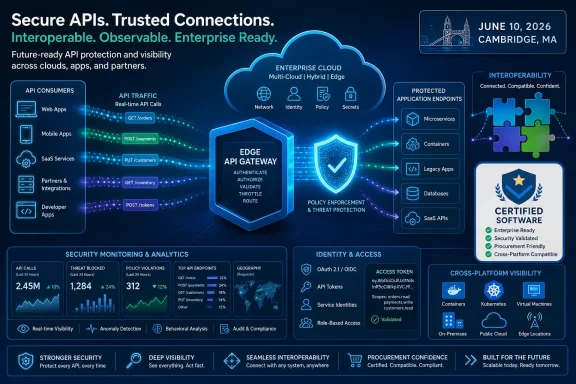
Secure API gateway diagram showing trusted, interoperable enterprise connections with analytics and identity protection.Microsoft’s Badge Is Not an Endorsement, but It Is a Signal​

The first thing to strip away is the marketing fog. Microsoft’s “Solutions Partner with certified software” designation is a partner-program credential, not a blanket guarantee that a product will stop breaches, eliminate misconfigurations, or behave perfectly in every tenant. The small print matters here: certified software status is tied to interoperability with Microsoft products and is based, in part, on information supplied by the solution owner.
That caveat does not make the designation meaningless. In enterprise procurement, especially around Azure, badges are part of the language buyers use to reduce ambiguity. A product that has cleared Microsoft’s partner-program requirements can move through vendor review, marketplace procurement, and cloud architecture discussions with less friction than one arriving as an unsupported outsider.
That is the real story behind Akamai’s announcement. The company is not merely saying that its API security product exists in the Azure orbit. It is saying that the product has been packaged, positioned, and reviewed in a way that Microsoft’s cloud customers can understand within Microsoft’s own partner taxonomy.
For WindowsForum readers, the practical distinction is important. This is not a Windows update, not a Defender feature, and not an Azure security control being added to every subscription. It is a third-party security platform gaining a Microsoft ecosystem credential, and that makes it relevant to the administrators and architects who increasingly build hybrid estates out of Microsoft services and non-Microsoft security layers.

API Security Has Become the Cloud’s Uncomfortable Blind Spot​

A decade ago, API security sounded like a developer concern. Today it is a business continuity concern. Modern applications do not merely expose a few documented endpoints for mobile apps or partners; they are often webs of internal APIs, public APIs, third-party integrations, legacy services, and automation hooks that change faster than traditional security inventories can track.
That is why Akamai’s press release leans so heavily on visibility. The company frames APIs as the foundation of digital interaction, and that is not just vendor flourish. In cloud-native estates, the API is frequently the real perimeter. Users may authenticate through Microsoft Entra ID, workloads may run in Azure, and traffic may pass through gateways and WAFs, but the exposed business logic still lives in API calls.
Attackers know this. Credential stuffing, token abuse, enumeration, scraping, shadow endpoints, excessive data exposure, and business-logic attacks often do not look like classic malware. They look like legitimate requests used in illegitimate ways. That makes API security difficult for teams that are still mentally organized around endpoints, firewalls, and patch levels.
Akamai’s pitch is that API Security can discover, classify, monitor, and protect APIs across environments, including those touching Azure workloads. The Microsoft designation does not prove that Akamai will solve every one of those problems in a customer’s estate. It does, however, place Akamai’s product in a Microsoft-compatible procurement lane at exactly the time when many enterprises are discovering that Azure-native security alone may not account for every API they actually expose.

Azure Is the Center of Gravity, Not the Whole Universe​

The most interesting phrase in the announcement is “cross-platform visibility.” That is the phrase enterprise security teams should linger over, because few large organizations run purely inside one cloud or one security stack. Even Microsoft-heavy shops tend to have SaaS platforms, legacy data centers, partner portals, CDN edges, Kubernetes environments, and a long tail of integrations that do not fit neatly into a single Azure diagram.
This is where Akamai’s history matters. Akamai built its reputation on distributed edge infrastructure, performance, content delivery, DDoS mitigation, and web security. Its security portfolio has increasingly pushed into application and API protection, not as an afterthought but as part of a broader argument: that the edge, the cloud, and the application layer are now inseparable.
Microsoft, meanwhile, has every incentive to make Azure the marketplace where customers discover, buy, and attach third-party capabilities. The Microsoft Cloud is no longer just a set of infrastructure services. It is also a commercial channel, an identity fabric, a compliance environment, and a partner ecosystem.
That dynamic creates a useful tension. Customers want tools that work with Azure without being trapped inside Azure. Microsoft wants partners that enrich its cloud without undermining its platform story. Akamai wants to reassure buyers that its API security layer can sit across the messiness of real enterprise architecture while still fitting into Microsoft’s approved partner framework.

The AI Angle Is Not Decoration​

Akamai’s announcement invokes AI adoption, and that is easy to dismiss as obligatory 2026 seasoning. Every vendor now feels compelled to mention AI, whether the connection is central or cosmetic. In this case, though, the connection is more substantial than the buzzword suggests.
AI systems consume APIs, expose APIs, generate code that calls APIs, and accelerate the pace at which organizations create new integration surfaces. Agentic workflows make the problem sharper. If software agents are allowed to take actions across systems, APIs become the rails on which those actions travel.
That means API inventory and behavioral monitoring are no longer just defensive hygiene. They are preconditions for safely deploying automation. An organization that does not know which APIs exist, what data they expose, which identities can call them, and what normal use looks like is not well positioned to let AI agents operate at speed.
This is also where Microsoft’s ecosystem relevance becomes obvious. Copilot, Azure AI services, Entra, Fabric, Dynamics, Power Platform, and custom Azure workloads are all pulling enterprises toward more automation and more integration. The security problem is not that AI creates APIs from nothing. It is that AI increases the value and velocity of the API layer already holding the business together.

The Fine Print Should Keep Buyers Sober​

The announcement includes Microsoft’s standard disclaimers, and those disclaimers deserve more attention than they usually receive. Microsoft explicitly avoids framing the designation as an endorsement, warranty, guarantee, or proof of effectiveness. It also makes clear that decisions about partner selection and implementation rest with the customer.
That is not legal boilerplate to ignore. It is the boundary between ecosystem validation and operational assurance. A Microsoft designation may help a buyer identify software that has met certain program criteria, but it does not replace architecture review, proof-of-concept testing, data governance analysis, or incident-response planning.
Security teams should therefore treat the badge as a starting point, not a finish line. The real evaluation still involves hard questions. Which APIs can the product actually discover? How does it integrate with existing gateways and traffic paths? What telemetry does it need? How are false positives handled? Can it detect abuse of authenticated APIs, or only obvious attack signatures? How well does it map to Azure logging, SIEM workflows, and identity context?
Those questions matter because API security failures are rarely caused by the total absence of tools. They are caused by blind spots between teams: developers who publish endpoints faster than security can review them, platform teams that assume gateways are enough, business units that maintain partner integrations outside central visibility, and SOCs that see events without understanding application behavior.

Akamai Is Buying Its Way Into the Azure Conversation Without Becoming Microsoft​

There is a broader market story here. Akamai is competing in a security world where Microsoft has become both partner and gravitational force. Microsoft Defender, Sentinel, Entra, Purview, Intune, and Azure-native controls occupy more of the enterprise security budget than ever. For a third-party vendor, ignoring that ecosystem is commercially dangerous.
At the same time, Microsoft cannot provide every best-of-breed security control for every customer architecture, especially where cross-cloud and edge-heavy environments are involved. The partner ecosystem exists because customers need more than Microsoft can or should build itself. The certified software designation is one mechanism for making that ecosystem legible.
Akamai’s gain is therefore not merely reputational. It potentially lowers friction for Azure Marketplace discovery, procurement, and internal justification. In large enterprises, that can matter as much as a feature comparison. If a security team can acquire a tool through existing Microsoft marketplace processes, apply cloud-committed spend where applicable, and point to a Microsoft partner designation, the internal sales cycle changes.
That does not mean Akamai gets an automatic win. Microsoft customers already have many overlapping tools, from Azure API Management and Application Gateway to Defender products, Sentinel analytics, third-party WAFs, bot protection platforms, and API posture-management vendors. The burden on Akamai is to prove that its product adds visibility and protection that customers cannot easily assemble from what they already own.

The Admin’s Problem Is Still Operational, Not Semantic​

For sysadmins and security engineers, the label “API Security” can conceal the real work. Tools do not secure APIs by existing. They secure APIs when traffic is routed correctly, assets are inventoried, ownership is established, policies are tuned, alerts are triaged, and developers are pulled into the loop before exposures become incidents.
That is where many deployments falter. A platform can discover shadow APIs, but someone has to decide whether they are legitimate. A tool can flag anomalous behavior, but the SOC needs application context to know whether a spike is fraud, a partner integration, or a product launch. A dashboard can show risk posture, but risk does not move until teams change code, rotate secrets, restrict scopes, or retire endpoints.
The Microsoft designation does not remove that operational burden. It may make integration more straightforward, and it may reassure stakeholders that Akamai’s product has been reviewed against Microsoft’s partner-program criteria. But the day-two work remains the same: connect the telemetry, define ownership, establish response paths, and measure whether the number of unknown APIs is actually shrinking.
For Azure-centric organizations, the strongest use case is likely not “replace Microsoft security.” It is “extend visibility where Azure-native controls stop being enough.” That could mean APIs exposed through Akamai’s edge, APIs spanning clouds, APIs used by partners, or APIs whose abuse patterns require behavioral analysis beyond standard gateway policies.

Marketplace Security Is Becoming the New Enterprise Default​

The rise of marketplace-attached security products is changing how enterprises buy infrastructure protection. In the old model, a vendor relationship often started with a separate sales motion, a standalone contract, and a bespoke integration plan. In the newer model, cloud marketplaces are becoming the front door.
That shift favors vendors that can prove compatibility, publish transactable offers, and align with cloud-provider partner programs. It also favors cloud providers, which become not only infrastructure suppliers but distribution hubs for security and operations software. Microsoft’s partner designations are part of that transformation.
There are benefits. Procurement can be faster. Customers can compare solutions within a familiar ecosystem. Partners can package integrations more cleanly. Security teams can push for tools that are easier to justify to finance and architecture boards.
There are also risks. Badges can be overread. Marketplace presence can be mistaken for deep architectural fit. Buyers can assume that “works with Microsoft Cloud” means “works with our environment,” even when their environment includes years of exceptions, acquisitions, legacy integrations, and undocumented services.
Akamai’s announcement is a useful reminder that cloud security decisions increasingly happen in that gray zone between technical merit and ecosystem convenience. The right answer is not cynicism. It is discipline.

The Real Test Comes After the Badge​

The concrete news is straightforward, but its importance will be measured later. Akamai API Security has gained a Microsoft partner-program designation for Security. The designation recognizes interoperability with Microsoft Cloud requirements. The product is positioned for organizations using Azure and other environments where API visibility and protection are increasingly difficult to maintain.
The harder question is whether the designation helps customers make better security decisions. It can, if they use it correctly. It can also become just another logo on a slide if procurement treats it as a substitute for engineering validation.
The best reading is pragmatic. Microsoft’s designation helps identify Akamai API Security as a solution that has met a defined ecosystem bar. Akamai’s broader value proposition still has to be tested against the customer’s real traffic, real APIs, real developers, and real incident workflows.
Akamai’s Microsoft Win Leaves Buyers With a Shorter Excuse List​

This announcement does not change the API security fundamentals, but it does remove one common objection for Microsoft-heavy shops: whether Akamai can credibly sit in the Azure conversation. That makes the next set of decisions more practical and less theoretical.
  • Akamai API Security has earned Microsoft’s Solutions Partner with certified software designation for Security within the Microsoft AI Cloud Partner Program.
  • The designation speaks to Microsoft Cloud interoperability and program requirements, not to a Microsoft guarantee that the product will be effective in every deployment.
  • The announcement matters most for enterprises using Azure alongside edge, hybrid, multi-cloud, or partner-facing API architectures.
  • AI adoption raises the stakes because automated systems tend to increase API usage, API dependency, and the consequences of poor API visibility.
  • Security teams should treat the designation as a procurement and integration signal, while still requiring proof-of-concept testing, telemetry review, and operational ownership.
  • The practical value will depend on whether Akamai helps customers find unknown APIs, detect abusive behavior, and close the gap between application teams and security operations.
The direction of travel is clear: API security is becoming less of a niche product category and more of a required control plane for cloud-era business. Akamai’s Microsoft designation will not settle the market, and it will not spare customers the work of implementation. But it does show where enterprise security is headed — toward ecosystems where the winning tools are not only technically capable, but also easy to procure, explain, and operate inside the platforms companies already depend on.

References​

  1. Primary source: The Manila Times
    Published: Wed, 10 Jun 2026 10:40:57 GMT
  2. Official source: partner.microsoft.com
  3. Official source: learn.microsoft.com
  4. Official source: azuremarketplace.microsoft.com
  5. Related coverage: akamai.com
  6. Official source: microsoft.com
  1. Related coverage: techdocs.akamai.com
  2. Related coverage: itpro.com
 

Akamai Technologies said on June 10, 2026, in Cambridge, Massachusetts, that its API Security product has earned Microsoft’s “Solutions Partner with certified software” designation for API Security inside the Microsoft AI Cloud Partner Program. The announcement is not merely another partner badge for a vendor website. It is a sign that API security, once treated as a specialist concern somewhere between application security and gateway configuration, is being pulled into the mainstream procurement machinery of the cloud. For Microsoft customers, the real story is less about Akamai’s logo placement and more about the new expectation that security products must prove they can live inside Azure-era operations without becoming yet another silo.

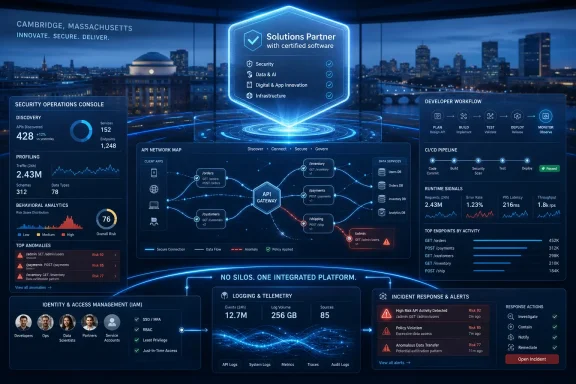
Futuristic cybersecurity dashboard with API network map, security status, and developer workflow panels over a city skyline.The Badge Matters Because the Battlefield Has Moved​

For years, enterprise security teams talked about APIs as if they were plumbing: necessary, messy, and mostly invisible unless something broke. That view no longer survives contact with modern software. APIs are now the product surface, the integration layer, the automation fabric, and increasingly the path through which AI systems fetch, transform, and expose sensitive business data.
That is why Akamai’s Microsoft designation deserves more than the usual shrug reserved for partner-program announcements. Microsoft is not certifying that Akamai will stop every API attack, and Akamai is not suddenly becoming a Microsoft-native security feature. What the designation says is narrower but still important: this software has been positioned, reviewed, and packaged to interoperate with Microsoft cloud environments in a way that matters to enterprise buyers.
That distinction is crucial. Security teams do not buy outcomes from partner catalogs; they buy tools, integrations, contracts, and operational promises. A certification cannot replace due diligence, but it can lower the first barrier in a procurement process increasingly dominated by platform fit.
The market has matured from “Do we need API security?” to “Which API security platform can we actually deploy across the systems we already run?” In Azure-heavy enterprises, that second question is often the one that decides whether a promising security project becomes production reality or dies in a pilot.

Microsoft’s Partner Machine Is Now Part of the Security Supply Chain​

Microsoft’s modern partner program is not the old world of silver and gold badges that mostly signaled training investment and sales alignment. The Microsoft AI Cloud Partner Program is more explicitly tied to measurable partner capability, marketplace readiness, customer traction, and technical review. That makes the badge more consequential, but also more complicated.
For a standard Solutions Partner designation, Microsoft uses a Partner Capability Score that weighs performance, skilling, and customer success. The threshold commonly cited for qualification is 70 points out of 100, with the score designed to reflect whether a partner is growing customers, maintaining relevant expertise, and delivering successful deployments. For certified software designations, Microsoft also emphasizes marketplace readiness, technical review, and evidence of customer success.
That does not mean Microsoft has performed an independent bake-off proving Akamai’s API Security is the best product in its category. It means the product has passed through a Microsoft-defined gate for interoperability and commercial readiness. In enterprise IT, those gates matter because they influence which products Microsoft sellers can co-sell, which products appear lower-risk to procurement teams, and which products are easiest to justify to executives already standardizing around Azure.
The uncomfortable truth is that partner ecosystems have become part of the security supply chain. A tool that integrates cleanly with the dominant cloud platform can spread faster than a technically elegant tool that requires bespoke deployment work. That may be frustrating for purists, but it reflects the reality inside large organizations: integration risk is security risk, operational risk, and budget risk all at once.
The fine print still matters. Microsoft’s certified software language is about interoperability with Microsoft products, not a blanket guarantee of security effectiveness. Akamai remains responsible for the actual performance of its product, and customers remain responsible for testing it against their traffic, their applications, and their risk model. But a narrower claim can still be useful if it answers the first question every CISO gets from the infrastructure team: will this work with what we already have?

API Security Has Outgrown the Gateway​

The old API security playbook was largely built around gateways, authentication, rate limits, and web application firewall rules. Those controls still matter, but they no longer describe the full problem. A modern enterprise may have public APIs, partner APIs, internal microservice APIs, serverless functions, mobile backends, forgotten test endpoints, third-party integrations, and AI-facing data services all changing faster than manual inventories can keep up.
That is the gap Akamai is trying to occupy. Its API Security pitch centers on discovery, profiling, behavioral analysis, and protection across environments. The promise is not just to block obviously malicious requests, but to understand what APIs exist, how they behave, what data they expose, and when something deviates from the expected pattern.
That promise is attractive because many organizations do not actually know how many APIs they operate. The phrase shadow API has become security shorthand for endpoints that exist outside formal governance: old versions left running, undocumented partner integrations, experimental services promoted into production, or internal APIs exposed more broadly than intended. Attackers do not care whether an endpoint appears in a CMDB. They care whether it answers.
This is where Microsoft certification has practical significance. Azure is not merely another hosting option; for many companies it is where identity, application hosting, analytics, developer tooling, DevOps workflows, and security telemetry converge. An API security platform that claims cross-platform visibility but cannot operate smoothly in Azure’s ecosystem will struggle in precisely the accounts where API sprawl is most acute.
The challenge for Akamai is to prove that “cross-platform visibility” is more than a phrase in a press release. Security teams need accurate discovery, low-noise alerting, context for prioritization, and remediation workflows that developers will not ignore. Microsoft’s designation can help Akamai get into the conversation, but only operational evidence will keep it there.

AI Turns API Sprawl Into Business Risk​

The AI angle in Akamai’s announcement is not incidental. AI systems rely on APIs to retrieve data, invoke tools, trigger workflows, connect to business applications, and expose new user experiences. The more enterprises move from chatbots to agentic workflows, the more APIs become the nervous system of AI-enabled operations.
That changes the security equation. A traditional application might expose a limited set of user-driven API calls. An AI-enabled workflow may chain together multiple services, query internal knowledge bases, pass data between systems, and act on behalf of a user or department. Each connection is an opportunity for over-permissioning, broken authorization, unintended data exposure, or business logic abuse.
The problem is not simply that AI creates more API traffic. It creates API traffic that may be harder to predict. If an AI agent can call tools dynamically, security teams must understand not just which endpoints exist, but which combinations of calls are legitimate, which identities are allowed to perform them, and what data should flow through them.
That is why behavioral analytics has become central to API security marketing. Static rules cannot keep up with complex API ecosystems, especially when development teams ship changes continuously. But behavioral systems introduce their own burden: they must distinguish meaningful anomalies from normal product evolution, seasonal business shifts, and noisy internal testing.
The best-case version of Akamai’s Microsoft alignment is that it helps Azure customers bring API discovery and protection closer to the places where applications are built and operated. The worst-case version is that another dashboard gets added to the pile while developers continue to ship new endpoints faster than security can classify them. The difference will come down to integration depth, workflow design, and whether security findings reach the teams that can fix them.

Microsoft Gets a Stronger Marketplace, Akamai Gets a Shorter Sales Cycle​

There is an obvious commercial bargain underneath the security language. Microsoft wants Azure to look like the safest and most complete place to build modern applications, including AI applications. Akamai wants deeper access to Microsoft’s enterprise customer base and a cleaner path through procurement.
Both sides benefit from making API security feel like a platform-adjacent decision rather than a standalone science project. For Microsoft, certified third-party software expands the range of problems Azure customers can solve without leaving the Microsoft commercial orbit. For Akamai, certification helps translate technical capability into buyer confidence.
This is especially important in security, where purchasing decisions are often shaped by fear of integration failure. A CISO may believe API security is necessary, but still face resistance from architecture teams, cloud platform owners, application teams, and finance. A Microsoft-recognized designation does not eliminate those objections, but it gives the buyer a shorter answer when asked why this vendor belongs in an Azure-centered environment.
The co-sell dimension should not be underestimated. Microsoft’s field organization has enormous influence over enterprise buying conversations. Products that fit into Microsoft’s marketplace and partner motions can gain visibility that would be expensive to replicate through traditional sales alone.
That does not make the product better by itself. It makes it easier to encounter, easier to justify, and easier to transact. In enterprise software, those are not small things.

The Self-Attestation Caveat Should Keep Buyers Sober​

The danger in partner designations is that buyers read them as guarantees. They are not. Microsoft’s certified software framing includes technical review and interoperability claims, but it also relies on information from the solution owner and does not substitute for independent security validation.
That should temper the enthusiasm. A certification can indicate that Akamai’s API Security fits Microsoft’s program requirements, but it cannot answer whether the product will discover every API in a particular customer environment, produce tolerable false-positive rates, or integrate cleanly with a company’s incident response process. Those are deployment realities, not badge realities.
Enterprises should treat the designation as a procurement accelerator, not a risk waiver. It belongs in the “this appears compatible with our platform strategy” column, not the “security problem solved” column. The latter requires architecture review, proof-of-concept testing, red-team exercises, and a hard look at operational ownership.
The most useful interpretation is pragmatic. Microsoft’s designation can reduce uncertainty about marketplace availability and Azure interoperability. It cannot reduce the need to define what success means: fewer unknown APIs, faster detection of abuse, clearer data exposure mapping, better developer remediation, or stronger governance across release pipelines.
Security leaders who understand that distinction will get value from the signal without mistaking it for assurance. Those who do not may discover, once again, that buying a control is easier than operating one.

Windows and Azure Shops Will Feel This in the Boring Places First​

For WindowsForum readers, the immediate relevance is not that a Cambridge security vendor received a cloud badge. It is that many Windows-centric organizations are now Azure-centric organizations, whether they planned it that way or arrived there through Microsoft 365, Entra ID, Defender, DevOps, and cloud migration projects.
API risk increasingly shows up in the boring places administrators already manage. Identity permissions, app registrations, service principals, secrets, conditional access policies, logging pipelines, and developer workflows all shape whether an API is defensible. The attack surface is not confined to a web gateway sitting at the network edge.
That makes API security a shared problem across teams that historically worked in separate lanes. AppSec owns code review and testing. Cloud teams own platform configuration. IAM teams own identity boundaries. SOC teams own detection and response. Developers own the services changing every sprint. The API is where all those responsibilities collide.
A certified Akamai product in the Microsoft ecosystem may appeal to organizations trying to reduce that fragmentation. If it can provide inventory and behavioral context across hybrid and cloud environments, it gives security teams a way to talk about API risk in operational terms. If it merely produces another stream of alerts, it will reinforce the same fragmentation it claims to solve.
The Windows angle is therefore organizational rather than desktop-bound. Microsoft’s enterprise stack has become the control plane for vast portions of corporate computing. Any security product that plugs credibly into that control plane has a chance to influence how risks are discovered, prioritized, and fixed.

The Real Test Is Whether Developers Change Behavior​

API security products often succeed or fail at the boundary between security teams and developers. Discovery is useful, but discovery without remediation becomes inventory theater. Detection is useful, but detection without ownership becomes alert fatigue. Posture management is useful, but posture findings must map to code, configuration, or process changes that teams can actually make.
Akamai has been pushing in that direction with posture-oriented API security capabilities and code-to-runtime mapping. The strategic logic is sound. If a platform can connect what exists in production to what developers maintain in source and pipelines, security can shift from scolding teams after deployment to helping them fix patterns earlier.
That is the dream, at least. The hard part is that developers already live under a mountain of tools: CI/CD scanners, dependency alerts, infrastructure-as-code checks, code quality gates, secrets detection, container scanning, and ticket queues. An API security finding has to be specific, prioritized, and credible enough to compete with everything else.
Microsoft integration could help here if it connects API findings to the systems developers and platform teams already use. Azure DevOps, GitHub, Microsoft Defender, Sentinel, Entra ID, and Azure-native logging all represent possible points of workflow gravity. The closer API security gets to those workflows, the more likely it is to influence behavior.
But this is where marketing language often outruns reality. “Single pane of glass” has been promised for decades, and administrators have accumulated enough panes to build a greenhouse. The better standard is not whether Akamai offers one console, but whether it reduces the number of unresolved questions during an incident: what endpoint was hit, who owns it, what data was exposed, what identity was used, and how quickly can it be fixed?

Certification Is a Signal, Not a Settlement​

Akamai’s announcement lands at a moment when API security is being squeezed from two directions. On one side, attackers increasingly understand that APIs expose business logic, identity flows, and sensitive data more directly than traditional web pages. On the other, AI adoption is pushing companies to connect systems faster than governance can comfortably absorb.
That makes third-party validation more valuable, even when it is limited. Buyers are drowning in vendor claims. A Microsoft designation at least says the product has met a defined set of ecosystem requirements. In a crowded category, that may be enough to move Akamai higher on a shortlist.
Still, the most important thing about the certification may be what it says about Microsoft. The company is effectively acknowledging that API security is not a niche add-on but a category that belongs in the cloud marketplace, partner program, and co-sell motion. That is a meaningful shift because Microsoft’s ecosystem often turns emerging operational concerns into standardized enterprise buying patterns.
For Akamai, the opportunity is to use that opening without letting the badge become the story. The company built its reputation on edge delivery and security at scale. API security gives it a way to extend that relevance into cloud-native application architecture, but the market will judge it on visibility, accuracy, remediation, and resilience.
For customers, the right posture is neither cynicism nor blind trust. The designation is worth noticing because interoperability matters. It is not worth worshipping because security outcomes still depend on deployment quality, policy design, and organizational follow-through.

The Procurement Badge Meets the Production Outage​

The most concrete lesson from Akamai’s Microsoft certification is that API security has entered the procurement mainstream. That is progress, but it also means buyers must become more precise about what they expect from the tools they approve.
  • Akamai’s Microsoft designation indicates certified software alignment for API Security within the Microsoft AI Cloud Partner Program, with particular relevance for Azure-centered customers.
  • Microsoft’s certification process signals interoperability and marketplace readiness, but it does not independently guarantee real-world attack prevention.
  • API security is becoming more urgent because AI-enabled applications increase the number, velocity, and complexity of API interactions.
  • Azure-heavy organizations should evaluate whether API security tools integrate with identity, logging, developer workflows, and incident response processes they already use.
  • The practical value of Akamai’s designation will depend on whether customers can turn discovery and behavioral analysis into faster remediation, not merely better dashboards.
The next phase of API security will not be won by the vendor with the most impressive badge wall. It will be won by the platforms that can make invisible software boundaries visible, tie runtime behavior back to accountable teams, and keep pace as AI turns every integration into a potential decision point. Akamai’s Microsoft certification is a useful marker on that road, but the harder journey begins after procurement, when the APIs are live, the agents are calling them, and the business expects the whole system to hold.

References​

  1. Primary source: BriefGlance
    Published: Wed, 10 Jun 2026 12:43:13 GMT
  2. Official source: learn.microsoft.com
  3. Official source: partner.microsoft.com
  4. Related coverage: streetinsider.com
  5. Related coverage: ng.investing.com
  6. Related coverage: akamai.com
  1. Official source: microsoft.com
  2. Official source: microsoft.github.io
  3. Official source: cdn-dynmedia-1.microsoft.com
  4. Related coverage: anda.cl
 

Akamai Technologies said on June 10, 2026, that its Akamai API Security software earned Microsoft’s Solutions Partner with certified software designation for Security within the Microsoft AI Cloud Partner Program, giving the company a Microsoft-recognized badge for API protection in cloud-heavy enterprise environments. The announcement is not a blockbuster product launch, and it does not magically make an API estate safe. But it is a useful marker of where enterprise security buying is moving: toward validated integrations, marketplace procurement, and security tools that can sit beside Microsoft’s cloud stack without forcing every workload into Microsoft’s own product portfolio.

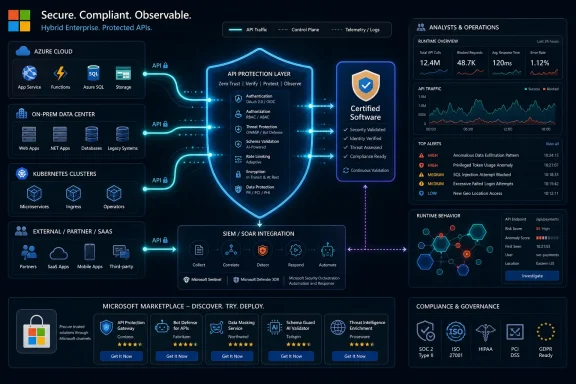
Dashboard showing Azure API security and compliance with traffic monitoring, protection layers, and alerts.Microsoft’s Badge Is Really a Procurement Signal​

The phrase “Solutions Partner with certified software” sounds like channel-program wallpaper, the sort of label that usually lives below the fold on a partner page. In practice, it matters because Microsoft has turned its partner ecosystem into a filtering system for enterprise buyers already committed to Azure, Microsoft 365, Defender, Sentinel, Entra, and the wider Microsoft cloud orbit.
For Akamai, the designation says its API Security offering has met Microsoft’s program requirements for interoperability and software readiness in the Security solution area. That does not mean Microsoft is underwriting every Akamai claim or replacing a customer’s own due diligence. It means Akamai has cleared a Microsoft-defined bar that can make the product easier to justify inside organizations where “does this work with our Microsoft environment?” is often the first procurement question.
That distinction is important. Security buyers are drowning in vendor promises, especially in API security, where discovery, posture management, runtime protection, and testing are frequently bundled into overlapping claims. A Microsoft designation does not settle the market, but it gives Akamai a sharper credential when selling to Microsoft-centric enterprises.
The timing is also telling. Microsoft’s partner program has been steadily reframed around AI and cloud, and security vendors increasingly need to prove that they are not just technically competent but ecosystem-compatible. In that world, certification is less about a framed certificate and more about access to the routes by which software actually gets bought.

API Security Has Become the Soft Underbelly of Cloud Modernization​

APIs used to be treated as plumbing. They connected mobile apps to back ends, partners to services, and microservices to one another. That framing is now dangerously outdated, because APIs have become the public and semi-public control surface of modern software.
Every enterprise cloud migration leaves behind an API map that is rarely as tidy as the architecture diagram. Some APIs are documented and governed. Some are forgotten. Some were spun up for a partner integration, a mobile app, a data pipeline, a proof of concept, or an internal tool that quietly became production. Attackers do not care which bucket an API falls into; they care whether it exposes useful data or business logic.
This is why API security has become a more serious boardroom issue. Traditional web application firewalls can help, but they were not designed to understand every business workflow exposed through APIs. Identity controls help, but they do not automatically detect excessive data exposure, shadow endpoints, broken object-level authorization, or logic flaws that look legitimate to a generic perimeter tool.
Akamai’s pitch is that API security needs lifecycle coverage: discovery, posture management, runtime protection, and testing. That is the right vocabulary for the problem. The hard part, as always, is execution inside messy real-world estates where APIs span Azure, other clouds, on-premises systems, SaaS platforms, gateways, load balancers, and application stacks owned by different teams.

Akamai Is No Longer Just the CDN Company​

For longtime infrastructure watchers, Akamai still carries the mental label of “content delivery network.” That label is now too small. The company has spent years broadening from edge delivery into security, cloud computing, segmentation, application protection, and now increasingly AI-adjacent infrastructure.
The API security push fits that broader strategy. Akamai acquired Noname Security in 2024, a deal that strengthened its position in API discovery and protection at a time when customers were asking for visibility across sprawling estates. The Microsoft designation gives that expanded portfolio a more formal place inside the Microsoft ecosystem.
This is not merely branding. Akamai’s core historical advantage has been its distributed network and its proximity to internet traffic. API security, especially runtime protection and anomaly detection, benefits from visibility. The more places a provider can observe traffic and integrate with enforcement points, the more credible its argument becomes.
Still, Akamai faces a crowded field. API security has attracted specialist vendors, cloud-native security platforms, application security companies, gateway providers, and the hyperscalers themselves. Microsoft’s certification does not remove that competition. It gives Akamai a better seat at the table when the buyer is already organizing its security architecture around Microsoft Cloud.

Microsoft Wins Even When the Product Is Not Microsoft’s​

The more interesting strategic angle may be Microsoft’s. By certifying partner software, Microsoft can make Azure and Microsoft Marketplace feel like safer places to buy third-party security tools. That matters because Microsoft cannot realistically build or dominate every niche of security, even if its own security portfolio is enormous.
The Microsoft AI Cloud Partner Program gives Microsoft a way to shape the ecosystem around its platforms. If customers want specialist tools, Microsoft would rather those tools integrate well with Microsoft Cloud, transact through Microsoft channels, and reinforce Azure as the default enterprise operating environment. In that sense, partner certification is both customer assurance and platform gravity.
For IT departments, this can be convenient. Marketplace procurement can simplify purchasing, private offers can align with existing cloud commitments, and certified software can reduce the friction of internal security reviews. For vendors, the upside is obvious: Microsoft’s ecosystem is where many enterprise deals now move.
The trade-off is that Microsoft’s partner labels can blur in the eyes of buyers. “Certified software” sounds reassuring, but it is not the same as an independent security audit of a customer’s implementation, nor is it a guarantee of outcomes. It is a program designation, not a magic shield.

Azure Compatibility Is Necessary, Not Sufficient​

Akamai’s announcement emphasizes cross-platform visibility and protection for customers using environments such as Microsoft Azure. That phrase is doing a lot of work. Most large organizations are not purely Azure, purely AWS, purely Google Cloud, or purely on-premises. They are hybrid by history, by acquisition, by regulatory constraint, and sometimes by accident.
That is exactly why API security is difficult. The exposed API surface is not limited to the cloud provider console. It may include developer-created endpoints, partner-facing interfaces, legacy application gateways, Kubernetes ingress controllers, SaaS integrations, and internal APIs that were never meant to be discoverable outside a narrow context.
If Akamai can help customers discover and classify those APIs without requiring a disruptive architecture change, the Microsoft certification becomes more meaningful. It says the product can participate in Microsoft-centric operations while still acknowledging the heterogeneous reality of enterprise infrastructure.
But buyers should resist the temptation to treat certification as a substitute for architectural fit. The real questions remain stubbornly practical: Which traffic sources can the product ingest? Which gateways and WAFs can it integrate with? How does it handle encrypted traffic? How noisy are its findings? How quickly can developers act on its recommendations? How does it separate exploitable risk from inventory trivia?

The AI Boom Makes API Sprawl Worse​

The announcement lands in the middle of a larger shift: AI systems are creating new pressure on APIs. Agents, copilots, retrieval systems, internal automation tools, and data connectors all rely on APIs to act on behalf of users and applications. The more organizations wire AI into business workflows, the more API governance becomes a security requirement rather than a developer preference.
This is where the phrase AI Cloud Partner Program becomes more than Microsoft branding. AI adoption depends on controlled access to data and services. APIs are the access layer. If that layer is poorly inventoried or inconsistently authorized, AI systems can amplify existing weaknesses by making more calls, connecting more systems, and automating more actions.
That does not mean every AI deployment is an API breach waiting to happen. It means that AI raises the cost of sloppy API management. A forgotten endpoint that once required a human to find and misuse may become part of an automated chain of tools. A permissive internal API may become a data leakage path when connected to a chatbot or agent workflow.
Akamai’s certification should be read against that backdrop. The company is not just selling protection for today’s mobile and web APIs. It is positioning API security as a foundation for the next generation of automated, AI-mediated enterprise software.

The Real Buyer Is the Security Team That Cannot See Everything​

The most compelling audience for Akamai’s API Security product is not the team that already has perfect API documentation. That team barely exists. The real buyer is the security organization that suspects it has far more APIs than it can currently see, and that knows attackers are increasingly adept at finding the gaps.
For those teams, discovery is often the first win. You cannot protect an API you do not know exists, and you cannot prioritize risk without understanding authentication, data exposure, endpoint behavior, and business context. An API inventory that is continuously updated is more valuable than a one-time spreadsheet assembled for an audit.
Runtime visibility is the second challenge. Many API problems are not obvious from static configuration alone. A technically authenticated request can still be abusive. A legitimate endpoint can still leak too much information. A normal-looking workflow can still be exploited if object-level authorization is broken.
This is why API security tools are trying to move beyond simple gateway policy checks. They need to understand behavior, schema drift, sensitive data movement, and deviations from expected patterns. That is also why integration with the rest of the security stack matters: findings need to flow into SIEMs, SOAR tools, ticketing systems, developer workflows, and incident response processes.

Certification Will Not Fix Security Tool Fatigue​

There is a risk, however, that another certified product becomes another dashboard. Security teams already face tool sprawl: endpoint security, identity protection, cloud posture management, workload protection, vulnerability management, application security testing, WAFs, SIEMs, SOAR platforms, and now API-specific tools.
Akamai’s challenge is to prove that API security is not simply another console but an operational capability. The difference is whether findings lead to action. A product that discovers 5,000 APIs but cannot help teams prioritize the 50 most dangerous ones will quickly become shelfware with better graphs.
Microsoft certification helps with trust and procurement, but operational adoption is earned after purchase. Security teams will judge the software by signal quality, integration depth, and whether developers can remediate issues without weeks of translation between security and engineering.
This is where the market is maturing. Buyers are less impressed by giant inventories and more interested in risk reduction. They want to know which APIs expose regulated data, which are unauthenticated, which changed unexpectedly, which violate policy, and which are actively being probed. The vendor that answers those questions cleanly wins more than the vendor with the longest feature checklist.

Windows and Microsoft Shops Should Read This as an Ecosystem Move​

For WindowsForum readers, the Microsoft angle matters because many organizations still experience cloud security through the Microsoft stack. Defender, Sentinel, Entra, Intune, Microsoft 365, Azure, and Windows Server form the daily operating environment for countless administrators. A third-party security product with Microsoft certification has a better chance of fitting into that world without becoming an exotic exception.
That does not mean Windows administrators will suddenly manage Akamai API Security the way they manage Group Policy or Defender for Endpoint. The audiences are different. But the procurement and integration pathways increasingly overlap, especially in enterprises where Azure Marketplace and Microsoft partner designations influence approved vendor lists.
This also reflects a broader truth about Microsoft’s security strategy. Microsoft wants its cloud to be the control plane, even when the underlying security function is delivered by a partner. The more certified tools orbit Microsoft Cloud, the easier it becomes for customers to stay inside Microsoft’s commercial ecosystem while still buying specialized products.
For administrators, that can be both useful and limiting. Useful, because fewer unsupported integrations mean less operational pain. Limiting, because ecosystem gravity can narrow the range of tools that get serious consideration. The best security architecture should be chosen on technical fit, not merely on marketplace convenience.

The Marketplace Is Becoming the New Security Channel​

Enterprise software used to move through long direct-sales cycles, reseller relationships, and bespoke procurement processes. Those still exist, but cloud marketplaces have changed the mechanics. A product listed in Microsoft Marketplace can be evaluated, purchased, and governed through processes many enterprises already use for cloud services.
That is why these designations matter more than they first appear. They are not just marketing badges; they are part of the machinery that turns a vendor into an easier purchase. For a security startup or specialist vendor, marketplace credibility can shorten the distance between interest and deployment. For a larger company like Akamai, it reinforces relevance inside accounts where Microsoft is already strategic.
This trend also shifts power toward the hyperscalers. If the most efficient way to buy security software is through Microsoft, AWS, or Google marketplaces, then those platforms become gatekeepers of enterprise security distribution. Vendors gain reach, but they also become more dependent on platform rules, incentives, and partner economics.
Customers should welcome easier procurement while remaining alert to lock-in by habit. The simplest buying path is not always the best architectural decision. Marketplace availability should start the evaluation, not end it.

Akamai’s Strongest Argument Is That API Security Has Outgrown the Gateway​

API gateways remain important. They help publish, route, authenticate, throttle, and monitor API traffic. But gateways are not the whole estate, and gateway-native controls are not always enough. In many organizations, multiple gateways coexist with direct service exposure, legacy middleware, cloud-native ingress, and partner-managed interfaces.
Akamai’s API Security pitch is strongest when it acknowledges that reality. If a security tool can discover APIs across environments, assess their posture, detect suspicious behavior at runtime, and feed remediation back into development and operations, it is addressing a problem that gateways alone cannot solve.
The challenge is proving coverage. API security vendors often claim broad visibility, but real deployments expose edge cases quickly. Encrypted traffic, proprietary protocols, high-volume environments, regional compliance requirements, and fragmented ownership can all complicate the neat product story.
This is where buyers should run pilots against their own messiest environments, not against a clean demo app. A certified product may be easier to approve, but only a realistic proof of value will show whether it can handle the organization’s actual API estate.

The Investor Headline Is Less Interesting Than the Security Signal​

The original Investing.com framing naturally ties the announcement to Akamai as a public company. That is fair enough; Akamai trades on Nasdaq, and security growth is part of the company’s broader investor narrative. But the more durable story is not a one-day market reaction.
The durable story is that API security is being normalized as a core enterprise control. It is moving from specialist concern to mainstream procurement category. Microsoft’s certification of Akamai’s software is one more sign that API protection is no longer an optional add-on for companies exposing digital services.
This is especially relevant for regulated industries, large retailers, financial services, healthcare, media, and any business with partner ecosystems. APIs carry customer data, payment flows, identity assertions, operational commands, and analytics pipelines. A breach through an API can look less like a spectacular exploit and more like a quiet abuse of intended functionality.
That quietness is what makes API security so uncomfortable. Many failures are not crashes or malware events. They are authorization mistakes, excessive data returns, undocumented endpoints, or workflows that trust the caller too much. Those are exactly the kinds of problems that require persistent visibility rather than periodic compliance theater.

The Microsoft-Akamai Signal, Stripped of the Marketing​

Akamai’s certification is useful, but it should be interpreted with precision. It is neither a revolutionary new product nor a trivial press-release flourish. It is a sign that API security has become important enough for Microsoft’s partner machinery to validate and promote specialized software in the category.
For practical buyers, the announcement should prompt a disciplined evaluation rather than a reflexive purchase. The most concrete lessons are straightforward:
  • Akamai API Security has received Microsoft’s Solutions Partner with certified software designation for Security within the Microsoft AI Cloud Partner Program.
  • The designation indicates Microsoft-recognized interoperability and program compliance, but it does not replace customer testing, security validation, or implementation review.
  • The certification is most relevant to organizations that already use Microsoft Cloud services and want third-party API protection that fits more easily into that ecosystem.
  • API security is becoming more urgent as enterprises expand cloud services, partner integrations, mobile applications, microservices, and AI-driven workflows.
  • Buyers should evaluate Akamai’s product on discovery coverage, runtime signal quality, remediation workflows, and integration with existing security operations rather than on certification alone.
The headline, then, is not that Akamai received a badge. The headline is that API security has become part of the certified cloud-security supply chain. Microsoft is blessing more of the ecosystem around its platforms, Akamai is sharpening its security identity beyond CDN roots, and enterprise buyers are being nudged toward a model where interoperability, marketplace access, and operational proof matter as much as raw feature claims. The next phase will be less about who can say “API security” most loudly and more about who can show, inside production environments, that they can find the APIs nobody owns before attackers do.

References​

  1. Primary source: investing.com
    Published: 2026-06-10T11:30:12.556522
  2. Related coverage: akamai.com
  3. Official source: azuremarketplace.microsoft.com
  4. Related coverage: it.investing.com
  5. Related coverage: ms.investing.com
  6. Related coverage: tr.investing.com
  1. Related coverage: il.investing.com
  2. Official source: azure.microsoft.com
  3. Related coverage: jp.investing.com
  4. Related coverage: ad-hoc-news.de
  5. Official source: marketplace.microsoft.com
  6. Related coverage: ir.akamai.com
  7. Official source: partner.microsoft.com
  8. Official source: learn.microsoft.com
  9. Official source: microsoft.com
  10. Official source: blogs.microsoft.com
  11. Official source: devicepartner.microsoft.com
  12. Related coverage: itpro.com
  13. Official source: cdn-dynmedia-1.microsoft.com
  14. Related coverage: gadesoft.com
 

Akamai said on June 10, 2026, in Cambridge, Massachusetts, that its API Security product has earned Microsoft’s Solutions Partner with certified software designation for API Security within the Microsoft AI Cloud Partner Program, adding Azure-marketplace credibility to Akamai’s cross-cloud security pitch. The announcement is not a product launch, and it is not Microsoft blessing Akamai as the only answer to API risk. It is more interesting than that: a sign that API security has moved from specialist tooling into the cloud-platform procurement machine. For WindowsForum readers, the story is less about a badge and more about how Microsoft’s ecosystem is absorbing another layer of security control that enterprises can no longer treat as optional.

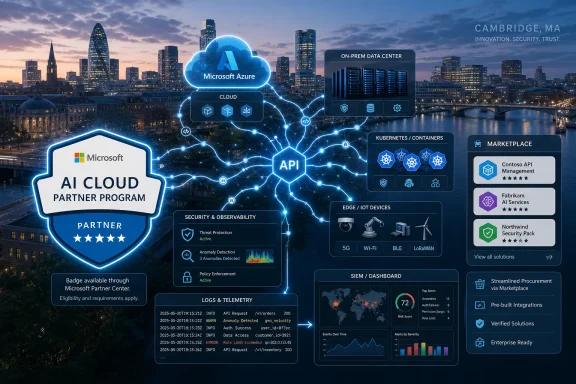
Microsoft Azure AI cloud network graphic over a Cambridge, MA city skyline with server, API, and security panels.Microsoft’s Badge Turns API Security Into a Procurement Argument​

The old way to sell API security was to scare the application team, persuade the security team, and then survive a procurement cycle full of architecture exceptions. The new way is to show up inside the Microsoft partner economy with language that sounds familiar to Azure buyers: interoperability, marketplace availability, customer success, and certified software.
That is the practical meaning of Akamai’s new designation. It gives Akamai API Security a Microsoft-aligned credential at the moment when many enterprises are trying to rationalize tool sprawl without pretending their applications all live in one cloud. For a company best known historically for content delivery, edge security, and distributed infrastructure, the badge helps frame API protection as part of mainstream cloud operations rather than a niche add-on.
Microsoft’s partner designations are not neutral decorations. They are commercial instruments, designed to tell customers which products and vendors can fit into Microsoft Cloud buying patterns. That matters because a security tool that is easier to buy, justify, and deploy through existing Microsoft channels has a lower barrier to entry than one that requires a fresh vendor-risk debate every time.
But the badge should not be mistaken for a magic seal of effectiveness. Microsoft’s own program language makes clear that certified software status is about interoperability with Microsoft products and program criteria, not a blanket endorsement that a product will catch every threat or solve every governance failure. That distinction is not fine print for lawyers; it is the central tension in this announcement.

The API Problem Outgrew the Gateway​

APIs used to be described as plumbing. That metaphor was always too gentle. In modern cloud estates, APIs are the exposed nervous system of the business: authentication flows, payment systems, partner integrations, mobile apps, internal automation, customer data, telemetry, and increasingly AI-driven workflows all depend on them.
The security problem is that APIs multiply faster than security inventories. Developers publish endpoints, teams split monoliths, mobile apps change, partners need access, and internal services become externalized under deadline pressure. A gateway may control some traffic, but it rarely tells the whole story. Shadow APIs, zombie endpoints, undocumented parameters, excessive permissions, and business-logic abuse often live outside the neat diagrams shown in architecture reviews.
Akamai’s pitch for API Security lands squarely in that gap. The company presents the product as a way to discover APIs, assess risk, monitor behavior, and respond to abuse across environments. That “across environments” phrasing is the important part for Azure customers, because the real world is messy: Azure may be the strategic cloud, but workloads often span legacy data centers, SaaS platforms, Kubernetes clusters, edge networks, and other public clouds.
This is why API security has become a board-level and CISO-level subject rather than just an application-security control. The risk is not merely that an endpoint has a bug. The risk is that an organization does not know which endpoints exist, what data they expose, who is using them, and whether normal-looking API calls are being used to drain value from the business.

AI Makes the Old Inventory Problem More Dangerous​

Akamai’s announcement leans into AI, and for once the AI angle is not just marketing glitter. The rise of AI-powered applications and agents increases the number of automated interactions between systems. It also increases the incentives for attackers to probe APIs at scale, chain legitimate calls in abusive ways, and exploit weak assumptions in workflows that were never designed for autonomous clients.
This does not mean every API security incident is now an “AI threat.” Most API failures remain depressingly familiar: broken object-level authorization, weak authentication, overexposed data, missing rate limits, poor logging, and endpoints that nobody remembered to retire. What AI changes is the speed and volume of abuse, and the number of legitimate-looking requests that can be generated with minimal human effort.
That puts pressure on security products to do more than validate schemas or block obvious attack strings. Behavioral analysis, discovery, anomaly detection, and context become more valuable when malicious activity can resemble normal usage. The hard part is separating clever marketing from operational usefulness, because every vendor now claims to see patterns and stop abuse.
For Microsoft-centric shops, the uncomfortable truth is that Azure-native controls are necessary but not always sufficient. Azure API Management, Defender services, Entra identity controls, logging, and policy enforcement all matter. Yet many organizations need visibility beyond a single gateway or subscription boundary, especially when acquisitions, hybrid architectures, and third-party integrations have left them with a sprawling API estate.

Akamai Wants to Be More Than the Edge Company​

Akamai has spent years expanding the definition of what it sells. The company is still associated with content delivery and edge scale, but its modern portfolio increasingly emphasizes security and cloud computing. API Security fits that repositioning because it connects Akamai’s historical strengths — traffic visibility, distributed infrastructure, and threat intelligence — with a fast-growing enterprise pain point.
The Microsoft designation helps Akamai tell a different story to Azure customers. Instead of arriving as an outside edge vendor bolted onto a Microsoft architecture, Akamai can point to certified software status and marketplace availability as evidence that its API security layer can coexist with Azure-native workloads. That does not erase integration work, but it changes the first conversation.
There is also a competitive subtext. API security is crowded, with cloud providers, application security vendors, WAAP platforms, API gateways, CNAPP vendors, and specialist startups all claiming slices of the problem. A Microsoft partner designation gives Akamai a procurement-friendly credential in a market where buyers are overwhelmed by overlapping acronyms.
This is why the announcement matters even if it does not include a dramatic new feature. Enterprise security markets are often shaped by trust signals long before they are shaped by technical shootouts. A product that arrives with a familiar partner designation, appears in a marketplace, and maps to a platform strategy can get evaluated sooner than a technically elegant tool that sits outside the approved purchasing lane.

The Fine Print Is the Most Honest Part of the Announcement​

The press release includes unusually important caveats. Microsoft’s designation should not be interpreted as an endorsement, guarantee, proof of effectiveness, warranty, or commitment. The certification is specific to interoperability with Microsoft products and is based on self-attestation by the solution owner.
That is not a reason to dismiss the designation. It is a reason to understand it correctly. Interoperability matters, especially in enterprises where a security product must integrate with identity systems, cloud platforms, logging pipelines, deployment workflows, and procurement controls. But interoperability is not the same thing as security efficacy.
A product can be well integrated and still poorly deployed. It can pass program criteria and still miss risks if telemetry is incomplete. It can be listed in a marketplace and still require careful policy design, tuning, ownership, and incident response planning. The badge helps answer “Can this fit into our Microsoft-oriented environment?” It does not answer “Have we governed our APIs properly?”
That distinction should appeal to serious IT pros, because it cuts through both vendor triumphalism and reflexive cynicism. Microsoft’s ecosystem stamp is commercially meaningful. Akamai’s API security capabilities may be valuable. Neither fact excuses customers from doing architecture review, data-flow mapping, proof-of-concept testing, and operational planning.

Azure Customers Need Cross-Platform Visibility, Not Another Console​

The most persuasive line in Akamai’s announcement is not the executive quote. It is the claim that the certified software solution provides cross-platform visibility and security for customers using environments such as Microsoft Azure. That phrase names the actual enterprise problem: Azure is important, but it is rarely alone.
Many organizations say they are “an Azure shop” because Entra ID, Microsoft 365, Intune, Defender, Sentinel, and Azure infrastructure form the center of gravity. Then the application inventory tells another story. There are SaaS backends, partner APIs, legacy systems, container platforms, third-party gateways, cloud functions, private endpoints, and public-facing services that predate the current architecture strategy.
In that environment, the API security product that wins is not necessarily the one with the prettiest dashboard. It is the one that can discover what exists, correlate activity across boundaries, and feed useful signals into the systems teams already use. For Windows-heavy enterprises, that often means integration with Microsoft identity, logging, ticketing, and security operations workflows.
The danger is console fatigue. Security teams do not need another pane of glass that becomes a pane of guilt. They need API findings that can be prioritized, assigned, remediated, and verified. If Akamai’s Microsoft designation helps customers deploy the tool more cleanly into Azure-centric operations, it will have practical value. If it merely adds another procurement-approved dashboard, the value will be thinner.

The Marketplace Is Becoming the New Security Perimeter​

Microsoft’s cloud marketplace is not just a catalog. It is increasingly part of how enterprise software becomes acceptable. Marketplace listings can simplify purchasing, align billing, support private offers, and help customers keep vendor acquisition inside existing governance structures. That has obvious appeal for Microsoft, but it also benefits vendors that want to ride the Azure procurement rail.
For security vendors, this shift is profound. The perimeter used to be a network concept. Then it became an identity concept. Now, in a very corporate but very real sense, the perimeter is also a procurement and integration concept: which products can enter the environment without months of exception handling?
Akamai’s presence in Microsoft’s marketplace ecosystem does not mean customers will deploy it automatically. It means the path from interest to trial to purchase may be shorter for Azure-aligned organizations. That matters in API security because delayed visibility is itself a risk. You cannot protect endpoints you do not know exist, and you cannot govern traffic you cannot see.
The counterargument is that marketplace convenience can make buyers lazy. A familiar cloud storefront and a partner badge can reduce friction, but they can also create false comfort. The responsible approach is to treat marketplace availability as the beginning of due diligence, not the end of it.

For Sysadmins, the Risk Is Ownership Drift​

API security often falls into an organizational gap. Developers build APIs, cloud teams host them, security teams monitor them, identity teams govern access, and operations teams get paged when something breaks. Everyone owns a slice. Nobody owns the whole risk.
That is where tools like Akamai API Security can either help or disappoint. Discovery and monitoring are valuable only if they lead to ownership. An alert that says an undocumented API is exposing sensitive data must land with a team that can identify the service, assess business impact, and make a change without triggering an outage.
WindowsForum’s sysadmin audience will recognize the pattern. It is the same story that played out with endpoint management, identity hygiene, certificate sprawl, and SaaS administration. The technology surfaces the mess; the organization still has to clean it up.
The Microsoft angle may help because many enterprises already organize operational workflows around Microsoft systems. If API security findings can be connected into Sentinel, Defender workflows, Entra context, Azure resource ownership, or existing ITSM processes, they have a better chance of becoming action rather than background noise. The badge does not guarantee those integrations will be mature in every environment, but it improves the odds that customers will ask the right integration questions up front.

Security Buyers Should Read “Certified” With Both Eyes Open​

The word “certified” does a lot of work in enterprise technology. It suggests maturity, review, and reduced risk. It can also blur important distinctions, especially when the certification is tied to interoperability and program requirements rather than independent adversarial testing.
Microsoft’s own caveats are blunt enough to be useful. The certification is specific to interoperability with Microsoft products. It is based on self-attestation by the solution owner. Functionality remains controlled by the vendor and can change. Microsoft is not promising that the product will meet every customer’s needs or prove effective in every deployment.
That should shape how buyers evaluate Akamai API Security. The right proof of concept should not merely confirm that the product can be purchased through a marketplace or connected to an Azure environment. It should test whether Akamai discovers the APIs the organization already knows about, finds the ones it does not, produces useful risk rankings, and fits into incident response without drowning analysts in noise.
The best question is not “Did Microsoft certify it?” The better question is “What exactly did the designation validate, and what do we still need to validate ourselves?” That is the difference between using partner programs intelligently and outsourcing judgment to a logo.

The Competitive Field Will Now Tilt Toward Ecosystem Trust​

API security vendors have spent years arguing about depth: who has better discovery, better behavioral analytics, better runtime protection, better posture management, better developer workflows. Those arguments still matter. But the next phase of the market will also be about ecosystem trust.
Microsoft, AWS, Google Cloud, Cloudflare, Akamai, Palo Alto Networks, F5, Imperva, Salt Security, Noname lineage, and other players are all pushing variations of the same promise: visibility and protection across APIs that are too numerous and too dynamic for manual governance. The technical differences are real, but buyers increasingly ask a more immediate question: which product fits the platform strategy we already have?
Akamai’s Microsoft designation gives it an answer for Azure-oriented customers. It says, in effect, that Akamai API Security is not an alien object in a Microsoft cloud program. That is useful, especially for enterprises that want third-party security depth without abandoning Microsoft’s operational center of gravity.
Still, ecosystem trust can cut both ways. A vendor too closely framed around one cloud may struggle in heterogeneous estates. A vendor too proudly independent may struggle with procurement. Akamai’s challenge is to use Microsoft alignment as an accelerant without losing the cross-platform credibility that makes its API security pitch attractive in the first place.

The Real Test Comes After the Badge Is Added to the Slide Deck​

The announcement gives Akamai a stronger Microsoft-facing story, but customers should turn the news into a practical evaluation plan rather than a congratulatory note. API security is too operationally sensitive to buy on partner status alone, and too urgent to postpone until after the next incident.
A disciplined buyer should leave this announcement with a short list of concrete checks:
  • The designation confirms Akamai API Security has met Microsoft program requirements for certified software, but it should not be treated as a Microsoft guarantee of security effectiveness.
  • Azure customers should test whether Akamai can discover APIs across real hybrid environments, not just the cleanest Azure workloads in a pilot.
  • Security teams should validate how Akamai findings flow into existing Microsoft-oriented operations, including identity context, SIEM workflows, incident response, and ticket ownership.
  • Application teams should use the evaluation to identify undocumented, duplicated, or abandoned APIs that normal gateway reviews may have missed.
  • Procurement teams should treat marketplace availability as a way to reduce friction, not as a substitute for architecture, privacy, and vendor-risk review.
  • Executives should understand that API security is now part of AI-era risk management, because automated clients and agentic workflows increase the cost of weak visibility.
The most significant thing about Akamai’s Microsoft designation is not that another security vendor earned another partner badge. It is that API security is being pulled deeper into the machinery of cloud platforms, marketplaces, and enterprise governance. That will make some deployments easier and some marketing louder, but it will also force a healthier conversation: APIs are no longer hidden plumbing, and protecting them now belongs in the same strategic category as identity, endpoint, and cloud posture. For Azure-heavy organizations, Akamai’s new status is a useful signal — but the real winners will be the teams that use it as a prompt to inventory, test, integrate, and govern the API layer before attackers and autonomous software do it for them.

References​

  1. Primary source: Investing News Network
    Published: 2026-06-10T14:30:09.654947
  2. Related coverage: akamai.com
  3. Official source: partner.microsoft.com
  4. Official source: learn.microsoft.com
  5. Official source: azuremarketplace.microsoft.com
  6. Related coverage: investing.com
  1. Related coverage: ad-hoc-news.de
  2. Official source: microsoft.com
  3. Related coverage: it.investing.com
  4. Related coverage: itpro.com
 

Back
Top