

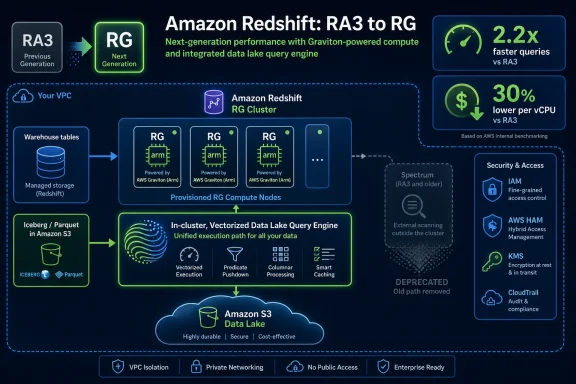
Amazon Web Services launched Amazon Redshift RG instances on May 12, 2026, bringing Graviton-powered provisioned clusters to its cloud data warehouse with claimed gains of up to 2.2 times over RA3 for warehouse workloads and lower per-vCPU pricing. The important part is not just the processor swap. AWS is also collapsing a long-standing boundary between Redshift’s warehouse engine and its data lake query path. For customers with serious Redshift estates, RG is less a routine instance refresh than a pricing, architecture, and procurement nudge all at once.
Cloud vendors love a clean benchmark number, and AWS has supplied several. RG instances are advertised as up to 2.2 times as fast as RA3 for conventional Redshift Managed Storage warehouse workloads, up to 2.4 times as fast for Apache Iceberg queries, and up to 1.5 times as fast for Apache Parquet workloads. They are also pitched at 30 percent lower price per vCPU than RA3.
That is the simple version, and it will make a tidy slide in many cost-optimization decks. But the more interesting change is that Redshift’s data lake work no longer needs to be pushed through the old Redshift Spectrum scanning fleet in the same way. RG instances include an integrated, vectorized data lake query engine that runs on the cluster nodes themselves.
That matters because Redshift Spectrum has always been both a feature and a tax. It let Redshift users query data in Amazon S3 without loading it into warehouse tables, which was useful and often strategically important. But it also came with a separate per-terabyte scan charge that made “just query the lake” less simple than it sounded once teams started running frequent exploratory or production analytics across large open-format datasets.
With RG, AWS is trying to make the hybrid warehouse-and-lake story feel less bolted together. SQL queries can still span managed Redshift tables and data in S3, but the economics and execution model change. The data lake is no longer just somewhere Redshift can reach; it becomes something the cluster is expected to process directly.
Redshift is a particularly meaningful place to extend that strategy. Data warehouses are expensive, sticky, and visible on the bill. They also sit close to executive dashboards, finance reporting, fraud systems, recommendation workloads, and the messy middle of enterprise analytics. If AWS can make Redshift cheaper and faster without forcing application rewrites, it strengthens one of the services most directly exposed to competition from Snowflake, Databricks, BigQuery, and Microsoft Fabric.
But the processor is not the whole story. A raw Arm migration in a managed warehouse would be useful, but not transformative. The architectural shift is that AWS is pairing Graviton with a native data lake execution path that removes Spectrum’s per-TB scan fee for the workloads RG handles through the integrated engine.
That changes the buying conversation. AWS is not only saying, “Here is a cheaper node.” It is saying, “Here is a cheaper node, a faster node, and a way to remove a line item that may have made your lake queries unpredictable.” For many IT teams, the third claim is the one that will get the most attention.
The bridge, however, had a toll. A $5-per-terabyte scanning charge is easy to understand but difficult to ignore at scale. It encourages engineering teams to partition data aggressively, convert files into columnar formats, prune columns, and think carefully before letting analysts run broad exploratory queries. Those are good habits, but they are also signs of a product boundary pushing back on user behavior.
RG does not eliminate the need for disciplined data layout. Badly partitioned data and sloppy query patterns can still waste compute, even if the meter changes. But by moving the data lake query engine onto the Redshift cluster nodes, AWS is making the cost model feel more like provisioned warehouse consumption and less like a hybrid of warehouse time plus scan-meter anxiety.
That is a subtle but important shift. In enterprise IT, predictability often matters as much as raw price. A monthly bill that is a little higher but explainable can be easier to defend than one that swings because a team queried a large S3 dataset more often than expected. AWS is clearly aware that data lake economics have become a boardroom issue, not merely a data engineering concern.
Iceberg has become one of the central table formats in the modern data lakehouse fight. It gives large analytical datasets table-like behavior over object storage, including schema evolution, partition evolution, snapshot isolation, and time travel capabilities. It is one of the formats around which vendors are trying to define the next durable layer of enterprise analytics.
By calling out Iceberg so prominently, AWS is doing more than adding format support. It is signaling that Redshift wants to remain relevant in a world where the “warehouse” is no longer the only home of structured analytical data. Customers increasingly want open table formats in S3 to serve multiple engines, including Spark, Flink, Trino, Athena, Redshift, and commercial platforms outside AWS.
That puts pressure on Redshift. If the warehouse cannot query those datasets quickly and economically, it risks becoming another specialized silo beside the lakehouse rather than the control plane for analytics. RG is AWS’s attempt to make Redshift feel native to that open-format world without conceding the customer relationship to another query engine.
Parquet also gets a performance claim, but Parquet is table stakes now. Iceberg is where the strategic contest is happening. AWS wants Redshift to be seen not merely as a classic MPP warehouse, but as an engine that can sit comfortably over managed warehouse storage and open data lake tables.
Data warehouses accumulate institutional sediment. Queries live in BI tools, notebooks, scheduled jobs, orchestration platforms, stored procedures, and half-forgotten scripts owned by teams that reorganized two years ago. A migration that requires broad SQL rewrites is not a migration; it is a political campaign.
The ability to move from RA3 to RG through Elastic Resize with a reported 10 to 15 minutes of downtime will appeal to teams that can tolerate a short maintenance window. Snapshot and Restore offers a more conservative path for those that want a parallel environment, more validation, or a rollback strategy. Both paths acknowledge the same reality: database migrations are less about clicking a button than preserving trust.
Still, “no code change” should not be mistaken for “no work.” Sensible teams will benchmark their own workloads, compare query plans, validate IAM behavior, examine monitoring differences, and test the behavior of external schemas under real concurrency. Data warehouse users are notoriously good at discovering edge cases that vendor benchmarks do not feature.
The claim is best read as a reduction in migration friction, not a guarantee of instant success. That is still valuable. In cloud infrastructure, the difference between “we need to rewrite applications” and “we need to schedule validation and resize” can determine whether a project happens this quarter or gets buried in next year’s roadmap.
The old Spectrum model involved a separate scanning fleet. That did not make it insecure by default, but it did create another conceptual component for architects to understand, document, and explain during reviews. When data processing happens on the Redshift cluster nodes themselves, the story becomes cleaner: the cluster performs the query, IAM controls access, and traffic stays within the expected network boundary.
Security teams like simple diagrams. They like fewer arrows crossing service boundaries. They like being able to explain which principal can access which bucket, from which network path, and under which policy. RG’s integrated engine gives AWS a stronger story for customers who were already comfortable with Redshift clusters but cautious about broad S3 analytics.
The practical benefit will vary by organization. Some customers already had mature governance around Spectrum and will see this as an incremental improvement. Others may find that the new architecture removes objections that previously slowed lakehouse adoption inside Redshift.
This is where performance, cost, and compliance intersect. A faster query engine is useful. A cheaper cost model is useful. But an architecture that is easier to approve can be the difference between a pilot and a production rollout.
RG fits that defensive evolution. AWS does not want customers to conclude that Redshift is where curated relational data goes, while S3 and open table formats belong to some other strategic engine. That split would leave Redshift exposed as a legacy reporting layer while higher-growth workloads move elsewhere.
The integrated data lake query engine helps AWS argue that Redshift can be both. It can run traditional warehouse workloads over managed storage, and it can query open data in S3 without the same Spectrum-era cost penalty. That does not make Redshift identical to Databricks or Athena or Snowflake, but it narrows one of the obvious gaps in the customer conversation.
The move is also an answer to procurement fatigue. Enterprises do not want every new data architecture pattern to require a new platform contract, a new governance model, and a new skills base. If Redshift can cover more lakehouse-style workloads with better economics, AWS gives existing customers a reason to expand inside the service rather than shop outside it.
That is the strategic center of RG. It is not merely about making Redshift faster. It is about making Redshift harder to displace.
For organizations with heavy Spectrum usage, the removal of per-terabyte scan charges for RG’s integrated lake queries may be more meaningful than the vCPU discount. For warehouse-heavy customers with little S3 querying, the performance-per-dollar calculation may hinge on whether the advertised gains show up in their real workloads. For customers with existing Reserved Instances, the timing of migration may be governed as much by finance as by engineering.
This is why AWS’s benchmark language deserves careful reading. “Up to” is doing its usual work. Vendors publish best-case improvements because best-case improvements are the ones worth publishing. The fact that AWS can show large gains does not mean every join, aggregation, dashboard refresh, or ELT job will see the same uplift.
That does not make the announcement weak. It simply means Redshift customers should approach RG like any serious infrastructure change: test representative workloads, model the bill, and validate operational behavior. The bigger the warehouse, the more dangerous it is to treat vendor benchmark numbers as a substitute for measurement.
The strongest early candidates are likely to be clusters with substantial data lake query usage, Iceberg adoption, or clear RA3 performance bottlenecks. For smaller or more static deployments, the case may still be positive, but less urgent.
European enterprises are especially sensitive to data residency, regulatory posture, and regional service availability. A new instance family that launches only in a small set of U.S. regions can be strategically interesting but operationally irrelevant for many customers. By including several European regions early, AWS is making RG a practical option for multinational and regulated workloads from the start.
Regional availability also affects benchmarking. A team may want to test RG in the same region where its data already lives, not copy datasets across regions and introduce network, compliance, or cost complications. For data warehouse workloads, locality is not a convenience; it is often a requirement.
The availability footprint suggests AWS understands that RG is not just a developer-preview curiosity. It is being positioned as a production-ready option for customers who already have Redshift estates and want a migration path now. That does not guarantee every desired region or instance size will have unlimited capacity, but the launch posture is clearly commercial rather than experimental.
On-Demand and Reserved Instance purchasing options further reinforce that point. AWS wants customers to trial RG quickly, then commit once the economics are proven. That is standard cloud sales choreography, but with data warehouses the reserved-capacity conversation can be especially consequential.
The first task is inventory. Teams need to know which RA3 clusters are candidates, which workloads use external schemas, which queries hit S3, which datasets are Iceberg or Parquet, and which dashboards or jobs are sensitive to maintenance windows. Without that map, RG becomes another theoretical optimization.
The second task is benchmarking. Administrators should compare representative queries on RA3 and RG, not just synthetic tests. They should include peak concurrency windows, scheduled transformations, BI workloads, and exploratory analytics. The goal is not to prove AWS right or wrong; it is to understand which workloads benefit, which are unchanged, and whether any regressions appear.
The third task is governance validation. IAM roles, S3 permissions, VPC routing, audit logs, and monitoring expectations should all be checked. The promise that existing roles and query syntax remain intact is encouraging, but production administrators are paid to verify promises under their own constraints.
Finally, teams need a financial model that includes both compute and avoided Spectrum charges. A cluster that looks only modestly cheaper on node pricing may become far more attractive once historical scan charges are included. Conversely, a cluster with little lake querying may need a stronger performance argument to justify immediate migration.
That is not a small thing. Developers and data engineers have spent years optimizing around warehouse economics: materializing tables to avoid repeated scans, partitioning data to control cost, scheduling jobs to reduce contention, and moving workloads between engines based on price quirks. Some of that discipline will remain necessary, but RG may remove one of the more annoying mental calculations around Redshift-to-S3 analytics.
For teams building around Iceberg, the improvement could be more pronounced. If Redshift becomes a faster and cheaper consumer of Iceberg tables in S3, developers may have more freedom to keep data in open formats rather than loading or duplicating it into warehouse-managed storage. That can reduce pipeline complexity, though it will not eliminate the need for thoughtful data modeling.
The real developer win is optionality. A query that can run economically where the data already lives is a query that does not force another copy, another pipeline, or another platform decision. In large organizations, avoiding one more duplicated dataset can be worth more than the benchmark headline.
Still, developers should resist the temptation to treat RG as a magic abstraction layer. File layout, table metadata, partition strategy, statistics, and workload management still matter. Better infrastructure raises the ceiling; it does not repeal physics.
The economics are aligned with AWS’s incentives. Graviton gives Amazon more control over performance and margins. Integrated data lake processing makes Redshift more competitive against engines that were designed around object storage from the start. Lower advertised pricing gives customers a reason to modernize without feeling like they are merely funding another vendor upsell.
The competitive pressure is equally obvious. Snowflake has pushed hard into external tables, Iceberg, and cross-cloud data collaboration. Databricks has made the lakehouse its entire identity. Google and Microsoft are tying analytics more tightly into broader AI and productivity ecosystems. AWS cannot afford for Redshift to look like a warehouse from a previous era.
RG is therefore a modernization move disguised as an instance launch. The name is small; the implication is larger. AWS is telling customers that the Redshift cluster should be the place where warehouse tables and lake data meet, not a legacy endpoint beside more fashionable platforms.
That argument will stand or fall on field results. If customers see meaningful savings and stable migrations, RG will quickly become the obvious default for new provisioned Redshift clusters. If performance gains are uneven or capacity is constrained, adoption will be slower and more selective. Either way, the direction is clear.
 AWS Turns Redshift’s Hardware Refresh Into a Data Lake Reset
Cloud vendors love a clean benchmark number, and AWS has supplied several. RG instances are advertised as up to 2.2 times as fast as RA3 for conventional Redshift Managed Storage warehouse workloads, up to 2.4 times as fast for Apache Iceberg queries, and up to 1.5 times as fast for Apache Parquet workloads. They are also pitched at 30 percent lower price per vCPU than RA3.That is the simple version, and it will make a tidy slide in many cost-optimization decks. But the more interesting change is that Redshift’s data lake work no longer needs to be pushed through the old Redshift Spectrum scanning fleet in the same way. RG instances include an integrated, vectorized data lake query engine that runs on the cluster nodes themselves.
That matters because Redshift Spectrum has always been both a feature and a tax. It let Redshift users query data in Amazon S3 without loading it into warehouse tables, which was useful and often strategically important. But it also came with a separate per-terabyte scan charge that made “just query the lake” less simple than it sounded once teams started running frequent exploratory or production analytics across large open-format datasets.
With RG, AWS is trying to make the hybrid warehouse-and-lake story feel less bolted together. SQL queries can still span managed Redshift tables and data in S3, but the economics and execution model change. The data lake is no longer just somewhere Redshift can reach; it becomes something the cluster is expected to process directly.
Graviton Is the Bait, but Integration Is the Hook
The Graviton branding will get most of the attention because it fits AWS’s broader playbook. Over the past several years, Amazon’s homegrown Arm processors have moved from an interesting cost-saving option to a default strategic lever across EC2, Aurora, ElastiCache, OpenSearch, Lambda, and other managed services. Every successful Graviton migration gives AWS more control over its cost base and weakens the gravitational pull of x86 incumbents.Redshift is a particularly meaningful place to extend that strategy. Data warehouses are expensive, sticky, and visible on the bill. They also sit close to executive dashboards, finance reporting, fraud systems, recommendation workloads, and the messy middle of enterprise analytics. If AWS can make Redshift cheaper and faster without forcing application rewrites, it strengthens one of the services most directly exposed to competition from Snowflake, Databricks, BigQuery, and Microsoft Fabric.
But the processor is not the whole story. A raw Arm migration in a managed warehouse would be useful, but not transformative. The architectural shift is that AWS is pairing Graviton with a native data lake execution path that removes Spectrum’s per-TB scan fee for the workloads RG handles through the integrated engine.
That changes the buying conversation. AWS is not only saying, “Here is a cheaper node.” It is saying, “Here is a cheaper node, a faster node, and a way to remove a line item that may have made your lake queries unpredictable.” For many IT teams, the third claim is the one that will get the most attention.
Spectrum’s Scan Fee Was a Product Boundary in Disguise
Redshift Spectrum solved a real problem when it arrived: customers had growing amounts of data in S3, but they did not always want to load everything into warehouse storage before querying it. That separation made sense technically and commercially. Redshift remained the warehouse, S3 remained the lake, and Spectrum became the bridge.The bridge, however, had a toll. A $5-per-terabyte scanning charge is easy to understand but difficult to ignore at scale. It encourages engineering teams to partition data aggressively, convert files into columnar formats, prune columns, and think carefully before letting analysts run broad exploratory queries. Those are good habits, but they are also signs of a product boundary pushing back on user behavior.
RG does not eliminate the need for disciplined data layout. Badly partitioned data and sloppy query patterns can still waste compute, even if the meter changes. But by moving the data lake query engine onto the Redshift cluster nodes, AWS is making the cost model feel more like provisioned warehouse consumption and less like a hybrid of warehouse time plus scan-meter anxiety.
That is a subtle but important shift. In enterprise IT, predictability often matters as much as raw price. A monthly bill that is a little higher but explainable can be easier to defend than one that swings because a team queried a large S3 dataset more often than expected. AWS is clearly aware that data lake economics have become a boardroom issue, not merely a data engineering concern.
Iceberg Gets the Loudest Signal
The standout performance claim is not the 2.2 times figure for warehouse workloads. It is the up to 2.4 times improvement for Apache Iceberg queries. That number is not accidental.Iceberg has become one of the central table formats in the modern data lakehouse fight. It gives large analytical datasets table-like behavior over object storage, including schema evolution, partition evolution, snapshot isolation, and time travel capabilities. It is one of the formats around which vendors are trying to define the next durable layer of enterprise analytics.
By calling out Iceberg so prominently, AWS is doing more than adding format support. It is signaling that Redshift wants to remain relevant in a world where the “warehouse” is no longer the only home of structured analytical data. Customers increasingly want open table formats in S3 to serve multiple engines, including Spark, Flink, Trino, Athena, Redshift, and commercial platforms outside AWS.
That puts pressure on Redshift. If the warehouse cannot query those datasets quickly and economically, it risks becoming another specialized silo beside the lakehouse rather than the control plane for analytics. RG is AWS’s attempt to make Redshift feel native to that open-format world without conceding the customer relationship to another query engine.
Parquet also gets a performance claim, but Parquet is table stakes now. Iceberg is where the strategic contest is happening. AWS wants Redshift to be seen not merely as a classic MPP warehouse, but as an engine that can sit comfortably over managed warehouse storage and open data lake tables.
The “No Code Change” Promise Is the Real Migration Pitch
AWS says the integrated data lake query engine is enabled by default on new RG clusters and does not require application code changes. Existing external tables, schemas, and query syntax are supposed to remain intact, including queries previously written for Spectrum. That promise is essential.Data warehouses accumulate institutional sediment. Queries live in BI tools, notebooks, scheduled jobs, orchestration platforms, stored procedures, and half-forgotten scripts owned by teams that reorganized two years ago. A migration that requires broad SQL rewrites is not a migration; it is a political campaign.
The ability to move from RA3 to RG through Elastic Resize with a reported 10 to 15 minutes of downtime will appeal to teams that can tolerate a short maintenance window. Snapshot and Restore offers a more conservative path for those that want a parallel environment, more validation, or a rollback strategy. Both paths acknowledge the same reality: database migrations are less about clicking a button than preserving trust.
Still, “no code change” should not be mistaken for “no work.” Sensible teams will benchmark their own workloads, compare query plans, validate IAM behavior, examine monitoring differences, and test the behavior of external schemas under real concurrency. Data warehouse users are notoriously good at discovering edge cases that vendor benchmarks do not feature.
The claim is best read as a reduction in migration friction, not a guarantee of instant success. That is still valuable. In cloud infrastructure, the difference between “we need to rewrite applications” and “we need to schedule validation and resize” can determine whether a project happens this quarter or gets buried in next year’s roadmap.
The VPC Boundary Becomes a Security Selling Point
AWS’s language around RG also emphasizes that data lake queries run within the VPC boundary and continue to use existing IAM roles. That may sound like cloud plumbing, but it is likely to matter to regulated customers and security teams.The old Spectrum model involved a separate scanning fleet. That did not make it insecure by default, but it did create another conceptual component for architects to understand, document, and explain during reviews. When data processing happens on the Redshift cluster nodes themselves, the story becomes cleaner: the cluster performs the query, IAM controls access, and traffic stays within the expected network boundary.
Security teams like simple diagrams. They like fewer arrows crossing service boundaries. They like being able to explain which principal can access which bucket, from which network path, and under which policy. RG’s integrated engine gives AWS a stronger story for customers who were already comfortable with Redshift clusters but cautious about broad S3 analytics.
The practical benefit will vary by organization. Some customers already had mature governance around Spectrum and will see this as an incremental improvement. Others may find that the new architecture removes objections that previously slowed lakehouse adoption inside Redshift.
This is where performance, cost, and compliance intersect. A faster query engine is useful. A cheaper cost model is useful. But an architecture that is easier to approve can be the difference between a pilot and a production rollout.
AWS Is Also Defending Redshift From the Lakehouse Narrative
Redshift has survived multiple waves of “the warehouse is dead” discourse. First came Hadoop, then cloud object storage, then serverless query engines, then lakehouse platforms, then AI-driven data platform consolidation. Each wave forced Redshift to absorb features that made it less like the original managed MPP warehouse and more like a broader analytics platform.RG fits that defensive evolution. AWS does not want customers to conclude that Redshift is where curated relational data goes, while S3 and open table formats belong to some other strategic engine. That split would leave Redshift exposed as a legacy reporting layer while higher-growth workloads move elsewhere.
The integrated data lake query engine helps AWS argue that Redshift can be both. It can run traditional warehouse workloads over managed storage, and it can query open data in S3 without the same Spectrum-era cost penalty. That does not make Redshift identical to Databricks or Athena or Snowflake, but it narrows one of the obvious gaps in the customer conversation.
The move is also an answer to procurement fatigue. Enterprises do not want every new data architecture pattern to require a new platform contract, a new governance model, and a new skills base. If Redshift can cover more lakehouse-style workloads with better economics, AWS gives existing customers a reason to expand inside the service rather than shop outside it.
That is the strategic center of RG. It is not merely about making Redshift faster. It is about making Redshift harder to displace.
The Price Cut Is Real, but the Bill Still Needs Reading
The 30 percent lower price per vCPU sounds straightforward, but cloud pricing rarely rewards lazy arithmetic. Customers should not assume that every Redshift bill drops by 30 percent the moment RG appears in a region. The actual outcome will depend on node sizing, concurrency, workload mix, reserved commitments, storage usage, data lake scan patterns, and how efficiently queries use the new engine.For organizations with heavy Spectrum usage, the removal of per-terabyte scan charges for RG’s integrated lake queries may be more meaningful than the vCPU discount. For warehouse-heavy customers with little S3 querying, the performance-per-dollar calculation may hinge on whether the advertised gains show up in their real workloads. For customers with existing Reserved Instances, the timing of migration may be governed as much by finance as by engineering.
This is why AWS’s benchmark language deserves careful reading. “Up to” is doing its usual work. Vendors publish best-case improvements because best-case improvements are the ones worth publishing. The fact that AWS can show large gains does not mean every join, aggregation, dashboard refresh, or ELT job will see the same uplift.
That does not make the announcement weak. It simply means Redshift customers should approach RG like any serious infrastructure change: test representative workloads, model the bill, and validate operational behavior. The bigger the warehouse, the more dangerous it is to treat vendor benchmark numbers as a substitute for measurement.
The strongest early candidates are likely to be clusters with substantial data lake query usage, Iceberg adoption, or clear RA3 performance bottlenecks. For smaller or more static deployments, the case may still be positive, but less urgent.
Europe Gets Immediate Availability, and That Matters
RG instances are available immediately in multiple AWS regions, including major European regions such as Frankfurt, Ireland, London, Paris, and Stockholm. That detail matters more than it might appear.European enterprises are especially sensitive to data residency, regulatory posture, and regional service availability. A new instance family that launches only in a small set of U.S. regions can be strategically interesting but operationally irrelevant for many customers. By including several European regions early, AWS is making RG a practical option for multinational and regulated workloads from the start.
Regional availability also affects benchmarking. A team may want to test RG in the same region where its data already lives, not copy datasets across regions and introduce network, compliance, or cost complications. For data warehouse workloads, locality is not a convenience; it is often a requirement.
The availability footprint suggests AWS understands that RG is not just a developer-preview curiosity. It is being positioned as a production-ready option for customers who already have Redshift estates and want a migration path now. That does not guarantee every desired region or instance size will have unlimited capacity, but the launch posture is clearly commercial rather than experimental.
On-Demand and Reserved Instance purchasing options further reinforce that point. AWS wants customers to trial RG quickly, then commit once the economics are proven. That is standard cloud sales choreography, but with data warehouses the reserved-capacity conversation can be especially consequential.
Administrators Inherit a Better Tool and a New Set of Tests
For sysadmins and cloud operations teams, the arrival of RG is good news with homework attached. The good news is obvious: better claimed performance, lower per-vCPU cost, fewer Spectrum scan charges, and a migration path that does not demand wholesale application rewrites. The homework is that every one of those claims needs to be translated into the local reality of a customer’s Redshift environment.The first task is inventory. Teams need to know which RA3 clusters are candidates, which workloads use external schemas, which queries hit S3, which datasets are Iceberg or Parquet, and which dashboards or jobs are sensitive to maintenance windows. Without that map, RG becomes another theoretical optimization.
The second task is benchmarking. Administrators should compare representative queries on RA3 and RG, not just synthetic tests. They should include peak concurrency windows, scheduled transformations, BI workloads, and exploratory analytics. The goal is not to prove AWS right or wrong; it is to understand which workloads benefit, which are unchanged, and whether any regressions appear.
The third task is governance validation. IAM roles, S3 permissions, VPC routing, audit logs, and monitoring expectations should all be checked. The promise that existing roles and query syntax remain intact is encouraging, but production administrators are paid to verify promises under their own constraints.
Finally, teams need a financial model that includes both compute and avoided Spectrum charges. A cluster that looks only modestly cheaper on node pricing may become far more attractive once historical scan charges are included. Conversely, a cluster with little lake querying may need a stronger performance argument to justify immediate migration.
Developers May Notice Less Than Finance Does
One of the stranger successes of a managed platform improvement is that developers may barely notice it. If AWS’s compatibility promises hold, SQL continues to run, external schemas remain usable, and application code does not need to change. The visible difference may be faster queries and fewer cost-related complaints.That is not a small thing. Developers and data engineers have spent years optimizing around warehouse economics: materializing tables to avoid repeated scans, partitioning data to control cost, scheduling jobs to reduce contention, and moving workloads between engines based on price quirks. Some of that discipline will remain necessary, but RG may remove one of the more annoying mental calculations around Redshift-to-S3 analytics.
For teams building around Iceberg, the improvement could be more pronounced. If Redshift becomes a faster and cheaper consumer of Iceberg tables in S3, developers may have more freedom to keep data in open formats rather than loading or duplicating it into warehouse-managed storage. That can reduce pipeline complexity, though it will not eliminate the need for thoughtful data modeling.
The real developer win is optionality. A query that can run economically where the data already lives is a query that does not force another copy, another pipeline, or another platform decision. In large organizations, avoiding one more duplicated dataset can be worth more than the benchmark headline.
Still, developers should resist the temptation to treat RG as a magic abstraction layer. File layout, table metadata, partition strategy, statistics, and workload management still matter. Better infrastructure raises the ceiling; it does not repeal physics.
Redshift’s Future Looks More Arm-Shaped and More Lake-Shaped
RG points toward a Redshift future in which AWS-designed silicon and open-format data lake analytics are not side stories but central pillars. That is a notable evolution for a service that began life as a managed cloud data warehouse and gradually absorbed more responsibilities as enterprise data architectures sprawled.The economics are aligned with AWS’s incentives. Graviton gives Amazon more control over performance and margins. Integrated data lake processing makes Redshift more competitive against engines that were designed around object storage from the start. Lower advertised pricing gives customers a reason to modernize without feeling like they are merely funding another vendor upsell.
The competitive pressure is equally obvious. Snowflake has pushed hard into external tables, Iceberg, and cross-cloud data collaboration. Databricks has made the lakehouse its entire identity. Google and Microsoft are tying analytics more tightly into broader AI and productivity ecosystems. AWS cannot afford for Redshift to look like a warehouse from a previous era.
RG is therefore a modernization move disguised as an instance launch. The name is small; the implication is larger. AWS is telling customers that the Redshift cluster should be the place where warehouse tables and lake data meet, not a legacy endpoint beside more fashionable platforms.
That argument will stand or fall on field results. If customers see meaningful savings and stable migrations, RG will quickly become the obvious default for new provisioned Redshift clusters. If performance gains are uneven or capacity is constrained, adoption will be slower and more selective. Either way, the direction is clear.
The Redshift Upgrade That Changes the Cost Conversation
The practical lesson from RG is that AWS is trying to remove objections, not merely add speed. The pitch combines better hardware, better data lake integration, fewer separate charges, and a migration path designed to look boring. For enterprise infrastructure, boring is often the highest compliment.- RG instances bring AWS Graviton processors to Redshift provisioned clusters with claimed gains of up to 2.2 times for warehouse workloads versus RA3.
- The integrated data lake query engine removes the Redshift Spectrum per-terabyte scan charge for supported RG data lake queries.
- AWS is emphasizing Iceberg performance because open table formats are now central to the warehouse-versus-lakehouse contest.
- Existing RA3 customers can migrate through Elastic Resize or Snapshot and Restore, but production teams should still benchmark and validate before switching.
- The strongest early case is likely among customers with heavy S3, Iceberg, Parquet, or Spectrum-style analytics workloads.
- The announcement makes Redshift more competitive as a hybrid warehouse and lake query engine, not just a faster managed database.
References
- Primary source: Techzine Global
Published: 2026-05-27T12:40:13.749341
Amazon Redshift gets a Graviton boost with bew RG instances - Techzine Global
Amazon launches Redshift RG instances based on Graviton. Up to 2.2x faster than RA3 at a 30% lower price per vCPU, with no Spectrum costs. www.techzine.eu
- Related coverage: aws.amazon.com
Amazon Redshift launches RG instances powered by AWS Graviton - AWS
Discover more about what's new at AWS with Amazon Redshift launches RG instances powered by AWS Gravitonaws.amazon.com
- Related coverage: utopiats.com
Amazon Redshift introduces AWS Graviton-based RG instances with an integrated data lake query engine · Utopia Tech
Amazon Redshift has launched RG instances powered by AWS Graviton processors, delivering up to 2.2x faster data warehouse performance than RA3 instances at 30% lower cost per vCPU. The new instances feature an integrated data lake query engine that eliminates the need for Redshift Spectrum...utopiats.com - Related coverage: aws-news.com
Meet Amazon Redshift RG – AWS Graviton-based instances with an integrated data lake query engine delivering up to 2.4x better performance at 30% lower price than RA3 | The AWS News Feed
Amazon Redshift RG instances, powered by AWS Graviton processors, deliver up to 2.4x faster performance for data lake workloads and 2.2x faster for…aws-news.com - Related coverage: archyde.com
Amazon Redshift RG Instances: Boost Performance and Reduce Costs with AWS Graviton – Archyde
Amazon today announced Redshift RG instances—AWS Graviton3e-powered clusters with an integrated data lake query engine that eliminates Redshift Spectrum feeswww.archyde.com - Related coverage: thenasguy.com
Amazon Redshift introduces AWS Graviton-based RG instances with an integrated data lake query engine - The NAS Guy
Since 2013, Amazon Redshift has given the full power of a data warehouse in the cloud, at a fraction of the on-premises cost. Every architectural generation—from dense compute to Amazon RA3 instances, from provisioned to Amazon Redshift Serverless—has made each query cheaper, faster, and more...www.thenasguy.com
- Related coverage: ironcastle.net
Amazon Redshift introduces AWS Graviton-based RG instances with an integrated data lake query engine - Iron Castle Systems
Since 2013, Amazon Redshift has given the full power of a data warehouse in the cloud, at a fraction of the on-premises cost. Every architectural generation—from dense compute to Amazon RA3 instances, from provisioned to Amazon Redshift Serverless—has made each query cheaper, faster, and more...www.ironcastle.net - Related coverage: dev.classmethod.jp
Amazon RedshiftにGravitonベースのRGインスタンスが登場しました | DevelopersIO
Amazon Redshift RGインスタンスが一般提供開始。Graviton 採用でRA3比最大2.2倍高速、Spectrumスキャン課金なしでS3データレイクをクエリ可能。東京リージョン で実際に起動して動作を確認しました。dev.classmethod.jp - Related coverage: noise.getoto.net
- Related coverage: 15721.courses.cs.cmu.edu
Amazon Redshift Re-invented
- Information systems -> Database design and models.Database management system engines.15721.courses.cs.cmu.edu
- Related coverage: reinvent.awsevents.com
