

AMD’s latest Linux audio work centers on support for AMD Audio Co-Processor 7.2 hardware for future processors, with kernel-side enablement appearing in the Linux sound stack ahead of the chips it is meant to serve. The important detail is not that Linux suddenly gets a magical new sound system, but that AMD is continuing the slow, unglamorous work of making next-generation platforms usable on day one. For Windows users watching from the other side of the fence, this is another reminder that modern PC hardware is increasingly defined by firmware, kernel plumbing, and driver timing long before retail boxes appear.
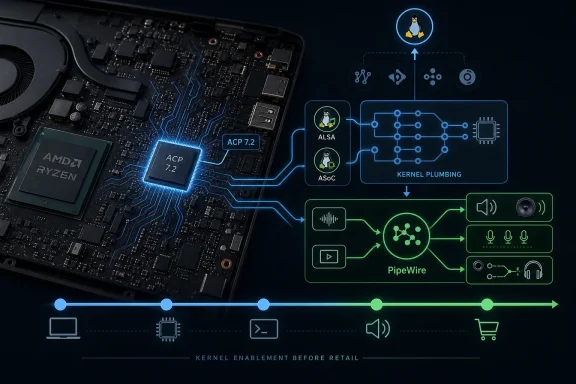
The easy version of this story is that AMD has “renewed audio on Linux” for upcoming processors. The more useful version is that AMD is preparing Linux for a newer generation of its Audio Co-Processor, often shortened to ACP, before those systems become common in the wild. That matters because laptop audio is no longer just a codec hanging off a simple bus waiting for a generic driver to poke it awake.
On modern AMD mobile platforms, the audio path can involve an on-die co-processor, digital microphones, smart amplifiers, codec glue, power-management rules, firmware expectations, and topology descriptions that tell the operating system how the board is wired. If any one of those pieces is missing or late, the result can be exactly the sort of failure Linux laptop buyers know too well: no speakers, no microphone, broken headphone switching, or audio that works only after a ritual of kernel parameters and forum archaeology.
The ACP 7.2 work should be read as platform enablement rather than a consumer-facing feature. It is not the Linux equivalent of installing a new equalizer app. It is the sort of kernel support that determines whether a future Ryzen laptop arrives with functioning internal audio or with a bug report that begins, “Sound works over HDMI, but not from the speakers.”
That distinction is important because the original claim has already drifted in the usual online-news way. “Linux 7.2” and “ACP 7.2” are easy to confuse, and the difference is not pedantic. One is a kernel release number; the other is an AMD audio hardware block version. The kernel may gain related AMD platform support in a given development cycle, but the key technical item is the hardware enablement itself.
Linux’s sound architecture has adapted to that reality through ALSA, ASoC, Sound Open Firmware on many systems, machine drivers, topology files, and user-space servers such as PipeWire. But adaptation does not mean instant support. The kernel can know that an AMD audio controller exists and still fail to expose a working speaker path if the board-specific machine driver is absent.
That is why ACP enablement is not glamorous but is deeply consequential. AMD’s audio co-processor sits in the middle of the real product experience. It can help manage low-power audio, route streams, support integrated microphones, and coordinate the embedded audio fabric that laptop makers depend on to ship thinner and more power-efficient machines.
The irony is that the more integrated the hardware becomes, the more fragile the out-of-box Linux experience can feel. Integration reduces board space and power draw, but it also means generic assumptions break down. A future laptop may contain a perfectly capable audio block and still need very specific kernel knowledge before it behaves like a normal computer.
But it is also worth resisting the caricature. Modern Linux audio is much better than its reputation, especially on mainstream desktop hardware and many recent laptops. PipeWire has cleaned up a great deal of the old PulseAudio-versus-JACK mess, gaming through Proton has matured, and Bluetooth handling has improved across major distributions.
The remaining problems are less about Linux being inherently bad at sound and more about the industry making audio part of a larger platform puzzle. Windows machines do not escape this complexity; they simply ship with OEM driver packages, certification paths, and vendor utilities that paper over it for most buyers. Linux users often meet the same complexity without the cushion.
That is why upstream-first support is so valuable. When AMD lands hardware enablement in the kernel before products hit shelves, it reduces the chance that users will depend on vendor recovery images, binary-only fixes, or months of waiting for distribution-specific patches. The driver is not the whole experience, but it is the foundation the rest of the experience stands on.
A notebook with broken sound is not “mostly supported” in any practical sense. It is broken. That is especially true for students, remote workers, developers, and gamers who rely on video calls, media playback, voice chat, and screen recording.
Day-one support also matters because Linux is no longer only a hobbyist install performed months after purchase. More users are buying machines with Linux in mind from the start, and more organizations are evaluating Linux desktops for development, engineering, and security-sensitive workflows. The tolerance for “wait three kernel releases and try again” is lower than it used to be.
AMD knows this because its client roadmap increasingly depends on laptops, AI PCs, and integrated silicon blocks that require deep software coordination. A CPU launch is no longer just a CPU launch. It is a platform launch, and every platform block that lacks upstream support becomes a small reputational liability.
ACP 7.2 fits that pattern. It is a breadcrumb from AMD’s future client silicon: more integrated audio, more platform-specific handling, and more reliance on kernel support being ready before retail availability. The driver work may follow existing ACP paths, which suggests evolution rather than revolution, but evolutionary plumbing is exactly how laptop compatibility improves.
This is also where the “new audio architecture” phrasing should be handled carefully. Kernel enablement for a new AMD audio block does not necessarily mean AMD has redesigned the entire Linux sound subsystem. It means the Linux sound stack is being extended to understand another generation of AMD’s audio hardware. That is still meaningful, but the significance lies in compatibility and integration rather than some sweeping reinvention of Linux audio.
For IT pros, the signal is simple: watch kernel support, not just silicon announcements. A processor generation can look excellent on paper and still be a poor deployment choice if its surrounding platform devices lag in mainline support. Conversely, boring-looking enablement patches can be the difference between a smooth pilot and an image-maintenance headache.
This does not mean a Linux kernel patch directly improves Windows audio. Windows still relies on AMD, Realtek, OEMs, Microsoft’s driver model, and device-specific packages. But the same hardware blocks, firmware assumptions, and power-management designs often sit underneath both operating systems. If AMD is forced to make those interfaces cleaner for Linux, the platform as a whole tends to become less mysterious.
There is also a procurement angle. Enterprises that standardize on Windows increasingly still care about Linux compatibility because developers dual-boot, security teams boot live environments, recovery tools use Linux kernels, and virtualization workflows depend on sane hardware behavior. A laptop that behaves well under Linux is often a laptop whose platform devices are less exotic and less brittle.
The Steam Deck effect should not be ignored either. Valve’s Linux-based gaming push has made driver quality, kernel timing, and AMD collaboration visible to a wider audience. Even users who never install Arch or Fedora now benefit from the competitive pressure created by Linux gaming, handheld PCs, and open graphics stacks.
Audio is particularly unforgiving because users notice failure instantly. A GPU scheduler bug may appear only under load. A CPU power-management regression may require benchmarking to prove. Broken speakers announce themselves the moment a user opens a video.
Late audio support is also messy to diagnose. The visible symptom may be “no sound,” but the cause could be a missing machine driver, an incorrect topology, a codec quirk, a firmware mismatch, a suspended controller, a user-space routing issue, or a desktop environment choosing the wrong sink. To the user, those distinctions are irrelevant. The laptop does not work.
That is why upstream ACP 7.2 enablement is best understood as risk reduction. It does not guarantee flawless audio on every future AMD laptop, because OEM board design still matters. But it moves a critical piece of the puzzle into the kernel early enough for distributions, testers, and hardware partners to shake out problems before launch windows harden.
Audio may seem small next to GPUs and NPUs, yet it belongs to the same story. A modern Ryzen platform is a bundle of specialized engines. Graphics, display, media encode, camera ISP, NPU, security processor, USB4, power management, and audio all need coordinated support. Users do not buy a CPU core; they buy a working machine.
The pressure will only increase as AMD pushes deeper into AI PCs. Systems with local inference features, advanced cameras, microphone processing, and richer conferencing workloads will lean harder on the same platform integration that has historically caused Linux pain. If AMD wants to be trusted in that category, it cannot treat peripheral blocks as afterthoughts.
This is where the company’s Linux work becomes a competitive argument. Intel has long invested heavily in upstream Linux enablement. Qualcomm’s PC ambitions have exposed how hard platform support can be outside tightly controlled software stacks. AMD’s opportunity is to make Ryzen laptops feel like first-class Linux citizens before the buyer has to learn what an ACP block is.
That timing gap is where many “Linux supports this” claims become frustrating. The kernel may support a hardware block in principle, while the distribution installed on a real laptop does not yet ship the necessary version. OEMs can close that gap with certified images and kernel backports, but not every consumer machine receives that level of care.
For Windows users evaluating Linux on a new AMD system, the practical advice is to check the kernel generation, not just the distribution name. A shiny new laptop paired with an older LTS kernel can still behave like unsupported hardware. A newer kernel can turn the same machine from an experiment into a daily driver.
Administrators should be even more conservative. If internal speakers, headset switching, microphone arrays, suspend-resume audio, and conferencing apps matter to a deployment, they should be tested as part of hardware qualification. Audio is not a vanity feature in a hybrid-work fleet. It is part of the endpoint’s basic reliability.
Board-specific integration remains a wild card. Two machines can use similar AMD silicon but different codecs, amplifiers, microphone layouts, BIOS settings, and firmware packaging. The kernel can provide the highway, but the OEM still has to build the on-ramp correctly.
User space also remains part of the equation. PipeWire, WirePlumber policies, ALSA configuration, desktop control panels, Bluetooth profiles, and application behavior all influence what users experience. Kernel support can expose the hardware correctly and still leave rough edges higher in the stack.
That does not diminish the value of AMD’s work. It simply places it in the right layer. The kernel driver is the piece that makes sane user-space behavior possible. Without it, everything above becomes guesswork.
That is hard for technology journalism, because visible failures are easier to describe than invisible competence. But for operating systems, boring is the gold standard. The more AMD can make future Ryzen audio disappear into ordinary reliability, the stronger its platform story becomes.
This is also why the “rusty can” framing, while amusing, risks underselling the issue. The goal is not better hi-fi mysticism. It is deterministic behavior across real hardware. Sound should route to the expected device, stay synchronized, survive suspend, respect power states, and work across the applications people actually use.
For gaming, that means fewer immersion-breaking dropouts and fewer voice-chat surprises. For creators, it means fewer unexplained latency problems. For enterprise users, it means fewer support tickets that begin with “my meeting can’t hear me.” None of this is glamorous, and all of it matters.
That is especially true in Linux, where early adopters are both forgiving and brutally effective at documenting pain. A single missing driver can generate months of forum threads, bug reports, kernel logs, and distribution-specific workarounds. Once that reputation attaches to a laptop model, it is hard to scrub away.
AMD appears to understand that the software runway has to start before the hardware launch. Getting ACP support into the kernel early gives the ecosystem time to test, integrate, and backport. It also gives OEMs fewer excuses if their machines ship with incomplete Linux behavior.
The larger story is that Linux enablement has become part of the launch itself. It is no longer a charitable side quest for enthusiasts. It is part of how modern PC platforms prove they are ready.
 AMD Is Moving the Audio Fight Upstream
The easy version of this story is that AMD has “renewed audio on Linux” for upcoming processors. The more useful version is that AMD is preparing Linux for a newer generation of its Audio Co-Processor, often shortened to ACP, before those systems become common in the wild. That matters because laptop audio is no longer just a codec hanging off a simple bus waiting for a generic driver to poke it awake.On modern AMD mobile platforms, the audio path can involve an on-die co-processor, digital microphones, smart amplifiers, codec glue, power-management rules, firmware expectations, and topology descriptions that tell the operating system how the board is wired. If any one of those pieces is missing or late, the result can be exactly the sort of failure Linux laptop buyers know too well: no speakers, no microphone, broken headphone switching, or audio that works only after a ritual of kernel parameters and forum archaeology.
The ACP 7.2 work should be read as platform enablement rather than a consumer-facing feature. It is not the Linux equivalent of installing a new equalizer app. It is the sort of kernel support that determines whether a future Ryzen laptop arrives with functioning internal audio or with a bug report that begins, “Sound works over HDMI, but not from the speakers.”
That distinction is important because the original claim has already drifted in the usual online-news way. “Linux 7.2” and “ACP 7.2” are easy to confuse, and the difference is not pedantic. One is a kernel release number; the other is an AMD audio hardware block version. The kernel may gain related AMD platform support in a given development cycle, but the key technical item is the hardware enablement itself.
The Sound Stack Became a Platform Problem
For years, desktop users treated PC audio as a solved problem. A Realtek codec, a pair of jacks, and a driver were enough to satisfy most expectations. Laptops broke that simplicity. Thin designs, power constraints, microphone arrays, wake-word features, DSP offload, and vendor-specific amplifier tuning pulled audio into the same platform-integration maze that already swallowed Wi-Fi, touchpads, cameras, and sleep states.Linux’s sound architecture has adapted to that reality through ALSA, ASoC, Sound Open Firmware on many systems, machine drivers, topology files, and user-space servers such as PipeWire. But adaptation does not mean instant support. The kernel can know that an AMD audio controller exists and still fail to expose a working speaker path if the board-specific machine driver is absent.
That is why ACP enablement is not glamorous but is deeply consequential. AMD’s audio co-processor sits in the middle of the real product experience. It can help manage low-power audio, route streams, support integrated microphones, and coordinate the embedded audio fabric that laptop makers depend on to ship thinner and more power-efficient machines.
The irony is that the more integrated the hardware becomes, the more fragile the out-of-box Linux experience can feel. Integration reduces board space and power draw, but it also means generic assumptions break down. A future laptop may contain a perfectly capable audio block and still need very specific kernel knowledge before it behaves like a normal computer.
The Rusty-Can Joke Lands Because Users Have Lived It
The joke that future AMD systems may finally stop sounding like a rusty can works because Linux audio failures have a long cultural memory. Most enthusiasts can recall an install where the wrong output was selected, the microphone was invisible, Bluetooth latency was absurd, or the HDMI audio device hijacked the desktop’s idea of what “default” meant. The punchline is funny because the pain has been real.But it is also worth resisting the caricature. Modern Linux audio is much better than its reputation, especially on mainstream desktop hardware and many recent laptops. PipeWire has cleaned up a great deal of the old PulseAudio-versus-JACK mess, gaming through Proton has matured, and Bluetooth handling has improved across major distributions.
The remaining problems are less about Linux being inherently bad at sound and more about the industry making audio part of a larger platform puzzle. Windows machines do not escape this complexity; they simply ship with OEM driver packages, certification paths, and vendor utilities that paper over it for most buyers. Linux users often meet the same complexity without the cushion.
That is why upstream-first support is so valuable. When AMD lands hardware enablement in the kernel before products hit shelves, it reduces the chance that users will depend on vendor recovery images, binary-only fixes, or months of waiting for distribution-specific patches. The driver is not the whole experience, but it is the foundation the rest of the experience stands on.
This Is Really About Day-One Hardware Credibility
AMD has spent years benefiting from the perception that it is the friendlier GPU and platform vendor for Linux users. The open AMDGPU driver stack, Mesa integration, and strong community visibility have given Radeon and Ryzen systems a credibility that Nvidia, fairly or not, often had to fight harder to earn in the Linux world. Audio support does not carry the same headline weight as graphics, but for laptop buyers it can be just as decisive.A notebook with broken sound is not “mostly supported” in any practical sense. It is broken. That is especially true for students, remote workers, developers, and gamers who rely on video calls, media playback, voice chat, and screen recording.
Day-one support also matters because Linux is no longer only a hobbyist install performed months after purchase. More users are buying machines with Linux in mind from the start, and more organizations are evaluating Linux desktops for development, engineering, and security-sensitive workflows. The tolerance for “wait three kernel releases and try again” is lower than it used to be.
AMD knows this because its client roadmap increasingly depends on laptops, AI PCs, and integrated silicon blocks that require deep software coordination. A CPU launch is no longer just a CPU launch. It is a platform launch, and every platform block that lacks upstream support becomes a small reputational liability.
The Kernel Is Becoming the Product Roadmap
One reason Linux hardware coverage has become such an interesting news beat is that kernel patches often reveal the shape of future products before marketing does. Support for a new graphics IP block, NPU generation, camera interface, or audio co-processor can appear before the devices are formally announced. The code does not always disclose the product name, but it tells us what the platform needs to do.ACP 7.2 fits that pattern. It is a breadcrumb from AMD’s future client silicon: more integrated audio, more platform-specific handling, and more reliance on kernel support being ready before retail availability. The driver work may follow existing ACP paths, which suggests evolution rather than revolution, but evolutionary plumbing is exactly how laptop compatibility improves.
This is also where the “new audio architecture” phrasing should be handled carefully. Kernel enablement for a new AMD audio block does not necessarily mean AMD has redesigned the entire Linux sound subsystem. It means the Linux sound stack is being extended to understand another generation of AMD’s audio hardware. That is still meaningful, but the significance lies in compatibility and integration rather than some sweeping reinvention of Linux audio.
For IT pros, the signal is simple: watch kernel support, not just silicon announcements. A processor generation can look excellent on paper and still be a poor deployment choice if its surrounding platform devices lag in mainline support. Conversely, boring-looking enablement patches can be the difference between a smooth pilot and an image-maintenance headache.
Windows Users Should Care Because Linux Support Changes the Whole PC
WindowsForum readers may reasonably ask why a Linux audio driver should matter to them. The answer is that Linux support has become a proxy for platform maturity. When vendors document hardware, upstream drivers, and work through public review, the entire ecosystem benefits from earlier bug discovery and clearer hardware behavior.This does not mean a Linux kernel patch directly improves Windows audio. Windows still relies on AMD, Realtek, OEMs, Microsoft’s driver model, and device-specific packages. But the same hardware blocks, firmware assumptions, and power-management designs often sit underneath both operating systems. If AMD is forced to make those interfaces cleaner for Linux, the platform as a whole tends to become less mysterious.
There is also a procurement angle. Enterprises that standardize on Windows increasingly still care about Linux compatibility because developers dual-boot, security teams boot live environments, recovery tools use Linux kernels, and virtualization workflows depend on sane hardware behavior. A laptop that behaves well under Linux is often a laptop whose platform devices are less exotic and less brittle.
The Steam Deck effect should not be ignored either. Valve’s Linux-based gaming push has made driver quality, kernel timing, and AMD collaboration visible to a wider audience. Even users who never install Arch or Fedora now benefit from the competitive pressure created by Linux gaming, handheld PCs, and open graphics stacks.
The Real Enemy Is Not Bad Audio, It Is Late Audio
Most driver stories are written as if the enemy is a specific bug. In practice, the larger enemy is delay. Late support forces users into workarounds, distributions into backports, OEMs into private patches, and forum communities into repeating the same troubleshooting scripts for months.Audio is particularly unforgiving because users notice failure instantly. A GPU scheduler bug may appear only under load. A CPU power-management regression may require benchmarking to prove. Broken speakers announce themselves the moment a user opens a video.
Late audio support is also messy to diagnose. The visible symptom may be “no sound,” but the cause could be a missing machine driver, an incorrect topology, a codec quirk, a firmware mismatch, a suspended controller, a user-space routing issue, or a desktop environment choosing the wrong sink. To the user, those distinctions are irrelevant. The laptop does not work.
That is why upstream ACP 7.2 enablement is best understood as risk reduction. It does not guarantee flawless audio on every future AMD laptop, because OEM board design still matters. But it moves a critical piece of the puzzle into the kernel early enough for distributions, testers, and hardware partners to shake out problems before launch windows harden.
AMD’s Linux Strategy Is Becoming Less Optional
AMD’s open-source posture has not always been perfect, but it has become a strategic asset. The company’s CPU resurgence, Radeon’s open driver presence, ROCm’s gradual expansion, and Ryzen AI ambitions all depend on software credibility. Linux is where much of that credibility is tested in public.Audio may seem small next to GPUs and NPUs, yet it belongs to the same story. A modern Ryzen platform is a bundle of specialized engines. Graphics, display, media encode, camera ISP, NPU, security processor, USB4, power management, and audio all need coordinated support. Users do not buy a CPU core; they buy a working machine.
The pressure will only increase as AMD pushes deeper into AI PCs. Systems with local inference features, advanced cameras, microphone processing, and richer conferencing workloads will lean harder on the same platform integration that has historically caused Linux pain. If AMD wants to be trusted in that category, it cannot treat peripheral blocks as afterthoughts.
This is where the company’s Linux work becomes a competitive argument. Intel has long invested heavily in upstream Linux enablement. Qualcomm’s PC ambitions have exposed how hard platform support can be outside tightly controlled software stacks. AMD’s opportunity is to make Ryzen laptops feel like first-class Linux citizens before the buyer has to learn what an ACP block is.
The Distribution Lag Will Still Decide Who Feels the Benefit
Even when support lands upstream, users do not all receive it at the same time. Rolling distributions will pick up new kernels quickly. Fedora, Arch, openSUSE Tumbleweed, CachyOS, and similar environments may expose the benefits early. Ubuntu LTS, Debian stable, enterprise Linux, and conservative corporate images may not see the work until later unless vendors backport it.That timing gap is where many “Linux supports this” claims become frustrating. The kernel may support a hardware block in principle, while the distribution installed on a real laptop does not yet ship the necessary version. OEMs can close that gap with certified images and kernel backports, but not every consumer machine receives that level of care.
For Windows users evaluating Linux on a new AMD system, the practical advice is to check the kernel generation, not just the distribution name. A shiny new laptop paired with an older LTS kernel can still behave like unsupported hardware. A newer kernel can turn the same machine from an experiment into a daily driver.
Administrators should be even more conservative. If internal speakers, headset switching, microphone arrays, suspend-resume audio, and conferencing apps matter to a deployment, they should be tested as part of hardware qualification. Audio is not a vanity feature in a hybrid-work fleet. It is part of the endpoint’s basic reliability.
The Driver Does Not Abolish the Usual Linux Audio Caveats
There is a temptation to turn any upstream driver patch into a victory lap. That would be premature here. ACP 7.2 support is a necessary condition for future AMD audio reliability, not a guarantee that every upcoming laptop will sing beautifully out of the box.Board-specific integration remains a wild card. Two machines can use similar AMD silicon but different codecs, amplifiers, microphone layouts, BIOS settings, and firmware packaging. The kernel can provide the highway, but the OEM still has to build the on-ramp correctly.
User space also remains part of the equation. PipeWire, WirePlumber policies, ALSA configuration, desktop control panels, Bluetooth profiles, and application behavior all influence what users experience. Kernel support can expose the hardware correctly and still leave rough edges higher in the stack.
That does not diminish the value of AMD’s work. It simply places it in the right layer. The kernel driver is the piece that makes sane user-space behavior possible. Without it, everything above becomes guesswork.
The Most Interesting Part Is How Boring This Should Become
The best future for AMD audio on Linux is one in which nobody writes about it. Users install a distribution, join a video call, play a game, switch to headphones, resume from sleep, and never learn the name of the audio co-processor. Successful platform support is invisible.That is hard for technology journalism, because visible failures are easier to describe than invisible competence. But for operating systems, boring is the gold standard. The more AMD can make future Ryzen audio disappear into ordinary reliability, the stronger its platform story becomes.
This is also why the “rusty can” framing, while amusing, risks underselling the issue. The goal is not better hi-fi mysticism. It is deterministic behavior across real hardware. Sound should route to the expected device, stay synchronized, survive suspend, respect power states, and work across the applications people actually use.
For gaming, that means fewer immersion-breaking dropouts and fewer voice-chat surprises. For creators, it means fewer unexplained latency problems. For enterprise users, it means fewer support tickets that begin with “my meeting can’t hear me.” None of this is glamorous, and all of it matters.
The Future Ryzen Laptop Will Be Judged by Its Smallest Broken Device
The concrete lesson from AMD’s ACP 7.2 work is that platform readiness lives in details most buyers never see. A future processor can bring faster cores, better graphics, and stronger AI acceleration, but a broken microphone can still poison the experience. The smallest unsupported device often becomes the thing users remember.That is especially true in Linux, where early adopters are both forgiving and brutally effective at documenting pain. A single missing driver can generate months of forum threads, bug reports, kernel logs, and distribution-specific workarounds. Once that reputation attaches to a laptop model, it is hard to scrub away.
AMD appears to understand that the software runway has to start before the hardware launch. Getting ACP support into the kernel early gives the ecosystem time to test, integrate, and backport. It also gives OEMs fewer excuses if their machines ship with incomplete Linux behavior.
The larger story is that Linux enablement has become part of the launch itself. It is no longer a charitable side quest for enthusiasts. It is part of how modern PC platforms prove they are ready.
The Notes AMD Buyers Should Keep Before the Launch Hype Arrives
The practical read is cautiously optimistic. AMD’s new audio enablement should improve the odds that upcoming Ryzen systems work properly under Linux, especially where the ACP block is central to internal speakers, microphones, and low-power audio paths. But the distance between kernel support and a flawless laptop remains long enough that buyers should keep their skepticism handy.- AMD’s latest work is best understood as enablement for a newer Audio Co-Processor generation, not as a wholesale reinvention of Linux audio.
- The biggest benefit should be better out-of-the-box support for future AMD laptops, particularly for internal speakers, microphones, and platform audio routing.
- Users on rolling distributions will likely feel improvements sooner than users on conservative LTS or enterprise kernels.
- OEM implementation will still matter, because codecs, amplifiers, firmware, and board-specific machine drivers can determine whether audio actually works.
- Windows users should still pay attention, because strong Linux support often signals cleaner platform integration and fewer hidden hardware assumptions.
- The real test will come when retail systems ship and ordinary users try suspend, headset switching, video calls, games, and Bluetooth audio without special workarounds.
References
- Primary source: Foro3D
Published: 2026-06-20T17:00:30.539073
AMD renews audio on Linux for its upcoming processors
AMD renews audio in Linux 7.2 for future processors, optimizing compatibility and performance. The update improves stability in video playback and gaming, offering more robust sound support on new hardware.foro3d.com - Related coverage: amd.com
- Related coverage: phoronix.com
Linux 7.2 Features Expected: Apple M3, Initial AMDGPU HDMI 2.1 FRL, USB4STREAM, Cache Aware Scheduling - Phoronix
Linux 7.1 stable is expected to be released this Sunday with its many new featureswww.phoronix.com
- Related coverage: news.lavx.hu
AMD Accelerates AIE4 NPU Support in Linux 7.2, Hinting at Ryzen AI Zen 6 Integration | LavX News
AMD’s AMDXDNA driver gains new AIE4 NPU features—including SR‑IOV, doorbell handling, and buffer init—through drm‑misc‑next patches that will land in the Linux 7.2 merge window, signaling a likely rollout in upcoming Ryzen AI Zen 6 “Medusa Point” silicon. news.lavx.hu
- Related coverage: techradar.com
Linux 7.0 finally arrives with AMD Zen 6 and Intel Nova Lake support, packed with massive new performance features | TechRadar
Linux 7.0 is bringing faster file systems, better graphics, and wider hardware supportwww.techradar.com - Related coverage: tomshardware.com
Linux 7.0 launches with enablement for Intel Nova Lake, AMD Zen 6 — major kernel update expected in Ubuntu 26.04 LTS and Fedora 44 first | Tom's Hardware
Linux 7.0 is everything you would expect from a major kernel update.www.tomshardware.com
- Related coverage: legacy.redhat.com
