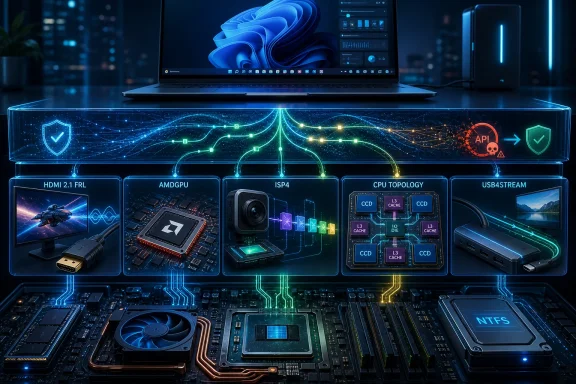
Linus Torvalds released Linux 7.2-rc1 on Sunday, June 28, 2026, opening the public stabilization phase for the next mainline Linux kernel after two weeks of merge-window work following Linux 7.1. The release is not a finished kernel, and that distinction matters. What arrived this weekend is less a consumer milestone than a map of where Linux hardware enablement, memory management, filesystems, graphics, and Rust infrastructure are heading next.
The shape of Linux 7.2 is familiar: a mountain of driver work, architecture plumbing, scheduler tuning, filesystem changes, and platform enablement that will be invisible to many users until their next distribution kernel quietly absorbs it. But the most interesting thing about this release candidate is not that it changes everything overnight. It is that Linux continues to move its center of gravity toward the hardware that is about to matter, rather than merely maintaining the hardware that already does.
The first release candidate of a Linux kernel is a strange public event. It sounds like a release, but it is really a handoff: from maintainers adding new code to testers trying to break it. The merge window is where feature work lands; the release-candidate cycle is where the community discovers whether that feature work behaves under pressure.
Torvalds’ reported description of the cycle as “reasonably normal” is the kind of phrase kernel watchers have learned to treat as reassuring. In Linux development, normal does not mean small. It means the chaos is distributed in the expected way: drivers dominate, architectures keep moving, filesystems evolve, tooling gets touched, and the diffstat contains at least one large vendor header dump that makes the release look more dramatic than it really is.
This time, that vendor-shaped distortion appears to come partly from AMD GPU register definitions, which reportedly account for a sizable chunk of the patch volume. That is not glamorous work, but it is exactly the kind of low-level scaffolding that modern graphics support requires. Every polished desktop frame, every gaming performance gain, and every display-mode fix begins life as tedious hardware description.
For WindowsForum readers, the temptation is to ask why a Linux release candidate should matter to a Windows-centric audience. The answer is that the border between Windows and Linux is no longer clean. Linux now runs inside Windows through WSL, underpins cloud workloads administered from Windows laptops, powers NAS boxes and routers in Windows-heavy homes, and increasingly competes with Windows on gaming handhelds, developer workstations, and AI systems.
Linux 7.2 is expected to follow that rhythm into the second half of August 2026. If the cycle stays on the usual seven-RC path, the stable release could arrive around August 16. If Torvalds decides the kernel needs an eighth release candidate, August 23 becomes the more likely target.
That predictability is not just a convenience for enthusiasts compiling kernels on a Sunday night. It is how distributions, silicon vendors, cloud providers, and enterprise engineering teams plan enablement. A feature that lands in 7.2 may not reach Ubuntu, Fedora, Arch, Debian, SUSE, Red Hat, or downstream appliance kernels at the same time, but rc1 tells everyone where the upstream baseline now stands.
This is one reason the kernel’s release candidates carry more weight than a typical beta. They are not marketing previews designed to build excitement. They are coordination points for an ecosystem that ranges from hobbyist laptops to hyperscale fleets.
HDMI 2.1 FRL matters because it is part of the path to higher resolutions and refresh rates over HDMI. For Linux desktop users, especially those using AMD hardware with TVs or gaming monitors, this is the kind of support that can decide whether a machine feels first-class or compromised. It is also a reminder that “Linux hardware support” often means years of patient enablement rather than one dramatic patch.
The politics around HDMI support have long been more complicated than DisplayPort because of licensing and specification access. Linux has often been strongest where open standards and open documentation let developers move quickly. When the industry routes consumer hardware through more restrictive channels, open-source operating systems feel the friction.
That makes the AMDGPU work in Linux 7.2 more than another driver bullet point. It is part of the broader effort to make Linux viable on the same living-room and gaming displays that Windows users take for granted. The gap is not closed by slogans about open source; it is closed by patches like this.
The Intel Xe driver is especially important because it represents Intel’s modern graphics driver path in the kernel. For years, Intel graphics on Linux benefited from unusually strong upstream support compared with many competitors. But the transition to newer GPU architectures and driver models is still work, not magic.
Panther Lake-related support fits the same pattern. The kernel needs to identify CPUs correctly, expose capabilities cleanly, and allow the rest of the stack to make sane decisions. By the time a new laptop platform shows up in a review unit, the upstream kernel work may already have been underway for months.
This is where Linux differs sharply from Windows in public perception. Windows users often experience hardware support as a vendor driver package delivered through Windows Update, an OEM image, or a support page. Linux users see more of the plumbing because upstreaming is public, incremental, and argumentative by design.
The “zerocopy” concept matters because kernels spend their lives moving, mapping, sharing, and interpreting memory. Every extra copy costs performance; every unsafe interpretation risks bugs. A Rust abstraction that helps developers work with memory layouts efficiently and safely is exactly the sort of small infrastructure piece that can make future Rust drivers more credible.
This is still an incremental story. Nobody should read Linux 7.2-rc1 as the moment Rust takes over the kernel. The more accurate framing is that Rust is slowly gaining the boring support structures it needs to be useful in real kernel work.
That distinction matters because Rust discussions often collapse into ideology. The kernel community is not adopting Rust because the internet likes language wars. It is doing so because some classes of kernel bugs are expensive, security-sensitive, and stubbornly common, and because new driver code may be a practical place to test whether stronger language tooling can help.
Large folios are part of the kernel’s broader memory-management evolution. In simplified terms, they allow the kernel to handle memory in larger chunks than traditional small pages in some paths, reducing overhead and potentially improving throughput. For a filesystem like Btrfs, which is already complex because of copy-on-write behavior and advanced features, defaulting to large folios signals confidence that the benefits are ready for wider testing.
Btrfs remains one of Linux’s most ambitious mainstream filesystems. It has won fans through snapshots, checksumming, compression, and flexible volume management, while also carrying a reputation shaped by earlier cautionary tales and workload-specific caveats. Kernel changes like this do not settle those debates, but they do show active investment in making Btrfs faster and more scalable.
For Windows users comparing filesystems, Btrfs is not a direct NTFS analog. It is closer to an argument about what a modern local filesystem should be allowed to do. Linux 7.2’s Btrfs work continues that argument at the memory-management layer, where user-visible wins may appear only after distributions and benchmarks catch up.
ARM64 is now central to phones, tablets, embedded systems, servers, developer boards, networking hardware, and increasingly laptops. Qualcomm’s Windows-on-Arm push has also made ARM a Windows story, not merely a Linux one. The same architectural contest that shapes Linux kernel patches shapes the future of Windows PCs.
Device-tree updates are the unglamorous part of that contest. They describe hardware so the kernel can initialize and manage it properly. When device-tree support improves, boards boot more reliably, peripherals work with fewer hacks, and downstream vendors have less excuse to ship ancient forked kernels.
The AArch64 hwcaps work points in a different direction: exposing CPU capabilities so software can take advantage of newer instruction-set features. Performance is not only about faster cores. It is about letting the operating system and userspace know what the silicon can actually do.
Multipath TCP allows connections to use multiple network paths, improving resilience and potentially throughput when devices have more than one route available. Better IPv6 signaling support matters because IPv6 is no longer a future migration story; it is deployed reality, unevenly adopted but unavoidable.
GRO and GSO support for PPPoE is similarly practical. Generic Receive Offload and Generic Segmentation Offload are performance mechanisms that reduce packet-processing overhead. PPPoE may sound like a relic to some users, but it remains relevant in broadband deployments, and performance improvements there can matter in the real world.
This is the kernel at its least flashy and most valuable. Nobody buys a laptop because a release candidate improved PPPoE offload behavior. But millions of users benefit when the Linux systems moving their packets get a little more efficient.
SMP load balancing is about how work gets distributed across multiple CPUs or cores. That used to be simpler when machines had fewer, more uniform cores. Modern systems are messier: hybrid CPU designs, chiplets, NUMA effects, cache hierarchies, power constraints, and thermal limits all complicate the idea of “just run the task on another core.”
This is one reason kernel development has become more hardware-specific without becoming less general-purpose. The kernel has to understand more about the shape of machines while still presenting a coherent operating system to everyone above it. Linux 7.2’s scheduler updates are part of that ongoing negotiation.
For desktop users, scheduler work can show up as smoother interactivity, better compile times, improved gaming frame pacing, or no visible difference at all. For cloud operators, the same class of change can affect fleet density and tail latency. That is why scheduler patches receive attention out of proportion to their readability.
That does not mean ordinary users have no role to play. The kernel depends on wide testing across hardware combinations vendors may not have in their labs. If you have a spare machine, a secondary boot entry, or a test VM that exercises a real workload, release candidates are where useful bug reports begin.
The best testing is boring and specific. Boot it, suspend it, resume it, stress the filesystem, check the display modes, run the workload you actually care about, and compare behavior against a known-good kernel. “It broke” is less useful than “this laptop with this GPU fails to resume after rc1 while 7.1 works.”
For administrators, the calculus is different. The release candidate is not something to deploy, but it is something to watch. If Linux 7.2 contains hardware enablement or filesystem behavior relevant to your estate, now is the time to identify it, not after a downstream distribution pulls the kernel into a release stream.
Linux is now the infrastructure substrate around Windows. The web services accessed from Windows clients often run on Linux. The containers built on Windows workstations often deploy to Linux clusters. The storage appliances, VPN concentrators, CI runners, home servers, and hypervisors surrounding Windows environments frequently rely on Linux kernels.
There is also competitive pressure. Linux gaming, once a punchline, is now credible enough that GPU, display, scheduler, and filesystem changes matter to people who might otherwise be Windows-only players. SteamOS and handheld PCs have made Linux performance and compatibility a consumer issue rather than a purely ideological one.
Even Microsoft’s own world has adapted. Azure is full of Linux. Windows developers use Linux tooling. Security teams investigate Linux vulnerabilities because mixed estates are normal. A mainline kernel release candidate is therefore not foreign news; it is part of the operating-system weather system Windows professionals already live in.
That is one of Linux’s great strengths and one of its permanent frustrations. The work is visible early, but the payoff arrives unevenly. A feature may be in mainline before your distribution ships it, before your firmware exposes it properly, before your desktop stack uses it, or before your device vendor stops carrying an out-of-tree workaround.
Windows hides more of this process behind vendor coordination and driver distribution channels. That can make the experience feel cleaner, especially on certified hardware. But it also means users see less of the negotiation between silicon reality and operating-system support.
Linux shows the sausage being made. Linux 7.2-rc1 is very much sausage-making: register definitions, driver hooks, memory abstractions, hardware descriptions, scheduler adjustments, and filesystem defaults. The result may later look effortless. It is not.
That downstream filtering is where kernel news becomes user experience. A Fedora user, an Arch user, an Ubuntu LTS user, a Debian stable user, and a Proxmox administrator may all encounter Linux 7.2 differently. Some will run the actual kernel soon. Others will see pieces of it quietly backported months later.
Hardware vendors also complicate the story. A kernel can contain support that still depends on firmware, BIOS updates, Mesa releases, user-space libraries, or distribution configuration. Kernel support is necessary, but it is rarely sufficient.
That is why rc1 should be read as a directional document. It tells us what upstream has accepted, what needs testing, and which areas are active. It does not guarantee that every user will benefit on the same schedule.
The most concrete signals from this first release candidate are already clear:
The shape of Linux 7.2 is familiar: a mountain of driver work, architecture plumbing, scheduler tuning, filesystem changes, and platform enablement that will be invisible to many users until their next distribution kernel quietly absorbs it. But the most interesting thing about this release candidate is not that it changes everything overnight. It is that Linux continues to move its center of gravity toward the hardware that is about to matter, rather than merely maintaining the hardware that already does.
 Linux 7.2 Begins Where Most Users Will Never Look
The first release candidate of a Linux kernel is a strange public event. It sounds like a release, but it is really a handoff: from maintainers adding new code to testers trying to break it. The merge window is where feature work lands; the release-candidate cycle is where the community discovers whether that feature work behaves under pressure.Torvalds’ reported description of the cycle as “reasonably normal” is the kind of phrase kernel watchers have learned to treat as reassuring. In Linux development, normal does not mean small. It means the chaos is distributed in the expected way: drivers dominate, architectures keep moving, filesystems evolve, tooling gets touched, and the diffstat contains at least one large vendor header dump that makes the release look more dramatic than it really is.
This time, that vendor-shaped distortion appears to come partly from AMD GPU register definitions, which reportedly account for a sizable chunk of the patch volume. That is not glamorous work, but it is exactly the kind of low-level scaffolding that modern graphics support requires. Every polished desktop frame, every gaming performance gain, and every display-mode fix begins life as tedious hardware description.
For WindowsForum readers, the temptation is to ask why a Linux release candidate should matter to a Windows-centric audience. The answer is that the border between Windows and Linux is no longer clean. Linux now runs inside Windows through WSL, underpins cloud workloads administered from Windows laptops, powers NAS boxes and routers in Windows-heavy homes, and increasingly competes with Windows on gaming handhelds, developer workstations, and AI systems.
The Kernel Calendar Is a Discipline, Not a Marketing Plan
The Linux kernel release process remains one of the industry’s more reliable rituals. A stable release lands, a two-week merge window opens, maintainers send pull requests, and Torvalds cuts rc1 when the window closes. After that, release candidates normally arrive weekly until the tree looks calm enough to ship.Linux 7.2 is expected to follow that rhythm into the second half of August 2026. If the cycle stays on the usual seven-RC path, the stable release could arrive around August 16. If Torvalds decides the kernel needs an eighth release candidate, August 23 becomes the more likely target.
That predictability is not just a convenience for enthusiasts compiling kernels on a Sunday night. It is how distributions, silicon vendors, cloud providers, and enterprise engineering teams plan enablement. A feature that lands in 7.2 may not reach Ubuntu, Fedora, Arch, Debian, SUSE, Red Hat, or downstream appliance kernels at the same time, but rc1 tells everyone where the upstream baseline now stands.
This is one reason the kernel’s release candidates carry more weight than a typical beta. They are not marketing previews designed to build excitement. They are coordination points for an ecosystem that ranges from hobbyist laptops to hyperscale fleets.
AMDGPU’s HDMI 2.1 Work Shows How Display Support Became Kernel Politics
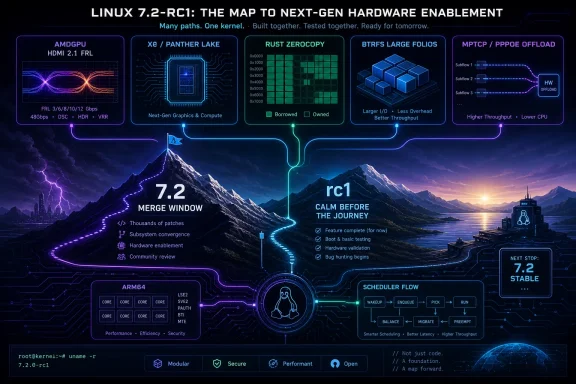
One of the headline changes in Linux 7.2 is initial HDMI 2.1 Fixed Rate Link support in the AMDGPU driver. That sounds narrow, but it lands in a long-running and sometimes frustrating corner of the Linux graphics stack. Modern displays are no longer simple rectangles plugged into simple ports; they are high-bandwidth, high-refresh, HDR-capable, variable-refresh ecosystems where the kernel driver, firmware, display engine, cable, monitor, and userspace stack all have to agree.HDMI 2.1 FRL matters because it is part of the path to higher resolutions and refresh rates over HDMI. For Linux desktop users, especially those using AMD hardware with TVs or gaming monitors, this is the kind of support that can decide whether a machine feels first-class or compromised. It is also a reminder that “Linux hardware support” often means years of patient enablement rather than one dramatic patch.
The politics around HDMI support have long been more complicated than DisplayPort because of licensing and specification access. Linux has often been strongest where open standards and open documentation let developers move quickly. When the industry routes consumer hardware through more restrictive channels, open-source operating systems feel the friction.
That makes the AMDGPU work in Linux 7.2 more than another driver bullet point. It is part of the broader effort to make Linux viable on the same living-room and gaming displays that Windows users take for granted. The gap is not closed by slogans about open source; it is closed by patches like this.
Intel’s Next Platforms Are Already Casting Shadows
Linux 7.2 also brings more Intel enablement, including initial CRI platform support for the Intel Xe driver and CPU model number support for Panther Lake R series processors. These are not features most users can toggle. They are upstream breadcrumbs for hardware that vendors, OEMs, and distro engineers need to support before retail availability becomes widespread.The Intel Xe driver is especially important because it represents Intel’s modern graphics driver path in the kernel. For years, Intel graphics on Linux benefited from unusually strong upstream support compared with many competitors. But the transition to newer GPU architectures and driver models is still work, not magic.
Panther Lake-related support fits the same pattern. The kernel needs to identify CPUs correctly, expose capabilities cleanly, and allow the rest of the stack to make sane decisions. By the time a new laptop platform shows up in a review unit, the upstream kernel work may already have been underway for months.
This is where Linux differs sharply from Windows in public perception. Windows users often experience hardware support as a vendor driver package delivered through Windows Update, an OEM image, or a support page. Linux users see more of the plumbing because upstreaming is public, incremental, and argumentative by design.
Rust Keeps Moving From Experiment to Infrastructure
Linux 7.2 reportedly adds support for a “zerocopy” library to the kernel’s Rust support, aimed at making low-cost memory manipulation easier. That phrase will not excite every administrator, but it points to one of the most watched long-term bets inside the kernel. Rust in Linux is not about rewriting the kernel in Rust. It is about allowing selected new code to use stronger memory-safety guarantees without abandoning the C codebase that built the operating system.The “zerocopy” concept matters because kernels spend their lives moving, mapping, sharing, and interpreting memory. Every extra copy costs performance; every unsafe interpretation risks bugs. A Rust abstraction that helps developers work with memory layouts efficiently and safely is exactly the sort of small infrastructure piece that can make future Rust drivers more credible.
This is still an incremental story. Nobody should read Linux 7.2-rc1 as the moment Rust takes over the kernel. The more accurate framing is that Rust is slowly gaining the boring support structures it needs to be useful in real kernel work.
That distinction matters because Rust discussions often collapse into ideology. The kernel community is not adopting Rust because the internet likes language wars. It is doing so because some classes of kernel bugs are expensive, security-sensitive, and stubbornly common, and because new driver code may be a practical place to test whether stronger language tooling can help.
Btrfs Large Folios Hint at the Filesystem Performance War Beneath the Surface
Another notable Linux 7.2 change is enabling large folios by default for Btrfs. Filesystem changes rarely have the surface appeal of GPU support, but they often matter more to people running real machines. A filesystem is where performance, integrity, snapshots, compression, repair tools, and failure modes meet the user’s data.Large folios are part of the kernel’s broader memory-management evolution. In simplified terms, they allow the kernel to handle memory in larger chunks than traditional small pages in some paths, reducing overhead and potentially improving throughput. For a filesystem like Btrfs, which is already complex because of copy-on-write behavior and advanced features, defaulting to large folios signals confidence that the benefits are ready for wider testing.
Btrfs remains one of Linux’s most ambitious mainstream filesystems. It has won fans through snapshots, checksumming, compression, and flexible volume management, while also carrying a reputation shaped by earlier cautionary tales and workload-specific caveats. Kernel changes like this do not settle those debates, but they do show active investment in making Btrfs faster and more scalable.
For Windows users comparing filesystems, Btrfs is not a direct NTFS analog. It is closer to an argument about what a modern local filesystem should be allowed to do. Linux 7.2’s Btrfs work continues that argument at the memory-management layer, where user-visible wins may appear only after distributions and benchmarks catch up.
ARM64 Is No Longer the Alternative Architecture
Linux 7.2 includes new hardware capability flags for 2025 dpISA extensions on AArch64, along with device-tree updates for 64-bit NXP/Freescale and Qualcomm platforms. In older Linux coverage, ARM support could be treated as a side quest. That framing no longer works.ARM64 is now central to phones, tablets, embedded systems, servers, developer boards, networking hardware, and increasingly laptops. Qualcomm’s Windows-on-Arm push has also made ARM a Windows story, not merely a Linux one. The same architectural contest that shapes Linux kernel patches shapes the future of Windows PCs.
Device-tree updates are the unglamorous part of that contest. They describe hardware so the kernel can initialize and manage it properly. When device-tree support improves, boards boot more reliably, peripherals work with fewer hacks, and downstream vendors have less excuse to ship ancient forked kernels.
The AArch64 hwcaps work points in a different direction: exposing CPU capabilities so software can take advantage of newer instruction-set features. Performance is not only about faster cores. It is about letting the operating system and userspace know what the silicon can actually do.
Networking Changes Keep Linux Ahead of the Weird Edge Cases
Linux 7.2 also brings MPTCP signaling support for IPv6 addresses and GRO/GSO support for PPPoE. These are the sort of networking changes that many desktop users will skim past, but sysadmins should not. Linux’s networking stack is one of the reasons the kernel dominates servers, appliances, containers, routers, and cloud infrastructure.Multipath TCP allows connections to use multiple network paths, improving resilience and potentially throughput when devices have more than one route available. Better IPv6 signaling support matters because IPv6 is no longer a future migration story; it is deployed reality, unevenly adopted but unavoidable.
GRO and GSO support for PPPoE is similarly practical. Generic Receive Offload and Generic Segmentation Offload are performance mechanisms that reduce packet-processing overhead. PPPoE may sound like a relic to some users, but it remains relevant in broadband deployments, and performance improvements there can matter in the real world.
This is the kernel at its least flashy and most valuable. Nobody buys a laptop because a release candidate improved PPPoE offload behavior. But millions of users benefit when the Linux systems moving their packets get a little more efficient.
Scheduler Work Is Where Small Numbers Become Big Outcomes
The Linux 7.2 merge window also includes SMP load-balancing updates. Scheduler changes are notoriously difficult to explain because they sit between hardware topology, workload behavior, power management, latency, throughput, and fairness. They are also among the changes most likely to produce passionate arguments, because a scheduler improvement for one workload can be noise or regression for another.SMP load balancing is about how work gets distributed across multiple CPUs or cores. That used to be simpler when machines had fewer, more uniform cores. Modern systems are messier: hybrid CPU designs, chiplets, NUMA effects, cache hierarchies, power constraints, and thermal limits all complicate the idea of “just run the task on another core.”
This is one reason kernel development has become more hardware-specific without becoming less general-purpose. The kernel has to understand more about the shape of machines while still presenting a coherent operating system to everyone above it. Linux 7.2’s scheduler updates are part of that ongoing negotiation.
For desktop users, scheduler work can show up as smoother interactivity, better compile times, improved gaming frame pacing, or no visible difference at all. For cloud operators, the same class of change can affect fleet density and tail latency. That is why scheduler patches receive attention out of proportion to their readability.
Release Candidates Are for Test Machines, Not Heroics
The usual warning applies with extra force: Linux 7.2-rc1 is not a production kernel. It is meant for testing, early integration, driver validation, and brave users who know how to recover from a bad boot. Installing it on a workstation you need for Monday morning is less enthusiasm than poor change control.That does not mean ordinary users have no role to play. The kernel depends on wide testing across hardware combinations vendors may not have in their labs. If you have a spare machine, a secondary boot entry, or a test VM that exercises a real workload, release candidates are where useful bug reports begin.
The best testing is boring and specific. Boot it, suspend it, resume it, stress the filesystem, check the display modes, run the workload you actually care about, and compare behavior against a known-good kernel. “It broke” is less useful than “this laptop with this GPU fails to resume after rc1 while 7.1 works.”
For administrators, the calculus is different. The release candidate is not something to deploy, but it is something to watch. If Linux 7.2 contains hardware enablement or filesystem behavior relevant to your estate, now is the time to identify it, not after a downstream distribution pulls the kernel into a release stream.
The Windows Angle Is Bigger Than WSL
It would be easy to reduce Linux kernel news for a Windows audience to WSL, and WSL is certainly part of the story. Microsoft’s Linux compatibility layer depends on a real Linux kernel, and developers who live in Windows terminals often care when upstream Linux gains filesystem, networking, or architecture improvements. But the Windows angle is broader than that.Linux is now the infrastructure substrate around Windows. The web services accessed from Windows clients often run on Linux. The containers built on Windows workstations often deploy to Linux clusters. The storage appliances, VPN concentrators, CI runners, home servers, and hypervisors surrounding Windows environments frequently rely on Linux kernels.
There is also competitive pressure. Linux gaming, once a punchline, is now credible enough that GPU, display, scheduler, and filesystem changes matter to people who might otherwise be Windows-only players. SteamOS and handheld PCs have made Linux performance and compatibility a consumer issue rather than a purely ideological one.
Even Microsoft’s own world has adapted. Azure is full of Linux. Windows developers use Linux tooling. Security teams investigate Linux vulnerabilities because mixed estates are normal. A mainline kernel release candidate is therefore not foreign news; it is part of the operating-system weather system Windows professionals already live in.
The Real Story Is Hardware Enablement Before Hardware Hype
Linux 7.2-rc1 is full of signs that the kernel is preparing for hardware before most users can buy it or fully exploit it. Panther Lake identifiers, Xe platform support, AMDGPU display plumbing, ARM64 capability flags, Qualcomm and NXP device-tree updates: these are not random patch notes. They are the upstream shadow of the next hardware cycle.That is one of Linux’s great strengths and one of its permanent frustrations. The work is visible early, but the payoff arrives unevenly. A feature may be in mainline before your distribution ships it, before your firmware exposes it properly, before your desktop stack uses it, or before your device vendor stops carrying an out-of-tree workaround.
Windows hides more of this process behind vendor coordination and driver distribution channels. That can make the experience feel cleaner, especially on certified hardware. But it also means users see less of the negotiation between silicon reality and operating-system support.
Linux shows the sausage being made. Linux 7.2-rc1 is very much sausage-making: register definitions, driver hooks, memory abstractions, hardware descriptions, scheduler adjustments, and filesystem defaults. The result may later look effortless. It is not.
The August Kernel Will Be Judged Downstream
Assuming the cycle stays on track, Linux 7.2 should become stable in mid-to-late August 2026. But stable upstream does not mean instantly relevant everywhere. Rolling distributions may pick it up quickly, while conservative enterprise distributions will backport selected fixes and enablement on their own timelines.That downstream filtering is where kernel news becomes user experience. A Fedora user, an Arch user, an Ubuntu LTS user, a Debian stable user, and a Proxmox administrator may all encounter Linux 7.2 differently. Some will run the actual kernel soon. Others will see pieces of it quietly backported months later.
Hardware vendors also complicate the story. A kernel can contain support that still depends on firmware, BIOS updates, Mesa releases, user-space libraries, or distribution configuration. Kernel support is necessary, but it is rarely sufficient.
That is why rc1 should be read as a directional document. It tells us what upstream has accepted, what needs testing, and which areas are active. It does not guarantee that every user will benefit on the same schedule.
The Patch Notes Point to a Kernel Built for the Next Wave
Linux 7.2-rc1 is not a revolution, and that is the point. The kernel’s power comes from disciplined accumulation: one display feature here, one filesystem default there, one architecture capability flag, one networking offload path, one Rust abstraction, one scheduler refinement. The result is not a single dramatic feature but a platform that keeps absorbing the future before the future has a retail box.The most concrete signals from this first release candidate are already clear:
- Linux 7.2-rc1 begins the public test phase after the two-week merge window that followed Linux 7.1.
- The stable Linux 7.2 release is likely to land in the second half of August 2026 if the cycle follows the usual seven- or eight-candidate pattern.
- AMDGPU’s initial HDMI 2.1 FRL support is a meaningful step for high-end display compatibility on Linux systems.
- Intel Xe and Panther Lake-related enablement show the kernel preparing for upcoming client hardware before it reaches most users.
- Rust support continues to mature through infrastructure such as zerocopy rather than through any sudden rewrite of the kernel.
- Filesystem, networking, ARM64, scheduler, and driver changes make this a broad platform release rather than a single-feature event.
References
- Primary source: 9to5Linux
Published: 2026-06-28T19:07:12.958916
- Related coverage: phoronix.com
Linux Dropping Old Drivers, AI Detected Vulnerabilities & Other Kernel Highlights Of Q2 - Phoronix
With Q2'2026 quickly coming to an end, here's a recap of the most popular Linux kernel news over the past three months on Phoronix.www.phoronix.com
- Related coverage: tomshardware.com
After 34 years, the Linux kernel community finally has a contingency plan to replace Linus Torvalds — formal plan drawn up now community is 'getting grey and old' | Tom's Hardware
Eeny, meeny, miny, moe...www.tomshardware.com - Related coverage: techradar.com
Linux finally plans life after Linus as aging kernel leaders admit one person running everything was risky long-term | TechRadar
Linux kernel quietly accepts reality by drafting rules for successionwww.techradar.com - Related coverage: opennet.ru
- Related coverage: pcgamer.com
The Linux community now has a succession plan for when Linus Torvalds checks out, after an apparently uplifting discussion about 'our eventual march toward death' | PC Gamer
In the absence of an agreed-upon process, the community would find itself playing Calvinball at an awkward time.www.pcgamer.com
- Related coverage: pcworld.com
The big new Linux release isn't a big deal | PCWorld
Linus Torvalds has announced the release candidate for the Linux 7.0 kernel, which is available for you to try.www.pcworld.com - Related coverage: charlie27.com
2026-06-19 — Linux 7.2 合併視窗快取感知排程落地、RMR/BRMR 提出單跳 RDMA 區塊複製新方案 - Charlie27's Blog
primary=https://lwn.net/Articles/1078068/ primary=https://www.phoronix.com/news/Linux-7.2-Scheduler primary=https://www.phoronix.com/news/Linux-7.2-Storage primary=https://www.phoronix.com/news/Linux-7.2-Rust primary=https://lwn.net/Articles/1074291/... www.charlie27.com
- Related coverage: upd.dev
- Related coverage: linuxteck.com
Why Linux Kernel 7.1 Is An Important Update | LinuxTeck
Linux kernel 7.1 shipped on June 14, 2026, announced by Linus Torvalds from a different timezone mid-travel. The release delivers a new in-kernel NTFSwww.linuxteck.com - Related coverage: spinics.net
[GIT PULL] ext4 changes for 7.2-rc1 — Linux Kernel
Linux Kernel: [GIT PULL] ext4 changes for 7.2-rc1 www.spinics.net
- Related coverage: jnikula.github.io
- Related coverage: releasealert.dev
Releases · torvalds/linux - GitHub | Release Alert
Latest releases for torvalds/linux on GitHub. Latest version: v7.2-rc1, last published: June 28, 2026releasealert.dev - Related coverage: archive.fosdem.org
Linux Kernel Mainline Real-Time History, Support and Experience Based on Robotic and Automotive Projects
PDF documentarchive.fosdem.org