

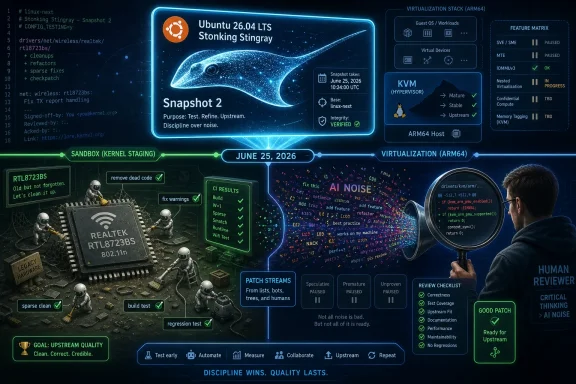
Ubuntu 26.10 “Stonking Stingray” Snapshot 2 was released on June 25, 2026, as Canonical’s second monthly test image for the next interim Ubuntu release, arriving alongside Linux 7.2 development news about Realtek Wi-Fi cleanup and stalled ARM64 KVM feature work. The three updates look unrelated at first glance. They are not. Together, they show a Linux ecosystem trying to keep its calendar moving while the kernel’s maintainers absorb old driver debt, new virtualization demands, and a rising tide of AI-assisted patch noise.
Canonical’s Snapshot 2 is not meant to be exciting in the consumer-product sense. It is not a polished beta, not a release candidate, and certainly not a build anyone should treat as a production operating system. The Ubuntu release team described these images as throwaway artifacts, which is unusually blunt and exactly the right framing.
That phrasing matters because Ubuntu’s monthly snapshot program is less about giving enthusiasts a shiny ISO and more about exercising the machinery that will matter in October. Installer paths, image publication, flavor coordination, mirror behavior, and release metadata all have to work repeatedly before they work reliably. A monthly snapshot gives Canonical a controlled rehearsal instead of waiting for the traditional panic around beta week.
For WindowsForum readers who dual-boot, run Linux in labs, or maintain Ubuntu images in mixed estates, the immediate practical advice is simple: Snapshot 2 is for testing, not trust. But the strategic point is more interesting. Canonical is trying to make the development branch more observable at regular intervals, and that is the sort of boring process change that often pays off more than a flashy feature.
Ubuntu 26.10 is expected to bring a newer GNOME stack, Linux 7.2, and the usual rolling wave of toolchain and desktop updates over Ubuntu 26.04 LTS. Snapshot 2 is therefore a photograph of a moving target. The value is not that this snapshot reveals the final form of Stonking Stingray; it is that Canonical is forcing the target to be photographed on schedule.
The Realtek RTL8723BS story belongs to the first category. The driver entered the Linux kernel’s staging area back in the Linux 4.12 era, and nearly a decade later it is still being reworked. In Linux terms, staging is supposed to be a probationary zone: code can land because it is useful, but it is not yet up to the standards expected of a mature subsystem. The hope is that contributors clean it up, align it with kernel conventions, and eventually graduate it.
The problem is that hope is not a project plan. The RTL8723BS driver has survived as an ongoing cleanup exercise because the hardware mattered to real devices, but the code reportedly came with wrappers, abstractions, and patterns that do not fit neatly with the rest of Linux networking. Linux 7.2’s staging pull once again spends substantial energy on this driver, with more than a hundred patches aimed at making the code less idiosyncratic and more maintainable.
That is not glamorous kernel work. It is also not optional. Users experience “Linux hardware support” as a binary question — does my Wi-Fi work or not? — but maintainers experience it as a long series of compromises between accepting ugly code for working hardware and enforcing standards that keep the kernel survivable.
The Linux kernel’s hardware support story is not built only around the latest AMD GPU, Intel platform, or Arm server board. It is also built around keeping unglamorous hardware alive long after the vendor marketing cycle has moved on. The desktop Linux community often treats this as a moral victory, and sometimes it is. But it is also a maintenance liability.
The phrase “beast of a driver” is funny because it is true in the way kernel maintainers use humor: as a pressure valve. A beast is not merely large. It resists domestication. The continuing RTL8723BS cleanup suggests a driver that has been useful enough to keep, problematic enough to remain in staging, and complicated enough to consume reviewer attention cycle after cycle.
For IT pros, the lesson is not that Realtek is uniquely bad or that old Wi-Fi chips are inherently dangerous. The lesson is that hardware enablement has a carrying cost. Every cheap component that ships in volume can become a long-term upstream obligation if enough users still need it and enough maintainers are willing to keep wrestling with the code.
This is where the argument becomes less about Linux and more about software engineering in 2026. AI tools can generate plausible patches quickly. They can also generate plausible-looking nonsense, duplicate work, subtly wrong fixes, and changes that impose a review tax on maintainers who did not ask for another queue to triage. In a project like Linux, the bottleneck has never been merely patch production. The bottleneck is trust.
Kernel development depends on a social and technical chain of custody. A patch is not just a diff; it is an assertion that someone understands the bug, the subsystem, the hardware implications, and the failure modes. When maintainers see more patches that look machine-assisted but still require expert validation, their workload expands even if the code volume looks productive from the outside.
The uncomfortable reality is that AI can make a project look more active while making it harder to move. If enough low-value or uncertain fixes hit a mailing list, maintainers have to spend scarce time separating real improvements from noise. That time comes from somewhere. In ARM64 KVM for Linux 7.2, it appears to have come from new feature review.
The Linux 7.2 KVM pull is not empty. x86 sees improvements on both Intel and AMD sides, including work around nested virtualization and confidential-computing-adjacent plumbing. RISC-V and s390 also receive meaningful changes. The striking asymmetry is that ARM64 KVM gets fixes but no new features.
That matters because ARM64 is no longer a niche curiosity in virtualization. Arm servers, developer boards, cloud instances, and Apple-adjacent cross-platform workflows have made ARM64 a real target for infrastructure planning. The Windows world has also been inching toward more serious Arm usage, with Windows on Arm, Arm-based developer kits, and cross-architecture testing becoming harder to ignore.
A feature pause in ARM64 KVM does not mean the architecture is in trouble. It does mean maintainers are making a rational trade: stabilize first, expand later. But if AI-generated patch volume continues to consume review capacity, the trade could become a recurring pattern rather than a one-cycle anomaly.
This is why the Snapshot 2 release should not be dismissed as a minor ISO announcement. The monthly snapshot model gives Canonical more chances to catch integration problems while those upstream components are still in flux. If Linux 7.2 carries unusual maintenance dynamics, Ubuntu’s regular snapshots become more valuable, not less.
There is also a release-management lesson here for organizations that consume Ubuntu but do not follow Ubuntu development closely. Interim releases are where Canonical can absorb newer kernels and desktops before the next long-term support cycle. Even if most enterprises stay on LTS, the quality of an LTS is influenced by what was learned in the interim releases before it.
That is especially true for hardware support. A cleaned-up Wi-Fi driver, a stabilized KVM path, or a release-image process that fails early instead of late may not appear in a marketing bullet. But those are the sorts of things that determine whether a Linux deployment feels professional or fragile.
Ubuntu 26.10 Snapshot 2 is not something most Windows users should install on bare metal today. But it is something lab users may test in VMs, and it is a signal about where Ubuntu’s next generation is heading. If Linux 7.2 lands as planned in the release, Stonking Stingray becomes an early mainstream distribution vehicle for that kernel’s hardware and virtualization changes.
The Realtek story has a direct Windows-adjacent resonance because cheap Wi-Fi hardware is common in the sort of secondary machines people repurpose for Linux. A device that worked under Windows thanks to a vendor driver may depend on years of community cleanup to behave properly under Linux. That gap between vendor enablement and upstream quality is where many migration frustrations are born.
The KVM story matters because virtualization is now a daily workflow, not a specialist’s toy. Developers run nested labs. Admins test deployment scripts. Security teams reproduce malware behavior in isolated environments. If ARM64 virtualization development slows, even temporarily, it affects the long-term diversity of platforms available for those workflows.
There is a difference between AI-assisted development and AI-abandoned development. The first can be useful: a competent developer uses tools to draft, test, explain, or explore a fix, then takes ownership of the result. The second is corrosive: generated patches are thrown over the wall in the hope that maintainers will do the hard part.
Kernel maintainers are not code janitors for the internet. They are domain experts managing a system where mistakes can crash machines, corrupt data, weaken security boundaries, or break hardware support for users who have no idea which patch caused the regression. Their skepticism is not conservatism for its own sake. It is operational memory.
The RTL8723BS cleanup and ARM64 KVM pause are therefore two sides of the same maintenance economy. Old code consumes attention because it was accepted before it was clean. New AI-generated code consumes attention because it may look clean before it is understood. In both cases, the scarce resource is not text. It is qualified review.
The traditional Linux release rhythm already contains many checkpoints: kernel merge windows, release candidates, distro freezes, beta milestones, and final releases. But users and downstream teams often encounter the results only when something breaks. Monthly snapshots create more moments for outside testing to intersect with release engineering.
That does not guarantee quality. A bad process can publish monthly bad builds with admirable punctuality. But a disciplined process can turn regular publication into a feedback loop, especially when flavors, mirrors, installers, and image naming conventions are all part of the test.
The Ubuntu release team’s note that all 30 images were published, even as some content-cache behavior was still settling, is the kind of detail that release engineers notice. It suggests that the snapshot program is exercising not only package contents but the distribution pipeline itself. That is exactly what should be tested before a release becomes precious.
Ubuntu is under calendar pressure because an October release has to become real through repeated integration. The staging tree is under maintenance pressure because useful hardware support can arrive in ugly code shapes that take years to normalize. KVM maintainers are under review pressure because the economics of patch submission are changing faster than the culture of patch responsibility.
None of this means Linux is failing. On the contrary, it is what a mature platform looks like when it is honest about its plumbing. Windows has its own analogous problems, hidden behind different development models and vendor channels. Linux exposes more of the argument in public, which can make the ecosystem look chaotic even when the process is functioning as designed.
The danger is not that Linux has old drivers, noisy patches, or conservative maintainers. The danger is pretending those things are separate from the user experience. Every successful boot, working Wi-Fi adapter, stable VM, and clean distro upgrade depends on people doing unglamorous work before users notice.
 Ubuntu’s Monthly Snapshot Is Really a Test of Discipline
Canonical’s Snapshot 2 is not meant to be exciting in the consumer-product sense. It is not a polished beta, not a release candidate, and certainly not a build anyone should treat as a production operating system. The Ubuntu release team described these images as throwaway artifacts, which is unusually blunt and exactly the right framing.That phrasing matters because Ubuntu’s monthly snapshot program is less about giving enthusiasts a shiny ISO and more about exercising the machinery that will matter in October. Installer paths, image publication, flavor coordination, mirror behavior, and release metadata all have to work repeatedly before they work reliably. A monthly snapshot gives Canonical a controlled rehearsal instead of waiting for the traditional panic around beta week.
For WindowsForum readers who dual-boot, run Linux in labs, or maintain Ubuntu images in mixed estates, the immediate practical advice is simple: Snapshot 2 is for testing, not trust. But the strategic point is more interesting. Canonical is trying to make the development branch more observable at regular intervals, and that is the sort of boring process change that often pays off more than a flashy feature.
Ubuntu 26.10 is expected to bring a newer GNOME stack, Linux 7.2, and the usual rolling wave of toolchain and desktop updates over Ubuntu 26.04 LTS. Snapshot 2 is therefore a photograph of a moving target. The value is not that this snapshot reveals the final form of Stonking Stingray; it is that Canonical is forcing the target to be photographed on schedule.
The Kernel Underneath Is Carrying More Than New Features
The timing of Snapshot 2 is awkward in a useful way. As Canonical packages the next Ubuntu release around Linux 7.2, upstream kernel development is showing two different forms of maintenance stress. One is ancient and familiar: messy hardware drivers that take years to clean up. The other is newer and more culturally charged: maintainers being flooded with AI-generated or AI-assisted fixes that still require human review.The Realtek RTL8723BS story belongs to the first category. The driver entered the Linux kernel’s staging area back in the Linux 4.12 era, and nearly a decade later it is still being reworked. In Linux terms, staging is supposed to be a probationary zone: code can land because it is useful, but it is not yet up to the standards expected of a mature subsystem. The hope is that contributors clean it up, align it with kernel conventions, and eventually graduate it.
The problem is that hope is not a project plan. The RTL8723BS driver has survived as an ongoing cleanup exercise because the hardware mattered to real devices, but the code reportedly came with wrappers, abstractions, and patterns that do not fit neatly with the rest of Linux networking. Linux 7.2’s staging pull once again spends substantial energy on this driver, with more than a hundred patches aimed at making the code less idiosyncratic and more maintainable.
That is not glamorous kernel work. It is also not optional. Users experience “Linux hardware support” as a binary question — does my Wi-Fi work or not? — but maintainers experience it as a long series of compromises between accepting ugly code for working hardware and enforcing standards that keep the kernel survivable.
The Realtek Driver Is a Warning About Hardware’s Long Tail
Realtek’s RTL8723BS is not a flagship chipset in 2026. It is an older 802.11n-era Wi-Fi part with Bluetooth 4.0 support, the kind of component found in inexpensive tablets, small systems, and machines that refuse to disappear from closets, classrooms, repair benches, and hobbyist shelves. That is precisely why it matters.The Linux kernel’s hardware support story is not built only around the latest AMD GPU, Intel platform, or Arm server board. It is also built around keeping unglamorous hardware alive long after the vendor marketing cycle has moved on. The desktop Linux community often treats this as a moral victory, and sometimes it is. But it is also a maintenance liability.
The phrase “beast of a driver” is funny because it is true in the way kernel maintainers use humor: as a pressure valve. A beast is not merely large. It resists domestication. The continuing RTL8723BS cleanup suggests a driver that has been useful enough to keep, problematic enough to remain in staging, and complicated enough to consume reviewer attention cycle after cycle.
For IT pros, the lesson is not that Realtek is uniquely bad or that old Wi-Fi chips are inherently dangerous. The lesson is that hardware enablement has a carrying cost. Every cheap component that ships in volume can become a long-term upstream obligation if enough users still need it and enough maintainers are willing to keep wrestling with the code.
AI Patch Noise Has Become a Scheduling Problem
The ARM64 KVM update is the more modern headache. For Linux 7.2, the ARM64 side of KVM reportedly has no new features because maintainers are spending their review bandwidth on fixes, including a wave described as AI-fueled. That is a striking milestone, not because AI-assisted coding exists, but because it is now being blamed for displacing feature work in a major kernel subsystem.This is where the argument becomes less about Linux and more about software engineering in 2026. AI tools can generate plausible patches quickly. They can also generate plausible-looking nonsense, duplicate work, subtly wrong fixes, and changes that impose a review tax on maintainers who did not ask for another queue to triage. In a project like Linux, the bottleneck has never been merely patch production. The bottleneck is trust.
Kernel development depends on a social and technical chain of custody. A patch is not just a diff; it is an assertion that someone understands the bug, the subsystem, the hardware implications, and the failure modes. When maintainers see more patches that look machine-assisted but still require expert validation, their workload expands even if the code volume looks productive from the outside.
The uncomfortable reality is that AI can make a project look more active while making it harder to move. If enough low-value or uncertain fixes hit a mailing list, maintainers have to spend scarce time separating real improvements from noise. That time comes from somewhere. In ARM64 KVM for Linux 7.2, it appears to have come from new feature review.
Virtualization Is Where Delay Becomes Visible
KVM is not an obscure corner of the kernel. It is the foundation under a large amount of Linux virtualization, cloud infrastructure, developer tooling, and lab automation. When KVM work slows in a particular architecture, the effects may not be obvious to a desktop user booting Ubuntu on a laptop, but they matter to the people building the platforms underneath.The Linux 7.2 KVM pull is not empty. x86 sees improvements on both Intel and AMD sides, including work around nested virtualization and confidential-computing-adjacent plumbing. RISC-V and s390 also receive meaningful changes. The striking asymmetry is that ARM64 KVM gets fixes but no new features.
That matters because ARM64 is no longer a niche curiosity in virtualization. Arm servers, developer boards, cloud instances, and Apple-adjacent cross-platform workflows have made ARM64 a real target for infrastructure planning. The Windows world has also been inching toward more serious Arm usage, with Windows on Arm, Arm-based developer kits, and cross-architecture testing becoming harder to ignore.
A feature pause in ARM64 KVM does not mean the architecture is in trouble. It does mean maintainers are making a rational trade: stabilize first, expand later. But if AI-generated patch volume continues to consume review capacity, the trade could become a recurring pattern rather than a one-cycle anomaly.
Ubuntu Inherits the Upstream Mood
Canonical can publish Snapshot 2 on schedule, but it cannot insulate Ubuntu 26.10 from the upstream realities of Linux 7.2. That is the core tension of distribution engineering. A distro can curate, integrate, patch, and test, but it still depends on the kernel, desktop, compiler, graphics, virtualization, and driver communities to deliver coherent building blocks.This is why the Snapshot 2 release should not be dismissed as a minor ISO announcement. The monthly snapshot model gives Canonical more chances to catch integration problems while those upstream components are still in flux. If Linux 7.2 carries unusual maintenance dynamics, Ubuntu’s regular snapshots become more valuable, not less.
There is also a release-management lesson here for organizations that consume Ubuntu but do not follow Ubuntu development closely. Interim releases are where Canonical can absorb newer kernels and desktops before the next long-term support cycle. Even if most enterprises stay on LTS, the quality of an LTS is influenced by what was learned in the interim releases before it.
That is especially true for hardware support. A cleaned-up Wi-Fi driver, a stabilized KVM path, or a release-image process that fails early instead of late may not appear in a marketing bullet. But those are the sorts of things that determine whether a Linux deployment feels professional or fragile.
The Windows Angle Is Not Just Dual-Boot Nostalgia
WindowsForum readers do not need to be persuaded that Linux matters. Many use it through WSL, Hyper-V, Proxmox, cloud images, rescue media, or dual-boot systems. The boundary between Windows administration and Linux competence has been porous for years, and Ubuntu remains one of the most common ways that boundary is crossed.Ubuntu 26.10 Snapshot 2 is not something most Windows users should install on bare metal today. But it is something lab users may test in VMs, and it is a signal about where Ubuntu’s next generation is heading. If Linux 7.2 lands as planned in the release, Stonking Stingray becomes an early mainstream distribution vehicle for that kernel’s hardware and virtualization changes.
The Realtek story has a direct Windows-adjacent resonance because cheap Wi-Fi hardware is common in the sort of secondary machines people repurpose for Linux. A device that worked under Windows thanks to a vendor driver may depend on years of community cleanup to behave properly under Linux. That gap between vendor enablement and upstream quality is where many migration frustrations are born.
The KVM story matters because virtualization is now a daily workflow, not a specialist’s toy. Developers run nested labs. Admins test deployment scripts. Security teams reproduce malware behavior in isolated environments. If ARM64 virtualization development slows, even temporarily, it affects the long-term diversity of platforms available for those workflows.
The Open Source Bargain Is Getting More Expensive
Open source has always run on a bargain: users get access to code, vendors get ecosystem value, and maintainers absorb much of the coordination cost. That bargain works when the flow of contributions is roughly matched by review capacity and when contributors bring enough context to reduce the burden on maintainers. AI threatens to upset that balance if it increases submission volume without increasing responsibility.There is a difference between AI-assisted development and AI-abandoned development. The first can be useful: a competent developer uses tools to draft, test, explain, or explore a fix, then takes ownership of the result. The second is corrosive: generated patches are thrown over the wall in the hope that maintainers will do the hard part.
Kernel maintainers are not code janitors for the internet. They are domain experts managing a system where mistakes can crash machines, corrupt data, weaken security boundaries, or break hardware support for users who have no idea which patch caused the regression. Their skepticism is not conservatism for its own sake. It is operational memory.
The RTL8723BS cleanup and ARM64 KVM pause are therefore two sides of the same maintenance economy. Old code consumes attention because it was accepted before it was clean. New AI-generated code consumes attention because it may look clean before it is understood. In both cases, the scarce resource is not text. It is qualified review.
Release Cadence Is Becoming a Competitive Feature
Canonical’s monthly snapshot approach should be read against that backdrop. In a world where upstream development is noisy, distributions that can make integration visible at predictable intervals have an advantage. A snapshot is not just an ISO; it is a checkpoint.The traditional Linux release rhythm already contains many checkpoints: kernel merge windows, release candidates, distro freezes, beta milestones, and final releases. But users and downstream teams often encounter the results only when something breaks. Monthly snapshots create more moments for outside testing to intersect with release engineering.
That does not guarantee quality. A bad process can publish monthly bad builds with admirable punctuality. But a disciplined process can turn regular publication into a feedback loop, especially when flavors, mirrors, installers, and image naming conventions are all part of the test.
The Ubuntu release team’s note that all 30 images were published, even as some content-cache behavior was still settling, is the kind of detail that release engineers notice. It suggests that the snapshot program is exercising not only package contents but the distribution pipeline itself. That is exactly what should be tested before a release becomes precious.
The Feature Story Is Smaller Than the Systems Story
It would be easy to reduce these updates to three headlines: Ubuntu has a new test snapshot, Realtek cleanup continues, and ARM64 KVM gets no new features. That summary is accurate and insufficient. The more important story is about systems under load.Ubuntu is under calendar pressure because an October release has to become real through repeated integration. The staging tree is under maintenance pressure because useful hardware support can arrive in ugly code shapes that take years to normalize. KVM maintainers are under review pressure because the economics of patch submission are changing faster than the culture of patch responsibility.
None of this means Linux is failing. On the contrary, it is what a mature platform looks like when it is honest about its plumbing. Windows has its own analogous problems, hidden behind different development models and vendor channels. Linux exposes more of the argument in public, which can make the ecosystem look chaotic even when the process is functioning as designed.
The danger is not that Linux has old drivers, noisy patches, or conservative maintainers. The danger is pretending those things are separate from the user experience. Every successful boot, working Wi-Fi adapter, stable VM, and clean distro upgrade depends on people doing unglamorous work before users notice.
Stonking Stingray’s Quiet Snapshot Carries a Loud Message
The practical conclusions from this week’s Linux and Ubuntu development news are modest but concrete. Snapshot 2 is useful because it is early and disposable. Linux 7.2 is interesting because its maintenance stories are as important as its feature stories. AI-assisted development is now a governance issue, not just a tooling trend.- Ubuntu 26.10 Snapshot 2 should be treated as a monthly test artifact for labs, VMs, and release-path validation, not as a dependable daily-driver image.
- Canonical’s monthly snapshot cadence gives testers more predictable opportunities to catch installer, image, flavor, and infrastructure problems before the October release.
- The RTL8723BS work shows that old hardware support can remain valuable while still imposing years of cleanup costs on kernel maintainers.
- The ARM64 KVM feature pause suggests that AI-generated patch volume can have real scheduling consequences when review capacity is the bottleneck.
- Windows administrators who rely on Ubuntu through WSL, VMs, cloud images, or dual-boot systems should watch Linux 7.2 less for headline features and more for the stability of its integration path.
References
- Primary source: Phoronix
Published: Fri, 26 Jun 2026 00:25:00 GMT
Ubuntu 26.10 Snapshot 2 Released For Monthly Testing - Phoronix
Daily ISOs of Ubuntu 26.10 'Stonking Stingray' continue to be published, but for those preferring something a bit more regulated, out today is Ubuntu 26.10 Snapshot 2 as the second monthly ISO image.www.phoronix.com
