

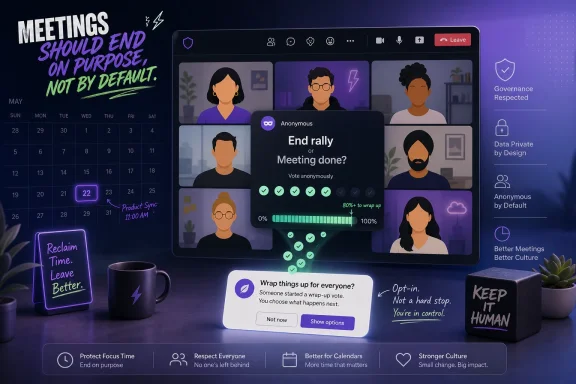
UX/UI and product designer Hanna Shevelova and colleagues built a two-day demo that lets Microsoft Teams meeting participants anonymously vote to end a meeting early, turning a meme about an “end rally” button into a working prototype shared on LinkedIn on May 31, 2026. The idea is comic, but the nerve it touches is real: Teams has become both workplace infrastructure and workplace weather. Everyone lives inside it, everyone complains about it, and almost nobody controls the room once the calendar has spoken.
The prototype is not a Microsoft feature, not an official Teams roadmap item, and not yet the kind of enterprise software that will survive a security review, a procurement queue, and a suspicious Teams admin. But it is a useful provocation because it reframes the meeting problem from productivity theater to product design. The question is not whether workers can leave a call. The question is why so many need permission to admit the call is over.
Shevelova described the project as “a startup in two days,” born from an image of an anonymous button for ending a Teams meeting. That origin matters. The strongest workplace tools often start as jokes because jokes are where employees say the thing the process manual will not.
The joke here is brutally simple: if enough people in a meeting are “morally exhausted,” the meeting ends democratically. In other words, the system stops pretending that endurance is engagement. Instead of silently checking email, turning cameras off, or waiting for a manager to release the room, participants get a hidden channel for collective truth.
That does not mean the feature should literally terminate every Teams call by majority vote. Enterprise collaboration software is full of asymmetries for good reasons: legal briefings, incident-response bridges, classrooms, board meetings, medical consults, and customer escalations cannot be run like a Twitch poll. But the meme works because most ordinary meetings are not those meetings.
The prototype also lands because Teams already contains the contradiction. Microsoft gives organizers and presenters the formal power to end meetings for everyone, while participants mostly get the softer power to leave, react, chat, or suffer. The democratic end button imagines a different social contract: the meeting exists only as long as the room still consents to it.
Yet platform richness is not the same as social agency. A meeting can have breakout rooms, live captions, recap features, app panels, chat, reactions, files, whiteboards, and attendance reports, while still failing the basic test of usefulness. The UI can be polished and the workflow can be integrated, but the human experience can remain: why are we still here?
That gap is where Shevelova’s prototype becomes interesting. It does not add another agenda template or another AI-generated summary. It attacks the meeting’s most protected assumption: that duration is set by the invite, not by usefulness.
The calendar is one of the last monarchies in office software. Once a 60-minute block exists, it tends to consume 60 minutes, even if the decision was made at minute 18. The democratic end button asks whether collaboration tools should merely host that ritual or help break it.
Nobody writes a requirements document saying, “Users need a covert way to express collective despair.” But the need is recognizable to anyone who has watched a meeting drift from decision-making into repetition. The value of the prototype is not that it solves every governance problem. It names a problem that enterprise software usually hides behind etiquette.
There is a long history of playful mechanics becoming serious interface patterns. Reactions were once frivolous; now they are meeting hygiene. Status indicators were once ambient; now they are management signals. Read receipts, emoji responses, typing indicators, and nudges all began as small social affordances before becoming part of the workplace stack.
A vote-to-end mechanism belongs to that family. It is not a scheduling feature. It is a social pressure valve. The fact that it feels transgressive is precisely why it deserves attention.
A mature product could tell the organizer that a threshold of participants believe the meeting has run its course. It could offer a graceful prompt: wrap up, convert remaining items to tasks, schedule a follow-up, or continue with a smaller group. The vote would not have to be a guillotine. It could be a dashboard light.
That distinction matters because the meeting problem is rarely only time. It is ambiguity. People do not know whether they are still needed, whether the decision has already been made, whether silence is agreement, or whether leaving will be interpreted as disrespect. Anonymous voting converts private fatigue into structured signal.
The strongest implementation would help organizers, not shame them. Most bad meetings are not hosted by villains. They are hosted by people trying to coordinate work with bad defaults, weak agendas, unclear decision rights, and too much calendar gravity. A tool that helps them see when the room is finished could be a kindness.
Teams apps can be powerful because they live close to the work. They can appear in meetings, participate in meeting workflows, and interact with users at the moment decisions are being made. That is also why administrators care about permissions, data handling, identity, retention, and whether an app introduces a side channel outside established compliance boundaries.
An anonymous voting tool raises immediate questions. Where are votes stored? Can the organizer see aggregate results only, or can an admin audit individual votes? Does the app process participant identities? Does it work for guests and external users? Can it be used in regulated meetings? Can a malicious participant spam the vote? Can a tenant restrict it to internal meetings?
Those are not reasons to dismiss the concept. They are the normal path from hackathon demo to enterprise software. In Microsoft 365, the idea is often the easy part. The hard part is proving that the idea behaves properly in a world of retention labels, eDiscovery, guest access, conditional access, and audit logs.
But anonymity in workplace systems is never neutral. It can protect candor, but it can also produce mischief, passive aggression, and plausible deniability. Anyone who has run anonymous Q&A in a town hall knows the trade-off: the best questions appear only when names disappear, and so do some of the worst behaviors.
A vote-to-end tool would need careful boundaries. It should probably show thresholds rather than raw drama. It should distinguish between “this meeting is complete” and “I personally want out.” It might need quorum rules, cooldowns, role-aware settings, and an organizer override.
The key is to avoid turning the meeting into a popularity contest. The goal is not to let the majority silence the minority or sabotage difficult conversations. The goal is to detect when the room has stopped producing value and give the host permission to land the plane.
AI meeting summaries are useful, especially for people who missed the call or need action items extracted from chaos. But they can also launder bad meeting culture by making every unnecessary discussion feel more manageable. If software can summarize the waste, the organization may feel less pressure to reduce it.
A vote-to-end mechanism points upstream. It treats meeting duration as a live design problem rather than an archival problem. The most efficient transcript is the one you never had to generate because the meeting ended when the work was done.
This is where the meme becomes a critique of the entire collaboration industry. Too many tools optimize around the assumption that more communication is always better. Workers know the opposite is often true. The scarce resource is not chat bandwidth or video fidelity. It is attention.
That is exactly how many meetings behave. They are scheduled as coordination but experienced as performance. Attendance becomes a signal of alignment. Speaking becomes a signal of engagement. Staying until the end becomes a signal of respect.
The democratic end button punctures that performance. It says the people in the room are not merely an audience for the meeting owner. They are participants with finite attention and legitimate judgment. If the meeting no longer needs them, the system should not conspire with etiquette to keep them trapped.
This is why the prototype drew interest from IT professionals. They recognized the absurdity because it was not absurd enough. It looked like a real product because the pain is real.
So Microsoft probably would not ship the meme version. It would soften it, rename it, wrap it in admin controls, and make it part of meeting insights. The button would become “Check engagement,” “Suggest wrap-up,” or “Collect readiness feedback.” The rebellion would be domesticated into telemetry.
That may be the right enterprise answer. But it would also lose some of the clarity that makes the prototype compelling. “End rally” is blunt in a way workplace software almost never is. It names the desired outcome instead of burying it under productivity euphemism.
The best product lesson is not that Microsoft should copy the button exactly. It is that Teams still has room for features that respect the emotional truth of work. People do not only need better ways to meet. They need better ways to stop meeting.
It may be meeting norms. It may be manager training. It may be the absence of agendas, decision owners, or documented outcomes. It may be that recurring meetings never expire, or that too many people are invited because the organization confuses transparency with attendance.
Teams administrators cannot fix all of that from the admin center. But they can influence defaults and culture. They can promote meeting templates, restrict unnecessary presenter rights, manage third-party apps carefully, and work with business leaders to define when meetings should be chats, documents, tasks, or recorded updates instead.
The prototype’s greatest value may be as a diagnostic. If employees love the idea, listen to what they are applauding. They are not merely cheering for a button. They are cheering for a little less helplessness.
The prototype is not a Microsoft feature, not an official Teams roadmap item, and not yet the kind of enterprise software that will survive a security review, a procurement queue, and a suspicious Teams admin. But it is a useful provocation because it reframes the meeting problem from productivity theater to product design. The question is not whether workers can leave a call. The question is why so many need permission to admit the call is over.
 A Meme Found the Weak Spot in the Meeting Machine
Shevelova described the project as “a startup in two days,” born from an image of an anonymous button for ending a Teams meeting. That origin matters. The strongest workplace tools often start as jokes because jokes are where employees say the thing the process manual will not.The joke here is brutally simple: if enough people in a meeting are “morally exhausted,” the meeting ends democratically. In other words, the system stops pretending that endurance is engagement. Instead of silently checking email, turning cameras off, or waiting for a manager to release the room, participants get a hidden channel for collective truth.
That does not mean the feature should literally terminate every Teams call by majority vote. Enterprise collaboration software is full of asymmetries for good reasons: legal briefings, incident-response bridges, classrooms, board meetings, medical consults, and customer escalations cannot be run like a Twitch poll. But the meme works because most ordinary meetings are not those meetings.
The prototype also lands because Teams already contains the contradiction. Microsoft gives organizers and presenters the formal power to end meetings for everyone, while participants mostly get the softer power to leave, react, chat, or suffer. The democratic end button imagines a different social contract: the meeting exists only as long as the room still consents to it.
Teams Has Controls, but the Calendar Still Rules the Room
Microsoft Teams is not short on meeting controls. Organizers can manage roles, presenters can steer sessions, apps can sit inside meetings, and polls can gather feedback. Microsoft has spent years turning Teams from a video-call window into a platform layer for work.Yet platform richness is not the same as social agency. A meeting can have breakout rooms, live captions, recap features, app panels, chat, reactions, files, whiteboards, and attendance reports, while still failing the basic test of usefulness. The UI can be polished and the workflow can be integrated, but the human experience can remain: why are we still here?
That gap is where Shevelova’s prototype becomes interesting. It does not add another agenda template or another AI-generated summary. It attacks the meeting’s most protected assumption: that duration is set by the invite, not by usefulness.
The calendar is one of the last monarchies in office software. Once a 60-minute block exists, it tends to consume 60 minutes, even if the decision was made at minute 18. The democratic end button asks whether collaboration tools should merely host that ritual or help break it.
The Best Product Ideas Often Look Unserious at First
The tech industry loves to tell itself that innovation begins with strategy decks, customer discovery, and market sizing. Sometimes it begins with a meme that refuses to die. That is especially true in workplace software, where the distance between official corporate language and daily user frustration is enormous.Nobody writes a requirements document saying, “Users need a covert way to express collective despair.” But the need is recognizable to anyone who has watched a meeting drift from decision-making into repetition. The value of the prototype is not that it solves every governance problem. It names a problem that enterprise software usually hides behind etiquette.
There is a long history of playful mechanics becoming serious interface patterns. Reactions were once frivolous; now they are meeting hygiene. Status indicators were once ambient; now they are management signals. Read receipts, emoji responses, typing indicators, and nudges all began as small social affordances before becoming part of the workplace stack.
A vote-to-end mechanism belongs to that family. It is not a scheduling feature. It is a social pressure valve. The fact that it feels transgressive is precisely why it deserves attention.
The Real Feature Is Not Ending the Meeting
If this idea ever became a serious Teams app, the most valuable version would probably not slam the door shut when 51 percent of attendees vote “done.” That would be funny once and catastrophic eventually. The better version would surface meeting health without making dissent socially dangerous.A mature product could tell the organizer that a threshold of participants believe the meeting has run its course. It could offer a graceful prompt: wrap up, convert remaining items to tasks, schedule a follow-up, or continue with a smaller group. The vote would not have to be a guillotine. It could be a dashboard light.
That distinction matters because the meeting problem is rarely only time. It is ambiguity. People do not know whether they are still needed, whether the decision has already been made, whether silence is agreement, or whether leaving will be interpreted as disrespect. Anonymous voting converts private fatigue into structured signal.
The strongest implementation would help organizers, not shame them. Most bad meetings are not hosted by villains. They are hosted by people trying to coordinate work with bad defaults, weak agendas, unclear decision rights, and too much calendar gravity. A tool that helps them see when the room is finished could be a kindness.
Enterprise IT Will See the Fun and Then Reach for the Policy Console
For WindowsForum’s audience, the practical question is not whether the demo is clever. It is what happens when a clever meeting app enters a Microsoft 365 tenant. That is where the meme collides with governance.Teams apps can be powerful because they live close to the work. They can appear in meetings, participate in meeting workflows, and interact with users at the moment decisions are being made. That is also why administrators care about permissions, data handling, identity, retention, and whether an app introduces a side channel outside established compliance boundaries.
An anonymous voting tool raises immediate questions. Where are votes stored? Can the organizer see aggregate results only, or can an admin audit individual votes? Does the app process participant identities? Does it work for guests and external users? Can it be used in regulated meetings? Can a malicious participant spam the vote? Can a tenant restrict it to internal meetings?
Those are not reasons to dismiss the concept. They are the normal path from hackathon demo to enterprise software. In Microsoft 365, the idea is often the easy part. The hard part is proving that the idea behaves properly in a world of retention labels, eDiscovery, guest access, conditional access, and audit logs.
Anonymous Feedback Is Powerful Because It Is Dangerous
The anonymity is the emotional core of the prototype. Without it, the feature becomes another awkward public poll where junior employees perform enthusiasm in front of senior staff. With it, the feature becomes honest enough to matter.But anonymity in workplace systems is never neutral. It can protect candor, but it can also produce mischief, passive aggression, and plausible deniability. Anyone who has run anonymous Q&A in a town hall knows the trade-off: the best questions appear only when names disappear, and so do some of the worst behaviors.
A vote-to-end tool would need careful boundaries. It should probably show thresholds rather than raw drama. It should distinguish between “this meeting is complete” and “I personally want out.” It might need quorum rules, cooldowns, role-aware settings, and an organizer override.
The key is to avoid turning the meeting into a popularity contest. The goal is not to let the majority silence the minority or sabotage difficult conversations. The goal is to detect when the room has stopped producing value and give the host permission to land the plane.
Microsoft’s AI Meeting Push Makes This Meme More Serious, Not Less
The timing is awkward for Microsoft in an interesting way. Teams has increasingly become a showcase for Microsoft 365’s AI ambitions, with recaps, summaries, suggested follow-ups, and productivity features designed to make meetings less costly after the fact. The democratic end button argues for a more radical intervention: prevent the unnecessary minutes from happening in the first place.AI meeting summaries are useful, especially for people who missed the call or need action items extracted from chaos. But they can also launder bad meeting culture by making every unnecessary discussion feel more manageable. If software can summarize the waste, the organization may feel less pressure to reduce it.
A vote-to-end mechanism points upstream. It treats meeting duration as a live design problem rather than an archival problem. The most efficient transcript is the one you never had to generate because the meeting ended when the work was done.
This is where the meme becomes a critique of the entire collaboration industry. Too many tools optimize around the assumption that more communication is always better. Workers know the opposite is often true. The scarce resource is not chat bandwidth or video fidelity. It is attention.
The Word “Rally” Says More Than It Means To
The dev.ua report uses “rally” where English-speaking Teams users would usually say “meeting,” a translation quirk that accidentally improves the story. A rally is not just a gathering. It is a motivational event, a call to energy, a demand for collective presence.That is exactly how many meetings behave. They are scheduled as coordination but experienced as performance. Attendance becomes a signal of alignment. Speaking becomes a signal of engagement. Staying until the end becomes a signal of respect.
The democratic end button punctures that performance. It says the people in the room are not merely an audience for the meeting owner. They are participants with finite attention and legitimate judgment. If the meeting no longer needs them, the system should not conspire with etiquette to keep them trapped.
This is why the prototype drew interest from IT professionals. They recognized the absurdity because it was not absurd enough. It looked like a real product because the pain is real.
The Feature Microsoft Probably Would Not Ship Is the One Users Understand Instantly
Microsoft is careful with Teams because Teams sits inside organizations, schools, governments, and regulated industries. A native “vote to end meeting” button would create obvious managerial and legal anxiety. Imagine the first headline after a compliance training, earnings-prep call, or classroom session is ended by anonymous rebellion.So Microsoft probably would not ship the meme version. It would soften it, rename it, wrap it in admin controls, and make it part of meeting insights. The button would become “Check engagement,” “Suggest wrap-up,” or “Collect readiness feedback.” The rebellion would be domesticated into telemetry.
That may be the right enterprise answer. But it would also lose some of the clarity that makes the prototype compelling. “End rally” is blunt in a way workplace software almost never is. It names the desired outcome instead of burying it under productivity euphemism.
The best product lesson is not that Microsoft should copy the button exactly. It is that Teams still has room for features that respect the emotional truth of work. People do not only need better ways to meet. They need better ways to stop meeting.
Admins Should Treat This as a Signal, Not a Toy
The easy reaction is to laugh, share the demo, and move on. The more useful reaction is to ask why such a small idea feels so satisfying. If your organization needs an anonymous revolt button, the problem is probably not Teams.It may be meeting norms. It may be manager training. It may be the absence of agendas, decision owners, or documented outcomes. It may be that recurring meetings never expire, or that too many people are invited because the organization confuses transparency with attendance.
Teams administrators cannot fix all of that from the admin center. But they can influence defaults and culture. They can promote meeting templates, restrict unnecessary presenter rights, manage third-party apps carefully, and work with business leaders to define when meetings should be chats, documents, tasks, or recorded updates instead.
The prototype’s greatest value may be as a diagnostic. If employees love the idea, listen to what they are applauding. They are not merely cheering for a button. They are cheering for a little less helplessness.
The Democratic Meeting Button Leaves a Useful Paper Trail
The concrete lessons from Shevelova’s demo are narrow, but they travel well beyond one LinkedIn post and one Lovable-built prototype. The story is a reminder that workplace software is judged not only by capability, but by whether it relieves the small social frictions users encounter every day.- A two-day prototype can expose a product gap that years of formal roadmap language manages to avoid.
- Teams already gives organizers ways to end meetings, but participants still lack a low-friction way to signal that a meeting has outlived its purpose.
- Anonymous voting would need strong governance before it belonged in an enterprise tenant.
- The most realistic version of the idea would prompt a wrap-up rather than automatically terminate a call.
- The popularity of the concept says more about meeting culture than about Microsoft’s UI.
- The collaboration tools that win the next decade will reduce unnecessary attention spend, not merely document it better.
References
- Primary source: dev.ua
Published: 2026-05-31T11:42:16.046310
"The rally ends democratically." IT-worker figured out how to end rallies in Teams based on a vote by participants who do not want to continue | dev.ua
UX/UI & Product Designer Hanna Shevelova, together with her colleagues, developed a solution for ending meetings in Microsoft Teams based on a vote by rally participants — if the majority does not want to continue.dev.ua - Official source: learn.microsoft.com
Apps for Teams meetings - Teams | Microsoft Learn
In this article, learn how apps works in Microsoft Teams meeting based on participant and user role and app extensibility.learn.microsoft.com - Official source: support.microsoft.com
Use meeting controls in Microsoft Teams | Microsoft Support
Learn how to use meeting controls like chat, apps, and more in a Microsoft Teams meeting.support.microsoft.com - Official source: techcommunity.microsoft.com
Meetings extensibility in Microsoft Teams meetings | Microsoft Community Hub
Meetings are not static experiences; there are several user interactions and activities leading up to, during, and following the meeting. With meetings... techcommunity.microsoft.com
- Official source: microsoft.com
Join a Microsoft Teams Meeting by ID | Microsoft Teams
Learn how to join a Microsoft Teams meeting quickly and easily with just a meeting ID. Once you’re in, explore Teams features to make your meeting successful.www.microsoft.com
- Related coverage: windowscentral.com
“It may feel different at first”: Microsoft Teams will stop you from leaving meetings or raising your hand accidentally | Windows Central
Small UI tweaks aim to cut down on accidental hand raises and premature exits.www.windowscentral.com
- Related coverage: techradar.com
Watch out - this fake Microsoft Teams app is actually dangerous malware, here's how to stay protected | TechRadar
Someone is trying to get users to authorize a malicious web appwww.techradar.com - Related coverage: abdn.ac.uk
- Related coverage: stpaul.gov
