

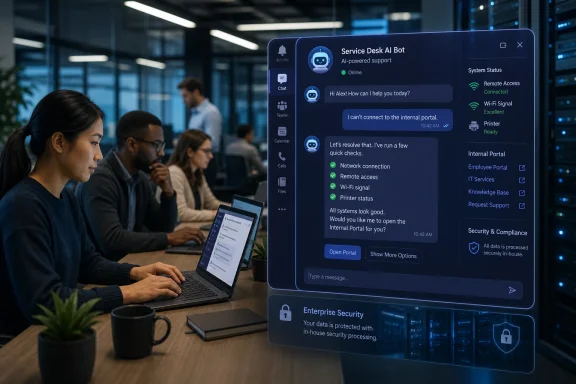
Dong-A Socio Holdings said on June 10, 2026, that it has deployed an AI-powered “service desk AI bot” for Dong-A Socio Group employees, built by IT affiliate DA Information and accessed through Microsoft Teams for real-time help with internal IT and system questions. The announcement is small in the way enterprise software rollouts often are small: no consumer app, no keynote, no sweeping platform promise. But it captures where corporate AI is actually becoming useful first. The first durable wave of workplace AI may not be the executive assistant that writes strategy memos; it may be the bot that tells a sales employee why remote access is failing at 9:40 p.m.
For all the breathless talk about autonomous agents and digital workers, Dong-A Socio’s deployment is refreshingly practical. The company is not claiming that AI will reinvent pharmaceuticals, replace administrators, or diagnose operational inefficiencies across the group. It is putting AI in the narrow, repetitive, high-friction space where employees already lose time: IT support.
That matters because the service desk is one of the least glamorous but most revealing corners of any digital transformation program. It is where policy, infrastructure, user habits, identity systems, hardware, software licensing, and security controls collide. If a company cannot answer routine questions about portals, printers, Wi-Fi, sales systems, and remote access quickly, its larger digital ambitions rest on sand.
The bot’s advertised scope is deliberately mundane. It covers the in-house portal, software installation, multifunction printers, Wi-Fi, the sales support system, and remote access. Those are not experimental workloads; they are the connective tissue of office life. By starting there, Dong-A Socio is signaling that AI adoption does not need to begin with moonshots. It can begin with the questions employees ask every day.
That is the hidden design insight behind the rollout. A support bot that lives in a separate system is another destination. A support bot embedded in collaboration software is part of the workday. The difference is not cosmetic; it changes whether employees use the system before frustration sets in.
For Windows-heavy enterprises, this is also a familiar pattern. Microsoft has spent years turning Teams into a platform rather than merely a chat client. Apps, bots, workflows, approvals, meetings, calls, files, and third-party integrations all converge there. Dong-A Socio’s help desk bot fits neatly into that model: Teams becomes the interface, while the company’s internal guides, policies, and service processes do the real work behind it.
This is where enterprise AI often succeeds or fails. The model is not the product. The product is the workflow around the model. A chatbot with no trusted data, no escalation path, and no security boundary is a novelty. A chatbot that knows the organization’s IT rules and can route unresolved issues to the right department is closer to operational infrastructure.
That makes the boundary around the bot as important as the bot itself. If the system answers based on internal security policies and system operation guides, the quality of those documents now shapes the quality of support. If the guides are stale, the bot will be confidently stale. If access rules are ambiguous, the bot may expose the organization’s procedural confusion faster than any audit would.
The company appears to understand this, at least in principle. The bot is described as answering from internal security policies and operating manuals, not from the open web. That is the right instinct. For corporate IT, grounding is not an academic feature; it is a risk control. Employees do not need a bot that improvises printer setup instructions from public forum posts. They need one that knows which printer fleet the company actually uses and which settings security has approved.
The escalation model is equally important. Dong-A Socio says simple inquiries are handled immediately, while matters requiring additional action are linked to the responsible department or assisted with inquiry submission. That preserves a human path for cases where automation is insufficient. The best service-desk AI does not pretend every problem is a chat problem. It reduces noise so the real problems are easier to see.
That makes it more representative of what many companies are actually doing in 2026. The AI market may be marketed in spectacular terms, but adoption often advances through narrow deployments tied to measurable friction. An internal IT bot does not need to change the company’s entire business model to justify itself. It only needs to reduce repeated questions, shorten resolution time, and make employees less dependent on office-hour support.
The healthcare and pharmaceutical context adds another layer. Dong-A Socio Group operates in a sector where governance, compliance, documentation, and security expectations are not optional decorations. Even a routine IT support bot must be deployed with care because the surrounding organization handles sensitive business processes and regulated workflows.
That does not mean the bot is handling clinical data or regulated product information. The announcement does not say that. But it does mean the company’s choice to keep consultation data inside its security environment is not just vendor boilerplate. In regulated or quasi-regulated industries, the location of data processing is a board-level concern disguised as an IT architecture decision.
This is why service-desk AI can be either a bridge or a wedge. Done well, it makes IT feel more available. Done poorly, it makes IT feel more remote. The difference often comes down to whether the organization measures success by employee outcomes or by deflected tickets alone.
There is a temptation in enterprise automation to celebrate volume reduction as the headline metric. Fewer phone calls, fewer emails, fewer basic tickets: all of that sounds efficient. But if users stop filing tickets because the automated path is frustrating, the numbers look good while the workplace gets worse. Dong-A Socio’s promise of linking more complex issues to responsible departments is therefore a crucial design choice, assuming it works in practice.
The service desk has always been a trust broker between employees and systems they do not fully control. AI intensifies that role. A bot answering access questions is implicitly interpreting policy. A bot guiding software installation is shaping endpoint behavior. A bot helping with remote access is operating at the edge of productivity and security. That is useful power, but it is still power.
The harder challenge begins after launch. Every support environment changes. Applications are updated, authentication methods shift, printer fleets are replaced, VPN policies evolve, Wi-Fi configurations change, and internal portals get redesigned. A service bot that is accurate in June can become wrong by September if the knowledge base is not maintained.
This is where companies discover that AI does not eliminate documentation work. It raises the stakes of documentation work. The bot becomes a distribution mechanism for internal knowledge, but someone still has to own that knowledge. Someone must decide which guide is authoritative, when a policy has changed, and how quickly the bot’s answers should reflect that change.
DA Information’s plan to continue enhancing the bot and expanding its support scope is therefore not a throwaway line. It is the difference between a launch and a service. Enterprise AI systems are not appliances that can be installed and forgotten. They are living operational systems, and their usefulness decays without governance.
But Dong-A Socio’s announcement also emphasizes that the bot was developed by DA Information, the group’s own IT affiliate. That distinction matters. The value is not only in using a global platform; it is in adapting automation to internal systems, internal language, internal policy, and internal process.
Many enterprise AI failures come from overbuying generic capability and underinvesting in organizational fit. A model may be powerful, but it does not know a company’s printer naming conventions, approval chains, or remote-access exception process unless those details are provided and maintained. Local integration is not glamorous, but it is often where the return on investment lives.
For WindowsForum readers, this is the part worth watching. The enterprise AI story will not be written only by foundation-model vendors. It will be written by internal IT teams, managed service providers, system integrators, and departmental technologists who connect models to the messy reality of corporate infrastructure.
These are not theoretical questions. Internal chatbots can become accidental side channels if they summarize documents too broadly or answer questions without enforcing role-based access. Even a help desk bot can leak sensitive operational details if it is allowed to retrieve from the wrong knowledge base.
The security model also has to account for prompt injection and social engineering. Employees may ask the bot to reveal restricted procedures, bypass policies, or provide administrative instructions framed as troubleshooting. A well-built system should refuse those requests or route them through approved channels. A poorly built one may become a polite accomplice.
None of this means Dong-A Socio’s system is insecure. The public information does not support that claim. It means that enterprise AI security must be judged by controls, testing, monitoring, and accountability rather than by the mere fact that a deployment is internal. In 2026, “inside the company” is no longer a sufficient security argument.
Remote and hybrid work made that more obvious, but the issue predates the pandemic. Sales staff travel. Field employees work away from headquarters. Managers prepare documents at night. New hires get stuck during onboarding. A service desk that operates only through human response queues can become a bottleneck at exactly the wrong moment.
An AI bot does not solve every one of those problems, but it can absorb the first layer of confusion. Where do I get the installer? Which portal do I use? Why does this access request fail? What is the approved remote-access process? These questions are small individually and expensive collectively.
That is why the productivity claim is stronger because it is modest. Dong-A Socio is not promising that AI will transform every employee into a superworker. It is promising to remove some of the drag that accumulates around routine systems. In enterprise IT, removing drag is often the difference between a digital tool that gets adopted and one that gets resented.
This is the feedback-loop opportunity. A chat-based support channel can generate structured insight into recurring pain points, provided the company analyzes it responsibly and protects employee privacy. Ticket categories, unresolved queries, escalation patterns, and repeated misunderstandings can all become signals for process improvement.
That is where the bot could move from support tool to transformation instrument. Digital transformation often fails when it is treated as a technology procurement exercise. It works better when companies use technology to discover where workflows are brittle, redundant, or opaque.
The risk is that management reads the data too narrowly. If the bot reduces repetitive inquiries, executives may conclude the job is done. But the more ambitious interpretation is that repetitive inquiries are symptoms. The bot can treat them, but the organization should still ask why they existed in the first place.
In many IT departments, repetitive tickets consume time that could be spent on higher-value work: endpoint modernization, identity hygiene, security hardening, application rationalization, automation, and user training. If the bot truly absorbs routine questions, it could improve the work of human support teams rather than simply reduce it.
But that outcome is not automatic. It depends on whether the organization reinvests saved time into better IT operations or simply expects the same staff to cover more territory. AI can relieve pressure, or it can become a justification for stretching teams thinner. The technology does not decide which path the company takes.
For employees, the labor question is also about dignity of support. A bot should not become a wall between workers and the help they need. The right model is triage with accountability: AI for the predictable, humans for the ambiguous, and clear ownership for everything that affects access, security, or business continuity.
The practical takeaways are concrete:
 The AI Revolution Arrives as a Help Desk Ticket
For all the breathless talk about autonomous agents and digital workers, Dong-A Socio’s deployment is refreshingly practical. The company is not claiming that AI will reinvent pharmaceuticals, replace administrators, or diagnose operational inefficiencies across the group. It is putting AI in the narrow, repetitive, high-friction space where employees already lose time: IT support.That matters because the service desk is one of the least glamorous but most revealing corners of any digital transformation program. It is where policy, infrastructure, user habits, identity systems, hardware, software licensing, and security controls collide. If a company cannot answer routine questions about portals, printers, Wi-Fi, sales systems, and remote access quickly, its larger digital ambitions rest on sand.
The bot’s advertised scope is deliberately mundane. It covers the in-house portal, software installation, multifunction printers, Wi-Fi, the sales support system, and remote access. Those are not experimental workloads; they are the connective tissue of office life. By starting there, Dong-A Socio is signaling that AI adoption does not need to begin with moonshots. It can begin with the questions employees ask every day.
Microsoft Teams Becomes the Front Door to Internal IT
The choice of Microsoft Teams is more than a convenience. Teams has become the default workplace surface for many organizations, and that makes it an obvious place to put service-desk automation. Employees are more likely to ask for help inside a tool they already keep open than to search a portal, compose an email, or wait on a phone queue.That is the hidden design insight behind the rollout. A support bot that lives in a separate system is another destination. A support bot embedded in collaboration software is part of the workday. The difference is not cosmetic; it changes whether employees use the system before frustration sets in.
For Windows-heavy enterprises, this is also a familiar pattern. Microsoft has spent years turning Teams into a platform rather than merely a chat client. Apps, bots, workflows, approvals, meetings, calls, files, and third-party integrations all converge there. Dong-A Socio’s help desk bot fits neatly into that model: Teams becomes the interface, while the company’s internal guides, policies, and service processes do the real work behind it.
This is where enterprise AI often succeeds or fails. The model is not the product. The product is the workflow around the model. A chatbot with no trusted data, no escalation path, and no security boundary is a novelty. A chatbot that knows the organization’s IT rules and can route unresolved issues to the right department is closer to operational infrastructure.
The Real Product Is Not the Bot, but the Boundary Around It
Dong-A Socio’s statement that consultation data is processed within the in-house security environment is one of the most important details in the announcement. It is also the detail that many employees will never notice unless something goes wrong. In an enterprise setting, an AI help desk is not merely answering questions; it is touching information about user accounts, internal systems, device problems, access errors, and sometimes business-critical workflows.That makes the boundary around the bot as important as the bot itself. If the system answers based on internal security policies and system operation guides, the quality of those documents now shapes the quality of support. If the guides are stale, the bot will be confidently stale. If access rules are ambiguous, the bot may expose the organization’s procedural confusion faster than any audit would.
The company appears to understand this, at least in principle. The bot is described as answering from internal security policies and operating manuals, not from the open web. That is the right instinct. For corporate IT, grounding is not an academic feature; it is a risk control. Employees do not need a bot that improvises printer setup instructions from public forum posts. They need one that knows which printer fleet the company actually uses and which settings security has approved.
The escalation model is equally important. Dong-A Socio says simple inquiries are handled immediately, while matters requiring additional action are linked to the responsible department or assisted with inquiry submission. That preserves a human path for cases where automation is insufficient. The best service-desk AI does not pretend every problem is a chat problem. It reduces noise so the real problems are easier to see.
Korea’s Enterprise AI Story Is Becoming Operational, Not Theatrical
South Korea has spent years talking about digital transformation in high-level terms: smart factories, AI semiconductors, public-sector automation, cloud migration, and data-driven healthcare. Dong-A Socio’s announcement belongs to a quieter but arguably more consequential category. It is not about national AI strategy; it is about internal process redesign.That makes it more representative of what many companies are actually doing in 2026. The AI market may be marketed in spectacular terms, but adoption often advances through narrow deployments tied to measurable friction. An internal IT bot does not need to change the company’s entire business model to justify itself. It only needs to reduce repeated questions, shorten resolution time, and make employees less dependent on office-hour support.
The healthcare and pharmaceutical context adds another layer. Dong-A Socio Group operates in a sector where governance, compliance, documentation, and security expectations are not optional decorations. Even a routine IT support bot must be deployed with care because the surrounding organization handles sensitive business processes and regulated workflows.
That does not mean the bot is handling clinical data or regulated product information. The announcement does not say that. But it does mean the company’s choice to keep consultation data inside its security environment is not just vendor boilerplate. In regulated or quasi-regulated industries, the location of data processing is a board-level concern disguised as an IT architecture decision.
The Help Desk Is Where AI Meets the Employee Trust Problem
There is a human politics to service-desk AI that companies tend to underplay. Employees do not judge workplace technology by strategy decks. They judge it by whether it helps them get unstuck. If the bot gives accurate answers at the moment of need, it earns trust. If it produces vague responses, loops users through irrelevant suggestions, or blocks access to a human, it becomes another corporate obstacle.This is why service-desk AI can be either a bridge or a wedge. Done well, it makes IT feel more available. Done poorly, it makes IT feel more remote. The difference often comes down to whether the organization measures success by employee outcomes or by deflected tickets alone.
There is a temptation in enterprise automation to celebrate volume reduction as the headline metric. Fewer phone calls, fewer emails, fewer basic tickets: all of that sounds efficient. But if users stop filing tickets because the automated path is frustrating, the numbers look good while the workplace gets worse. Dong-A Socio’s promise of linking more complex issues to responsible departments is therefore a crucial design choice, assuming it works in practice.
The service desk has always been a trust broker between employees and systems they do not fully control. AI intensifies that role. A bot answering access questions is implicitly interpreting policy. A bot guiding software installation is shaping endpoint behavior. A bot helping with remote access is operating at the edge of productivity and security. That is useful power, but it is still power.
Repetitive Work Is the Easy Target, but Maintenance Is the Hard Part
Dong-A Socio Holdings expects the bot to reduce repetitive inquiry response work and improve the efficiency of IT support services. That is plausible. Routine questions are exactly where chat-based automation tends to perform best, especially when answers can be drawn from structured internal documents.The harder challenge begins after launch. Every support environment changes. Applications are updated, authentication methods shift, printer fleets are replaced, VPN policies evolve, Wi-Fi configurations change, and internal portals get redesigned. A service bot that is accurate in June can become wrong by September if the knowledge base is not maintained.
This is where companies discover that AI does not eliminate documentation work. It raises the stakes of documentation work. The bot becomes a distribution mechanism for internal knowledge, but someone still has to own that knowledge. Someone must decide which guide is authoritative, when a policy has changed, and how quickly the bot’s answers should reflect that change.
DA Information’s plan to continue enhancing the bot and expanding its support scope is therefore not a throwaway line. It is the difference between a launch and a service. Enterprise AI systems are not appliances that can be installed and forgotten. They are living operational systems, and their usefulness decays without governance.
The Microsoft Angle Is Familiar, but the Local Build Matters
The Teams integration will naturally draw attention because Microsoft’s collaboration stack is central to many enterprise AI strategies. Microsoft wants Teams, Microsoft 365, Azure, Copilot, and related security tooling to become the operating layer for AI-assisted work. A help desk bot inside Teams fits that direction even if it is not necessarily a Copilot-branded deployment.But Dong-A Socio’s announcement also emphasizes that the bot was developed by DA Information, the group’s own IT affiliate. That distinction matters. The value is not only in using a global platform; it is in adapting automation to internal systems, internal language, internal policy, and internal process.
Many enterprise AI failures come from overbuying generic capability and underinvesting in organizational fit. A model may be powerful, but it does not know a company’s printer naming conventions, approval chains, or remote-access exception process unless those details are provided and maintained. Local integration is not glamorous, but it is often where the return on investment lives.
For WindowsForum readers, this is the part worth watching. The enterprise AI story will not be written only by foundation-model vendors. It will be written by internal IT teams, managed service providers, system integrators, and departmental technologists who connect models to the messy reality of corporate infrastructure.
Security Claims Need Operational Proof
The announcement’s security language is sensible, but it should not be treated as self-validating. Saying that consultation data is processed inside an in-house security environment is a good starting point, not the end of the discussion. Administrators will want to know how logs are retained, who can inspect conversations, how access to knowledge sources is controlled, and whether the bot can surface information beyond a user’s entitlement.These are not theoretical questions. Internal chatbots can become accidental side channels if they summarize documents too broadly or answer questions without enforcing role-based access. Even a help desk bot can leak sensitive operational details if it is allowed to retrieve from the wrong knowledge base.
The security model also has to account for prompt injection and social engineering. Employees may ask the bot to reveal restricted procedures, bypass policies, or provide administrative instructions framed as troubleshooting. A well-built system should refuse those requests or route them through approved channels. A poorly built one may become a polite accomplice.
None of this means Dong-A Socio’s system is insecure. The public information does not support that claim. It means that enterprise AI security must be judged by controls, testing, monitoring, and accountability rather than by the mere fact that a deployment is internal. In 2026, “inside the company” is no longer a sufficient security argument.
The Productivity Pitch Is Modest—and Stronger for It
The company says employees will be able to check necessary information regardless of time and place, improving convenience and productivity. That is the kind of corporate phrasing that often disappears into the wallpaper. Yet in this case, the claim is grounded in a real workplace behavior: people need IT help outside neat support windows.Remote and hybrid work made that more obvious, but the issue predates the pandemic. Sales staff travel. Field employees work away from headquarters. Managers prepare documents at night. New hires get stuck during onboarding. A service desk that operates only through human response queues can become a bottleneck at exactly the wrong moment.
An AI bot does not solve every one of those problems, but it can absorb the first layer of confusion. Where do I get the installer? Which portal do I use? Why does this access request fail? What is the approved remote-access process? These questions are small individually and expensive collectively.
That is why the productivity claim is stronger because it is modest. Dong-A Socio is not promising that AI will transform every employee into a superworker. It is promising to remove some of the drag that accumulates around routine systems. In enterprise IT, removing drag is often the difference between a digital tool that gets adopted and one that gets resented.
The Service Desk Becomes a Map of Digital Maturity
A successful AI help desk can do more than answer questions. It can reveal where the organization’s systems are confusing. If hundreds of employees ask the same question about portal access, the answer may not be better chatbot wording. The answer may be a redesigned login flow, clearer onboarding, or fewer overlapping systems.This is the feedback-loop opportunity. A chat-based support channel can generate structured insight into recurring pain points, provided the company analyzes it responsibly and protects employee privacy. Ticket categories, unresolved queries, escalation patterns, and repeated misunderstandings can all become signals for process improvement.
That is where the bot could move from support tool to transformation instrument. Digital transformation often fails when it is treated as a technology procurement exercise. It works better when companies use technology to discover where workflows are brittle, redundant, or opaque.
The risk is that management reads the data too narrowly. If the bot reduces repetitive inquiries, executives may conclude the job is done. But the more ambitious interpretation is that repetitive inquiries are symptoms. The bot can treat them, but the organization should still ask why they existed in the first place.
The Labor Story Is Subtler Than Replacement
Any AI service desk rollout raises questions about support staff. The obvious fear is replacement: if the bot handles simple inquiries, fewer humans may be needed. The corporate framing is usually efficiency, not headcount reduction. Reality tends to be more complicated.In many IT departments, repetitive tickets consume time that could be spent on higher-value work: endpoint modernization, identity hygiene, security hardening, application rationalization, automation, and user training. If the bot truly absorbs routine questions, it could improve the work of human support teams rather than simply reduce it.
But that outcome is not automatic. It depends on whether the organization reinvests saved time into better IT operations or simply expects the same staff to cover more territory. AI can relieve pressure, or it can become a justification for stretching teams thinner. The technology does not decide which path the company takes.
For employees, the labor question is also about dignity of support. A bot should not become a wall between workers and the help they need. The right model is triage with accountability: AI for the predictable, humans for the ambiguous, and clear ownership for everything that affects access, security, or business continuity.
Dong-A Socio’s Small Bot Carries a Bigger Enterprise Lesson
Dong-A Socio’s deployment offers a useful template precisely because it is not spectacular. The company picked a familiar interface, targeted recurring support needs, grounded answers in internal policy, and kept data processing within its security environment. Those choices are more important than any grand claim about AI transformation.The practical takeaways are concrete:
- Dong-A Socio Holdings introduced the service desk AI bot on June 10, 2026, for employees across Dong-A Socio Group.
- DA Information, the group’s IT affiliate, developed the service to handle real-time IT and system inquiries through Microsoft Teams.
- The bot covers routine workplace systems such as the internal portal, software installation, multifunction printers, Wi-Fi, sales support, and remote access.
- The company says answers are based on internal security policies and system operation guides, with consultation data processed inside its in-house security environment.
- Simple inquiries are handled immediately, while issues requiring additional action are routed to responsible departments or supported through inquiry submission.
- The long-term value will depend less on the chatbot interface than on maintenance, governance, escalation quality, and whether recurring support data is used to improve underlying systems.
References
- Primary source: Chosunbiz
Published: 2026-06-10T08:42:07.790011
Dong-A Socio deploys AI help desk to speed digital transformation in Korea - CHOSUNBIZ
Dong-A Socio deploys AI help desk to speed digital transformation in Korea Dong-A Socio Holdings said on the 10th that it introduced a service desk Abiz.chosun.com - Related coverage: cbiz.chosun.com
- Related coverage: crn.com
Pia Bets On Microsoft Teams For AI-Powered Service Desk Automation For MSPs
Pia unveils Teams-based AI support workflow aimed at reducing MSP ticket noise.www.crn.com - Related coverage: oecd.org
How can AI help make better regional development policies in Korea (EN)
https://doi.org/10.1787/be01f52d-enwww.oecd.org
- Related coverage: act.jinbo.net
