

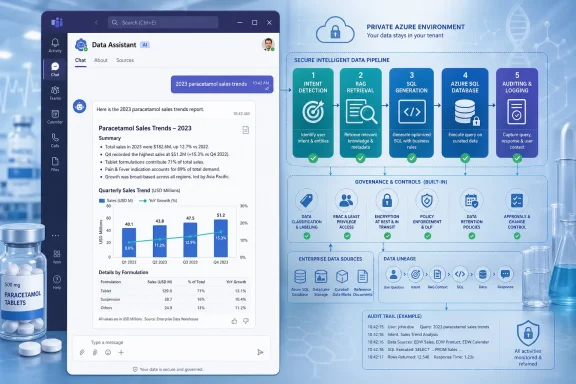
Tieto Tech Consulting says it helped Ukrainian pharmaceutical manufacturer Darnytsia build a private Azure OpenAI-powered data analytics bot for Microsoft Teams, using retrieval-augmented generation to turn natural-language business questions into SQL-backed reports and summaries. The project is not interesting because it is another chatbot. It is interesting because it shows where enterprise generative AI is actually becoming useful: not as a magic oracle, but as a tightly fenced interpreter between employees and corporate data.
The consumer version of the generative AI story has trained everyone to look for the wrong thing. We ask whether the bot sounds clever, whether it can write a paragraph, whether it can riff on strategy. In Darnytsia’s case, the useful part is much more prosaic: a business user asks about sales trends or competitor comparisons, and the system returns a report, a short explanation, and, if requested, a chart.
That makes the chatbot less of a knowledge worker replacement than a new front end for business intelligence. The underlying work is still data access, permissions, schema mapping, query generation, validation, and reporting. The novelty is that the user does not need to know which table to query, which Power BI dashboard to open, or how to phrase a request to the analytics team.
This is the quiet enterprise version of the AI boom. It does not promise that a model “understands” the pharmaceutical market. It promises that an employee can type something like “trends of paracetamol sales in 2023” and get a structured answer quickly enough for the question still to matter.
That distinction matters because many corporate AI pilots fail by treating the model as the system. Here, the model is a component inside a workflow. The real system is the combination of Azure OpenAI, RAG, Azure Bot Service, Azure SQL Database, Azure App Services, Microsoft Teams, and Darnytsia’s own data estate.
Darnytsia’s case study describes a classic version of that bottleneck. The company had rising demand for business intelligence across operations, supply and demand planning, sales analytics, and commercial intelligence. The analytics team was under pressure from ad hoc requests, and business units wanted faster answers than the old process could reliably provide.
That is a meaningful framing because it keeps the project away from AI theater. The target was not “innovation” in the abstract. It was time-to-insight, report creation cost, and the uneven distribution of analytical skill across the company.
The decision to consider, then move beyond, a broad Power BI Copilot rollout is also revealing. Microsoft’s own ecosystem now offers several ways to put AI next to data, but enterprise economics are not uniform. A general-purpose copilot can be attractive when the workflows are standardized and the licensing model fits. A custom assistant starts to make more sense when the reporting needs are highly specific, the data estate is complex, or the organization wants tighter control over how questions are translated into queries.
For a pharmaceutical company, that constraint is not a luxury. Sales analytics, competitive comparisons, and operational reporting are not casual knowledge-base lookups. They involve sensitive commercial data, regulated business contexts, and decisions that can ripple through planning, supply chains, and market execution.
Tieto’s description of the bot emphasizes that it operates within the client’s Azure environment and is designed to work strictly within the context of internal data. That is the correct architecture pattern for this kind of use case. A model that can improvise may be entertaining; a model that can be prevented from improvising is much more valuable.
The system reportedly includes specialized AI components for different stages of the analytics workflow, from language detection to visualization. That modularity is important because “ask a question, get an answer” hides a chain of operations that each have different failure modes. Language detection can fail. Intent classification can fail. SQL generation can fail. Data retrieval can fail. Summarization can mislead. Visualization can imply a trend that the underlying numbers do not support.
The promise of RAG is not that these risks disappear. The promise is that the system can be engineered so each stage is narrower, auditable, and improvable.
A user asking for “sales rates of key products against five major competitors” is not simply requesting a SELECT statement. The system must understand which products are “key,” which competitors are relevant, which geography and time frame apply, which units should be compared, how returns or discounts are handled, and whether the data is complete enough to support the conclusion. In a mature analytics organization, those assumptions are usually embedded in documentation, dashboards, analyst habits, and institutional memory.
A good GenAI analytics bot must therefore do more than generate SQL. It must know when to ask a clarifying question, when to apply a default business definition, when to show its assumptions, and when to refuse an answer because the data does not support it. The article-style case study mentions monitoring and auditing interactions, which is exactly where organizations should focus once the demo works.
The worst version of this technology is a confident bot that returns a polished chart from a flawed query. The best version is closer to a junior analyst with a strict supervisor: fast, helpful, bounded, and always leaving a trail.
That makes Teams a natural home for workflow bots that sit between business users and internal systems. A sales manager does not want to install a separate analytics client to ask one question before a meeting. A planner on a phone does not want to navigate a reporting portal just to check whether a trend changed overnight. If the tool lives where the conversation already happens, adoption has a chance.
But Teams also changes the psychological contract. A dashboard looks like a reporting artifact. A chatbot feels like a conversation. That can make analytics more approachable, but it can also make outputs feel more authoritative than they deserve.
This is why interface design matters. The bot should not merely answer; it should communicate uncertainty, expose filters, show report attachments, and make clear which internal data source was used. In enterprise analytics, convenience without provenance is a liability.
That is the architecture enterprise buyers increasingly want. They are not rejecting generative AI outright; they are rejecting uncontrolled data movement, opaque retention, and tools that make it unclear where sensitive prompts and outputs travel. Azure OpenAI’s appeal in this context is partly the model capability, but just as much the enterprise wrapping: identity, networking, logging, compliance posture, and integration with existing Microsoft infrastructure.
For WindowsForum’s audience, this is the familiar Microsoft playbook. The company’s strongest enterprise products rarely win only because they are the most elegant individual tools. They win because they sit inside the identity, management, governance, and licensing structures that IT departments already understand.
A Teams analytics bot powered by Azure OpenAI is therefore not just an AI story. It is an Azure consumption story, a Microsoft 365 surface-area story, and a governance story. That is why Microsoft’s AI strategy in the enterprise is so formidable: it can make AI feel less like a new platform decision and more like an extension of the stack already in place.
Still, the claim has a plausible core. Many analytics delays are not caused by deep research; they are caused by queues. A business user asks for a slice of data that already exists. An analyst eventually writes or modifies a query. A spreadsheet is generated. A short explanation is sent back. If a bot can safely automate that routine layer, the time savings are real.
The more subtle benefit is not speed alone. It is the release of analyst capacity. If analytics teams spend less time on repetitive ad hoc requests, they can spend more time improving data models, defining metrics, building reusable assets, and investigating genuinely hard questions.
That is the enterprise AI productivity story at its most credible. The bot does not replace the analytics function. It changes what the analytics function spends its time doing.
The difficult parts of this work often happen before and after deployment. Before deployment, the organization needs to understand data quality, schema complexity, access controls, metric definitions, and user roles. After deployment, it needs monitoring, feedback loops, prompt and query refinement, error analysis, and policy decisions about which questions the bot may answer.
In other words, the software can be installed quickly; institutional trust takes longer. That is not a criticism of the project. It is the difference between standing up a capability and making it dependable enough for everyday decision-making.
For small companies with tidy databases, a rapid rollout may be realistic. For large enterprises with fragmented data warehouses, competing definitions of revenue, regional reporting quirks, and legacy systems, the real project is less about the bot and more about the data architecture it exposes.
Sales trends in pain management or cardiology products are not just trivia. They can influence inventory planning, market prioritization, field-force activity, and management attention. Competitive analysis can shape pricing discussions, promotional strategy, and supply expectations. A fast answer can help, but a wrong fast answer can be worse than a slow correct one.
That makes auditability central. Tieto’s case study says interactions are monitored so teams can audit queries, identify inconsistencies, and improve performance. That is not a footnote; it is the operational control that makes the whole idea plausible.
AI analytics systems should be judged less by the charm of their demos than by the quality of their exception handling. What happens when the user asks an ambiguous question? What happens when a table has stale data? What happens when two internal sources disagree? What happens when the generated SQL returns an outlier? In pharma, those questions are not academic.
The Darnytsia deployment is described as engaging around 1,000 employees. At that scale, permissions and role-based access are not implementation details. They define the product. A commercial manager, finance analyst, supply planner, and executive may all ask similar questions, but they should not necessarily see the same data or receive the same level of detail.
The system also needs a position on data leakage through summaries. Even if the SQL layer enforces permissions, a generated narrative could reveal sensitive comparisons, infer restricted trends, or combine allowed data in ways that create new sensitivity. This is not unique to AI, but generative interfaces make it easier to synthesize information across boundaries.
Governance therefore has to sit above the model and below the interface. It has to shape retrieval, query generation, output formatting, logging, retention, and review. The more natural the interface becomes, the more deliberate the controls must be.
The more likely future is a layered one. Dashboards remain the canonical view for recurring metrics. Analysts maintain governed models and investigate complex questions. GenAI assistants handle the conversational middle: ad hoc slicing, quick comparisons, first-pass explanations, and report generation for users who do not live inside BI tools.
That middle layer has long been underserved. Search boxes were too literal. Dashboards were too rigid. Asking an analyst was too slow. Natural language analytics has failed in earlier waves because the language layer was brittle and the data context was too weak. Generative AI gives the interface another chance, but only if it is tied to governed enterprise data rather than left to freestyle.
In that sense, the Darnytsia bot is not anti-BI. It is BI with a conversational intake valve.
Voice also raises the stakes. Spoken queries are often less precise than typed ones. They are more likely to omit filters, context, and exact names. Speech recognition can introduce errors before the AI system even begins its work. A misheard product name or date range could produce an answer that looks legitimate but is based on the wrong request.
The design response should not be to avoid voice, but to slow it down at the right moments. For simple queries, voice can be frictionless. For consequential comparisons or ambiguous requests, the bot should confirm the interpreted question before running the analysis. “I heard you ask for 2023 paracetamol sales trends by region; should I use net sales or unit volume?” is not a nuisance. It is a safety feature.
Voice-driven BI will be most useful when it behaves less like a smart speaker and more like a careful analyst.
The wait for a dashboard change. The wait for an export. The wait for a data team to prioritize a small request. The wait for someone who knows SQL. The wait for a meeting where the numbers can finally be explained.
That is why an internal analytics bot can feel transformative even if the underlying technology is not magical. It collapses the distance between curiosity and evidence. A user can ask a follow-up while the thought is still fresh. A team can test a hypothesis before the meeting moves on. A manager can request a chart without opening another tool.
For IT leaders, the challenge is to capture that speed without letting it outrun governance. The organizations that succeed will not be the ones that simply “add AI” to reporting. They will be the ones that redesign the analytics workflow around fast access, explicit assumptions, and continuous oversight.
That is where the current wave of enterprise AI is likely to produce durable value. The winning projects will be small enough to govern, close enough to existing workflows to adopt, and specific enough that success can be measured. They will use large models, but they will not depend on large-model mystique.
For Windows and Microsoft ecosystem professionals, the pattern is especially relevant. Azure-hosted AI, Teams distribution, SQL-backed data, App Service deployment, and Bot Service integration are not exotic ingredients. They are the enterprise Microsoft stack with a new conversational layer on top.
That does not make implementation trivial. It makes it familiar. And in corporate IT, familiar often beats spectacular.
 The Chatbot Is the Interface, Not the Product
The consumer version of the generative AI story has trained everyone to look for the wrong thing. We ask whether the bot sounds clever, whether it can write a paragraph, whether it can riff on strategy. In Darnytsia’s case, the useful part is much more prosaic: a business user asks about sales trends or competitor comparisons, and the system returns a report, a short explanation, and, if requested, a chart.That makes the chatbot less of a knowledge worker replacement than a new front end for business intelligence. The underlying work is still data access, permissions, schema mapping, query generation, validation, and reporting. The novelty is that the user does not need to know which table to query, which Power BI dashboard to open, or how to phrase a request to the analytics team.
This is the quiet enterprise version of the AI boom. It does not promise that a model “understands” the pharmaceutical market. It promises that an employee can type something like “trends of paracetamol sales in 2023” and get a structured answer quickly enough for the question still to matter.
That distinction matters because many corporate AI pilots fail by treating the model as the system. Here, the model is a component inside a workflow. The real system is the combination of Azure OpenAI, RAG, Azure Bot Service, Azure SQL Database, Azure App Services, Microsoft Teams, and Darnytsia’s own data estate.
Darnytsia’s Problem Was Not a Lack of Dashboards
The familiar enterprise BI problem is not that companies have no data. It is that access to useful data tends to concentrate around a small group of people who know the systems, the schema, the caveats, and the politics of reporting. Everyone else files requests, waits for a dashboard to be adjusted, or exports a spreadsheet and hopes the assumptions still hold.Darnytsia’s case study describes a classic version of that bottleneck. The company had rising demand for business intelligence across operations, supply and demand planning, sales analytics, and commercial intelligence. The analytics team was under pressure from ad hoc requests, and business units wanted faster answers than the old process could reliably provide.
That is a meaningful framing because it keeps the project away from AI theater. The target was not “innovation” in the abstract. It was time-to-insight, report creation cost, and the uneven distribution of analytical skill across the company.
The decision to consider, then move beyond, a broad Power BI Copilot rollout is also revealing. Microsoft’s own ecosystem now offers several ways to put AI next to data, but enterprise economics are not uniform. A general-purpose copilot can be attractive when the workflows are standardized and the licensing model fits. A custom assistant starts to make more sense when the reporting needs are highly specific, the data estate is complex, or the organization wants tighter control over how questions are translated into queries.
RAG Becomes Less Glamorous and More Useful
Retrieval-augmented generation, or RAG, is often described as a way to reduce hallucinations by grounding model responses in enterprise data. That description is true but incomplete. In analytics, RAG is not merely about giving the model documents to quote. It is about constraining the model’s operating environment so the answer is derived from known internal sources rather than from the model’s statistical memory.For a pharmaceutical company, that constraint is not a luxury. Sales analytics, competitive comparisons, and operational reporting are not casual knowledge-base lookups. They involve sensitive commercial data, regulated business contexts, and decisions that can ripple through planning, supply chains, and market execution.
Tieto’s description of the bot emphasizes that it operates within the client’s Azure environment and is designed to work strictly within the context of internal data. That is the correct architecture pattern for this kind of use case. A model that can improvise may be entertaining; a model that can be prevented from improvising is much more valuable.
The system reportedly includes specialized AI components for different stages of the analytics workflow, from language detection to visualization. That modularity is important because “ask a question, get an answer” hides a chain of operations that each have different failure modes. Language detection can fail. Intent classification can fail. SQL generation can fail. Data retrieval can fail. Summarization can mislead. Visualization can imply a trend that the underlying numbers do not support.
The promise of RAG is not that these risks disappear. The promise is that the system can be engineered so each stage is narrower, auditable, and improvable.
Natural Language to SQL Is Where the Risk Lives
Turning natural language into SQL is one of the most attractive enterprise AI use cases because it attacks a real usability barrier. It is also one of the most dangerous if treated casually. A syntactically valid query can still be semantically wrong, financially misleading, or operationally expensive.A user asking for “sales rates of key products against five major competitors” is not simply requesting a SELECT statement. The system must understand which products are “key,” which competitors are relevant, which geography and time frame apply, which units should be compared, how returns or discounts are handled, and whether the data is complete enough to support the conclusion. In a mature analytics organization, those assumptions are usually embedded in documentation, dashboards, analyst habits, and institutional memory.
A good GenAI analytics bot must therefore do more than generate SQL. It must know when to ask a clarifying question, when to apply a default business definition, when to show its assumptions, and when to refuse an answer because the data does not support it. The article-style case study mentions monitoring and auditing interactions, which is exactly where organizations should focus once the demo works.
The worst version of this technology is a confident bot that returns a polished chart from a flawed query. The best version is closer to a junior analyst with a strict supervisor: fast, helpful, bounded, and always leaving a trail.
Teams Is the Distribution Channel Microsoft Already Won
The choice of Microsoft Teams as the bot’s primary interface is not incidental. For many enterprises, Teams has become the lowest-friction deployment surface for internal tools. Employees already have it open, IT already manages identity and access around it, and mobile support comes for free compared with building a standalone app.That makes Teams a natural home for workflow bots that sit between business users and internal systems. A sales manager does not want to install a separate analytics client to ask one question before a meeting. A planner on a phone does not want to navigate a reporting portal just to check whether a trend changed overnight. If the tool lives where the conversation already happens, adoption has a chance.
But Teams also changes the psychological contract. A dashboard looks like a reporting artifact. A chatbot feels like a conversation. That can make analytics more approachable, but it can also make outputs feel more authoritative than they deserve.
This is why interface design matters. The bot should not merely answer; it should communicate uncertainty, expose filters, show report attachments, and make clear which internal data source was used. In enterprise analytics, convenience without provenance is a liability.
The Private Cloud Angle Is the Selling Point
The most important word in the Darnytsia deployment may be “private.” Not private in the consumer privacy-policy sense, but private as in hosted inside the client’s Microsoft Azure environment, using internal data under corporate controls.That is the architecture enterprise buyers increasingly want. They are not rejecting generative AI outright; they are rejecting uncontrolled data movement, opaque retention, and tools that make it unclear where sensitive prompts and outputs travel. Azure OpenAI’s appeal in this context is partly the model capability, but just as much the enterprise wrapping: identity, networking, logging, compliance posture, and integration with existing Microsoft infrastructure.
For WindowsForum’s audience, this is the familiar Microsoft playbook. The company’s strongest enterprise products rarely win only because they are the most elegant individual tools. They win because they sit inside the identity, management, governance, and licensing structures that IT departments already understand.
A Teams analytics bot powered by Azure OpenAI is therefore not just an AI story. It is an Azure consumption story, a Microsoft 365 surface-area story, and a governance story. That is why Microsoft’s AI strategy in the enterprise is so formidable: it can make AI feel less like a new platform decision and more like an extension of the stack already in place.
“Weeks to Seconds” Is a Marketing Line With a Real Core
Tieto says the assistant reduced time-to-insight from weeks to seconds. That is the kind of vendor phrase that deserves skepticism, because it compresses many different workflows into one impressive contrast. Some reports really do take weeks because they require new data modeling, stakeholder alignment, quality checks, and interpretation. A chatbot does not eliminate that work just because it can generate a fast answer.Still, the claim has a plausible core. Many analytics delays are not caused by deep research; they are caused by queues. A business user asks for a slice of data that already exists. An analyst eventually writes or modifies a query. A spreadsheet is generated. A short explanation is sent back. If a bot can safely automate that routine layer, the time savings are real.
The more subtle benefit is not speed alone. It is the release of analyst capacity. If analytics teams spend less time on repetitive ad hoc requests, they can spend more time improving data models, defining metrics, building reusable assets, and investigating genuinely hard questions.
That is the enterprise AI productivity story at its most credible. The bot does not replace the analytics function. It changes what the analytics function spends its time doing.
The Two-Day Deployment Claim Needs Context
The case study says small-scale database implementations can take as little as two days, while more complex data warehouse environments can take up to two weeks. Those numbers are striking, and they may be true for a narrowly scoped implementation with accessible data, clear permissions, and a reusable architecture. They should not be mistaken for the total time required to make enterprise AI analytics trustworthy.The difficult parts of this work often happen before and after deployment. Before deployment, the organization needs to understand data quality, schema complexity, access controls, metric definitions, and user roles. After deployment, it needs monitoring, feedback loops, prompt and query refinement, error analysis, and policy decisions about which questions the bot may answer.
In other words, the software can be installed quickly; institutional trust takes longer. That is not a criticism of the project. It is the difference between standing up a capability and making it dependable enough for everyday decision-making.
For small companies with tidy databases, a rapid rollout may be realistic. For large enterprises with fragmented data warehouses, competing definitions of revenue, regional reporting quirks, and legacy systems, the real project is less about the bot and more about the data architecture it exposes.
Pharma Makes the Use Case Sharper
A pharmaceutical company is a particularly revealing environment for this kind of tool. Pharma businesses are data-rich, commercially competitive, operationally complex, and culturally sensitive to accuracy. Even when the data involved is commercial rather than clinical, errors can matter.Sales trends in pain management or cardiology products are not just trivia. They can influence inventory planning, market prioritization, field-force activity, and management attention. Competitive analysis can shape pricing discussions, promotional strategy, and supply expectations. A fast answer can help, but a wrong fast answer can be worse than a slow correct one.
That makes auditability central. Tieto’s case study says interactions are monitored so teams can audit queries, identify inconsistencies, and improve performance. That is not a footnote; it is the operational control that makes the whole idea plausible.
AI analytics systems should be judged less by the charm of their demos than by the quality of their exception handling. What happens when the user asks an ambiguous question? What happens when a table has stale data? What happens when two internal sources disagree? What happens when the generated SQL returns an outlier? In pharma, those questions are not academic.
The Bot Is Also a Governance Test
Every successful internal AI tool creates a new governance problem: people start using it. That sounds obvious, but adoption changes risk. A pilot used by a handful of analysts is one thing; a Teams bot available across an enterprise is another.The Darnytsia deployment is described as engaging around 1,000 employees. At that scale, permissions and role-based access are not implementation details. They define the product. A commercial manager, finance analyst, supply planner, and executive may all ask similar questions, but they should not necessarily see the same data or receive the same level of detail.
The system also needs a position on data leakage through summaries. Even if the SQL layer enforces permissions, a generated narrative could reveal sensitive comparisons, infer restricted trends, or combine allowed data in ways that create new sensitivity. This is not unique to AI, but generative interfaces make it easier to synthesize information across boundaries.
Governance therefore has to sit above the model and below the interface. It has to shape retrieval, query generation, output formatting, logging, retention, and review. The more natural the interface becomes, the more deliberate the controls must be.
Power BI Is Not Replaced So Much as Repositioned
It would be tempting to read this project as a rebuke to traditional BI tools. That would be too simple. Power BI, dashboards, semantic models, and curated reports still matter because enterprises need stable views of the business. A chatbot is better for exploration than for every kind of reporting.The more likely future is a layered one. Dashboards remain the canonical view for recurring metrics. Analysts maintain governed models and investigate complex questions. GenAI assistants handle the conversational middle: ad hoc slicing, quick comparisons, first-pass explanations, and report generation for users who do not live inside BI tools.
That middle layer has long been underserved. Search boxes were too literal. Dashboards were too rigid. Asking an analyst was too slow. Natural language analytics has failed in earlier waves because the language layer was brittle and the data context was too weak. Generative AI gives the interface another chance, but only if it is tied to governed enterprise data rather than left to freestyle.
In that sense, the Darnytsia bot is not anti-BI. It is BI with a conversational intake valve.
Voice Is the Next Convenience and the Next Risk
Darnytsia is reportedly extending the solution with a mobile version that includes speech recognition and voice-based commands and responses. That is a logical next step for on-the-go business intelligence, especially for managers who need quick answers away from a desk.Voice also raises the stakes. Spoken queries are often less precise than typed ones. They are more likely to omit filters, context, and exact names. Speech recognition can introduce errors before the AI system even begins its work. A misheard product name or date range could produce an answer that looks legitimate but is based on the wrong request.
The design response should not be to avoid voice, but to slow it down at the right moments. For simple queries, voice can be frictionless. For consequential comparisons or ambiguous requests, the bot should confirm the interpreted question before running the analysis. “I heard you ask for 2023 paracetamol sales trends by region; should I use net sales or unit volume?” is not a nuisance. It is a safety feature.
Voice-driven BI will be most useful when it behaves less like a smart speaker and more like a careful analyst.
The Real Competition Is the Old Ticket Queue
Enterprise AI is often framed as a contest among vendors: Microsoft versus Google, OpenAI versus Anthropic, Copilot versus custom builds. In the daily life of a business user, the competitor is often much simpler. It is the wait.The wait for a dashboard change. The wait for an export. The wait for a data team to prioritize a small request. The wait for someone who knows SQL. The wait for a meeting where the numbers can finally be explained.
That is why an internal analytics bot can feel transformative even if the underlying technology is not magical. It collapses the distance between curiosity and evidence. A user can ask a follow-up while the thought is still fresh. A team can test a hypothesis before the meeting moves on. A manager can request a chart without opening another tool.
For IT leaders, the challenge is to capture that speed without letting it outrun governance. The organizations that succeed will not be the ones that simply “add AI” to reporting. They will be the ones that redesign the analytics workflow around fast access, explicit assumptions, and continuous oversight.
The Darnytsia Lesson Is Narrow, Which Is Why It Matters
The most persuasive thing about this deployment is its narrowness. It does not claim to reinvent pharmaceutical operations. It does not claim to replace analysts or solve every data problem. It identifies a concrete bottleneck and applies generative AI as an interface and orchestration layer.That is where the current wave of enterprise AI is likely to produce durable value. The winning projects will be small enough to govern, close enough to existing workflows to adopt, and specific enough that success can be measured. They will use large models, but they will not depend on large-model mystique.
For Windows and Microsoft ecosystem professionals, the pattern is especially relevant. Azure-hosted AI, Teams distribution, SQL-backed data, App Service deployment, and Bot Service integration are not exotic ingredients. They are the enterprise Microsoft stack with a new conversational layer on top.
That does not make implementation trivial. It makes it familiar. And in corporate IT, familiar often beats spectacular.
What Darnytsia’s Bot Says About the Next AI Budget Meeting
The practical lesson from this project is not that every company needs a pharma analytics bot. It is that AI spending will increasingly be judged by whether it removes a specific operational choke point. The most credible proposals will sound less like science fiction and more like workflow repair.- A private RAG-based analytics assistant is most useful when it is grounded in governed internal data rather than allowed to answer from general model knowledge.
- Microsoft Teams is becoming a serious deployment surface for enterprise AI because it puts new tools inside an interface employees already use.
- Natural-language-to-SQL systems need monitoring, auditing, and clear assumptions because a polished answer can still be built on a flawed query.
- Custom AI assistants can compete with broad copilot rollouts when licensing, data complexity, or workflow specificity makes a general tool less economical.
- The biggest productivity gain may come from reducing routine ad hoc analytics work, not from replacing analysts.
- Voice-based business intelligence will be convenient only if the system confirms ambiguous requests before producing consequential outputs.
References
- Primary source: Tieto
Published: 2026-05-31T19:48:37.756825
GenAI data analytics bot development for a pharma company
Darnytsia cut reporting time from two weeks to three seconds with GenAI data analytics bot, built with Azure OpenAI service.www.tieto.com
