

Mizo announced on June 24, 2026, that its AI service desk agents can now resolve more than 15 Microsoft 365 support scenarios end to end for managed service providers, including identity verification through MFA push before sensitive account changes. The claim is narrow enough to sound operational, but broad enough to matter: Microsoft 365 is where MSP help desks burn enormous amounts of Level 1 time. If Mizo’s release works as described, the competitive line in service desk AI is moving from “suggest the next step” to “take the action and own the ticket.” That is a bigger shift than another chatbot, because it puts autonomous software directly into the administrative path of identity, mail, Teams, SharePoint, licensing, and offboarding.
For years, service desk automation has been framed as a relief valve for the queue. A bot collects the symptoms, a workflow tags the ticket, a knowledge base article appears in the technician’s pane, and the human still does the thing that matters. That model was useful, but it never changed the economics of Level 1 support as dramatically as vendors promised.
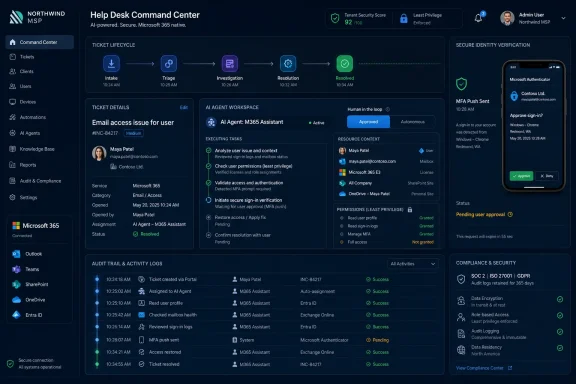
Mizo’s announcement takes aim at that gap. The company says its agents can authenticate the requester, perform the requested Microsoft 365 change, communicate with the user, resolve the ticket, and document the work in the MSP’s own toolset. In other words, the agent is not just writing the runbook; it is executing it.
That distinction is the heart of the story. Triage automation improves routing, but autonomous resolution attacks the ticket itself. It turns a password reset or shared mailbox permission change from a human task supported by software into a software task supervised by humans only when policy demands it.
The list of supported Microsoft 365 scenarios is familiar to anyone who has worked a small-business or midmarket help desk: password resets, MFA resets, account unlocks, license assignment, distribution list changes, Teams membership, mailbox forwarding, aliases, SharePoint and OneDrive access, new user provisioning, offboarding, and conditional access exceptions. None of those jobs is glamorous. Collectively, they are the repetitive infrastructure of MSP margins.
That matters because autonomous service desk tools are only as credible as their authentication model. A bot that can reset MFA, change mailbox forwarding, or add a user to a group is not merely a convenience layer. It is a privileged actor moving through the customer tenant, and the difference between automation and risk depends on how rigorously that actor proves the user’s identity and records its own behavior.
Microsoft 365 is also not a neutral playground. It is the identity, collaboration, and data layer for a huge share of the business world. A careless license change is annoying; a careless conditional access exception or mailbox forwarding change can become an incident. That is why Mizo is wisely leading with “verified identity” rather than simply promising faster ticket closure.
Still, MFA push is not magic. It reduces one kind of risk while introducing operational questions MSPs will need to answer. What happens when the user’s device is lost? How does the workflow detect social engineering? Which actions require a second approval? How are exceptions handled when an executive is traveling, a device is broken, or an account is already compromised?
Those are not reasons to dismiss the launch. They are reasons to treat policy design as the actual deployment work. Autonomous resolution does not eliminate governance; it makes governance executable.
That creates a staffing trap. Entry-level technicians need repetitive tickets to learn the environment, but too many repetitive tickets turn the service desk into a treadmill. Senior technicians are pulled into escalations because the front line is overloaded. Customers complain about response times for work that feels, from their perspective, routine.
Mizo is pitching its agents as a way out of that trap. CEO and co-founder Mat Tougas framed the release around freeing technicians from repetitive Level 1 work so they can focus on service quality and problems that need human judgment. That is exactly the message MSP owners want to hear in a labor market where skilled technical staff are expensive and customer expectations keep rising.
But the industry should be careful about pretending this is only a morale story. It is also an operating model story. If autonomous agents can reliably close routine Microsoft 365 tickets, an MSP can support more endpoints per technician, smooth after-hours coverage, reduce dispatch pressure, and standardize work across clients with different documentation quality. That is leverage, and leverage is what the MSP market has been chasing since the first RMM console promised to end truck rolls.
The platform is also structured enough for automation to be plausible. Users, groups, licenses, mailboxes, Teams memberships, SharePoint permissions, and conditional access policies all sit behind administrative interfaces and APIs. The tasks are frequent, rule-bound, and measurable. That makes Microsoft 365 a natural proving ground for agentic support software.
There is another reason this matters: Microsoft itself has spent the last few years pushing the idea that AI agents will operate across business systems, not merely summarize documents. Microsoft’s own agent strategy increasingly emphasizes governance, observability, and control planes because enterprises are expected to run many agents with access to sensitive data and workflows. Mizo’s move fits that broader direction, but with an MSP-specific angle.
The MSP angle is crucial. Internal IT departments can standardize around one tenant, one culture, and one set of policies. MSPs have to operationalize across many customers, each with different contracts, risk tolerance, documentation, and approval rules. If Mizo can make autonomous resolution portable across that mess, it has a more valuable product than a single-tenant help desk bot.
That is why Mizo’s positioning is sharp. The company is not merely saying, “Use our AI to reduce tickets.” It is saying MSPs can become the first proof point for the AI-enabled service model they will later package for customers. The help desk becomes the demonstration environment.
There is a commercial logic here. MSPs are constantly searching for differentiation in a market where endpoint management, backup, security bundles, and Microsoft licensing can blur together. If an MSP can show customers that it runs an autonomous Level 1 desk with auditable controls, it gets a story about speed, scale, and maturity that is more tangible than vague AI consulting.
The risk is that “Customer Zero” becomes another channel slogan if the technology does not survive contact with real-world tickets. MSPs have seen enough vendor roadmaps to know that demos rarely include messy tenants, stale documentation, duplicate user accounts, broken MFA registrations, and clients who file tickets from personal email addresses. The test will not be whether an agent can complete a clean workflow. The test will be whether it can stop safely when the workflow is dirty.
No serious MSP is going to give a new AI agent blanket authority over every Microsoft 365 action on day one. The rational adoption path is staged. Let the agent draft responses and propose resolutions. Let it execute low-risk changes with confirmation. Let it handle certain high-volume workflows autonomously for well-documented customers. Keep sensitive actions behind approval until the audit trail, exception handling, and customer consent model are proven.
This is where the product category will separate itself from hype. A good autonomous service desk agent should not be judged only by how often it acts. It should be judged by how well it knows when not to act. Refusing a risky request, escalating an ambiguous identity signal, or flagging a policy conflict is not a failure of autonomy. It is the basis for autonomy that an MSP can insure, explain, and defend.
The permission model also has customer-relations implications. Many MSP clients will want to know exactly which tasks an AI agent is allowed to perform in their tenant. Some will accept autonomous password resets but require approval for mailbox forwarding. Others may permit license changes but block conditional access exceptions. The MSP that treats those choices as part of the service agreement will have an advantage over the MSP that waves away the concern with “the AI handles it.”
When a user asks who changed a mailbox permission, when a customer audits offboarding, or when an insurer asks how access was controlled, the ticket record becomes the story of what happened. A human technician may forget to write down the command they ran or the exact approval chain they followed. An agent should have no such excuse.
The audit trail must include more than “resolved by AI.” It needs to show who requested the action, how identity was verified, what policy applied, what change was made, when it occurred, what system accepted it, and whether any approval was required. If autonomous service desk platforms cannot produce that level of traceability, they will remain a convenience feature rather than an operational backbone.
This is also where integration depth matters. Mizo’s public positioning references common MSP systems such as PSA and documentation platforms. The more cleanly the agent writes back into the tools technicians already use, the less likely it is to create a shadow service desk that solves tickets quickly but leaves humans blind.
Identity workflows are especially sensitive because they sit near the beginning of many attack chains. Account unlocks, MFA resets, external access, group membership, and mailbox forwarding are all areas where convenience and compromise can look uncomfortably similar. An MSP deploying autonomous resolution has to assume attackers will eventually probe the support channel.
The right answer is not to keep humans in every loop forever. Humans are also fallible, and help desks have long been targets for social engineering. The better answer is to make the agent’s authority explicit, constrained, logged, and revocable. Automation can improve security if it enforces policy consistently and refuses shortcuts that tired technicians might accept under pressure.
That is the upside Mizo is implicitly selling. A well-designed agent does not get impatient. It does not skip MFA because the requester sounds annoyed. It does not forget to remove a license during offboarding. It does not invent a one-off workaround unless the workflow allows it. The challenge is proving that discipline across the endless variety of MSP customer environments.
That shift will make buyers more demanding. A copilot can be forgiven for producing a mediocre suggestion because a human remains responsible for the outcome. An autonomous agent that closes a ticket has a different burden. It must be correct, secure, explainable, and reversible enough to fit into real service operations.
This is why “agentic” is both the right word and an overused one. In its weakest form, it means a chatbot with tool access. In its strongest form, it means software that can pursue a goal across systems while respecting policy, identity, and context. Mizo is clearly trying to claim the stronger definition.
MSPs should welcome that ambition while testing it ruthlessly. The release should not be evaluated by demo videos or the number of use cases alone. It should be evaluated by exception rates, escalation quality, false approvals, rollback procedures, customer acceptance, technician trust, and whether the promised time savings survive a month-end rush of onboarding and offboarding tickets.
The next stage will be expansion across the MSP tool stack. That means RMM actions, endpoint remediation, security alerts, backup checks, line-of-business app access, procurement workflows, and perhaps eventually cross-platform incident response. Each added system increases the potential value and the potential blast radius.
That is why Microsoft 365 coverage is both a milestone and a warning. If Mizo and its competitors cannot make identity-heavy Microsoft 365 workflows safe, auditable, and commercially acceptable, the rest of the agentic service desk story will struggle. If they can, Level 1 support may become the first major MSP function where autonomous AI moves from marketing slide to default operating model.
 Mizo Is Selling the End of the Half-Automated Ticket
For years, service desk automation has been framed as a relief valve for the queue. A bot collects the symptoms, a workflow tags the ticket, a knowledge base article appears in the technician’s pane, and the human still does the thing that matters. That model was useful, but it never changed the economics of Level 1 support as dramatically as vendors promised.Mizo’s announcement takes aim at that gap. The company says its agents can authenticate the requester, perform the requested Microsoft 365 change, communicate with the user, resolve the ticket, and document the work in the MSP’s own toolset. In other words, the agent is not just writing the runbook; it is executing it.
That distinction is the heart of the story. Triage automation improves routing, but autonomous resolution attacks the ticket itself. It turns a password reset or shared mailbox permission change from a human task supported by software into a software task supervised by humans only when policy demands it.
The list of supported Microsoft 365 scenarios is familiar to anyone who has worked a small-business or midmarket help desk: password resets, MFA resets, account unlocks, license assignment, distribution list changes, Teams membership, mailbox forwarding, aliases, SharePoint and OneDrive access, new user provisioning, offboarding, and conditional access exceptions. None of those jobs is glamorous. Collectively, they are the repetitive infrastructure of MSP margins.
The MFA Push Is the Product, Not a Footnote
The most important part of Mizo’s launch is not the number of supported workflows. It is the identity checkpoint sitting in front of them. The company says its agents verify the end user in real time through MFA push before taking sensitive actions, tying account changes to a confirmed requester.That matters because autonomous service desk tools are only as credible as their authentication model. A bot that can reset MFA, change mailbox forwarding, or add a user to a group is not merely a convenience layer. It is a privileged actor moving through the customer tenant, and the difference between automation and risk depends on how rigorously that actor proves the user’s identity and records its own behavior.
Microsoft 365 is also not a neutral playground. It is the identity, collaboration, and data layer for a huge share of the business world. A careless license change is annoying; a careless conditional access exception or mailbox forwarding change can become an incident. That is why Mizo is wisely leading with “verified identity” rather than simply promising faster ticket closure.
Still, MFA push is not magic. It reduces one kind of risk while introducing operational questions MSPs will need to answer. What happens when the user’s device is lost? How does the workflow detect social engineering? Which actions require a second approval? How are exceptions handled when an executive is traveling, a device is broken, or an account is already compromised?
Those are not reasons to dismiss the launch. They are reasons to treat policy design as the actual deployment work. Autonomous resolution does not eliminate governance; it makes governance executable.
Level 1 Work Was Always a Margin Problem
MSPs live and die by utilization, ticket volume, and trust. The least strategic work often arrives with the greatest urgency: “I’m locked out,” “I need access,” “my MFA broke,” “add this user,” “remove that user,” “why can’t I open this mailbox?” These requests are simple enough to bore senior technicians and important enough to punish mistakes.That creates a staffing trap. Entry-level technicians need repetitive tickets to learn the environment, but too many repetitive tickets turn the service desk into a treadmill. Senior technicians are pulled into escalations because the front line is overloaded. Customers complain about response times for work that feels, from their perspective, routine.
Mizo is pitching its agents as a way out of that trap. CEO and co-founder Mat Tougas framed the release around freeing technicians from repetitive Level 1 work so they can focus on service quality and problems that need human judgment. That is exactly the message MSP owners want to hear in a labor market where skilled technical staff are expensive and customer expectations keep rising.
But the industry should be careful about pretending this is only a morale story. It is also an operating model story. If autonomous agents can reliably close routine Microsoft 365 tickets, an MSP can support more endpoints per technician, smooth after-hours coverage, reduce dispatch pressure, and standardize work across clients with different documentation quality. That is leverage, and leverage is what the MSP market has been chasing since the first RMM console promised to end truck rolls.
Microsoft 365 Is the Obvious First Battlefield
Mizo says Microsoft 365 is the first environment to reach full end-to-end coverage. That is not surprising. For MSPs, Microsoft 365 is both the most common customer platform and one of the richest sources of repetitive identity and access work.The platform is also structured enough for automation to be plausible. Users, groups, licenses, mailboxes, Teams memberships, SharePoint permissions, and conditional access policies all sit behind administrative interfaces and APIs. The tasks are frequent, rule-bound, and measurable. That makes Microsoft 365 a natural proving ground for agentic support software.
There is another reason this matters: Microsoft itself has spent the last few years pushing the idea that AI agents will operate across business systems, not merely summarize documents. Microsoft’s own agent strategy increasingly emphasizes governance, observability, and control planes because enterprises are expected to run many agents with access to sensitive data and workflows. Mizo’s move fits that broader direction, but with an MSP-specific angle.
The MSP angle is crucial. Internal IT departments can standardize around one tenant, one culture, and one set of policies. MSPs have to operationalize across many customers, each with different contracts, risk tolerance, documentation, and approval rules. If Mizo can make autonomous resolution portable across that mess, it has a more valuable product than a single-tenant help desk bot.
“Customer Zero” Turns From Slogan Into Operating Pressure
Mizo connects the launch to Pax8’s “Customer Zero” concept, the idea that MSPs should adopt AI internally before selling it outward to clients. The slogan is tidy, but the operational pressure behind it is real. MSPs cannot credibly advise customers on autonomous AI if their own ticket queues still depend entirely on human swivel-chair labor.That is why Mizo’s positioning is sharp. The company is not merely saying, “Use our AI to reduce tickets.” It is saying MSPs can become the first proof point for the AI-enabled service model they will later package for customers. The help desk becomes the demonstration environment.
There is a commercial logic here. MSPs are constantly searching for differentiation in a market where endpoint management, backup, security bundles, and Microsoft licensing can blur together. If an MSP can show customers that it runs an autonomous Level 1 desk with auditable controls, it gets a story about speed, scale, and maturity that is more tangible than vague AI consulting.
The risk is that “Customer Zero” becomes another channel slogan if the technology does not survive contact with real-world tickets. MSPs have seen enough vendor roadmaps to know that demos rarely include messy tenants, stale documentation, duplicate user accounts, broken MFA registrations, and clients who file tickets from personal email addresses. The test will not be whether an agent can complete a clean workflow. The test will be whether it can stop safely when the workflow is dirty.
The Human-in-the-Loop Toggle Is Where Trust Will Be Won
Mizo says customers can choose the permission level for every action, from human-in-the-loop to fully autonomous. That flexibility may sound like a deployment detail, but it is probably one of the most important buying criteria.No serious MSP is going to give a new AI agent blanket authority over every Microsoft 365 action on day one. The rational adoption path is staged. Let the agent draft responses and propose resolutions. Let it execute low-risk changes with confirmation. Let it handle certain high-volume workflows autonomously for well-documented customers. Keep sensitive actions behind approval until the audit trail, exception handling, and customer consent model are proven.
This is where the product category will separate itself from hype. A good autonomous service desk agent should not be judged only by how often it acts. It should be judged by how well it knows when not to act. Refusing a risky request, escalating an ambiguous identity signal, or flagging a policy conflict is not a failure of autonomy. It is the basis for autonomy that an MSP can insure, explain, and defend.
The permission model also has customer-relations implications. Many MSP clients will want to know exactly which tasks an AI agent is allowed to perform in their tenant. Some will accept autonomous password resets but require approval for mailbox forwarding. Others may permit license changes but block conditional access exceptions. The MSP that treats those choices as part of the service agreement will have an advantage over the MSP that waves away the concern with “the AI handles it.”
Documentation Becomes Evidence, Not Paperwork
Mizo says its agents document every action in the partner’s toolset. That line may not sound as exciting as autonomous resolution, but MSPs should pay close attention to it. In managed services, documentation is not just internal hygiene; it is evidence.When a user asks who changed a mailbox permission, when a customer audits offboarding, or when an insurer asks how access was controlled, the ticket record becomes the story of what happened. A human technician may forget to write down the command they ran or the exact approval chain they followed. An agent should have no such excuse.
The audit trail must include more than “resolved by AI.” It needs to show who requested the action, how identity was verified, what policy applied, what change was made, when it occurred, what system accepted it, and whether any approval was required. If autonomous service desk platforms cannot produce that level of traceability, they will remain a convenience feature rather than an operational backbone.
This is also where integration depth matters. Mizo’s public positioning references common MSP systems such as PSA and documentation platforms. The more cleanly the agent writes back into the tools technicians already use, the less likely it is to create a shadow service desk that solves tickets quickly but leaves humans blind.
Security Teams Will Ask About the Agent’s Blast Radius
The security objection to autonomous Level 1 resolution is straightforward: if the agent can do useful work, it can also do harmful work if compromised, misconfigured, or manipulated. That does not make the model untenable. It makes least privilege, tenant isolation, approval boundaries, and observability non-negotiable.Identity workflows are especially sensitive because they sit near the beginning of many attack chains. Account unlocks, MFA resets, external access, group membership, and mailbox forwarding are all areas where convenience and compromise can look uncomfortably similar. An MSP deploying autonomous resolution has to assume attackers will eventually probe the support channel.
The right answer is not to keep humans in every loop forever. Humans are also fallible, and help desks have long been targets for social engineering. The better answer is to make the agent’s authority explicit, constrained, logged, and revocable. Automation can improve security if it enforces policy consistently and refuses shortcuts that tired technicians might accept under pressure.
That is the upside Mizo is implicitly selling. A well-designed agent does not get impatient. It does not skip MFA because the requester sounds annoyed. It does not forget to remove a license during offboarding. It does not invent a one-off workaround unless the workflow allows it. The challenge is proving that discipline across the endless variety of MSP customer environments.
The Competitive Race Is Moving From Copilots to Coworkers
The broader AI service desk market is crowded with copilots, chatbots, summarizers, and workflow assistants. Many are useful. Few change the accountability model. Mizo’s announcement is part of a larger shift toward AI systems that behave less like advisory overlays and more like operational coworkers.That shift will make buyers more demanding. A copilot can be forgiven for producing a mediocre suggestion because a human remains responsible for the outcome. An autonomous agent that closes a ticket has a different burden. It must be correct, secure, explainable, and reversible enough to fit into real service operations.
This is why “agentic” is both the right word and an overused one. In its weakest form, it means a chatbot with tool access. In its strongest form, it means software that can pursue a goal across systems while respecting policy, identity, and context. Mizo is clearly trying to claim the stronger definition.
MSPs should welcome that ambition while testing it ruthlessly. The release should not be evaluated by demo videos or the number of use cases alone. It should be evaluated by exception rates, escalation quality, false approvals, rollback procedures, customer acceptance, technician trust, and whether the promised time savings survive a month-end rush of onboarding and offboarding tickets.
The Microsoft 365 Help Desk Just Became the Trial Run
Mizo’s launch is not the final form of the autonomous MSP. It is the first serious checkpoint. Microsoft 365 is broad enough to matter, repetitive enough to automate, and sensitive enough to expose weak security design quickly.The next stage will be expansion across the MSP tool stack. That means RMM actions, endpoint remediation, security alerts, backup checks, line-of-business app access, procurement workflows, and perhaps eventually cross-platform incident response. Each added system increases the potential value and the potential blast radius.
That is why Microsoft 365 coverage is both a milestone and a warning. If Mizo and its competitors cannot make identity-heavy Microsoft 365 workflows safe, auditable, and commercially acceptable, the rest of the agentic service desk story will struggle. If they can, Level 1 support may become the first major MSP function where autonomous AI moves from marketing slide to default operating model.
The Real Test Comes After the First Thousand Closed Tickets
The launch gives MSPs a concrete reason to revisit their assumptions about service desk AI. The following points are the ones that should survive the sales call and make it into the deployment plan.- Mizo says its agents can now resolve more than 15 Microsoft 365 service desk scenarios from intake to closure without a technician in the middle.
- The most consequential feature is real-time MFA push verification before sensitive actions, because identity assurance is the hinge between useful automation and unacceptable risk.
- MSPs should start with granular permissions and human approval for higher-risk workflows rather than treating full autonomy as the default setting.
- The audit trail must capture requester identity, verification method, policy basis, action taken, timestamp, and system outcome in the MSP’s normal toolset.
- Microsoft 365 is the right first environment because it concentrates a large share of repetitive MSP work, but it also exposes the product to serious identity and access-management risk.
- The business case will depend less on whether the agent can close clean tickets and more on how safely it handles ambiguous, messy, or hostile ones.
References
- Primary source: AiThority
Published: Wed, 24 Jun 2026 14:42:28 GMT
- Related coverage: mizo.tech
AI agent automation for MSPs and MIPs - Mizo
Mizo: AI agents transform your MSP. Automate tasks, boost productivity, and reduce costs. See how Mizo can help you grow.mizo.tech
- Official source: microsoft.com
Agentic Service Solutions | Microsoft Dynamics 365
Discover agentic customer service solutions from Microsoft Dynamics 365. Improve experiences, lower costs, and lead with agentic service innovation.www.microsoft.com
- Official source: marketplace.microsoft.com
Rezolve.ai
Modern Full Featured Service Desk Based on MS Teams, that uses AI to Auto-Resolve Employee Requests.marketplace.microsoft.com
- Related coverage: pax8.com
Beyond 2026 Day Two Recap | Pax8 Blog
Find out everything that happened on Day Two of Beyond 2026, including keynotes from Pax8 President Nick Heddy and Pax8 CEO Scott Chasin.www.pax8.com - Related coverage: news.cognizant.com
Cognizant and Microsoft Expand Partnership to Advance AI Transformation and Frontier Firm Experiences - Dec 18, 2025
PDF documentnews.cognizant.com
- Official source: cdn-dynmedia-1.microsoft.com
AZBC: Executive AI Briefing: Inside Microsoft’s Customer Zero Playbook
PDF documentcdn-dynmedia-1.microsoft.com
