

Anthropic’s rumored Claude Mythos successor, reportedly appearing as
The most important word in the rumored model name is not Oceanus. It is the suffix: a versioned, testable candidate that appears to be moving through evaluation rather than sitting in a research notebook. If reports are accurate,
That matters because Anthropic has already treated Mythos as something different from a normal Claude upgrade. Mythos Preview was not merely pitched as “smarter Opus.” It was framed around cybersecurity capability, long-context reasoning, and controlled access — the kind of language companies use when they believe a model has crossed from productivity tool into dual-use infrastructure.
The public speculation now is that Oceanus represents the next phase of that rollout: either a stronger successor to Mythos Preview, a hardened release candidate, or an internal branch being tested before Anthropic decides how much access customers should receive. None of those possibilities would be trivial. Each would mean Anthropic is trying to convert a model it has treated cautiously into a product with pricing, policy, and operational boundaries.
The reported pricing only sharpens that interpretation. At $16 per million input tokens and $80 per million output tokens, Oceanus would sit firmly in premium-model territory, aimed at organizations willing to pay for high-value work rather than casual prompt experimentation. In plain enterprise language, that is not “ask it to rewrite an email” pricing. That is “use it where a human expert hour costs far more” pricing.
The claims around Mythos Preview have centered on advanced reasoning, software engineering, cybersecurity analysis, long-context work, and agentic execution. Those are precisely the domains where small quality improvements can compound into large changes in practice. A model that is 10 percent better at maintaining state across a messy codebase may be more than 10 percent more useful to a developer. A model that is more persistent in tracing an exploit path may change what vulnerability research looks like.
That is why the leak has drawn attention beyond the usual AI influencer circuit. If Oceanus is real and is being tested under the Mythos umbrella, the story is not just that Anthropic may release a more expensive Claude. The story is that Anthropic may be preparing to commercialize a class of AI work that was previously kept behind controlled preview gates.
The coding productivity claim in the source material — engineers contributing up to eight times more code with Mythos Preview versus roughly two and a half times more with Claude Opus 4.5 — should be treated carefully. Internal charts are not independent evidence, and “more code” is not the same thing as better software. But even as an unverified claim, it shows what Anthropic appears to be optimizing for: sustained throughput in complex work, not merely clever answers in isolated prompts.
For a model like Mythos or Oceanus, red-team testing would likely focus on whether the system can meaningfully assist with exploit development, privilege escalation, credential abuse, supply-chain compromise, automated reconnaissance, or malware adaptation. The same capabilities that make a model useful for defending codebases can make it useful for attacking them. That is not an abstract policy debate; it is the central dilemma of AI-assisted cybersecurity.
Anthropic’s public posture has long leaned into safety language more aggressively than many competitors. That has given the company credibility with some enterprise buyers, but it also creates a burden: if Anthropic releases Mythos too broadly and the model is quickly tied to serious abuse, the company’s safety brand takes the hit first. A tightly managed red-team phase is therefore both technically necessary and reputationally necessary.
The interesting question is whether Anthropic can find a middle tier between “not public” and “available to anyone with a credit card.” The AI market wants access, developers want capability, and enterprises want defensible procurement pathways. But cybersecurity models may force a more gated future, where access depends on identity, use case, monitoring, and contractual controls.
In software engineering, the economics can be brutal. If a model helps a small platform team understand a sprawling codebase, produce a patch, generate tests, and draft a migration plan in hours rather than days, the token bill may be noise. If it produces plausible but brittle code that later breaks production, the cheap part was the model call.
That is where Mythos will be judged differently from consumer AI. A $20 chatbot subscription can be forgiven for hallucinating a recipe or mangling a spreadsheet formula. A premium agent used in security review, CI pipelines, incident response, or enterprise code modernization must meet a much higher standard. The cost of failure is not an annoyed user; it can be a breached network, a bad patch, or a compliance incident.
The reported pricing also suggests Anthropic knows output tokens are where the expensive work lives. Long plans, generated code, audit reports, exploit analyses, and agentic traces all expand quickly. If Oceanus is truly built for long-horizon workflows, its business model must account for customers asking it to think, write, test, revise, and continue for extended periods.
The more interesting question is not whether Mythos helps developers type faster. It is whether it helps teams converge on correct, maintainable changes faster. That means better issue triage, cleaner diffs, more relevant tests, stronger documentation, and fewer review cycles. In enterprise Windows environments, it also means understanding PowerShell scripts, Group Policy interactions, Intune configurations, legacy .NET applications, driver dependencies, and the strange sedimentary layers that accumulate in real IT estates.
A genuinely stronger reasoning model could be useful in exactly those messy contexts. It could trace why a Windows update breaks a line-of-business app, compare registry changes across builds, explain a crash dump, or help modernize an old deployment script without losing all the institutional knowledge embedded in it. That is where frontier AI stops being a demo and starts looking like a junior-to-mid engineer who never gets tired but still needs supervision.
The danger is that organizations mistake fluency for authority. A Mythos-class model may be better at sustaining a line of reasoning, but it will still operate inside imperfect prompts, incomplete repos, stale documentation, and ambiguous business rules. The productivity gain will belong to teams that build review systems around the model, not teams that simply let it spray code into production.
For WindowsForum’s core readership, this is the part that matters most. Windows is not just an operating system on a laptop; it is a sprawling enterprise platform composed of identity, endpoint management, update channels, directory services, cloud integration, legacy compatibility, and third-party security tooling. A model that can reason across that complexity would be enormously useful to defenders.
Imagine an AI system that can correlate a suspicious PowerShell command, an Entra ID sign-in anomaly, a Defender alert, a vulnerable driver, and a recent patch regression into a coherent incident narrative. That is not science fiction anymore; it is the obvious direction of travel. The limiting factors are trust, data access, model reliability, and whether the organization can verify the model’s conclusions quickly enough to act.
But the offensive side is equally obvious. Attackers do not need perfection. They need scale, persistence, and enough accuracy to reduce the cost of probing targets. A frontier model that helps identify brittle configurations or generate working proof-of-concept exploit paths could change the economics of intrusion attempts, especially against underfunded organizations that already struggle to patch and monitor.
That is the capability frontier every major AI lab is chasing. Chatbots are useful, but agents are where vendors see durable enterprise revenue. A model that can complete a software migration, operate a security investigation, or manage a research task across hours has a very different value proposition from one that merely summarizes a document.
The problem is that agentic systems amplify both competence and error. A single bad answer is visible and bounded. A bad agent can make a series of locally plausible decisions that collectively produce damage. It can delete the wrong file, apply the wrong patch, misclassify an alert, or follow a flawed assumption across dozens of steps before anyone notices.
If Oceanus is being tested for agentic durability, Anthropic’s challenge is not just raw intelligence. It must prove that the model knows when to stop, when to ask for permission, when to preserve state, when to surface uncertainty, and when to refuse dangerous work. Those behaviors are not decorative safety features. They are the difference between a useful enterprise agent and a liability with an API key.
This is not the old chatbot beauty contest. Enterprise buyers increasingly care less about which model writes the wittiest essay and more about which one can integrate into developer tools, cloud platforms, security systems, and compliance workflows. The frontier model is becoming a component in a larger stack.
For Microsoft watchers, that competitive dynamic matters because OpenAI’s models are woven deeply into Copilot, Azure AI, GitHub, and Microsoft 365. Anthropic, by contrast, has pursued partnerships across cloud and enterprise channels without owning the Windows productivity layer. If Mythos is genuinely ahead in software engineering or security reasoning, Microsoft will face pressure to match that capability through OpenAI, internal tooling, or broader model choice in Azure.
That is why the Mythos story belongs on a Windows and Microsoft forum even though Anthropic is not Microsoft. The AI model race increasingly determines what developers expect from IDEs, what security teams expect from SOC tooling, and what administrators expect from cloud-management assistants. The operating system is no longer the whole platform; the model behind the interface is becoming part of the platform, too.
A market price does not prove Anthropic’s launch plan. It proves that enough traders believe the available signals point toward a near-term release. That is useful context, but it is not equivalent to an official date, a product page, or a customer availability notice.
The ambiguity around “launch” matters too. A launch could mean a public API. It could mean a limited enterprise preview. It could mean availability to selected cloud partners. It could mean a safety report plus expanded red-team access. Each version would satisfy a different audience and carry different consequences.
This is where readers should resist the hype cycle’s binary thinking. Mythos may “launch” without becoming broadly available. Oceanus may be real without being the final public name. Anthropic may expand access while still withholding the most sensitive capabilities. The frontier AI market increasingly launches in layers, not moments.
Those questions will define Mythos adoption more than any viral chart. A security team cannot simply paste proprietary incident data into a model because it looks smart. A regulated enterprise cannot let an autonomous agent modify production systems without change controls. A software vendor cannot outsource vulnerability analysis to a black-box model without understanding how findings are verified and disclosed.
Anthropic will likely lean on its safety posture as a differentiator, but safety claims must become operational features. Enterprises will want admin controls, retention settings, eval reports, abuse monitoring, and contractual commitments. They will also want to know whether Anthropic can explain model behavior well enough for high-stakes review.
The irony is that the more powerful Mythos appears, the slower some buyers may move. High capability triggers procurement enthusiasm, but it also triggers legal, security, and governance review. The organizations most able to benefit from Mythos are often the ones least able to deploy it casually.
If Anthropic can place Mythos into coding environments, security platforms, cloud consoles, and incident-response products, Windows shops may encounter it indirectly. It could appear as a code-review assistant for PowerShell and C#, a vulnerability triage helper, a policy-analysis tool, or a migration planner for aging infrastructure. In that form, the model’s name may matter less than the permissions granted to the integration.
This is the practical risk surface. An AI assistant embedded in an IDE can suggest code. An AI assistant embedded in a security platform can influence investigations. An AI assistant embedded in an endpoint-management workflow could recommend configuration changes across thousands of machines. The blast radius depends on integration design.
Administrators should therefore evaluate AI features the same way they evaluate scripts, agents, and management tooling. What can it read? What can it change? Who approved it? How is it logged? Can it be rolled back? If the answer is vague, the model is not ready for privileged work, no matter how impressive its benchmark scores look.
That is unhealthy but understandable. Frontier labs are building systems with enormous economic and security implications while revealing only selective information. Developers and customers, hungry for planning signals, interpret whatever they can find. A stray model name can move sentiment because the official roadmap is usually opaque.
Anthropic is hardly alone here. OpenAI, Google, xAI, Meta, and others all operate in an environment where model identifiers and API traces are treated like intelligence intercepts. The result is a public conversation that is often ahead of the facts and behind the reality at the same time.
For journalists and readers, the right posture is disciplined skepticism. The Oceanus leak may be meaningful. The pricing may be accurate. The red-team testing may indicate a release candidate. But until Anthropic confirms availability, capabilities, access rules, and pricing, the only honest conclusion is that the signals point toward movement, not certainty.
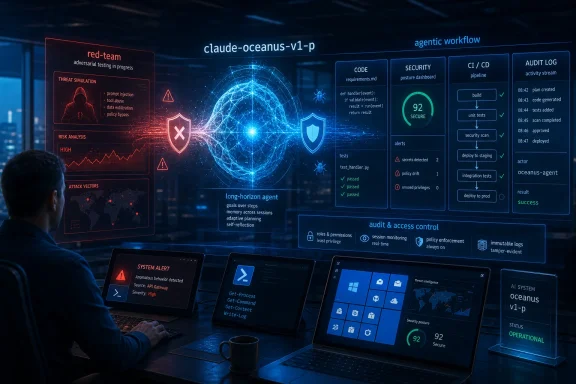
claude-oceanus-v1-p in red-team testing in early June 2026, has intensified speculation that the company is preparing a broader launch of its most closely watched frontier model within weeks. The leak is not a launch announcement, and it is not proof that Anthropic has decided to put Mythos into ordinary customer hands. But it is another signal that the AI industry’s next competitive front is shifting from chatbots that answer questions to systems that can reason, code, audit, plan, and operate across long-running workflows. For Windows users, developers, and enterprise administrators, that makes Mythos less of a curiosity and more of a preview of the next software-security arms race.
 The Leak Is Really About Anthropic’s Confidence Threshold
The most important word in the rumored model name is not Oceanus. It is the suffix: a versioned, testable candidate that appears to be moving through evaluation rather than sitting in a research notebook. If reports are accurate, claude-oceanus-v1-p has reached red-team testers, a group whose job is not to applaud benchmark charts but to break the model, abuse it, and discover what happens when powerful capability meets adversarial intent.That matters because Anthropic has already treated Mythos as something different from a normal Claude upgrade. Mythos Preview was not merely pitched as “smarter Opus.” It was framed around cybersecurity capability, long-context reasoning, and controlled access — the kind of language companies use when they believe a model has crossed from productivity tool into dual-use infrastructure.
The public speculation now is that Oceanus represents the next phase of that rollout: either a stronger successor to Mythos Preview, a hardened release candidate, or an internal branch being tested before Anthropic decides how much access customers should receive. None of those possibilities would be trivial. Each would mean Anthropic is trying to convert a model it has treated cautiously into a product with pricing, policy, and operational boundaries.
The reported pricing only sharpens that interpretation. At $16 per million input tokens and $80 per million output tokens, Oceanus would sit firmly in premium-model territory, aimed at organizations willing to pay for high-value work rather than casual prompt experimentation. In plain enterprise language, that is not “ask it to rewrite an email” pricing. That is “use it where a human expert hour costs far more” pricing.
Mythos Was Never Just Another Chat Model
The AI industry’s launch rhythm has made it too easy to treat every new model as a leaderboard event. A vendor publishes a system card, a few developers test coding tasks, social media argues about vibes, and within 72 hours everyone has moved on to the next rumored codename. Mythos has resisted that cycle because its alleged strengths sit in areas where capability is both commercially valuable and operationally dangerous.The claims around Mythos Preview have centered on advanced reasoning, software engineering, cybersecurity analysis, long-context work, and agentic execution. Those are precisely the domains where small quality improvements can compound into large changes in practice. A model that is 10 percent better at maintaining state across a messy codebase may be more than 10 percent more useful to a developer. A model that is more persistent in tracing an exploit path may change what vulnerability research looks like.
That is why the leak has drawn attention beyond the usual AI influencer circuit. If Oceanus is real and is being tested under the Mythos umbrella, the story is not just that Anthropic may release a more expensive Claude. The story is that Anthropic may be preparing to commercialize a class of AI work that was previously kept behind controlled preview gates.
The coding productivity claim in the source material — engineers contributing up to eight times more code with Mythos Preview versus roughly two and a half times more with Claude Opus 4.5 — should be treated carefully. Internal charts are not independent evidence, and “more code” is not the same thing as better software. But even as an unverified claim, it shows what Anthropic appears to be optimizing for: sustained throughput in complex work, not merely clever answers in isolated prompts.
Red-Team Access Is a Sign of Maturity, Not Imminent Safety
Red-team testing is often misunderstood as a final rubber stamp before release. In reality, it is a stress test that can produce three different outcomes: a green light, a delayed launch, or a decision to restrict access more tightly than originally planned. The more capable the system, the more red teaming becomes a product-design input rather than a compliance ritual.For a model like Mythos or Oceanus, red-team testing would likely focus on whether the system can meaningfully assist with exploit development, privilege escalation, credential abuse, supply-chain compromise, automated reconnaissance, or malware adaptation. The same capabilities that make a model useful for defending codebases can make it useful for attacking them. That is not an abstract policy debate; it is the central dilemma of AI-assisted cybersecurity.
Anthropic’s public posture has long leaned into safety language more aggressively than many competitors. That has given the company credibility with some enterprise buyers, but it also creates a burden: if Anthropic releases Mythos too broadly and the model is quickly tied to serious abuse, the company’s safety brand takes the hit first. A tightly managed red-team phase is therefore both technically necessary and reputationally necessary.
The interesting question is whether Anthropic can find a middle tier between “not public” and “available to anyone with a credit card.” The AI market wants access, developers want capability, and enterprises want defensible procurement pathways. But cybersecurity models may force a more gated future, where access depends on identity, use case, monitoring, and contractual controls.
Pricing Tells Us Who Anthropic Thinks Mythos Is For
The rumored $16 input and $80 output pricing would make Oceanus expensive enough to discourage casual use but not so expensive that serious engineering teams would ignore it. That is a familiar enterprise-software pattern. Price high enough to communicate scarcity and cost, but low enough that the buyer can justify the spend if it replaces senior labor on high-value tasks.In software engineering, the economics can be brutal. If a model helps a small platform team understand a sprawling codebase, produce a patch, generate tests, and draft a migration plan in hours rather than days, the token bill may be noise. If it produces plausible but brittle code that later breaks production, the cheap part was the model call.
That is where Mythos will be judged differently from consumer AI. A $20 chatbot subscription can be forgiven for hallucinating a recipe or mangling a spreadsheet formula. A premium agent used in security review, CI pipelines, incident response, or enterprise code modernization must meet a much higher standard. The cost of failure is not an annoyed user; it can be a breached network, a bad patch, or a compliance incident.
The reported pricing also suggests Anthropic knows output tokens are where the expensive work lives. Long plans, generated code, audit reports, exploit analyses, and agentic traces all expand quickly. If Oceanus is truly built for long-horizon workflows, its business model must account for customers asking it to think, write, test, revise, and continue for extended periods.
Developers May Get More Code Before They Get Better Software
The eight-times-more-code claim is the kind of metric that grabs attention and should immediately raise eyebrows. Developers have spent decades learning that code volume is a dangerous productivity measure. A tool that helps engineers produce more code can be transformative, but it can also flood repositories with abstractions, test gaps, dependency sprawl, and security debt.The more interesting question is not whether Mythos helps developers type faster. It is whether it helps teams converge on correct, maintainable changes faster. That means better issue triage, cleaner diffs, more relevant tests, stronger documentation, and fewer review cycles. In enterprise Windows environments, it also means understanding PowerShell scripts, Group Policy interactions, Intune configurations, legacy .NET applications, driver dependencies, and the strange sedimentary layers that accumulate in real IT estates.
A genuinely stronger reasoning model could be useful in exactly those messy contexts. It could trace why a Windows update breaks a line-of-business app, compare registry changes across builds, explain a crash dump, or help modernize an old deployment script without losing all the institutional knowledge embedded in it. That is where frontier AI stops being a demo and starts looking like a junior-to-mid engineer who never gets tired but still needs supervision.
The danger is that organizations mistake fluency for authority. A Mythos-class model may be better at sustaining a line of reasoning, but it will still operate inside imperfect prompts, incomplete repos, stale documentation, and ambiguous business rules. The productivity gain will belong to teams that build review systems around the model, not teams that simply let it spray code into production.
Security Teams Are the First Real Audience
The Mythos story has always had a cybersecurity shadow. Anthropic’s earlier positioning around Mythos Preview emphasized its ability to find vulnerabilities, including serious flaws across major software ecosystems. That is the sort of claim that instantly turns a model release into a coordination problem. If defenders get access before attackers, it can improve security. If attackers get equivalent capability at scale, the same model becomes an accelerant.For WindowsForum’s core readership, this is the part that matters most. Windows is not just an operating system on a laptop; it is a sprawling enterprise platform composed of identity, endpoint management, update channels, directory services, cloud integration, legacy compatibility, and third-party security tooling. A model that can reason across that complexity would be enormously useful to defenders.
Imagine an AI system that can correlate a suspicious PowerShell command, an Entra ID sign-in anomaly, a Defender alert, a vulnerable driver, and a recent patch regression into a coherent incident narrative. That is not science fiction anymore; it is the obvious direction of travel. The limiting factors are trust, data access, model reliability, and whether the organization can verify the model’s conclusions quickly enough to act.
But the offensive side is equally obvious. Attackers do not need perfection. They need scale, persistence, and enough accuracy to reduce the cost of probing targets. A frontier model that helps identify brittle configurations or generate working proof-of-concept exploit paths could change the economics of intrusion attempts, especially against underfunded organizations that already struggle to patch and monitor.
Agentic Workflows Are Where the Stakes Escalate
The phrase long-horizon agentic workflows sounds like vendor poetry until you unpack it. It means a model does not merely answer a question; it pursues a goal over many steps. It reads, plans, calls tools, edits files, checks results, revises its approach, and continues.That is the capability frontier every major AI lab is chasing. Chatbots are useful, but agents are where vendors see durable enterprise revenue. A model that can complete a software migration, operate a security investigation, or manage a research task across hours has a very different value proposition from one that merely summarizes a document.
The problem is that agentic systems amplify both competence and error. A single bad answer is visible and bounded. A bad agent can make a series of locally plausible decisions that collectively produce damage. It can delete the wrong file, apply the wrong patch, misclassify an alert, or follow a flawed assumption across dozens of steps before anyone notices.
If Oceanus is being tested for agentic durability, Anthropic’s challenge is not just raw intelligence. It must prove that the model knows when to stop, when to ask for permission, when to preserve state, when to surface uncertainty, and when to refuse dangerous work. Those behaviors are not decorative safety features. They are the difference between a useful enterprise agent and a liability with an API key.
The GPT-5.6 Timing Is More Than Launch Theater
The source material frames a potential Mythos release window as overlapping with an expected GPT-5.6 arrival. Even if that exact timing remains speculative, the competitive logic is clear. Anthropic and OpenAI are now fighting over the same high-value territory: coding, reasoning, enterprise agents, and AI-assisted security work.This is not the old chatbot beauty contest. Enterprise buyers increasingly care less about which model writes the wittiest essay and more about which one can integrate into developer tools, cloud platforms, security systems, and compliance workflows. The frontier model is becoming a component in a larger stack.
For Microsoft watchers, that competitive dynamic matters because OpenAI’s models are woven deeply into Copilot, Azure AI, GitHub, and Microsoft 365. Anthropic, by contrast, has pursued partnerships across cloud and enterprise channels without owning the Windows productivity layer. If Mythos is genuinely ahead in software engineering or security reasoning, Microsoft will face pressure to match that capability through OpenAI, internal tooling, or broader model choice in Azure.
That is why the Mythos story belongs on a Windows and Microsoft forum even though Anthropic is not Microsoft. The AI model race increasingly determines what developers expect from IDEs, what security teams expect from SOC tooling, and what administrators expect from cloud-management assistants. The operating system is no longer the whole platform; the model behind the interface is becoming part of the platform, too.
Prediction Markets Are Useful Signals, Not Evidence
The Polymarket odds cited in the report — roughly a 68 percent probability of Mythos launching by the end of next month — are worth noting but not worshipping. Prediction markets can aggregate expectations quickly, especially when traders follow leaks, product telemetry, hiring patterns, and private chatter. They can also be distorted by thin liquidity, ambiguous resolution criteria, and the same rumor loops that drive social media.A market price does not prove Anthropic’s launch plan. It proves that enough traders believe the available signals point toward a near-term release. That is useful context, but it is not equivalent to an official date, a product page, or a customer availability notice.
The ambiguity around “launch” matters too. A launch could mean a public API. It could mean a limited enterprise preview. It could mean availability to selected cloud partners. It could mean a safety report plus expanded red-team access. Each version would satisfy a different audience and carry different consequences.
This is where readers should resist the hype cycle’s binary thinking. Mythos may “launch” without becoming broadly available. Oceanus may be real without being the final public name. Anthropic may expand access while still withholding the most sensitive capabilities. The frontier AI market increasingly launches in layers, not moments.
Enterprise IT Will Ask Boring Questions First
The enthusiast conversation will revolve around benchmarks, model names, and whether Mythos beats GPT-5.6 on coding tasks. Enterprise IT will ask duller and more important questions. Where does the data go? How is access logged? Can output be audited? What is the liability model? Can the system be restricted by role, repository, tenant, or task type?Those questions will define Mythos adoption more than any viral chart. A security team cannot simply paste proprietary incident data into a model because it looks smart. A regulated enterprise cannot let an autonomous agent modify production systems without change controls. A software vendor cannot outsource vulnerability analysis to a black-box model without understanding how findings are verified and disclosed.
Anthropic will likely lean on its safety posture as a differentiator, but safety claims must become operational features. Enterprises will want admin controls, retention settings, eval reports, abuse monitoring, and contractual commitments. They will also want to know whether Anthropic can explain model behavior well enough for high-stakes review.
The irony is that the more powerful Mythos appears, the slower some buyers may move. High capability triggers procurement enthusiasm, but it also triggers legal, security, and governance review. The organizations most able to benefit from Mythos are often the ones least able to deploy it casually.
Windows Admins Should Watch the Toolchain, Not Just the Model
For Windows administrators, the immediate question is not whether they will open Claude and select “Mythos” from a dropdown. The question is where Mythos-class capability will appear in the tools they already use. AI value tends to arrive through workflows, not standalone chat windows.If Anthropic can place Mythos into coding environments, security platforms, cloud consoles, and incident-response products, Windows shops may encounter it indirectly. It could appear as a code-review assistant for PowerShell and C#, a vulnerability triage helper, a policy-analysis tool, or a migration planner for aging infrastructure. In that form, the model’s name may matter less than the permissions granted to the integration.
This is the practical risk surface. An AI assistant embedded in an IDE can suggest code. An AI assistant embedded in a security platform can influence investigations. An AI assistant embedded in an endpoint-management workflow could recommend configuration changes across thousands of machines. The blast radius depends on integration design.
Administrators should therefore evaluate AI features the same way they evaluate scripts, agents, and management tooling. What can it read? What can it change? Who approved it? How is it logged? Can it be rolled back? If the answer is vague, the model is not ready for privileged work, no matter how impressive its benchmark scores look.
The Leak Economy Is Becoming Part of AI Product Strategy
The AI industry now runs on a strange mixture of official announcements, benchmark screenshots, model strings, pricing tables, Discord archaeology, prediction markets, and carefully phrased denials. Leaks have become part of the product cycle, whether vendors want them or not. They shape expectations before companies publish anything formal.That is unhealthy but understandable. Frontier labs are building systems with enormous economic and security implications while revealing only selective information. Developers and customers, hungry for planning signals, interpret whatever they can find. A stray model name can move sentiment because the official roadmap is usually opaque.
Anthropic is hardly alone here. OpenAI, Google, xAI, Meta, and others all operate in an environment where model identifiers and API traces are treated like intelligence intercepts. The result is a public conversation that is often ahead of the facts and behind the reality at the same time.
For journalists and readers, the right posture is disciplined skepticism. The Oceanus leak may be meaningful. The pricing may be accurate. The red-team testing may indicate a release candidate. But until Anthropic confirms availability, capabilities, access rules, and pricing, the only honest conclusion is that the signals point toward movement, not certainty.
The Mythos Signal Is Strongest Where the Hype Is Weakest
The most concrete lesson from the Oceanus report is not that everyone should prepare for a specific launch date. It is that Anthropic appears to be moving a Mythos-class system through the hard parts of productization: testing, pricing, access control, and safety evaluation. That is where the story becomes less speculative and more consequential.- Anthropic has not officially confirmed a public Oceanus launch, so the reported model name and pricing should be treated as leak-based information rather than settled product fact.
- Red-team testing would suggest a serious evaluation phase, but it does not guarantee broad availability or a near-term consumer release.
- The rumored pricing points to professional and enterprise workloads, especially software engineering, security analysis, and long-running agentic tasks.
- Claims of dramatic coding productivity gains remain unverified, and code volume alone is a poor measure of software quality.
- Windows administrators should focus on how Mythos-class models enter IDEs, security tools, cloud consoles, and endpoint-management workflows.
- The central risk is dual use: the same reasoning that helps defenders find vulnerabilities can help attackers scale their own discovery and exploitation work.
References
- Primary source: thewincentral.com
Published: 2026-06-05T07:20:14.420068
Claude Mythos Leak Suggests Launch Is Just Weeks Away - WinCentral
: A new Claude Oceanus model has surfaced, suggesting Anthropic's powerful Mythos AI could launch soon - Read in AI News on WinCentral thewincentral.com
- Related coverage: techradar.com
EU to talk with Anthropic over access to Mythos AI Model | TechRadar
The European Commission is sending representatives to San Franciscowww.techradar.com - Related coverage: claudemythos.info
Claude Mythos Release Date: Polymarket Says 45% by June 2026
When is Claude Mythos launching? Polymarket odds: April 27%, June 45%. IPO connection, phased rollout plan, and how to get early access. claudemythos.info
- Related coverage: tomshardware.com
Anthropic's latest AI model identifies 'thousands of zero-day vulnerabilities' in 'every major operating system and every major web browser' — Claude Mythos Preview sparks race to fix critical bugs, some unpatched for decades | Tom's Hardware
Anthropic holds back its most advanced model yet to allow companies and institutions to prepare.www.tomshardware.com - Related coverage: computerworld.com
Leak reveals Anthropic’s ‘Mythos,’ a powerful AI model aimed at cybersecurity use cases – Computerworld
The draft blog post describes a compute‑intensive LLM with advanced reasoning that Anthropic plans to roll out cautiously, starting with enterprise security teams. www.computerworld.com
- Related coverage: livescience.com
Claude Mythos explained: Is Anthropic's most powerful AI model really too dangerous to release to the public? | Live Science
Anthropic's Mythos AI is being kept behind closed doors as governments assess what faster, AI-driven vulnerability discovery means for cybersecurity.www.livescience.com
- Related coverage: axios.com
Anthropic withholds Mythos Preview model because its hacking is too powerful
This is the one of the first times an AI company has held back a model over societal risks.www.axios.com
- Related coverage: themonexus.com
Inside the Discord That Hunts Unreleased AI Models: How 'Mythos' Got Found Before Anthropic Finished Locking Its Doors — The Monexus
A small group of Discord users accessed Anthropic's 'Mythos' — the model the company itself described as a 'step change' in AI capability — on the day it launched. They didn't hack a firewall. They guessed the URL. Bloomberg has the screenshots; Anthropic has...themonexus.com - Related coverage: aitipsters.com
- Related coverage: theatlantic.com
Claude Mythos Preview Is Everyone’s Problem - The Atlantic
What happens when AI can hack everything?www.theatlantic.com
- Related coverage: dig.watch
Claude Mythos Preview sets new benchmark for AI capability and raises governance questions | Digital Watch Observatory
Anthropic's Claude Mythos Preview is its most capable model to date, withheld from public release and made available only to a closed partner network amid concerns about its cybersecurity capabilities and governance implications.dig.watch - Related coverage: mythos.one
Claude Mythos Release Date: Now Live as Fable 5 & Mythos 5 - MythOS
Claude Mythos went public June 9, 2026 as Claude Fable 5 and Mythos 5, following the restricted Mythos Preview. Confirmed timeline and what's still reported.mythos.one - Related coverage: wireloop.ai
Anthropic's Mythos leak puts cybersecurity at the center of frontier AI — Wireloop
In late March 2026, security researchers found an open cache of nearly 3,000 unpublished Anthropic assets, including a draft blog post describing "Claude Mythos" as a step change in AI with unprecedented cybersecurity implications. Days later, a separate leak exposed the full source...www.wireloop.ai
- Related coverage: claudemythos.blog

Claude Mythos Release Date: Q2-Q3 2026 Timeline Tracker
When is Claude Mythos coming out? Track the expected release date, Anthropic's model cadence, and get notified the moment it launches.
claudemythos.blog
- Related coverage: assets.kpmg.com
Claude Mythos: What Frontier AI Vulnerability Discovery Means for Canadian Enterprises
PDF documentassets.kpmg.com
- Related coverage: labs.cloudsecurityalliance.org
