

On June 27, 2026, Asian AI companies Sakana AI in Tokyo and 360 Security Technology in Beijing moved into the market space opened by U.S. restrictions on Anthropic’s Mythos 5 and Fable 5 models. The timing is not just a startup land grab. It is an early test of whether export controls on frontier AI create security leverage for Washington or simply accelerate regional alternatives. For Windows administrators and enterprise security teams, the uncomfortable lesson is that access to the most capable AI tooling is now a geopolitical dependency, not merely a procurement choice.
The U.S. government’s move against Anthropic’s Mythos-class models was framed as a national security intervention, and there is a coherent argument behind that instinct. If a cybersecurity-focused frontier model can materially improve vulnerability discovery, exploit chaining, malware analysis, or red-team automation, then it is no longer just another productivity tool. It becomes dual-use infrastructure.
But export controls do not merely remove technology from foreign hands. They also send a global procurement memo: do not build critical workflows around systems that can disappear by order of a foreign capital. That message landed hardest not in adversarial states, where U.S. model access was already politically fraught, but among allies and multinational companies that had been treating American AI labs as default infrastructure.
Anthropic’s situation made the risk unusually vivid. The reported directive did not only affect overseas customers. It reportedly reached foreign nationals as a category, including people inside the United States and even employees of the company itself. That distinction matters because it converts model access from a commercial entitlement into a citizenship boundary.
For IT buyers, the result is not a philosophical debate about sovereignty. It is a risk register entry. If an AI model is embedded in secure coding, vulnerability triage, incident response, SOC summarization, endpoint telemetry analysis, or cloud operations, then losing access is operational disruption.
Fugu’s positioning as an orchestration model also reflects where enterprise AI is moving. The next layer of competition may not be only about the largest monolithic model. It may be about systems that decide which model, tool, API, dataset, or agent should handle a given task, then coordinate the handoff.
That architecture has obvious appeal in Japan. A model optimized for Japanese business culture, language nuance, government workflows, and domestic compliance requirements can deliver value even if it is not universally superior to Anthropic, OpenAI, or Google on broad benchmarks. Local fit is not a consolation prize; in many enterprise deployments, it is the product.
The export-control angle gives that pitch urgency. Sakana can now tell Japanese enterprises and agencies that model diversity is not just about cost, latency, or customization. It is about continuity. When a vendor’s access policy can be rewritten by another country’s national security apparatus, redundancy becomes strategic.
That pairing is important. Vulnerability discovery and defensive automation sit on opposite sides of the same blade. The same class of reasoning that helps a defender find a weak point before an attacker does can help an attacker find it first. This is why the Mythos controversy is not just another model-release dustup; it sits at the boundary between software engineering, intelligence capability, and cyber conflict.
360 founder Zhou Hongyi reportedly framed vulnerability-finding AI as a national strategic asset and warned about “one-way transparency.” The phrase captures the core geopolitical fear: if one bloc has frontier tools that can see into everyone else’s software faster than they can respond, then the global vulnerability ecosystem becomes asymmetric.
For WindowsForum readers, that should sound familiar. Windows has always been a prime target because of its ubiquity across businesses, governments, hospitals, factories, and schools. If AI compresses the time between bug discovery and weaponization, the already brutal patch-management race gets faster.
That does not mean every new model instantly becomes an autonomous cyberweapon. Vendor claims deserve skepticism, especially when companies have commercial incentives to compare themselves with the most restricted and hyped system in the market. But the direction of travel is clear enough: AI systems are becoming more capable at reading code, generating test cases, proposing exploit paths, summarizing logs, and guiding operators through complex technical workflows.
The practical risk is uneven acceleration. Large security vendors, national cyber agencies, and well-funded attackers will adopt these systems early. Smaller IT departments may receive the consequences later, in the form of faster-moving attacks and more automated reconnaissance, without equivalent defensive capacity.
Microsoft’s ecosystem is not passive in this shift. Defender, Sentinel, Copilot for Security, Intune, Entra, GitHub, and Azure all sit in the path of AI-assisted operations. But customers increasingly need to know not only whether a security assistant works, but where its model access comes from, what data it retains, whether foreign staff can support it, and whether government policy can interrupt it.
That is not a stable foundation for enterprise architecture. Security-sensitive AI needs evaluation, tiering, access controls, auditability, abuse monitoring, and incident-response obligations. It may need licensing rules for the most dangerous capabilities. But if the process appears improvised, the policy itself becomes a reason to diversify away from U.S. providers.
This is where Washington faces a contradiction. The United States wants its AI companies to dominate global infrastructure, because that dominance carries economic and strategic benefits. At the same time, it wants to reserve the right to restrict the most capable systems when they become too sensitive. Those goals can coexist only if allies and customers trust the rules.
Right now, the rules look more like a stop sign that can be dropped into the road after the cars are already moving. That may satisfy an immediate security concern, but it incentivizes every major market to build alternate routes.
For CIOs, this shifts the due-diligence conversation. A model that is marginally less capable but locally available, contractually predictable, and culturally tuned may beat a frontier model whose availability is uncertain. This is especially true in regulated sectors, public administration, defense-adjacent work, and critical infrastructure.
For developers, the lesson is architectural. Applications that hard-code themselves around a single model provider inherit that provider’s policy risk. Agent frameworks, routing layers, model abstraction, and graceful degradation are no longer just engineering niceties. They are resilience mechanisms.
For security teams, the shift is sharper. If vulnerability analysis, triage, or response automation depends on a frontier model, teams need a plan for what happens when that model is unavailable. They also need to assume adversaries are running their own alternatives, whether from China, Japan, open-source communities, or domestic labs.
Sakana’s Fugu speaks to one version of sovereignty, rooted in allied diversification. Japan does not have to reject U.S. models to decide that it needs domestic capability and orchestration layers. It can keep using American systems while reducing the chance that a single export decision cripples important workflows.
360’s Tulongfeng speaks to another version, rooted in strategic competition. China has spent years responding to U.S. chip controls, cloud restrictions, and software pressure by emphasizing self-reliance. A Chinese “Mythos-like” cybersecurity tool fits neatly into that broader industrial narrative.
The danger is that both paths normalize a fragmented AI security order. Instead of one global ecosystem of broadly available tools, the world gets capability blocs: U.S.-approved models, allied domestic models, Chinese alternatives, open-source systems, and restricted government versions. That fragmentation may be inevitable, but it will complicate standards, incident coordination, and trust.
That is familiar territory for Windows administrators. Mature IT does not assume a cloud provider, endpoint agent, identity system, or backup platform will always behave perfectly. It plans for outages, vendor disputes, licensing changes, data-residency requirements, and compliance audits. AI now belongs in that same category.
The complication is that AI vendors have been selling speed before governance. They promise faster coding, faster tickets, faster investigations, faster summaries, and faster decisions. The Mythos ban adds a less marketable but more important feature request: faster recovery when access vanishes.
This is where multi-model strategy becomes less fashionable and more practical. Enterprises do not need to chase every new model announcement. They do need enough abstraction to shift workloads, enough logging to understand model-driven decisions, and enough human expertise to avoid becoming dependent on an assistant they cannot replace.
That pitch will resonate differently by region. In Japan, it supports a pragmatic diversification strategy. In China, it supports self-reliance and national cyber capability. In India, Europe, South Korea, and Southeast Asia, it will intensify debates that were already underway about local models, sovereign clouds, data residency, and dependency on U.S. platforms.
For Anthropic and other American labs, this is not fatal. U.S. AI companies still have enormous advantages in talent, infrastructure, capital, research velocity, enterprise relationships, and developer mindshare. But trust is easier to lose than capability, and enterprise trust is rarely rebuilt with a benchmark chart.
If access is restored, customers will not simply forget the interruption. They will ask for contractual assurances, government-review clarity, regional deployment options, and technical escape hatches. The smartest vendors will not pretend this never happened; they will productize continuity.
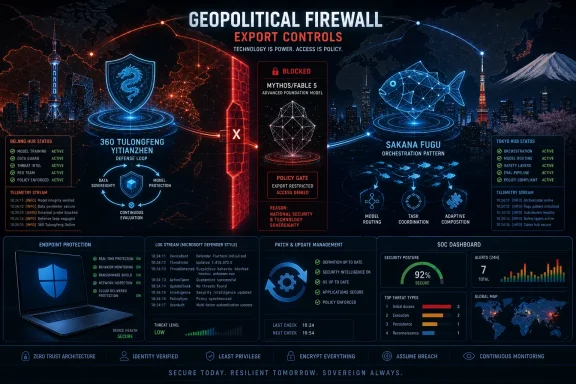 Washington Wanted a Choke Point and Created a Market Signal
The U.S. government’s move against Anthropic’s Mythos-class models was framed as a national security intervention, and there is a coherent argument behind that instinct. If a cybersecurity-focused frontier model can materially improve vulnerability discovery, exploit chaining, malware analysis, or red-team automation, then it is no longer just another productivity tool. It becomes dual-use infrastructure.But export controls do not merely remove technology from foreign hands. They also send a global procurement memo: do not build critical workflows around systems that can disappear by order of a foreign capital. That message landed hardest not in adversarial states, where U.S. model access was already politically fraught, but among allies and multinational companies that had been treating American AI labs as default infrastructure.
Anthropic’s situation made the risk unusually vivid. The reported directive did not only affect overseas customers. It reportedly reached foreign nationals as a category, including people inside the United States and even employees of the company itself. That distinction matters because it converts model access from a commercial entitlement into a citizenship boundary.
For IT buyers, the result is not a philosophical debate about sovereignty. It is a risk register entry. If an AI model is embedded in secure coding, vulnerability triage, incident response, SOC summarization, endpoint telemetry analysis, or cloud operations, then losing access is operational disruption.
Sakana Sells the Hedge, Not the Revolution
Sakana AI’s Fugu is interesting precisely because the company is not presenting it as a nationalist rupture with American AI. The Tokyo startup’s pitch is subtler: U.S. models remain important, but customers need a fallback path that is not hostage to a single export regime. That is a more commercially credible argument than declaring the end of U.S. AI dominance.Fugu’s positioning as an orchestration model also reflects where enterprise AI is moving. The next layer of competition may not be only about the largest monolithic model. It may be about systems that decide which model, tool, API, dataset, or agent should handle a given task, then coordinate the handoff.
That architecture has obvious appeal in Japan. A model optimized for Japanese business culture, language nuance, government workflows, and domestic compliance requirements can deliver value even if it is not universally superior to Anthropic, OpenAI, or Google on broad benchmarks. Local fit is not a consolation prize; in many enterprise deployments, it is the product.
The export-control angle gives that pitch urgency. Sakana can now tell Japanese enterprises and agencies that model diversity is not just about cost, latency, or customization. It is about continuity. When a vendor’s access policy can be rewritten by another country’s national security apparatus, redundancy becomes strategic.
China’s 360 Makes the Subtext Text
Where Sakana presents Fugu as a hedge, 360 Security Technology is reportedly making a more direct claim. Its Tulongfeng model is being positioned as a Chinese answer to Mythos, aimed at automated vulnerability discovery. Its companion system, Yitianzhen, is described as a tool for cyber defense and incident response.That pairing is important. Vulnerability discovery and defensive automation sit on opposite sides of the same blade. The same class of reasoning that helps a defender find a weak point before an attacker does can help an attacker find it first. This is why the Mythos controversy is not just another model-release dustup; it sits at the boundary between software engineering, intelligence capability, and cyber conflict.
360 founder Zhou Hongyi reportedly framed vulnerability-finding AI as a national strategic asset and warned about “one-way transparency.” The phrase captures the core geopolitical fear: if one bloc has frontier tools that can see into everyone else’s software faster than they can respond, then the global vulnerability ecosystem becomes asymmetric.
For WindowsForum readers, that should sound familiar. Windows has always been a prime target because of its ubiquity across businesses, governments, hospitals, factories, and schools. If AI compresses the time between bug discovery and weaponization, the already brutal patch-management race gets faster.
The Windows Security Stack Is in the Blast Radius
This story may appear to belong to the AI industry, but its consequences land in endpoint management, identity, cloud security, and patch operations. Windows administrators already live in a world where every month brings cumulative updates, zero-day advisories, driver issues, EDR tuning, and identity-hardening work. AI-driven vulnerability discovery threatens to shorten the breathing room between disclosure, proof-of-concept code, and broad exploitation.That does not mean every new model instantly becomes an autonomous cyberweapon. Vendor claims deserve skepticism, especially when companies have commercial incentives to compare themselves with the most restricted and hyped system in the market. But the direction of travel is clear enough: AI systems are becoming more capable at reading code, generating test cases, proposing exploit paths, summarizing logs, and guiding operators through complex technical workflows.
The practical risk is uneven acceleration. Large security vendors, national cyber agencies, and well-funded attackers will adopt these systems early. Smaller IT departments may receive the consequences later, in the form of faster-moving attacks and more automated reconnaissance, without equivalent defensive capacity.
Microsoft’s ecosystem is not passive in this shift. Defender, Sentinel, Copilot for Security, Intune, Entra, GitHub, and Azure all sit in the path of AI-assisted operations. But customers increasingly need to know not only whether a security assistant works, but where its model access comes from, what data it retains, whether foreign staff can support it, and whether government policy can interrupt it.
Export Controls Are a Bad Substitute for a Security Standard
The strongest case for restricting Mythos-class systems is that frontier cybersecurity models may create real offensive risk. The weakest part of the current approach is that emergency export controls can look arbitrary from the outside. Customers see a model available one week, unavailable the next, then partially restored or renegotiated through government channels.That is not a stable foundation for enterprise architecture. Security-sensitive AI needs evaluation, tiering, access controls, auditability, abuse monitoring, and incident-response obligations. It may need licensing rules for the most dangerous capabilities. But if the process appears improvised, the policy itself becomes a reason to diversify away from U.S. providers.
This is where Washington faces a contradiction. The United States wants its AI companies to dominate global infrastructure, because that dominance carries economic and strategic benefits. At the same time, it wants to reserve the right to restrict the most capable systems when they become too sensitive. Those goals can coexist only if allies and customers trust the rules.
Right now, the rules look more like a stop sign that can be dropped into the road after the cars are already moving. That may satisfy an immediate security concern, but it incentivizes every major market to build alternate routes.
The Model Race Is Becoming an Access Race
The AI industry still talks in benchmarks, context windows, tool use, agentic planning, coding scores, and multimodal reasoning. Those metrics matter. But the Mythos episode shows that another benchmark is emerging: can customers actually keep using the system when politics change?For CIOs, this shifts the due-diligence conversation. A model that is marginally less capable but locally available, contractually predictable, and culturally tuned may beat a frontier model whose availability is uncertain. This is especially true in regulated sectors, public administration, defense-adjacent work, and critical infrastructure.
For developers, the lesson is architectural. Applications that hard-code themselves around a single model provider inherit that provider’s policy risk. Agent frameworks, routing layers, model abstraction, and graceful degradation are no longer just engineering niceties. They are resilience mechanisms.
For security teams, the shift is sharper. If vulnerability analysis, triage, or response automation depends on a frontier model, teams need a plan for what happens when that model is unavailable. They also need to assume adversaries are running their own alternatives, whether from China, Japan, open-source communities, or domestic labs.
The Real Sovereignty Fight Is Over Operational Dependency
The phrase “AI sovereignty” is often used loosely, sometimes as a political slogan and sometimes as a vendor sales pitch. In this case, it has a concrete meaning: who controls the systems that help a country’s companies write code, defend networks, analyze vulnerabilities, and operate digital infrastructure?Sakana’s Fugu speaks to one version of sovereignty, rooted in allied diversification. Japan does not have to reject U.S. models to decide that it needs domestic capability and orchestration layers. It can keep using American systems while reducing the chance that a single export decision cripples important workflows.
360’s Tulongfeng speaks to another version, rooted in strategic competition. China has spent years responding to U.S. chip controls, cloud restrictions, and software pressure by emphasizing self-reliance. A Chinese “Mythos-like” cybersecurity tool fits neatly into that broader industrial narrative.
The danger is that both paths normalize a fragmented AI security order. Instead of one global ecosystem of broadly available tools, the world gets capability blocs: U.S.-approved models, allied domestic models, Chinese alternatives, open-source systems, and restricted government versions. That fragmentation may be inevitable, but it will complicate standards, incident coordination, and trust.
IT Departments Need to Treat AI Vendors Like Critical Suppliers
The immediate temptation is to ask which model is “better”: Anthropic’s Mythos, Sakana’s Fugu, or 360’s Tulongfeng. That is the wrong first question for most enterprises. The more useful question is which model can be governed, audited, integrated, and replaced without breaking operations.That is familiar territory for Windows administrators. Mature IT does not assume a cloud provider, endpoint agent, identity system, or backup platform will always behave perfectly. It plans for outages, vendor disputes, licensing changes, data-residency requirements, and compliance audits. AI now belongs in that same category.
The complication is that AI vendors have been selling speed before governance. They promise faster coding, faster tickets, faster investigations, faster summaries, and faster decisions. The Mythos ban adds a less marketable but more important feature request: faster recovery when access vanishes.
This is where multi-model strategy becomes less fashionable and more practical. Enterprises do not need to chase every new model announcement. They do need enough abstraction to shift workloads, enough logging to understand model-driven decisions, and enough human expertise to avoid becoming dependent on an assistant they cannot replace.
The Mythos Gap Has Already Changed the Sales Pitch
The most durable impact of the Anthropic restriction may not be lost revenue during a temporary ban. It may be the change in how every competitor sells against American frontier labs. The new pitch is simple: our model may not win every benchmark, but no foreign government can switch it off for you overnight.That pitch will resonate differently by region. In Japan, it supports a pragmatic diversification strategy. In China, it supports self-reliance and national cyber capability. In India, Europe, South Korea, and Southeast Asia, it will intensify debates that were already underway about local models, sovereign clouds, data residency, and dependency on U.S. platforms.
For Anthropic and other American labs, this is not fatal. U.S. AI companies still have enormous advantages in talent, infrastructure, capital, research velocity, enterprise relationships, and developer mindshare. But trust is easier to lose than capability, and enterprise trust is rarely rebuilt with a benchmark chart.
If access is restored, customers will not simply forget the interruption. They will ask for contractual assurances, government-review clarity, regional deployment options, and technical escape hatches. The smartest vendors will not pretend this never happened; they will productize continuity.
The Week Mythos Became a Procurement Risk
The concrete lessons from this episode are less dramatic than the rhetoric around AI arms races, but they are more useful for the people who have to run systems on Monday morning.- Enterprises should assume frontier AI access can be interrupted by government action, especially when the model has cybersecurity, defense, intelligence, or critical-infrastructure relevance.
- Security teams should avoid building vulnerability management or incident response workflows that depend entirely on a single model provider.
- Regional AI systems will gain ground when they combine adequate capability with language, compliance, and availability advantages.
- Model orchestration is becoming a serious resilience strategy rather than a buzzword for agent demos.
- Windows administrators should expect AI-assisted vulnerability discovery to increase pressure on patch speed, asset visibility, and endpoint hardening.
- Vendor risk reviews should now include model access policy, nationality restrictions, data-retention rules, support eligibility, and export-control exposure.
References
- Primary source: TechCrunch
Published: 2026-06-27T12:10:21.396565
Asian AI startups launch Mythos-like models as Anthropic's export ban drags on | TechCrunch
New models are launching in Asia that promise Mythos-like capabilities without fear of an export ban. U.S. AI labs may never recover this enormous market.techcrunch.com - Related coverage: axios.com
Commerce Department greenlights partial return of Anthropic's Mythos
The government's abrupt removal of the AI models stunned the industrywww.axios.com
- Related coverage: techradar.com
Chinese cybersecurity company 360 unveils “China's version of Mythos”, and Yitianzhen, to automate cyber defense | TechRadar
China "cannot afford to wait", the company sayswww.techradar.com - Related coverage: tomshardware.com
Anthropic’s powerful Mythos AI reportedly breached ‘almost all’ NSA classified systems within a few hours during red-team test — report sheds more light on the U.S. government's sudden ban on the flagship models | Tom's Hardwa
Access to Fable 5 and Mythos 5 barred for foreign nationals immediately following security evaluationwww.tomshardware.com - Related coverage: gtlaw.com
- Related coverage: scworld.com
China’s 360 Security Technology unveils AI models for vulnerability discovery | brief | SC Media
During the ISC.AI 2026 conference in Beijing, 360 Security Technology introduced Yitian Tulong, comprising two AI models: Tulongfeng for vulnerability discovery and Yitianzhen for automated defense and incident response.www.scworld.com
- Related coverage: fortune.com
U.S. Anthropic ban opens door for open-source AI, particularly from China | Fortune
“Frontier intelligence should not … be subject to withdrawal by a handful of rules at any moment,” Z.ai, a Chinese AI developer, wrote on social media.fortune.com
- Related coverage: wired.com
Anthropic Offers Mythos Upgrade for Cyber Partners and a ‘Safe’ Version for the Rest of You | WIRED
Anthropic is releasing Claude Mythos 5 to trusted organizations and Claude Fable 5 to the public, a version it says can’t be used for cyberattacks.www.wired.com - Related coverage: semafor.com
White House move to limit Anthropic linked to concerns about Chinese access to Mythos | Semafor
Trump adviser David Sacks said restrictions aren’t connected to prior conflicts with AI company.www.semafor.com - Related coverage: m.economictimes.com
Is Sakana Fugu really better than Anthropic's Fable 5 and Mythos preview? - The Economic Times
Japanese artificial intelligence (AI) startup Sakana AI has launched its multiagent orchestration system Sakana Fugu, claiming it outperforms American AI startup Anthropics popular frontier models, Fable 5 and Mythos Preview. Here is all you need to know about the AI system.m.economictimes.com
- Related coverage: elpais.com
- Related coverage: liccardo.house.gov
6.18.26 letter to commerce department on frontier model export controls
PDF documentliccardo.house.gov
- Related coverage: zeronoise.ai
