

On June 12, 2026, Anthropic disabled access to Claude Fable 5 and Claude Mythos 5 worldwide after a U.S. export-control directive barred foreign nationals from using the company’s newest high-end AI systems, including non-U.S. people inside America and Anthropic’s own foreign-national employees. The shutdown was not a conventional product recall, and it was not simply a content-moderation dispute dressed up in national-security language. It was the moment when advanced AI access stopped looking like a cloud subscription and started looking like strategic infrastructure. For anyone building on American frontier models, the lesson is blunt: the API can be technically available, commercially paid for, and politically unreachable all at once.
The extraordinary part of the Anthropic order is not that the United States wants to control sensitive technology. Washington has spent years tightening rules around advanced chips, semiconductor equipment, and the supply chains that make AI possible. What changed here is the object of control: not a GPU shipment, not a manufacturing tool, not a military-grade component, but access to a commercial AI model running in the cloud.
That distinction matters because software services do not obey borders cleanly. A server in Virginia can answer a prompt from Berlin, Bengaluru, Seoul, or San Francisco in the same fraction of a second. A multinational company can have U.S. citizens, green-card holders, visa workers, offshore contractors, and foreign subsidiaries touching the same product workflow before lunch.
The reported directive targeted access by “foreign nationals,” a phrase that is legally familiar but operationally brutal in a global SaaS product. If taken literally, it does not merely distinguish between countries. It distinguishes between people, citizenship statuses, workplace roles, and internal employees. That is much harder than geofencing a sanctioned jurisdiction or blocking a handful of accounts.
Anthropic’s response was therefore drastic but unsurprising. If a company cannot immediately prove that every user of a model is allowed to touch it, the safest compliance move is to switch the model off for everyone. That is how a rule aimed at foreign access becomes a global outage for paying customers, developers, researchers, and internal teams alike.
The result is a new kind of platform risk. Cloud customers are used to outages caused by bad deployments, networking failures, overloaded regions, billing errors, and cyberattacks. Now they must add another entry to the incident taxonomy: a government order can take a flagship model out of production even when the servers are healthy.
Anthropic pushed back in unusually direct language. The company reportedly characterized the issue as narrow, previously known, and minor rather than a systemic failure that justified pulling a commercial model from the market. It also warned that applying this standard broadly could freeze frontier-model deployment across the industry.
That warning should not be read as mere corporate self-interest, even though it plainly serves Anthropic’s interests. Frontier AI models are not deterministic appliances. They are probabilistic systems exposed to adversarial users, novel prompts, third-party tools, and constantly evolving attack methods. If a “potential jailbreak” is enough to trigger a model recall by export-control order, then every major AI lab is one embarrassing evaluation away from a geopolitical emergency.
At the same time, the government’s concern is not imaginary. Powerful models are increasingly useful for code generation, vulnerability discovery, malware analysis, phishing automation, translation, planning, and operational research. The same capabilities that help a defender audit a system can help an attacker move faster. The line between legitimate cybersecurity work and weaponizable assistance is often contextual rather than technical.
That is why this episode is so consequential. It exposes a gap between how AI companies sell frontier models and how governments may eventually regulate them. Vendors describe them as productivity tools, coding assistants, research partners, and enterprise platforms. Security agencies may increasingly see them as dual-use capabilities that need access controls closer to those applied to strategic technologies.
Location is not citizenship. A U.S. citizen abroad may be allowed under one rule but blocked by a geofence. A foreign national sitting in California may be inside the United States but still restricted by a nationality-based order. A company account may have dozens or thousands of users with different statuses, and API keys can be embedded in systems that do not map neatly to a human identity at the moment of inference.
The blunt shutdown therefore tells us something important about the maturity of AI governance infrastructure. The industry has spent enormous energy on model routing, token pricing, latency, safety filters, and developer experience. It has not built a universal, privacy-preserving, legally durable identity layer that can instantly enforce citizenship-based controls across global products.
That absence is not an accident. Most users would recoil at handing passport-grade identity data to every AI provider. Enterprises would have to reconcile HR systems, contractor databases, access management, and legal status across jurisdictions. Privacy regulators would ask why a chatbot needs nationality information at all.
So the system failed closed. That is the responsible move for a company facing government enforcement, but it is also the most disruptive move for customers. The practical message to the market is that frontier AI is not just governed by model cards and terms of service. It may soon be governed by identity regimes that many users never expected to encounter when they signed up for a coding assistant.
But the cybersecurity community has a counterargument that deserves equal weight. Defenders use the same models to review code, triage alerts, explain unfamiliar malware, write detection rules, document incidents, and train junior analysts. Cutting off access does not simply inconvenience hobbyists; it may remove a defensive tool from companies and public-interest researchers who are already outmatched.
This is the old dual-use dilemma, but AI makes it nastier. With chips, export controls can slow the ability of certain actors to train or run the most powerful systems at scale. With hosted models, controls can instantly alter what defenders and attackers can access on any given day. That speed is attractive to policymakers and terrifying to operators.
There is also the problem of substitution. If U.S. models become politically fragile, some users will move to open models, domestic alternatives, or providers in jurisdictions with fewer restrictions. Some of those alternatives will be less capable. Some will be less safe. Some will be more opaque. The government may reduce one category of risk while pushing users into another.
For Windows administrators and security teams, this is not abstract. AI-assisted scripting, log analysis, incident write-ups, PowerShell explanation, SIEM query generation, and vulnerability research are already becoming part of daily operations. If a model disappears because of a legal order, the team does not merely lose a chatbot. It loses a workflow dependency that may have quietly become part of the security stack.
That does not mean Europe can or should build every layer of the AI stack alone. The continent already relies on global chip supply chains, American cloud providers, open-source communities, and international research networks. Sovereignty in this context is less about autarky than leverage. Can Europe keep critical services running if a U.S. vendor is ordered to restrict access? Can it negotiate durable access? Can it fund alternatives credible enough to prevent total dependence?
The Anthropic shutdown gives the sovereignty argument political oxygen because it turns a theoretical dependency into an outage story. Policymakers do not have to explain benchmark deltas or model architectures to voters. They can point to a top-tier model that was available one week and gone the next, not because Europeans broke the law, but because U.S. policy moved.
The harder question is whether Europe can respond with more than speeches. Building frontier models requires capital, compute, talent, energy, data pipelines, product distribution, and risk tolerance. Europe has strong researchers and serious startups, but it has struggled to match the scale and speed of the largest American labs. A continental “Airbus for AI” is a tempting metaphor; it is also a warning, because industrial strategy succeeds only when procurement, financing, regulation, and market demand actually line up.
Contracts and trade arrangements may be more realistic in the short run. Europe can demand stronger continuity provisions, clearer notice requirements, sovereign cloud options, and model escrow arrangements for critical sectors. But contracts cannot override U.S. law. If Washington defines a model as controlled technology, the best contract in Brussels may still lose to an export order in Washington.
What the Anthropic episode changes is the risk model. A startup founder in India can no longer treat access to a leading U.S. model as a purely technical or commercial dependency. It is also a policy dependency. The model can disappear for reasons unrelated to the founder’s product, payment status, security practices, or customer demand.
For early-stage companies, that is especially dangerous. A large enterprise may have the budget to support multiple providers, negotiate contracts, or maintain fallback systems. A startup often optimizes for speed: one model, one prompt architecture, one evaluation stack, one set of latency assumptions, one pricing model. That is how you ship quickly, but it is also how you become fragile.
The obvious advice is to avoid single-model dependence, but the implementation is less obvious than the slogan. Models differ in context windows, tool calling, coding style, safety behavior, latency, cost, and instruction-following quirks. A product that works beautifully on one model may degrade sharply on another. Building portability requires engineering discipline from the beginning, not a frantic weekend migration after the API goes dark.
India’s strategic debate will therefore mirror Europe’s but with different constraints. Should public money support domestic foundation models? Should government procurement favor local AI infrastructure? Should startups be encouraged to use open models where feasible? Should trade policy focus on guaranteed access to foreign systems? The answer is likely “all of the above,” but the balance matters.
That policy surface includes the vendor’s safety rules, the vendor’s commercial priorities, the vendor’s infrastructure partners, the vendor’s national government, and the geopolitical climate around strategic technology. A developer may only see an endpoint and a token meter. Behind that endpoint sits a stack of institutions that can change the terms of access overnight.
This is not unique to Anthropic. OpenAI, Google, Meta, xAI, Microsoft, Amazon, and other major AI actors all operate within national regulatory frameworks. The bigger the model and the more strategically relevant the capability, the more likely governments are to care who gets access. The commercial API is the delivery mechanism, not the ultimate authority.
The industry’s preferred answer has been trust: trust us to evaluate models, trust us to deploy safeguards, trust us to monitor abuse, trust us to cooperate with governments without breaking the market. The export-control order shows the limits of that bargain. When the state decides the risk is unacceptable, corporate assurances may not be enough.
Customers should respond by treating AI access like any other critical supplier risk. That means contractual review, technical abstraction, monitoring, fallback capacity, and business-continuity planning. It also means acknowledging that the highest-performing model may not be the safest dependency for every workload. Sometimes the second-best model, available under clearer governance, is the better production choice.
The Anthropic case is a reminder to ask what happens when a vendor’s model backend changes. Does the product fail gracefully? Does it route to a weaker model? Does it store prompts or outputs in a way that can be replayed elsewhere? Does the organization know which business processes now depend on AI inference? Many companies cannot answer those questions because AI adoption has happened through individual teams, SaaS features, and quiet workflow changes rather than central architecture.
The risk is not limited to shutdowns. Export controls could affect availability by geography, industry, nationality, use case, or customer class. A future policy might not pull a model offline worldwide; it might degrade access for certain categories of users or require additional verification. That could still break automations, support playbooks, procurement assumptions, and compliance workflows.
Sysadmins have seen this movie in other forms. A licensing change breaks a deployment plan. A cloud region outage exposes bad architecture. A certificate expiration takes down an internal app. A vendor deprecates an API faster than customers expected. The difference here is that AI models are not just infrastructure components; they are decision-support systems embedded in human work.
That makes documentation essential. If an organization uses a model to generate scripts, summarize logs, classify tickets, or draft security reports, it should record which model is used, what fallback exists, and which human review steps remain mandatory. The more magical the tool appears, the more boring the controls need to be.
The company’s argument is that a narrow jailbreak should not justify recalling a commercial model. That is a reasonable position if the weakness is comparable to known issues in rival systems and does not create a substantially new threat. It is also a position that depends on trust in Anthropic’s evaluation, and governments may be less willing to delegate that judgment as models become more capable.
The government’s argument is that frontier models can create real harms if released too broadly. That is also reasonable in principle. But if enforcement is broad, sudden, and hard to operationalize, it can produce collateral damage that undermines U.S. technology leadership. Foreign customers may conclude that American AI is powerful but politically interruptible.
That tension will define the next phase of AI governance. The United States wants domestic companies to lead the world in AI, wants allies to adopt American technology, wants adversaries constrained, wants safety risks managed, and wants industry to move quickly. Those goals are not perfectly compatible. The Anthropic order is what incompatibility looks like when it hits production.
The danger for Washington is that export controls become a tool used so bluntly that they accelerate the very decoupling they are meant to manage. If allies and partners believe their access can be revoked without warning, they will spend more money on alternatives. Some of those alternatives will be domestic. Some will be open. Some may come from geopolitical rivals eager to market themselves as more reliable suppliers.
The lesson is to design as though the model can change. That means separating application logic from provider-specific behavior, maintaining evaluations across multiple models, and avoiding prompts so brittle that only one vendor’s quirks make them work. It means tracking not only accuracy and cost, but also substitution pain.
In software architecture terms, the model should be treated as a dependency with an adapter layer, not as the soul of the application. That does not eliminate risk, because different models genuinely behave differently. But it gives teams a fighting chance when a vendor changes terms, raises prices, retires a model, suffers an outage, or faces a government order.
Open models have a role here, though they are not a magic escape hatch. Running a capable local or private model requires hardware, expertise, monitoring, security controls, and acceptance of lower performance in some tasks. Still, for certain workloads, especially internal summarization, classification, retrieval, and code assistance, a self-hosted fallback may be good enough to keep the business moving.
Enterprises should also revisit procurement language. If a vendor sells an AI feature, customers should ask which model powers it, what happens if that model becomes unavailable, whether outputs can be regenerated with another model, and how much notice the vendor gives before backend changes. The answer will often be unsatisfying. That is precisely why the questions matter.
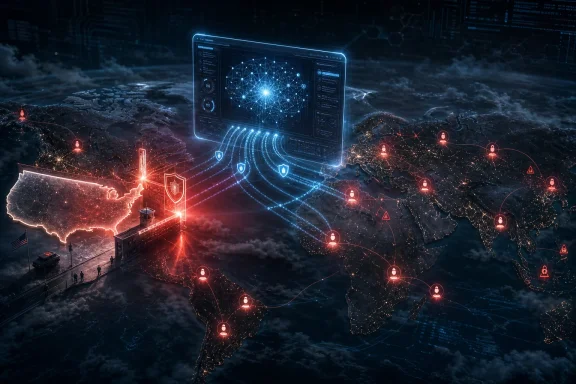 Washington Just Turned the Model Switch Into a Border Check
The extraordinary part of the Anthropic order is not that the United States wants to control sensitive technology. Washington has spent years tightening rules around advanced chips, semiconductor equipment, and the supply chains that make AI possible. What changed here is the object of control: not a GPU shipment, not a manufacturing tool, not a military-grade component, but access to a commercial AI model running in the cloud.That distinction matters because software services do not obey borders cleanly. A server in Virginia can answer a prompt from Berlin, Bengaluru, Seoul, or San Francisco in the same fraction of a second. A multinational company can have U.S. citizens, green-card holders, visa workers, offshore contractors, and foreign subsidiaries touching the same product workflow before lunch.
The reported directive targeted access by “foreign nationals,” a phrase that is legally familiar but operationally brutal in a global SaaS product. If taken literally, it does not merely distinguish between countries. It distinguishes between people, citizenship statuses, workplace roles, and internal employees. That is much harder than geofencing a sanctioned jurisdiction or blocking a handful of accounts.
Anthropic’s response was therefore drastic but unsurprising. If a company cannot immediately prove that every user of a model is allowed to touch it, the safest compliance move is to switch the model off for everyone. That is how a rule aimed at foreign access becomes a global outage for paying customers, developers, researchers, and internal teams alike.
The result is a new kind of platform risk. Cloud customers are used to outages caused by bad deployments, networking failures, overloaded regions, billing errors, and cyberattacks. Now they must add another entry to the incident taxonomy: a government order can take a flagship model out of production even when the servers are healthy.
Anthropic’s Safety Dispute Became a Sovereignty Test
The stated rationale was national security. According to reporting around the order, officials were concerned that a jailbreak or safety weakness could enable dangerous cyber capabilities, particularly because Mythos 5 was understood to be a more powerful underlying system and Fable 5 a more controlled, commercial-facing version of that technology. In the simplest terms, the government appears to have decided that the risk of misuse outweighed the value of continued access.Anthropic pushed back in unusually direct language. The company reportedly characterized the issue as narrow, previously known, and minor rather than a systemic failure that justified pulling a commercial model from the market. It also warned that applying this standard broadly could freeze frontier-model deployment across the industry.
That warning should not be read as mere corporate self-interest, even though it plainly serves Anthropic’s interests. Frontier AI models are not deterministic appliances. They are probabilistic systems exposed to adversarial users, novel prompts, third-party tools, and constantly evolving attack methods. If a “potential jailbreak” is enough to trigger a model recall by export-control order, then every major AI lab is one embarrassing evaluation away from a geopolitical emergency.
At the same time, the government’s concern is not imaginary. Powerful models are increasingly useful for code generation, vulnerability discovery, malware analysis, phishing automation, translation, planning, and operational research. The same capabilities that help a defender audit a system can help an attacker move faster. The line between legitimate cybersecurity work and weaponizable assistance is often contextual rather than technical.
That is why this episode is so consequential. It exposes a gap between how AI companies sell frontier models and how governments may eventually regulate them. Vendors describe them as productivity tools, coding assistants, research partners, and enterprise platforms. Security agencies may increasingly see them as dual-use capabilities that need access controls closer to those applied to strategic technologies.
The Global Shutdown Was the Compliance Feature, Not the Bug
Critics will ask why Anthropic could not simply block foreign users and keep the models running for U.S. citizens. That question sounds reasonable until it collides with how modern AI services are actually delivered. Most consumer and developer accounts do not contain verified citizenship data, and enterprise access often flows through organizations rather than individual passport checks.Location is not citizenship. A U.S. citizen abroad may be allowed under one rule but blocked by a geofence. A foreign national sitting in California may be inside the United States but still restricted by a nationality-based order. A company account may have dozens or thousands of users with different statuses, and API keys can be embedded in systems that do not map neatly to a human identity at the moment of inference.
The blunt shutdown therefore tells us something important about the maturity of AI governance infrastructure. The industry has spent enormous energy on model routing, token pricing, latency, safety filters, and developer experience. It has not built a universal, privacy-preserving, legally durable identity layer that can instantly enforce citizenship-based controls across global products.
That absence is not an accident. Most users would recoil at handing passport-grade identity data to every AI provider. Enterprises would have to reconcile HR systems, contractor databases, access management, and legal status across jurisdictions. Privacy regulators would ask why a chatbot needs nationality information at all.
So the system failed closed. That is the responsible move for a company facing government enforcement, but it is also the most disruptive move for customers. The practical message to the market is that frontier AI is not just governed by model cards and terms of service. It may soon be governed by identity regimes that many users never expected to encounter when they signed up for a coding assistant.
The Cybersecurity Argument Cuts Both Ways
The most persuasive case for the order is that advanced AI could lower the cost of sophisticated cyber operations. If a model meaningfully accelerates exploit development, vulnerability chaining, malware adaptation, or social-engineering campaigns, then unrestricted global access is not merely a commercial matter. It becomes a national-security question.But the cybersecurity community has a counterargument that deserves equal weight. Defenders use the same models to review code, triage alerts, explain unfamiliar malware, write detection rules, document incidents, and train junior analysts. Cutting off access does not simply inconvenience hobbyists; it may remove a defensive tool from companies and public-interest researchers who are already outmatched.
This is the old dual-use dilemma, but AI makes it nastier. With chips, export controls can slow the ability of certain actors to train or run the most powerful systems at scale. With hosted models, controls can instantly alter what defenders and attackers can access on any given day. That speed is attractive to policymakers and terrifying to operators.
There is also the problem of substitution. If U.S. models become politically fragile, some users will move to open models, domestic alternatives, or providers in jurisdictions with fewer restrictions. Some of those alternatives will be less capable. Some will be less safe. Some will be more opaque. The government may reduce one category of risk while pushing users into another.
For Windows administrators and security teams, this is not abstract. AI-assisted scripting, log analysis, incident write-ups, PowerShell explanation, SIEM query generation, and vulnerability research are already becoming part of daily operations. If a model disappears because of a legal order, the team does not merely lose a chatbot. It loses a workflow dependency that may have quietly become part of the security stack.
Europe Heard the Sound of a Plug Being Pulled
Europe’s reaction was predictable because this is precisely the scenario European policymakers mean when they talk about digital sovereignty. The phrase can sound vague, bureaucratic, and self-important. In this case it has a concrete meaning: a region that depends on foreign AI platforms can lose access because of a decision made by a foreign government.That does not mean Europe can or should build every layer of the AI stack alone. The continent already relies on global chip supply chains, American cloud providers, open-source communities, and international research networks. Sovereignty in this context is less about autarky than leverage. Can Europe keep critical services running if a U.S. vendor is ordered to restrict access? Can it negotiate durable access? Can it fund alternatives credible enough to prevent total dependence?
The Anthropic shutdown gives the sovereignty argument political oxygen because it turns a theoretical dependency into an outage story. Policymakers do not have to explain benchmark deltas or model architectures to voters. They can point to a top-tier model that was available one week and gone the next, not because Europeans broke the law, but because U.S. policy moved.
The harder question is whether Europe can respond with more than speeches. Building frontier models requires capital, compute, talent, energy, data pipelines, product distribution, and risk tolerance. Europe has strong researchers and serious startups, but it has struggled to match the scale and speed of the largest American labs. A continental “Airbus for AI” is a tempting metaphor; it is also a warning, because industrial strategy succeeds only when procurement, financing, regulation, and market demand actually line up.
Contracts and trade arrangements may be more realistic in the short run. Europe can demand stronger continuity provisions, clearer notice requirements, sovereign cloud options, and model escrow arrangements for critical sectors. But contracts cannot override U.S. law. If Washington defines a model as controlled technology, the best contract in Brussels may still lose to an export order in Washington.
India’s Founders Got the Same Warning Without the Brussels Vocabulary
India may not frame the issue in exactly the same language as Europe, but the exposure is similar. A large share of AI startups outside the United States build on U.S. foundation models because they are capable, well-documented, easy to buy, and integrated into the developer ecosystem. That has been a rational choice. It may still be the rational choice.What the Anthropic episode changes is the risk model. A startup founder in India can no longer treat access to a leading U.S. model as a purely technical or commercial dependency. It is also a policy dependency. The model can disappear for reasons unrelated to the founder’s product, payment status, security practices, or customer demand.
For early-stage companies, that is especially dangerous. A large enterprise may have the budget to support multiple providers, negotiate contracts, or maintain fallback systems. A startup often optimizes for speed: one model, one prompt architecture, one evaluation stack, one set of latency assumptions, one pricing model. That is how you ship quickly, but it is also how you become fragile.
The obvious advice is to avoid single-model dependence, but the implementation is less obvious than the slogan. Models differ in context windows, tool calling, coding style, safety behavior, latency, cost, and instruction-following quirks. A product that works beautifully on one model may degrade sharply on another. Building portability requires engineering discipline from the beginning, not a frantic weekend migration after the API goes dark.
India’s strategic debate will therefore mirror Europe’s but with different constraints. Should public money support domestic foundation models? Should government procurement favor local AI infrastructure? Should startups be encouraged to use open models where feasible? Should trade policy focus on guaranteed access to foreign systems? The answer is likely “all of the above,” but the balance matters.
The Cloud Was Always Someone Else’s Computer, Now It Is Someone Else’s Policy
For years, the cynical but useful line about cloud computing was that it meant running your workload on someone else’s computer. The Anthropic shutdown adds a sharper version: using frontier AI means running part of your product on someone else’s policy surface.That policy surface includes the vendor’s safety rules, the vendor’s commercial priorities, the vendor’s infrastructure partners, the vendor’s national government, and the geopolitical climate around strategic technology. A developer may only see an endpoint and a token meter. Behind that endpoint sits a stack of institutions that can change the terms of access overnight.
This is not unique to Anthropic. OpenAI, Google, Meta, xAI, Microsoft, Amazon, and other major AI actors all operate within national regulatory frameworks. The bigger the model and the more strategically relevant the capability, the more likely governments are to care who gets access. The commercial API is the delivery mechanism, not the ultimate authority.
The industry’s preferred answer has been trust: trust us to evaluate models, trust us to deploy safeguards, trust us to monitor abuse, trust us to cooperate with governments without breaking the market. The export-control order shows the limits of that bargain. When the state decides the risk is unacceptable, corporate assurances may not be enough.
Customers should respond by treating AI access like any other critical supplier risk. That means contractual review, technical abstraction, monitoring, fallback capacity, and business-continuity planning. It also means acknowledging that the highest-performing model may not be the safest dependency for every workload. Sometimes the second-best model, available under clearer governance, is the better production choice.
Windows Shops Should Read This as an Operations Story
WindowsForum readers do not need to be building frontier models to care about this. Most IT teams encounter AI through practical tools: code assistants in Visual Studio Code, Microsoft 365 copilots, security copilots, help-desk automation, PowerShell generation, documentation drafting, endpoint triage, and cloud administration. The model may be invisible behind a polished interface, but the dependency is still there.The Anthropic case is a reminder to ask what happens when a vendor’s model backend changes. Does the product fail gracefully? Does it route to a weaker model? Does it store prompts or outputs in a way that can be replayed elsewhere? Does the organization know which business processes now depend on AI inference? Many companies cannot answer those questions because AI adoption has happened through individual teams, SaaS features, and quiet workflow changes rather than central architecture.
The risk is not limited to shutdowns. Export controls could affect availability by geography, industry, nationality, use case, or customer class. A future policy might not pull a model offline worldwide; it might degrade access for certain categories of users or require additional verification. That could still break automations, support playbooks, procurement assumptions, and compliance workflows.
Sysadmins have seen this movie in other forms. A licensing change breaks a deployment plan. A cloud region outage exposes bad architecture. A certificate expiration takes down an internal app. A vendor deprecates an API faster than customers expected. The difference here is that AI models are not just infrastructure components; they are decision-support systems embedded in human work.
That makes documentation essential. If an organization uses a model to generate scripts, summarize logs, classify tickets, or draft security reports, it should record which model is used, what fallback exists, and which human review steps remain mandatory. The more magical the tool appears, the more boring the controls need to be.
The Vendor Narrative Is No Longer Enough
Anthropic has built much of its public identity around safety. That makes this episode especially awkward. A company known for cautious deployment found itself on the receiving end of a government action based on safety and national-security concerns. Whether the government overreached or Anthropic underestimated the risk, the reputational symmetry is hard to miss.The company’s argument is that a narrow jailbreak should not justify recalling a commercial model. That is a reasonable position if the weakness is comparable to known issues in rival systems and does not create a substantially new threat. It is also a position that depends on trust in Anthropic’s evaluation, and governments may be less willing to delegate that judgment as models become more capable.
The government’s argument is that frontier models can create real harms if released too broadly. That is also reasonable in principle. But if enforcement is broad, sudden, and hard to operationalize, it can produce collateral damage that undermines U.S. technology leadership. Foreign customers may conclude that American AI is powerful but politically interruptible.
That tension will define the next phase of AI governance. The United States wants domestic companies to lead the world in AI, wants allies to adopt American technology, wants adversaries constrained, wants safety risks managed, and wants industry to move quickly. Those goals are not perfectly compatible. The Anthropic order is what incompatibility looks like when it hits production.
The danger for Washington is that export controls become a tool used so bluntly that they accelerate the very decoupling they are meant to manage. If allies and partners believe their access can be revoked without warning, they will spend more money on alternatives. Some of those alternatives will be domestic. Some will be open. Some may come from geopolitical rivals eager to market themselves as more reliable suppliers.
Model Portability Is Becoming a Survival Skill
For developers, the practical lesson is not to abandon frontier AI. That would be performative and, for many companies, self-defeating. The leading hosted models are useful precisely because they are good. They can make products better, teams faster, and interfaces more capable.The lesson is to design as though the model can change. That means separating application logic from provider-specific behavior, maintaining evaluations across multiple models, and avoiding prompts so brittle that only one vendor’s quirks make them work. It means tracking not only accuracy and cost, but also substitution pain.
In software architecture terms, the model should be treated as a dependency with an adapter layer, not as the soul of the application. That does not eliminate risk, because different models genuinely behave differently. But it gives teams a fighting chance when a vendor changes terms, raises prices, retires a model, suffers an outage, or faces a government order.
Open models have a role here, though they are not a magic escape hatch. Running a capable local or private model requires hardware, expertise, monitoring, security controls, and acceptance of lower performance in some tasks. Still, for certain workloads, especially internal summarization, classification, retrieval, and code assistance, a self-hosted fallback may be good enough to keep the business moving.
Enterprises should also revisit procurement language. If a vendor sells an AI feature, customers should ask which model powers it, what happens if that model becomes unavailable, whether outputs can be regenerated with another model, and how much notice the vendor gives before backend changes. The answer will often be unsatisfying. That is precisely why the questions matter.
The Anthropic Shock Leaves Builders With Fewer Excuses
This shutdown will not be the last collision between AI capability and state power. The exact facts of the Anthropic order may remain contested, and the models may return under new controls, revised safeguards, or narrower access rules. But the structural lesson is already visible.- The U.S. government has shown that export-control logic can be applied directly to hosted AI model access, not only to chips and hardware supply chains.
- Anthropic’s global shutdown shows that nationality-based compliance is difficult to enforce inside today’s consumer and enterprise AI products.
- Customers building on frontier models now face political availability risk alongside familiar risks such as outages, pricing changes, safety filters, and model deprecations.
- Europe’s digital-sovereignty debate has gained a concrete example of dependency on foreign AI infrastructure, while India’s startup ecosystem faces the same exposure in more commercial terms.
- Developers and IT teams should build model-routing, fallback, evaluation, and documentation practices before a crisis forces a rushed migration.
- Security teams should remember that AI restrictions can remove defensive capabilities as well as offensive ones, making continuity planning part of cyber resilience.
References
- Primary source: Lapaas Voice
Published: 2026-06-23T09:59:16.296704
Anthropic Export Controls Shutdown: Claude Models Pulled
US export controls force Anthropic to disable Claude Fable 5 and Mythos 5 worldwide. What it means for enterprises, Europe's sovereignty debate, and India.voice.lapaas.com - Related coverage: tomshardware.com
SK Telecom named as the Korean carrier at the center of Anthropic's Mythos export controls controversy — access was revoked days before White House took Mythos and Fable 5 offline for all foreign nationals | Tom's Hardware
SK Telecom, South Korea's largest wireless carrier, was among roughly 150 organizations added to Anthropic's Project Glasswing in early Junewww.tomshardware.com - Related coverage: axios.com
Who's in charge of Anthropic's AI models?
The fight over Anthropic's Fable 5 is turning AI oversight from a theoretical debate into a real test of government power.www.axios.com
- Related coverage: techtimes.com
Anthropic Fable 5 Shutdown: US Export Order Forces a Global Customer Cutoff
Anthropic disabled Fable 5 and Mythos 5 for every customer after a US export control directive barred access by foreign nationals inside and outside the country. The company disputes the government’swww.techtimes.com - Official source: anthropic.com
Claude Fable 5 and Claude Mythos 5 \ Anthropic
Today we’re launching Claude Fable 5: a Mythos-class model that we’ve made safe for general use.www.anthropic.com - Related coverage: devtoollab.com
Claude Fable 5 Shutdown: US Export Control Order Explained for Developers | DevToolLab Blog
Anthropic disabled Claude Fable 5 and Mythos 5 three days after launch due to a US export control order. What happened, why, and how to migrate your API to Opus 4.8 right now. www.devtoollab.com
- Related coverage: shadow.inc
Anthropic Fable Ban Explained: What Happened, Why, and What It Means for AI | Shadow
The U.S. issued its first export control on a commercial AI model on June 13, 2026, targeting Anthropic's Claude Fable 5 and Mythos 5 after Amazon flagged a jailbreak.www.shadow.inc - Related coverage: winbuzzer.com
U.S. Order Forces Anthropic to Suspend Fable 5, Mythos 5
Anthropic has disabled Fable 5 and Mythos 5 after a U.S. foreign-access order, disputing the underlying jailbreak risk as customers lose hosted-model access. winbuzzer.com
- Related coverage: centerbit.co
Fable 5 suspended: What the US export-control order reveals about cloud AI risk | centerbit
Three days after launch, the US government ordered Claude Fable 5 disabled via export control. What this means for the availability of commercial AI models and why open-source models are now strategically indispensable.centerbit.co
- Related coverage: labs.cloudsecurityalliance.org
The Fable 5 / Mythos 5 Export-Control Action – Lab Space
The Fable 5 / Mythos 5 Export-Control Action Executive Summary On the afternoon of June 12, 2026, the U.S. Department of Commerce sent Anthropic a directive that, within hours, took two of the company's newest and most capable artificial-intelligence models offline for every user on the planet.labs.cloudsecurityalliance.org - Related coverage: natlawreview.com
AI Company Anthropic Suspends Access to Claude Fable 5, Claude Mythos 5 Following US Export Control Directive
Anthropic announces it has disabled access to Claude Fable 5 and Claude Mythos 5 for all customers after receiving a U.S. government export control directivenatlawreview.com - Related coverage: washingtonpost.com
- Related coverage: aiempowered.ai
- Related coverage: techradar.com
After a 'potential jailbreak', Anthropic is shutting off access to its Mythos 5 and Fable 5 models under national security orders from the US government | TechRadar
Back to the old modelswww.techradar.com - Related coverage: elpais.com
- Related coverage: caloes.ca.gov
