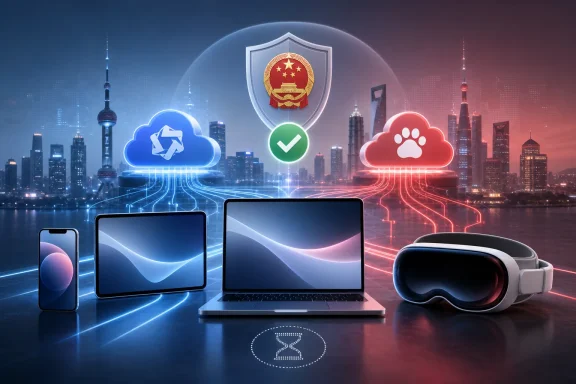
Apple Intelligence has cleared its most consequential China regulatory hurdle: on July 15, the Cyberspace Administration of China registered Apple’s on-device generative AI service for use on iPhones in the country. Reuters reported that Alibaba’s Qwen models will be integrated into the China-specific Apple Intelligence experience across iOS, iPadOS, macOS and visionOS, ending a delay that has kept the platform unavailable in mainland China.
That registration does not mean the feature is live today. Apple has not announced a rollout date, a final feature list, supported-device rules for mainland China, or the precise software build that will switch the service on. But the timing puts a launch alongside iOS 27 and Apple’s usual autumn hardware cycle firmly in play.
The change matters beyond Apple’s sales pitch. It creates a separate regional implementation of one of the industry’s highest-profile personal AI platforms, with a Chinese model provider and regulatory requirements shaping what users can do, how requests are processed, and which connected services are available.
Alibaba confirmed to Reuters that Qwen will be integrated into Apple Intelligence experiences for Chinese users, covering text and image understanding and generation. The wording is important: it confirms a platform-level partnership rather than a simple optional chatbot handoff.
Apple Intelligence elsewhere blends local processing, Apple-hosted compute for more demanding tasks, and selectively invoked external services. The mainland China version will necessarily have a different service stack. The CAC’s registration applies to Apple’s on-device generative AI service, while Alibaba’s statement describes Qwen as an integrated component across Apple’s operating systems.
That is a notable distinction for users and administrators assessing the technology. “On-device” does not establish that every task stays on the device, nor does the approval confirm that Apple’s global Private Cloud Compute design will operate unchanged in China. Neither Apple nor Alibaba has publicly detailed request routing, retention policies, server ownership, model hosting, or the exact boundary between Apple’s own models and Qwen.
Claims that all Apple Intelligence cloud processing will run on Apple-operated servers inside China should therefore be treated as unconfirmed. China’s data-residency regime and Apple’s existing local iCloud arrangements make localized infrastructure plausible, but plausible is not a technical disclosure.
Earlier reporting in 2025 said Apple had considered Baidu as its principal China AI partner before turning to Alibaba after difficulties adapting Baidu’s models to Apple’s requirements. The latest reporting supports the view that the work was divided rather than entirely abandoned: Alibaba supplies Qwen for the broader Apple Intelligence experience, while Baidu has a role in the localized offering.
What has not been publicly established is the exact division of labor. There is no confirmed feature matrix saying, for example, that one company handles Visual Intelligence, search, Siri AI, image generation, or particular languages. Nor has either company published commercial terms, model versions, safety rules, or API details.
For that reason, IT teams should avoid assuming that Apple Intelligence in China will produce the same outputs as Apple Intelligence in the United States, or that a workflow tested on a U.S.-configured iPhone will behave identically on a mainland China device and Apple Account. The product name may be consistent; the service behind it will be regionally specific.
That caveat now has a clear expiration path. The CAC registration arrived roughly a month after Apple’s iOS 27 announcement, giving Apple time to complete localization, integration testing and carrier- or account-level deployment planning before its next major consumer launch window.
Apple’s published iOS 27 support material identifies Apple Intelligence-capable hardware as iPhone 15 Pro and iPhone 15 Pro Max, iPhone 16 models and later, iPads with M1 or later, compatible Macs with M1 or later, Apple Vision Pro, and newer supported Apple Watch models when paired with an eligible iPhone. Mainland China availability, however, has historically involved more than hardware compatibility.
The practical eligibility questions remain open:
The important questions are operational: where does a request go, which provider processes it, what identifiers accompany it, how long are logs retained, what content filtering occurs, and what audit evidence can a customer obtain? For enterprises, the answers affect data classification policies as much as they affect consumer trust.
Apple’s ability to retain a tightly controlled interface is real. It owns the operating system, the user experience, device security architecture, account layer and distribution channel. But integration control is not the same thing as full control over the model, infrastructure or legal environment surrounding each generative request.
That is the broader lesson in this launch. AI availability is becoming a regional systems-integration problem, not merely a matter of downloading the same app or updating to the same OS version.
For Apple, the approval removes a visible product gap in a market where domestic Android vendors have already made AI features part of their premium-phone pitch. For Alibaba, Qwen’s inclusion is a major validation of its model family as infrastructure for a global consumer platform rather than only a standalone assistant or cloud service.
The next milestone is no longer regulatory clearance but Apple’s release documentation. Until the company publishes the country-specific requirements for iOS 27, its China rollout remains a cleared but unfinished deployment—one that will be closely watched for the feature limits, data path and account rules Apple has yet to disclose.
That registration does not mean the feature is live today. Apple has not announced a rollout date, a final feature list, supported-device rules for mainland China, or the precise software build that will switch the service on. But the timing puts a launch alongside iOS 27 and Apple’s usual autumn hardware cycle firmly in play.
The change matters beyond Apple’s sales pitch. It creates a separate regional implementation of one of the industry’s highest-profile personal AI platforms, with a Chinese model provider and regulatory requirements shaping what users can do, how requests are processed, and which connected services are available.
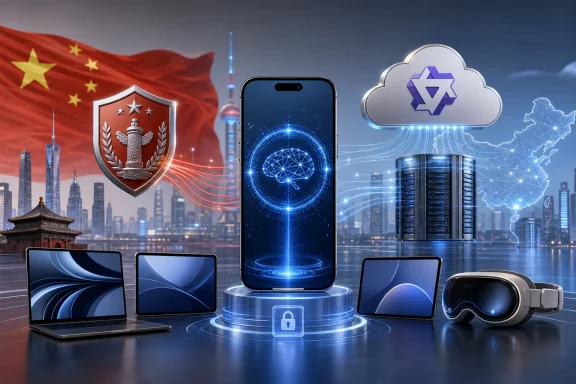 Qwen Becomes the Core Local Model Partner
Alibaba confirmed to Reuters that Qwen will be integrated into Apple Intelligence experiences for Chinese users, covering text and image understanding and generation. The wording is important: it confirms a platform-level partnership rather than a simple optional chatbot handoff.Apple Intelligence elsewhere blends local processing, Apple-hosted compute for more demanding tasks, and selectively invoked external services. The mainland China version will necessarily have a different service stack. The CAC’s registration applies to Apple’s on-device generative AI service, while Alibaba’s statement describes Qwen as an integrated component across Apple’s operating systems.
That is a notable distinction for users and administrators assessing the technology. “On-device” does not establish that every task stays on the device, nor does the approval confirm that Apple’s global Private Cloud Compute design will operate unchanged in China. Neither Apple nor Alibaba has publicly detailed request routing, retention policies, server ownership, model hosting, or the exact boundary between Apple’s own models and Qwen.
Claims that all Apple Intelligence cloud processing will run on Apple-operated servers inside China should therefore be treated as unconfirmed. China’s data-residency regime and Apple’s existing local iCloud arrangements make localized infrastructure plausible, but plausible is not a technical disclosure.
Baidu Still Appears to Be Part of the Picture
The short version of this story is not simply “Apple replaced Baidu with Alibaba.” Reporting from Reuters, The Information, and the South China Morning Post indicates that Baidu remains a technical partner, even as Alibaba’s Qwen has emerged as the named foundation-model integration for Apple Intelligence.Earlier reporting in 2025 said Apple had considered Baidu as its principal China AI partner before turning to Alibaba after difficulties adapting Baidu’s models to Apple’s requirements. The latest reporting supports the view that the work was divided rather than entirely abandoned: Alibaba supplies Qwen for the broader Apple Intelligence experience, while Baidu has a role in the localized offering.
What has not been publicly established is the exact division of labor. There is no confirmed feature matrix saying, for example, that one company handles Visual Intelligence, search, Siri AI, image generation, or particular languages. Nor has either company published commercial terms, model versions, safety rules, or API details.
For that reason, IT teams should avoid assuming that Apple Intelligence in China will produce the same outputs as Apple Intelligence in the United States, or that a workflow tested on a U.S.-configured iPhone will behave identically on a mainland China device and Apple Account. The product name may be consistent; the service behind it will be regionally specific.
Apple’s iOS 27 Plans Make the Timing More Relevant
At WWDC in June, Apple said its next major platform releases would be iOS 27, iPadOS 27, macOS 27, watchOS 27 and visionOS 27. Apple also said at the time that Siri AI and other Apple Intelligence features would not initially be available in China while it worked through regulatory requirements.That caveat now has a clear expiration path. The CAC registration arrived roughly a month after Apple’s iOS 27 announcement, giving Apple time to complete localization, integration testing and carrier- or account-level deployment planning before its next major consumer launch window.
Apple’s published iOS 27 support material identifies Apple Intelligence-capable hardware as iPhone 15 Pro and iPhone 15 Pro Max, iPhone 16 models and later, iPads with M1 or later, compatible Macs with M1 or later, Apple Vision Pro, and newer supported Apple Watch models when paired with an eligible iPhone. Mainland China availability, however, has historically involved more than hardware compatibility.
The practical eligibility questions remain open:
- Apple has not said whether capability will be determined by device sales region, physical location, Apple Account region, language and Siri settings, or a combination of those signals.
- Apple has not confirmed whether every iOS 27 Apple Intelligence feature will ship in China at once.
- Apple has not said whether Qwen-backed services will be available to travelers using non-China devices, or to mainland users whose devices and accounts were configured elsewhere.
- Apple has not detailed whether third-party developer integrations using its Foundation Models framework will have different behavior or compliance restrictions in mainland China.
The Privacy Story Needs Technical Evidence, Not Assumptions
Apple has made privacy a defining part of Apple Intelligence, particularly through its claims around on-device inference and Private Cloud Compute. Yet a localized Qwen partnership means Apple’s China privacy narrative cannot be evaluated solely by looking at Apple’s global architecture documentation.The important questions are operational: where does a request go, which provider processes it, what identifiers accompany it, how long are logs retained, what content filtering occurs, and what audit evidence can a customer obtain? For enterprises, the answers affect data classification policies as much as they affect consumer trust.
Apple’s ability to retain a tightly controlled interface is real. It owns the operating system, the user experience, device security architecture, account layer and distribution channel. But integration control is not the same thing as full control over the model, infrastructure or legal environment surrounding each generative request.
That is the broader lesson in this launch. AI availability is becoming a regional systems-integration problem, not merely a matter of downloading the same app or updating to the same OS version.
For Apple, the approval removes a visible product gap in a market where domestic Android vendors have already made AI features part of their premium-phone pitch. For Alibaba, Qwen’s inclusion is a major validation of its model family as infrastructure for a global consumer platform rather than only a standalone assistant or cloud service.
The next milestone is no longer regulatory clearance but Apple’s release documentation. Until the company publishes the country-specific requirements for iOS 27, its China rollout remains a cleared but unfinished deployment—one that will be closely watched for the feature limits, data path and account rules Apple has yet to disclose.
References
- Primary source: quasa.io
Published: 2026-07-18T12:26:11+00:00
Apple Intelligence Set for Launch in China Powered by Alibaba’s Qwen
The company received approval from China’s Cyberspace Administration of China (CAC), paving the way for a full rollout of Apple Intelligence later this year.quasa.io
- Related coverage: techcrunch.com
Apple Intelligence approved for launch in China with Alibaba and Baidu | TechCrunch
The deal, which was rumored to be in the works last year, marks an important step for Apple's AI ambitions in a key market.techcrunch.com - Related coverage: macrumors.com
Apple Intelligence Finally Cleared to Launch in China
Apple Intelligence has been approved by Chinese regulators, opening the door for the AI system to reach iPhones in the country for the first time. Reuters reports that China's Cyberspace Administration registered Apple's on-device generative AI service this week, putting it on a list...www.macrumors.com - Related coverage: theinformation.com
Apple Receives China’s Approval for AI Services Powered by Alibaba, Baidu — The Information
Apple has received key approval in China that paves the way for the release of its Apple Intelligence on-device AI service in the country, as the Chinese internet regulator permitted the Apple AI service, along with six other services, under generative AI rules. Apple worked with Chinese...www.theinformation.com - Related coverage: techrepublic.com
Apple Intelligence Clears China Approval Hurdle
Apple Intelligence cleared a China approval hurdle, with Alibaba’s Qwen and Baidu set to support AI features for iPhone users in mainland China.www.techrepublic.com
- Related coverage: easternherald.com
Apple Intelligence Cleared for China With Alibaba AI
China approved Apple Intelligence for launch in the country, with Alibaba's Qwen AI and Baidu powering features across iPhone and Apple devices after years of delays.easternherald.com