China-linked operators are reportedly using new and familiar malware families to keep multiple paths back into compromised networks, with recent reporting in March 2026 tying BPFDoor, TinyShell, Windows service hijacking, Cobalt Strike, and Google Drive command-and-control to long-lived access campaigns across telecom, government, and edge infrastructure. The immediate defender takeaway is blunt: treat these intrusions less like isolated malware infections and more like unauthorized access platforms. The practical question is no longer only how the attackers got in, but how many doors they left behind before anyone noticed.
That framing matters because it changes the response plan. A wiped endpoint, a rotated password, or a patched perimeter box may be necessary, but it may not be sufficient if the same operator has already planted a passive backdoor on Linux infrastructure, hijacked a Windows service for persistence, staged a Cobalt Strike beacon, or hidden command traffic inside a service the business already trusts. For WindowsForum readers, especially sysadmins managing mixed Windows, Linux, cloud, and network estates, this is the part of the story that deserves more attention than the name of the latest implant.
The most important detail in the latest China-linked APT reporting is not the novelty of a malware family. It is the pattern that surrounds it. CISA’s September 2025 joint advisory said PRC state-sponsored actors had been conducting sustained global operations since at least 2021 and often maintained several methods of access inside compromised networks.
That single observation should rewire how defenders read the March 2026 disclosures. Rapid7’s analysis of China-linked Red Menshen activity described BPFDoor variants and TinyShell appearing in telecom backbone environments, not as opportunistic malware dropped during a smash-and-grab intrusion, but as part of a persistent access layer. Check Point’s Silver Dragon reporting, meanwhile, described a Windows-heavy persistence model involving hijacked legitimate services, Cobalt Strike, and Google Drive-based command-and-control.
Put together, the picture is not one actor using one tool against one target. It is a doctrine. Edge services provide entry, telecom infrastructure provides visibility, Linux implants provide stealth, Windows services provide persistence, and legitimate cloud platforms provide cover for command traffic.
That is why defenders should be careful about treating each report as a separate malware bulletin. A BPFDoor discovery in a telecom environment and a Windows service hijack in a government network may look like two unrelated incidents on paper. In practice, they point toward the same strategic habit: build durable access, make it quiet, and preserve re-entry options after the first cleanup pass.
That creates a defensive blind spot. Windows endpoints may be covered by EDR, identity logs may flow into a SIEM, and cloud sign-ins may trigger conditional-access alerts, while the appliance that brokers remote access or routes traffic is monitored with less depth and patched with more anxiety. Attackers understand that difference.
WindowsForum has covered this theme before in the context of China-linked targeting of core routers and edge networking equipment. The new reporting makes that older warning feel less like a niche network-security concern and more like a central enterprise risk. If an adversary can compromise an edge device and then establish a second, quieter access method elsewhere, the edge exploit becomes only the first chapter.
That is the trap in many incident-response timelines. Teams often reconstruct the initial intrusion path and then breathe easier once that path is closed. But if the actor’s operating model assumes redundancy, the closing of the first door may simply test whether the second one works.
That is a different defensive problem from a noisy beacon calling home every few minutes. Passive or low-signal implants make the network feel normal until a specific activation pattern appears. The adversary is not always “inside” in the cinematic sense of an operator typing commands in real time. Sometimes the more dangerous reality is that access is simply waiting.
Telecom environments sharpen the concern because they combine infrastructure scale with operational opacity. Backbone systems, virtualization layers, high-performance appliances, and service-provider architecture are not watched in the same way as a standard Windows laptop fleet. They also offer attackers strategic value that goes beyond one compromised customer.
For enterprise defenders outside telecom, the lesson still applies. Any infrastructure layer that is hard to inspect, rarely rebuilt, and trusted by default can become a persistence layer. That includes authentication gateways, management servers, file transfer systems, jump boxes, monitoring platforms, backup infrastructure, and the servers administrators assume are too boring to be the main story.
A Windows service can look routine in a sea of routine. Administrators expect services to start at boot, run in the background, write logs, and call other processes. If malware can ride that mechanism while using Cobalt Strike or another post-exploitation tool, it gets a form of legitimacy that defenders must actively disprove.
The Google Drive command-and-control element makes the same point from a different angle. Blocking obviously malicious infrastructure is one thing; spotting abuse of a mainstream cloud service is harder. In many organizations, cloud storage traffic is normal, encrypted, and business-critical, which makes it a comfortable place for adversaries to hide tasking and results.
This is where Windows defenders need to be unsentimental. Service inventory should not be treated as a compliance artifact that gets reviewed once and forgotten. It should be a living baseline: what service exists, what binary it launches, what account it runs under, when it appeared, what parent process created it, and whether its behavior matches the business reason it supposedly serves.
CISA’s September 2025 warning that PRC state-sponsored actors often maintain several access methods should be read literally. The operator may not be betting on a single implant surviving forever. The operator may be betting that the defender will find one path, remediate it under pressure, and miss the other two.
That explains why the same strategic ecosystem can include edge exploitation, Linux implants, TinyShell, Cobalt Strike, Windows service hijacking, DNS tunneling, and cloud-based command channels. Each technique answers a different failure mode. If an edge appliance gets patched, a Windows service may remain. If an endpoint beacon gets caught, a passive network implant may still be callable. If a command domain gets blocked, a cloud channel may blend into normal traffic.
This redundancy also complicates attribution-driven comfort. Whether a specific cluster is tracked as Red Menshen, Silver Dragon, APT41-linked, or some overlapping China-nexus label matters to researchers and governments. For defenders, the more urgent point is that the observed techniques reflect a mature access-management strategy by the attacker.
That means the response should widen quickly from “remove malware from host X” to “map every durable access path the actor could have created.” The search should include edge infrastructure, identity systems, privileged accounts, service configurations, scheduled execution, remote-management tooling, cloud storage abuse, unusual tunneling, and east-west traffic that does not match the organization’s normal administrative patterns.
This is uncomfortable because it often crosses team boundaries. Network engineers own routers and firewalls. Windows admins own services and servers. Security operations owns alerts. Cloud teams own SaaS configuration. Identity teams own access policy. The attacker does not care about those boundaries.
The fastest way to lose the plot is to run four separate investigations that never meet. The better approach is to build a single access map: initial entry points, confirmed implants, suspected persistence, credential exposure, lateral movement, and all observed command channels. That map should drive remediation order.
But patching answers only part of this story. If the operator’s goal is long-term access, the compromise may already have moved beyond the original vulnerable service. A patched firewall does not remove a malicious Windows service. A cleaned Windows server does not remove a passive implant on a Linux host. A rotated user password may not invalidate a stolen token, a service credential, or another access method.
For WindowsForum’s sysadmin audience, the operational challenge is to pair patch management with persistence hunting. That means looking for what changed because of the intrusion, not only what allowed the intrusion. The difference is subtle but decisive.
This is also where backup and rebuild strategy becomes security strategy. Some systems should not be trusted merely because the visible malware was removed. Where feasible, high-risk infrastructure should be rebuilt from known-good media and rejoined to the environment under controlled credentials, rather than lovingly cleaned in place while the attacker’s assumptions remain intact.
A useful service baseline is not just a CSV export of names. It records expected binaries, hashes where appropriate, startup types, service accounts, descriptions, installation times, and dependencies. It also ties those details to change management, so a newly created or modified service has an explanation beyond “it exists now.”
The same logic applies to Cobalt Strike detections. Many organizations have signatures and analytics for common Cobalt Strike behavior, but post-exploitation frameworks persist because attackers adapt their delivery, staging, and command channels. Detection cannot depend on one obvious indicator.
Administrators should also remember that service hijacking is often downstream of broader access. If an attacker can register or modify a service, the environment already has a privilege problem. The service is the foothold; the permissions that allowed it are the terrain.
The lesson is that infrastructure systems are targets in their own right. They are not merely pipes, appliances, or background services supporting the “real” endpoints. Attackers prize them because they provide reach, durability, and visibility.
In an enterprise, the equivalent may be a VPN concentrator, an identity federation server, a monitoring collector, a backup server, or a management jump host. These systems often have broad network access and high trust. They also tend to accumulate exceptions because breaking them breaks the business.
That combination is exactly what persistent operators want. The quieter and more essential a system is, the more dangerous it becomes when compromised. A workstation compromise is bad; a compromise of the system administrators use to reach everything else is worse.
This does not mean organizations should panic-block every major cloud storage service. It means “it went to a reputable provider” is not enough context. Security teams need to understand which users, hosts, and services normally access which cloud platforms, and what volume, timing, and file patterns make sense.
For Windows environments, this is where endpoint, proxy, identity, and cloud logs need to line up. A server that has no business interacting with consumer-style cloud storage should stand out. A service process initiating unusual outbound traffic should stand out. A host that begins uploading small task-result files after a suspicious service change should stand out.
The uncomfortable truth is that many organizations collect pieces of this evidence but do not correlate them fast enough. Persistent operators exploit that delay. They do not need to be invisible forever; they need to remain unconnected long enough to establish the next access path.
The better question is how many independent re-entry mechanisms existed. A single compromised host with three persistence methods may be more strategically dangerous than five endpoints hit by the same commodity loader. An edge appliance used for initial access, a Windows service used for persistence, and a cloud channel used for tasking should be treated as a system, not three disconnected artifacts.
This is where tabletop exercises should evolve. Many incident simulations still end with containment of the obvious intrusion vector. A more realistic exercise would ask what happens when the attacker returns after the first remediation window using a method the team did not find.
That scenario is not pessimism. It is alignment with the adversary model described by CISA and reinforced by the March 2026 reporting. If the attacker builds layers, the defender has to validate removal layer by layer.
The BPFDoor and Silver Dragon reports should therefore be read together. One points toward stealthy implants in telecom and Linux-heavy infrastructure. The other points toward Windows service persistence and cloud-based command paths. Many organizations have both kinds of terrain.
That hybrid reality makes ownership a security issue. If the Windows team assumes the network team is watching edge devices, and the network team assumes the SOC is watching outbound command traffic, and the SOC assumes endpoint tooling will catch malicious services, nobody owns the full persistence picture.
Prior WindowsForum coverage of China-linked router targeting, Azure password spraying, and FamousSparrow activity has circled the same underlying problem from different angles. The perimeter, the cloud identity plane, and the endpoint are no longer separate battlegrounds. They are mutually reinforcing access layers.
Privileged access management matters because service creation, remote execution, and lateral movement depend on credentials and rights. Network segmentation matters because a foothold should not automatically become an internal transit hub. Egress monitoring matters because command traffic has to leave or move somewhere. Asset inventory matters because defenders cannot hunt persistence on systems they do not know exist.
The same is true for logging retention. A campaign that lasts months will defeat an organization that keeps only a thin slice of useful telemetry. If the first sign of compromise appears today but the initial access occurred far earlier, short retention turns the investigation into guesswork.
There is also a cultural control: skepticism after remediation. A serious APT cleanup should include a defined watch period, renewed hunting, and explicit validation that closed access paths stay closed. The absence of immediate alerts is not proof of eviction.
Administrators should instead ask which systems could preserve access even after the first fix. That includes externally exposed systems, domain or local admin pathways, service accounts, remote-management servers, cloud storage integrations, backup platforms, and infrastructure hosts that rarely receive the same scrutiny as user endpoints.
The facts available in the public reporting are still incomplete, and that matters. We do not have a universal victim list, a single guaranteed entry point, or a neat set of indicators that can be pasted into every environment with confidence. Anyone selling certainty from thin facts is overreaching.
But the absence of a complete public map does not weaken the thesis. It strengthens the need for local validation. The only organization that can determine whether an attacker has multiple re-entry paths in your environment is yours.
That framing matters because it changes the response plan. A wiped endpoint, a rotated password, or a patched perimeter box may be necessary, but it may not be sufficient if the same operator has already planted a passive backdoor on Linux infrastructure, hijacked a Windows service for persistence, staged a Cobalt Strike beacon, or hidden command traffic inside a service the business already trusts. For WindowsForum readers, especially sysadmins managing mixed Windows, Linux, cloud, and network estates, this is the part of the story that deserves more attention than the name of the latest implant.
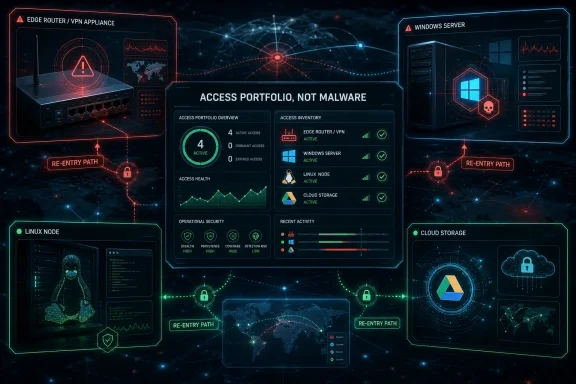 Beijing’s Operators Are Building Access Portfolios, Not Malware Collections
The most important detail in the latest China-linked APT reporting is not the novelty of a malware family. It is the pattern that surrounds it. CISA’s September 2025 joint advisory said PRC state-sponsored actors had been conducting sustained global operations since at least 2021 and often maintained several methods of access inside compromised networks.That single observation should rewire how defenders read the March 2026 disclosures. Rapid7’s analysis of China-linked Red Menshen activity described BPFDoor variants and TinyShell appearing in telecom backbone environments, not as opportunistic malware dropped during a smash-and-grab intrusion, but as part of a persistent access layer. Check Point’s Silver Dragon reporting, meanwhile, described a Windows-heavy persistence model involving hijacked legitimate services, Cobalt Strike, and Google Drive-based command-and-control.
Put together, the picture is not one actor using one tool against one target. It is a doctrine. Edge services provide entry, telecom infrastructure provides visibility, Linux implants provide stealth, Windows services provide persistence, and legitimate cloud platforms provide cover for command traffic.
That is why defenders should be careful about treating each report as a separate malware bulletin. A BPFDoor discovery in a telecom environment and a Windows service hijack in a government network may look like two unrelated incidents on paper. In practice, they point toward the same strategic habit: build durable access, make it quiet, and preserve re-entry options after the first cleanup pass.
The First Move Still Often Starts at the Edge
The edge remains attractive because it is where corporate networks expose their most brittle assumptions. VPN appliances, firewalls, routers, externally reachable servers, and remote access platforms sit at the boundary between internet noise and privileged internal reach. They are also frequently managed outside the rhythm of ordinary endpoint operations.That creates a defensive blind spot. Windows endpoints may be covered by EDR, identity logs may flow into a SIEM, and cloud sign-ins may trigger conditional-access alerts, while the appliance that brokers remote access or routes traffic is monitored with less depth and patched with more anxiety. Attackers understand that difference.
WindowsForum has covered this theme before in the context of China-linked targeting of core routers and edge networking equipment. The new reporting makes that older warning feel less like a niche network-security concern and more like a central enterprise risk. If an adversary can compromise an edge device and then establish a second, quieter access method elsewhere, the edge exploit becomes only the first chapter.
That is the trap in many incident-response timelines. Teams often reconstruct the initial intrusion path and then breathe easier once that path is closed. But if the actor’s operating model assumes redundancy, the closing of the first door may simply test whether the second one works.
BPFDoor Turns the Network Itself Into a Waiting Room
BPFDoor is especially useful as a symbol of this shift because it does not behave like the malware most enterprise playbooks were originally built to catch. Rapid7’s March 2026 reporting described BPFDoor variants in telecom environments as stealthy access mechanisms embedded deeply enough to support long-term, low-noise presence. The point is not constant chatter; the point is quiet availability.That is a different defensive problem from a noisy beacon calling home every few minutes. Passive or low-signal implants make the network feel normal until a specific activation pattern appears. The adversary is not always “inside” in the cinematic sense of an operator typing commands in real time. Sometimes the more dangerous reality is that access is simply waiting.
Telecom environments sharpen the concern because they combine infrastructure scale with operational opacity. Backbone systems, virtualization layers, high-performance appliances, and service-provider architecture are not watched in the same way as a standard Windows laptop fleet. They also offer attackers strategic value that goes beyond one compromised customer.
For enterprise defenders outside telecom, the lesson still applies. Any infrastructure layer that is hard to inspect, rarely rebuilt, and trusted by default can become a persistence layer. That includes authentication gateways, management servers, file transfer systems, jump boxes, monitoring platforms, backup infrastructure, and the servers administrators assume are too boring to be the main story.
Windows Service Hijacking Is the Familiar Trick That Still Works
The Silver Dragon reporting brings the story closer to the Windows estate most readers know. Check Point described the group using Windows service hijacking to blend malicious activity into normal system behavior. That is not glamorous, but it is effective precisely because services are supposed to be persistent, privileged, and boring.A Windows service can look routine in a sea of routine. Administrators expect services to start at boot, run in the background, write logs, and call other processes. If malware can ride that mechanism while using Cobalt Strike or another post-exploitation tool, it gets a form of legitimacy that defenders must actively disprove.
The Google Drive command-and-control element makes the same point from a different angle. Blocking obviously malicious infrastructure is one thing; spotting abuse of a mainstream cloud service is harder. In many organizations, cloud storage traffic is normal, encrypted, and business-critical, which makes it a comfortable place for adversaries to hide tasking and results.
This is where Windows defenders need to be unsentimental. Service inventory should not be treated as a compliance artifact that gets reviewed once and forgotten. It should be a living baseline: what service exists, what binary it launches, what account it runs under, when it appeared, what parent process created it, and whether its behavior matches the business reason it supposedly serves.
The Campaign Logic Is Redundancy
The word persistence often gets flattened into a checkbox. A scheduled task is persistence. A service is persistence. A backdoor is persistence. But the more revealing concept in the recent China-linked reporting is redundancy.CISA’s September 2025 warning that PRC state-sponsored actors often maintain several access methods should be read literally. The operator may not be betting on a single implant surviving forever. The operator may be betting that the defender will find one path, remediate it under pressure, and miss the other two.
That explains why the same strategic ecosystem can include edge exploitation, Linux implants, TinyShell, Cobalt Strike, Windows service hijacking, DNS tunneling, and cloud-based command channels. Each technique answers a different failure mode. If an edge appliance gets patched, a Windows service may remain. If an endpoint beacon gets caught, a passive network implant may still be callable. If a command domain gets blocked, a cloud channel may blend into normal traffic.
This redundancy also complicates attribution-driven comfort. Whether a specific cluster is tracked as Red Menshen, Silver Dragon, APT41-linked, or some overlapping China-nexus label matters to researchers and governments. For defenders, the more urgent point is that the observed techniques reflect a mature access-management strategy by the attacker.
The Defender’s First Job Is to Stop Declaring Victory Too Early
The practical response starts with humility. If a China-linked APT has been inside an environment long enough to deploy multiple tools, the first confirmed implant is probably not the whole incident. It is the first visible symptom.That means the response should widen quickly from “remove malware from host X” to “map every durable access path the actor could have created.” The search should include edge infrastructure, identity systems, privileged accounts, service configurations, scheduled execution, remote-management tooling, cloud storage abuse, unusual tunneling, and east-west traffic that does not match the organization’s normal administrative patterns.
This is uncomfortable because it often crosses team boundaries. Network engineers own routers and firewalls. Windows admins own services and servers. Security operations owns alerts. Cloud teams own SaaS configuration. Identity teams own access policy. The attacker does not care about those boundaries.
The fastest way to lose the plot is to run four separate investigations that never meet. The better approach is to build a single access map: initial entry points, confirmed implants, suspected persistence, credential exposure, lateral movement, and all observed command channels. That map should drive remediation order.
Patch Management Is Necessary, But It Is Not the Whole Play
There is an understandable temptation to turn every APT story into a patching lecture. Patch the exposed systems. Reduce the internet-facing attack surface. Retire unsupported appliances. Tighten remote access. Those steps remain mandatory, and ignoring them is malpractice.But patching answers only part of this story. If the operator’s goal is long-term access, the compromise may already have moved beyond the original vulnerable service. A patched firewall does not remove a malicious Windows service. A cleaned Windows server does not remove a passive implant on a Linux host. A rotated user password may not invalidate a stolen token, a service credential, or another access method.
For WindowsForum’s sysadmin audience, the operational challenge is to pair patch management with persistence hunting. That means looking for what changed because of the intrusion, not only what allowed the intrusion. The difference is subtle but decisive.
This is also where backup and rebuild strategy becomes security strategy. Some systems should not be trusted merely because the visible malware was removed. Where feasible, high-risk infrastructure should be rebuilt from known-good media and rejoined to the environment under controlled credentials, rather than lovingly cleaned in place while the attacker’s assumptions remain intact.
Windows Fleets Need Service Baselines Before the Crisis
The Silver Dragon reporting should push Windows administrators to revisit service baselining with more urgency. A service that appears legitimate because it uses a familiar name, runs under a plausible account, or launches a binary from a tolerated path can still be malicious. The point of hijacking is to exploit that trust.A useful service baseline is not just a CSV export of names. It records expected binaries, hashes where appropriate, startup types, service accounts, descriptions, installation times, and dependencies. It also ties those details to change management, so a newly created or modified service has an explanation beyond “it exists now.”
The same logic applies to Cobalt Strike detections. Many organizations have signatures and analytics for common Cobalt Strike behavior, but post-exploitation frameworks persist because attackers adapt their delivery, staging, and command channels. Detection cannot depend on one obvious indicator.
Administrators should also remember that service hijacking is often downstream of broader access. If an attacker can register or modify a service, the environment already has a privilege problem. The service is the foothold; the permissions that allowed it are the terrain.
Telecom Lessons Belong in Enterprise Networks Too
It would be easy for a corporate Windows admin to read the BPFDoor telecom reporting and decide it belongs to someone else’s world. That would be a mistake. Telecom is the extreme case, but the defensive lesson travels well.The lesson is that infrastructure systems are targets in their own right. They are not merely pipes, appliances, or background services supporting the “real” endpoints. Attackers prize them because they provide reach, durability, and visibility.
In an enterprise, the equivalent may be a VPN concentrator, an identity federation server, a monitoring collector, a backup server, or a management jump host. These systems often have broad network access and high trust. They also tend to accumulate exceptions because breaking them breaks the business.
That combination is exactly what persistent operators want. The quieter and more essential a system is, the more dangerous it becomes when compromised. A workstation compromise is bad; a compromise of the system administrators use to reach everything else is worse.
Cloud C2 Makes Normal Traffic Less Reassuring
The use of Google Drive for command-and-control in the Silver Dragon reporting illustrates a broader defensive headache: trusted platforms can become attacker infrastructure without looking like attacker infrastructure. Enterprises have spent years allowing cloud services through proxies, firewalls, and endpoint controls because employees need them to work. Adversaries have spent the same period learning how to hide inside that permission structure.This does not mean organizations should panic-block every major cloud storage service. It means “it went to a reputable provider” is not enough context. Security teams need to understand which users, hosts, and services normally access which cloud platforms, and what volume, timing, and file patterns make sense.
For Windows environments, this is where endpoint, proxy, identity, and cloud logs need to line up. A server that has no business interacting with consumer-style cloud storage should stand out. A service process initiating unusual outbound traffic should stand out. A host that begins uploading small task-result files after a suspicious service change should stand out.
The uncomfortable truth is that many organizations collect pieces of this evidence but do not correlate them fast enough. Persistent operators exploit that delay. They do not need to be invisible forever; they need to remain unconnected long enough to establish the next access path.
Incident Response Must Count Doors, Not Bodies
Traditional incident metrics can mislead. How many hosts were infected? How many malware samples were found? How many alerts fired? Those are useful numbers, but for this class of activity they are not the most important ones.The better question is how many independent re-entry mechanisms existed. A single compromised host with three persistence methods may be more strategically dangerous than five endpoints hit by the same commodity loader. An edge appliance used for initial access, a Windows service used for persistence, and a cloud channel used for tasking should be treated as a system, not three disconnected artifacts.
This is where tabletop exercises should evolve. Many incident simulations still end with containment of the obvious intrusion vector. A more realistic exercise would ask what happens when the attacker returns after the first remediation window using a method the team did not find.
That scenario is not pessimism. It is alignment with the adversary model described by CISA and reinforced by the March 2026 reporting. If the attacker builds layers, the defender has to validate removal layer by layer.
The WindowsForum Angle Is the Hybrid Estate
WindowsForum readers tend to live in the real world, not in vendor diagrams. That means Windows servers beside Linux appliances, legacy line-of-business systems beside Microsoft 365, branch firewalls beside cloud identity, and remote management tools that predate the current security architecture. This mixed estate is exactly where long-term access strategies thrive.The BPFDoor and Silver Dragon reports should therefore be read together. One points toward stealthy implants in telecom and Linux-heavy infrastructure. The other points toward Windows service persistence and cloud-based command paths. Many organizations have both kinds of terrain.
That hybrid reality makes ownership a security issue. If the Windows team assumes the network team is watching edge devices, and the network team assumes the SOC is watching outbound command traffic, and the SOC assumes endpoint tooling will catch malicious services, nobody owns the full persistence picture.
Prior WindowsForum coverage of China-linked router targeting, Azure password spraying, and FamousSparrow activity has circled the same underlying problem from different angles. The perimeter, the cloud identity plane, and the endpoint are no longer separate battlegrounds. They are mutually reinforcing access layers.
The Controls That Matter Most Are the Ones Attackers Hate to Lose
Defenders cannot guarantee that no edge device will ever be exploited or no user will ever open a malicious attachment. The more realistic goal is to make durable access hard to establish, hard to hide, and hard to reuse. That requires controls that reduce attacker freedom after the first compromise.Privileged access management matters because service creation, remote execution, and lateral movement depend on credentials and rights. Network segmentation matters because a foothold should not automatically become an internal transit hub. Egress monitoring matters because command traffic has to leave or move somewhere. Asset inventory matters because defenders cannot hunt persistence on systems they do not know exist.
The same is true for logging retention. A campaign that lasts months will defeat an organization that keeps only a thin slice of useful telemetry. If the first sign of compromise appears today but the initial access occurred far earlier, short retention turns the investigation into guesswork.
There is also a cultural control: skepticism after remediation. A serious APT cleanup should include a defined watch period, renewed hunting, and explicit validation that closed access paths stay closed. The absence of immediate alerts is not proof of eviction.
The New APT Playbook Leaves Administrators With Fewer Comforting Shortcuts
The sharpest operational lesson from the China-linked reporting is that defenders should stop looking for a single “patient zero” story to explain everything. Patient zero is useful for chronology, but it can become a false ending. In a layered access campaign, the initial compromise is only one part of the architecture.Administrators should instead ask which systems could preserve access even after the first fix. That includes externally exposed systems, domain or local admin pathways, service accounts, remote-management servers, cloud storage integrations, backup platforms, and infrastructure hosts that rarely receive the same scrutiny as user endpoints.
The facts available in the public reporting are still incomplete, and that matters. We do not have a universal victim list, a single guaranteed entry point, or a neat set of indicators that can be pasted into every environment with confidence. Anyone selling certainty from thin facts is overreaching.
But the absence of a complete public map does not weaken the thesis. It strengthens the need for local validation. The only organization that can determine whether an attacker has multiple re-entry paths in your environment is yours.
The Practical Read for WindowsForum Administrators
The immediate response should be a focused hunt for persistence across the layers these reports highlight, rather than a narrow search for one malware name. Start with exposed edge systems and remote access paths, then pivot into Windows service changes, suspicious post-exploitation tooling, unusual cloud storage traffic, and Linux or infrastructure hosts that may not be covered by standard endpoint telemetry.- Review internet-facing infrastructure as a likely entry and re-entry surface, not merely as a patch-management category.
- Baseline Windows services and investigate unexpected service creation, service DLL changes, unusual service accounts, and service-launched processes that do not fit the host’s role.
- Treat BPFDoor, TinyShell, Cobalt Strike, and cloud command-and-control as signs of an access strategy rather than isolated tool detections.
- Correlate endpoint, identity, proxy, DNS, and cloud-storage telemetry because no single log source is likely to show the whole campaign.
- Assume a serious China-linked intrusion may include more than one persistence method until hunting proves otherwise.
- Rebuild or recredential high-risk systems when trust is no longer defensible, rather than relying only on malware removal.
References
- Primary source: thehackernews.com
APT41-Linked Silver Dragon Targets Governments Using Cobalt Strike and Google Drive C2
Researchers link Silver Dragon APT to APT41 after attacks on government entities using Cobalt Strike, DNS tunneling, and Google Drive-based C2.thehackernews.com
- Independent coverage: cisa.gov
- Independent coverage: bleepingcomputer.com
China-linked hackers exploited Sitecore zero-day for initial access
An advanced threat actor tracked as UAT-8837 and believed to be linked to China has been focusing on critical infrastructure systems in North America, gaining access by exploiting both known and zero-day vulnerabilities.www.bleepingcomputer.com
- Independent coverage: securityweek.com
Chinese Hackers Caught Deep Within Telecom Backbone Infrastructure - SecurityWeek
Chinese state-sponsored hackers deployed the BPFdoor passive backdoor deep within telecom backbone infrastructure worldwide.www.securityweek.com